Cemetery Book Review: Stories in Stone

For this month’s cemetery book review, I wanted to talk about Stories in Stone: A Field Guide to Cemetery Symbolism and Iconography by Douglas Keister. I have been meaning to share this one for a while now. This is one of my favorite cemetery books, and one of my go-to reference books when it comes to looking up symbolism. I see it pop up now and then on the cemetery side of Instagram and Facebook and thought I should finally share my thoughts on it. 

This book has been on my bookshelf for a very long time and it is something I go back to over and over again. It is a great resource for explaining the meaning and history behind most of the symbolism and iconography you will come across in a cemetery. Every symbol has a meaning, and the descriptions can range from simple to quite in-depth. The book itself is compact, so it’s easy to slip it into your hiking or camera bag if you want to take it with you on your cemetery travels. It’s filled with full-color photos as well to help identify all the variety of symbols you might come across. 

Here is a snippet of the book synopsis from Goodreads.com: “Stories in Stone provides history along with images of a wide variety of common and not-so-common cemetery symbols and offers an in-depth examination of stone relics and the personal and intimate details they display; flora and fauna, religious icons, society symbols, and final impressions of how the deceased wished to be remembered. Douglas Keister has created a practical field guide that is compact and portable, perfect for those interested in family histories and genealogical research.”
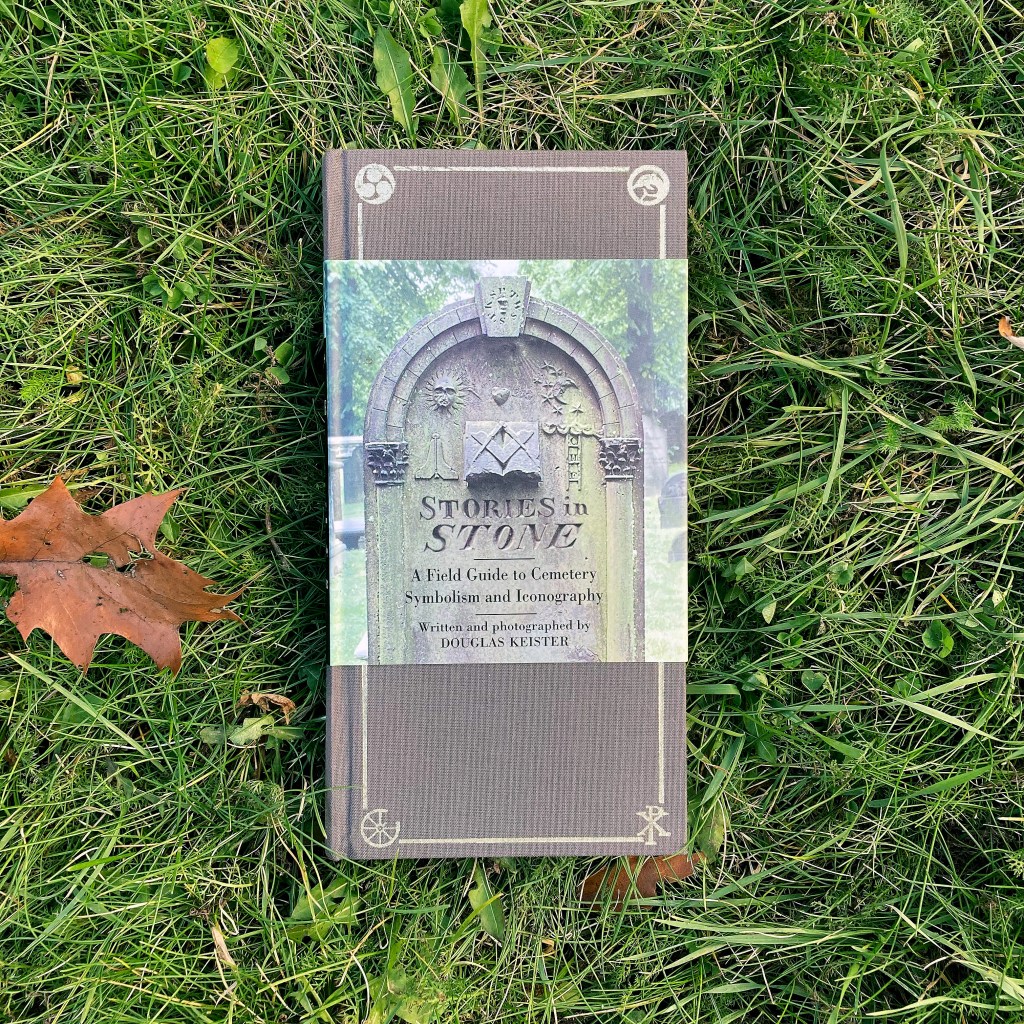
I don’t recall where I picked up my copy, but it is a reference I use often. I never bring mine with me on my cemetery travels, but my cloth-bound hardcover copy has a special place at my desk for easy access when I need to look something up. This book covers iconography from A to Z, as well as the different art styles and architecture that can be found in cemeteries. It covers everything from religious and military symbols to fraternal organizations and secret societies. Douglas Keister is also an amazing photographer and his beautiful color photos of detailed gravestone symbols add depth to the descriptions. It also has a very thorough index at the back, which is very handy for moving back and forth throughout the book. 

The name Douglas Keister may sound familiar to you. This is not the first book of his that I have reviewed. Back in July 2022, I reviewed his book Going out in Style: The Architecture of Eternity. You can read that review here. Douglas is no stranger to cemeteries and has written quite a few books about them. He is a photographer, author, and co-author of forty-five critically acclaimed books, twenty-five of which are on architecture.2

I highly recommend this book to any budding taphophiles and those interested in learning more about cemetery symbolism and history. This book would be a handy tool for genealogists as well, as many interesting and thoughtful things can be learned about the deceased based on what is on their gravestone.

This book has been an invaluable resource for me. I have always loved learning more about the stories that gravestones can tell us, and finding new symbols to research and learn about is one of my favorite things. It’s a beautiful, high quality book, that I think is an essential addition to any taphophiles library. 

Have your read Stories in Stone? I would love to read your thoughts in the comments.

Thanks for reading! 


I am always on the hunt for cemetery-related book recommendations. Please feel free to share yours in the comments. If you are an author and have a cemetery-related book you would like me to review, please reach out at hello@chantallarochelle.ca. I would love to hear from you.


References:

  1. Stories in Stone: A Field Guide to Cemetery Symbolism and Iconography | Goodreads.com
  2. About Douglas Keister | DouglasKeister.com

Cemetery Book Review: The Rural Cemetery Movement

Today’s cemetery-related book review is another AGS Bookclub pick; The Rural Cemetery Movement: Places of Paradox in Nineteenth-Century America by Jeffery Smith. I found this one very fascinating and wanted to share my thoughts. 

I was looking forward to reading this one. I am very interested in the different types of cemeteries and graveyards that exist. I haven’t had the chance to visit many rural cemeteries, also sometimes called garden cemeteries. I have visited only a handful of them, but I look forward to visiting more after having read this.  

The Rural Cemetery Movement was published in 2017 and is available in three different formats; hardcover, softcover, and a kindle edition. I was able to find a paperback edition on Amazon.ca. It’s filled with lovely black-and-white photos as well as some detailed cemetery maps. 

Here is a snippet of the book synopsis from Goodreads.com: “The Rural Cemetery Movement: Places of Paradox in Nineteenth-Century America breaks new ground in the history of cemeteries in the nineteenth century. This book examines these “rural” cemeteries modeled after Mount Auburn that were founded between the 1830s and 1850s. As such, it provides a new way of thinking about these spaces and a new paradigm for seeing and visiting them. While they fulfilled the sacred function of burial, they were first and foremost businesses. The landscape and design, regulation of gravestones, appearance, and rhetoric furthered their role as a business that provided necessary services in cities that went well beyond merely burying bodies. They provided urban green spaces and respites from urban life, established institutions where people could craft their roles in collective memory, and served as prototypes for both urban planning and city parks.”

This fascinating book is incredibly well-researched and takes an in-depth look into the rise of the rural cemetery movement. It details the gradual shift and impacts it had on urban planning and ultimately the business of cemeteries. Essentially this is a book of essays that look at different aspects of the rural cemetery and its effects on burial and cemeteries worldwide. It’s full of fascinating history about the creation and layout of garden cemeteries and the effect they had on other landscapes, such as what we know today as public parks. I found it also fascinating to read about the effort that went into creating the look of rural cemeteries and how the rules and regulations evolved to maintain that look. There is also an interesting section on cemetery tours and how some were created as marketing tools before a cemetery was even opened!

I found the content so interesting that I devoured this one pretty quickly. It’s well-researched and written at a high level but still very graspable which made it an excellent read. I found the added photographs and maps a nice touch as well. There are also extensive notes and a bibliography if you are interested in further reading. 

I extremely enjoyed this book. It’s a great resource for those looking for information specifically about garden cemeteries. This would also be a good read for those interested in learning more about different styles of cemeteries, or anyone interested in a behind-the-scenes look at how cemeteries operate and the business of cemeteries. 

There are not many garden cemeteries in my local area, but I know I will be thinking about this book the next time I do visit one. Have you read The Rural Cemetery Movement? If not, will you be adding it to your reading list? Do you have a favorite garden cemetery? I would love to read your thoughts in the comments. 

Thanks for reading! 


I am always on the hunt for cemetery-related book recommendations. Please feel free to share yours in the comments. If you are an author and have a cemetery-related book you would like me to review, please reach out at hello@chantallarochelle.ca. I would love to hear from you.


References:

  1. The Rural Cemetery Movement | Goodreads.com

Cemetery Book Review: The American Resting Place

It’s been a little while since I shared a book review on the blog. I have some catching up to do on my reading. There are a lot of cemetery-related books in my to-be-read pile! Now that October has come to an end, I should have a bit more time to read through them. There are quite a few I am really looking forward to getting into. 

I did manage to get some reading in last month, so today I wanted to talk about The American Resting Place, by Marilyn Yalom, with photography by Reid S. Yalom. “Four hundred years of history through our cemeteries and burial grounds.” This book, published in 2008, by Houghton Mifflin Company, boasts 64 pages of beautiful black and white cemetery photographs and traces a path across America, looking closely at the ever-changing ideologies on death, burial practices, and history.

Here is the book synopsis from Goodreads

“Cemeteries and burial grounds, as illuminated by an acclaimed cultural historian, are unique windows onto our religious, ethnic, and deeply human history as Americans.

The dedicated mother-son team of Marilyn and Reid Yalom visited hundreds of cemeteries to create The American Resting Place, following a coast-to-coast trajectory that mirrors the vast historical pattern of American migration.

Yalom’s incisive, often poignant exploration of gravestone inscriptions reveals changing ideas about death and personal identity and demonstrates how class and gender play out in stone. Rich particulars include the story of one seventeenth-century Bostonian who amassed a thousand pairs of gloves in his funeral-going lifetime, the unique burial rites and funerary symbols found in today’s Native American cultures, and a “lost” Czech community brought uncannily to life in Chicago’s Bohemian National Columbarium.

From fascinating past to startling future–DVDs embedded in tombstones, “green” burials, and “the new aesthetic of death”–The American Resting Place is the definitive history of the American cemetery.”

The first 64 pages of the hardcover version of The American Resting Place consist of glossy black-and-white photos. They range from lovely landscapes to detailed close-ups. It’s a feast for the eyes before you even get into the meat of the book. The book chapters are broken down into geographical locations, but there are also a couple of chapters on the history and evolution of death and burial practices. Because the photos are presented at the front of the book, it requires some flipping back and forth to reference them when they are mentioned in the text. That would be my only negative critique of the book. 

Otherwise, Marilyn and her son Reid take the reader on a very well-researched and informative trip across the state, taking us along with them on their journey, as they explore funerary art and burial practices. I was a little afraid when I started reading this book that it would be incredibly dry and academic, but the information is presented in a tone that is relatable and keeps you interested. I would love to see something similar written about Canadian cemeteries and burial grounds. 

This would be a great read for anyone looking for information specifically on American burial rites and practices. It is very fascinating stuff, so I think any taphophile would love this book for their bookshelf. The copy of The American Resting Place I found was a previously loved library book. I am a bit sad it was retired and will no longer be discovered by curious readers, but I am very happy to have it now in my collection. I hope there are many more copies of it out there, in other libraries that are piquing the interest of budding taphophiles.

As usual, I am always on the hunt for cemetery-related book recommendations. Please feel free to share in the comments. If you are an author and have a cemetery-related book you would like me to review, please reach out at hello@chantallarochelle.ca. I would love to hear from you.

Thanks for reading!

Cemetery Book Review: Tales and Tombstones of Sunset Cemetery

I haven’t posted a book review in a little while, so I thought I would review this month’s AGS book club pick: Tales and Tombstones of Sunset Cemetery: Tracing Lives and Memorial Customs in a Southern Graveyard by June Hadden Hobbs and Joe DePriest. Having just come out this year, 2022, this book takes a look specifically at the stories and tombstones of those buried in Sunset Cemetery in Shelby, North Carolina. Here is the book synopsis:

“This book relates the stories of the people buried in Shelby, North Carolina’s historic Sunset Cemetery, a microcosm of the Southeastern United States. The authors, an academic and a journalist, detail the lives and memories of people who are buried here, from Civil War soldiers to those who created the Jim Crow South and promoted the narrative of the Lost Cause. Featured are authors W.J. Cash and Thomas Dixon, whose racist novel was the basis for The Birth of a Nation. Drawn from historical research and local memory, it includes the tales of musicians Don Gibson and Bobby Pepper Head London, as well as a paratrooper who died in the Battle of the Bulge and other ordinary folks who rest in the cemetery. A bigger responsibility is to give a voice to the silenced, enslaved people of color buried in unmarked graves. Cemeteries are sacred places where artistry and memory meet–to understand, we need both the tales and the tombstones.” – Goodreads 

I enjoyed this book. Although I have never visited this cemetery in person, I feel like I have spent many hours walking among its stones. This book is very well written and the photos by Hal Bryant that accompany the stories are beautiful. What I found really interesting about this book is that it’s almost like 2 books in one. One is a journalistic look at the stories of the people behind, or should I say beneath the tombstones. This storytelling dives deep into the history of Shelby and its residents, painting a bright and sometimes dark picture of life there and its community members. The second is a look through the lens of gravestone studies, examining the tombstones themselves; looking at the different types of monuments, the symbolism chosen for the stones, and how different time periods would reflect those choices. When visiting a cemetery we often don’t know who the people are, that the tombstones represent. This book sheds light on the diverse cross-section of stories that are buried beneath the tombstones. 

I read this book in early April when my local cemeteries were still covered in snow. I loved being able to “walk” around Sunset Cemetery via this book. This would be a great read for those looking to cemetery travel, without actually traveling. This book touches on many interesting facets of history, accompanied by beautiful tombstone photos that accent the storytelling. Because of this, I highly recommend it to anyone interested in gravestones, history, or good storytelling.  

Have you read this book? Have you visited Sunset Cemetery? I would love to hear your thoughts in the comments.

Thanks for reading!