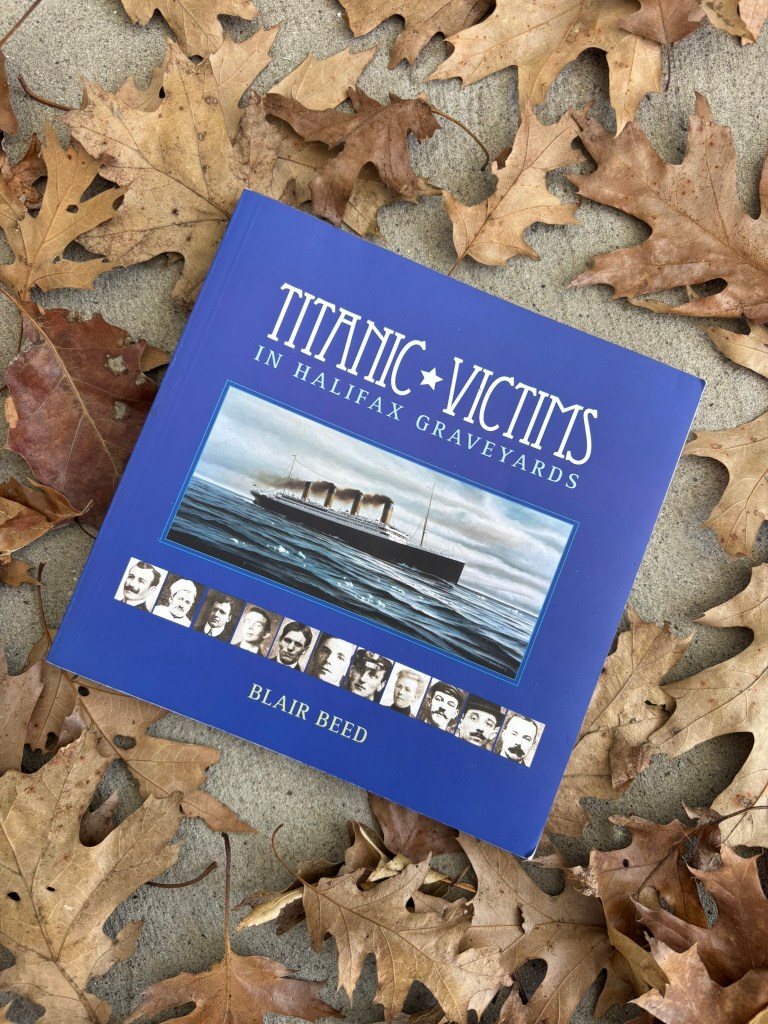
April always makes me think of the Titanic. It’s hard not to, with the anniversary of that tragic sinking approaching. This year, I spent some time reading Titanic Victims in Halifax Graveyards, a book my mom found while thrifting. She’s always been fascinated by Titanic history, and after finishing it, she knew I would love it too, so she passed it along.
Written by Blair Beed and first published in 2001, this book is a deep dive into the stories of Titanic victims who ended up in Halifax, Nova Scotia. Beed, a Halifax resident, brings his experience as a tour guide and tourism professional to the page, giving the book both historical context and local insight.
Here is the synopsis from Goodreads:
“For eighty-five years dozens of victims of one of the most famous ships in history rested quietly in Halifax, Nova Scotia, until the 1997 film Titanic created a renewed interest in the burial sites. Visitors to Halifax have many questions about the city’s connection to the infamous ship. Of the 328 bodies found, why were some buried at sea? Why were 59 bodies sent elsewhere for burial and the rest buried in Halifax? Titanic Victims in Halifax Graveyards answers those questions while telling the intriguing and little-known story of the 150 passengers and crew who were buried in the port city of Halifax. Using official reports and newspaper articles, author Blair Beed provides an outline of life on board the Titanic, describes society as it was in 1912, and highlights the care for the dead taken by the crews of the recovery ships and those who met them on arrival in Halifax. This revised edition, with two new chapters and an updated design, is an important addition to any Titanic library.”
I love that my copy still had the receipt tucked inside. It was purchased at the Maritime Museum in Halifax, which houses many Titanic artifacts. It may seem odd, but I’ve kept the receipt with the book. It feels like a small, tangible connection to the city and the history it preserves.
The book is meticulously researched, walking readers through the victims’ stories with care and detail. It would make an excellent companion if you’re planning to visit the Halifax cemeteries, which I hope to do someday. I’d love to take my mom along too, since she shares my fascination with this history.
The details blew me away! From the recovery mission itself, to how every piece of clothing and even tattoos were documented to help identify the victims. I also appreciated how Beed organizes the book: part historical narrative, part cemetery guide, making it easy to follow the locations and stories of each burial site.
I absolutely loved this book. I’d recommend it to anyone interested in Titanic history, Halifax’s maritime past, or even just those with a morbid curiosity. It’s incredible to realize how much there is still to learn about this tragic event, even 114 years later.
Thanks for reading!
I am always on the hunt for cemetery-related book recommendations. If you are an author and have a cemetery-related book you would like me to review, please reach out at hello@chantallarochelle.ca. I would love to hear from you!
 Cemetery Photography by Chantal Larochelle