Year in Review – 2023

Can you believe that we made it through another year? 2023 just flew by! I feel like just yesterday it was Halloween, but here we are! It’s been an interesting year, full of ups and downs. So for this week’s blog post, I wanted to carry on the tradition from last year and take a look back at what happened throughout the year. 

2023 was unfortunately the year of COVID for me. I managed to catch it twice, first suffering through two and half weeks of the worst head cold of my life. The second time I caught it, it was mild like a light cold. Unfortunately, the second time I caught COVID, I was also suffering through my first bout of poison ivy. 

Catching poison ivy, from a cemetery visit (of course), was quite the learning experience for me. It was a hard reminder that you should always dress appropriately when out in the field, especially when exploring overgrown cemeteries. Dealing with my bad case of poison ivy put me out of commission for about a month, in the middle of summer. It was not an opportune time and had me itching to get back in the field.

Even though I had more downtime this year, I still managed to have a successful field season, visiting 113 cemeteries. 103 of those cemeteries were first-time visits. I didn’t take a count of how many new photos I added to my archives, but there is a lot to sift through and edit this winter. I can’t wait to share them on my portfolio page, and also add them to Find a Grave

This year also marked another new record for the number of cemeteries visited in one day! A friend and I incredibly visited 25 cemeteries during a day trip to Midland. At the time it didn’t feel like we had visited that many, but the photos don’t lie. We’ll see if we can break this new record in 2024.

Highlights

In April of 2023, I had a great opportunity to participate in a juried photography show, Our Story in Black and White. My cemetery photography was proudly hung beside other great works by local photographers; Caio Higa, Debbie Anzinger Mckay, Debby Trahan-Pero, and Rita Vanderhooft at Gallery 6500. The exhibit ran from April 30th to June 30th. After this initial run, the photography show was moved to the South End Pubic Library and ran for another month. Being part of a group show was such a great experience! I hope I can participate in more photography shows in the future.

Another highlight of 2023 was getting published! 

I was contacted by the Bereavement Authority of Ontario (BAO) which was interested in my photography for their online, quarterly magazine, BeyondA condensed version of my articles about visiting the graves of Tom Thomson was published as the cover story of their October issue, along with some of my photography. That was incredibly exciting, and I hope to work with Beyond and the BAO again the future. 

Statistics

This year was also a great year for growth. On the website, I had 6,805 visitors this year, with 12,793 views. That’s the highest count, since starting this website in 2018. I will note that I didn’t start consistently posting till 2021. Speaking of blog posts, I posted 42 times this year, with a word count of 29.3k. I have been very weary about calling myself a writer, but after seeing that word count I might have to change my mind. There is still work to be done to upgrade my writing skills, but it is kind of fun to think of myself as a cemetery tourism writer. 

I often write articles that I would like to find and read. My favorite articles to write are cemetery tourism pieces, where I talk about visiting cemeteries and related sites. I also really enjoy researching so these pieces are really fun for me to write. I also feel more connected to these sites after learning about them and visiting them in person.

I also have a lot of fun writing cemetery recipe posts. These posts seem to resonate with readers as well, as they are often the most searched-for articles. I do enjoy experimenting with cooking and baking and these posts encourage me to do that, while also having a research element to connect the recipe to the gravestone.

This year the top viewed blog posts are a bit varied, with one post from last year ranking in second place.

Top 5 blog posts of 2023

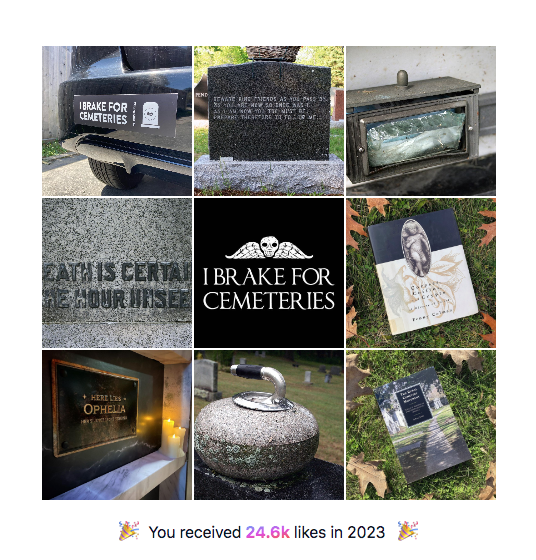
On social media, my Instagram account is growing as well. At 2,754 followers, it’s my favorite place to interact with followers and share my photos.

Overall it has been an excellent year, full of growth and adventures. As I settle in for the winter, I will put my hiking boots away and focus more on research and photo editing. The winter break is an excellent opportunity for me to update my portfolio, as well as research and write more in-depth blog posts about this year’s cemetery travels. I am currently working on a few stone stories and have plans to start a new blog series of cemetery stories. I also would like to catch up on my reading and post some more cemetery book reviews.

Of course, I have already started thinking about next year’s cemetery adventures as well, and have started some maps and travel plans. I hope to visit some more unique grave sites, cemeteries, and famous graves next year. Maybe even exploring out of province. The possibilities are endless, and I am always finding new and interesting places to visit when I go down the research rabbit hole.

I want to finish this 2023 recap by thanking every one of you for your support and encouragement.

All the comments, likes and shares do not go unnoticed. I love being part of this cemetery community and have met so many amazing new people because of it. I appreciate all of you, and wish you all the best in the coming new year.

Here is to another year full of curiosity and adventure!

As always, thanks for reading!

Happy Holidays

As another year draws to a close, I wanted to share my appreciation for you, the reader, for joining me on my graveyard adventures. At this special time of year, I would like to say thank you, and wish you all a happy holiday season, and a happy new year!

It’s Winter in the Cemetery

Winter is here in Northern Ontario! 

We’ve had a few snowfalls since November, and the temperature has been steadily dropping. I have never been a Winter person really, although I have tried many times to find a winter activity that might make me enjoy it more. Figure skating, ice fishing, snowshoeing—not for me!

I tried again today to see if maybe winter cemetery visits might be something I would enjoy. It doesn’t hurt to try right? I was quickly reminded why I don’t like graving in winter, as soon as I exited my vehicle. 

I hate the cold!

It isn’t even that cold today, but still makes me question why I live somewhere where the air hurts my face. It’s -3°C in Sudbury today, but feels like -8°C with the wind chill. That’s 26.6°F which feels like 17.6°F for my American friends.

Aside from being uncomfortable, the cold isn’t good for my equipment either. The cold can drain the battery life of my DSLR, which would shorten my cemetery trip unexpectedly. I would rather not play that game of roulette. 

Wandering cemeteries in the winter isn’t that safe either, for me or the stones. The snow isn’t that deep yet, but soon it will be a couple of feet deep, which can completely obscure some gravestones. I wouldn’t want to accidentally step on and damage a tombstone. They also become tripping hazards as well. I wouldn’t want to hurt myself tripping over a stone, while also damaging it in the process. Too risky, if you ask me.

I’m sure for some, visiting cemeteries in the winter, is a great past time. If you have the proper outerwear, can tolerate the cold, and come prepared with backup batteries an outing in a snow-covered cemetery sounds delightful.

For me, I see this time of year as a great opportunity to curl up with a good book and a hot beverage or research by the light of my iMac. Reading, scouring the internet, and sifting through my photo archive to work on future blog posts and cemetery trips seems like a much more comfortable use of my time.  

When I visited Civic Cemetery today, I did notice a few beautiful and interesting scenes. Many of the graves were decorated with Christmas ornaments, wreaths, and lights. I also found a small Christmas tree, that looked like it had been recently put up, judging by the tracks in the snow. I also saw some rabbit and possibly dog tracks dotting the fresh snow as well. 

Despite the cold weather, the cemetery was a fairly active place today, with a handful of visitors in the mausoleum, a burial taking place, and a couple of folks just out and about for a walk, dressed warmly in their mitts, toques and snow pants of course.

Cemeteries in the winter sure are pretty though. The starkness created by the grey weather, bare trees, and white snow does create a mood. That being said, cemeteries in Autumn are still my favorite.

So until the snow melts, I’ll stick to online research, book reading, and updating my online portfolio. I do have some upcoming Stone Stories to share with you as well!

Stay warm out there, and thanks for reading! 

Cemetery Book Review: Sacred Ground, Volume Two

I hinted last week that I had been working on another cemetery book review for you. For this month’s book review, I wanted to share Sacred Ground, Loyalist Cemeteries of Eastern Ontario, Volume Two by Stuart Lyall Manson.
Sacred Ground, Volume Two continues the author’s exploration of United Empire Loyalists buried in loyalist cemeteries in Canada. This volume looks at five cemeteries in the Eastern Ontario County of Glengarry, and one other in Cornwall, Ontario. I was very excited when Stuart reached out, asking if I would be interested in reviewing his second book on loyalist cemeteries. You might remember a previous blog post I wrote, reviewing his first book, Sacred Ground: Loyalist Cemeteries of Eastern Ontario, Volume One 

Stuart Lyall Manson is a professional research historian with over 25 years of experience and is also a heritage cemetery advocate.1 His second book Sacred Ground, Volume Two just came out in September of this year. He graciously provided me with a PDF version of his book to review. This book, also available in softcover, is 214 pages and contains color as well as black and white images. 

Here is the book synopsis from Goodreads:

“The second volume of the book series Sacred Ground: Loyalist Cemeteries of Eastern Ontario continues the approach of the first volume, describing notable loyalist cemeteries situated in Eastern Ontario. This volume covers cemeteries in the counties of Stormont and Glengarry. It is a collection of detailed profiles of a selection of these historical locations in the region. In each chapter, the author discusses, in-depth, a single cemetery containing the mortal remains of at least one loyalist. A historical overview is provided of each of these burial grounds, along with biographical information on specific loyalists with particularly remarkable stories. The locations were selected based on geographic distribution, religious diversity, and other factors. The book is based on rigorous primary and secondary source research. It complements other publications that list burials or transcribe tombstone inscriptions. Those publications are important resources. This book supplements that basic data with greater historical context and additional research into the lives and experiences of these men, women, and children who laid the foundations of modern Ontario. This volume includes the following cemeteries:

  • St. Andrew’s United Cemetery (Williamstown)
  • St. John’s Presbyterian Cemetery (Cornwall)
  • Falkner Settlement Cemetery (South Lancaster)
  • Salem United Cemetery (Summerstown)
  • St. Raphael’s Cemetery (St. Raphael’s)
  • Gleninore Cemetery (Charlottenburgh)”

I enjoyed this book. The author digs deep to uncover the lives of those who have been forgotten by many. I liked the fact that the author does not shy away from explaining that this type of research can be quite difficult when many people have the same names and full details are not always written out. I can just imagine the rabbit holes of research one had to go down to pull it all together.

As well as providing life stories and timelines of those buried, Volume Two also looks at the story of the cemeteries themselves. The one that stands out the most to me is St. John’s Presbyterian Cemetery in the city of Cornwall. A beautiful cairn was constructed with the remaining gravestones in the 1930’s. In 2017, with hardly any notice the cairn was demolished, destroying most of the remaining gravestones. Today there is only an empty lot where this cemetery sits. Without this kind of research and documentation, these sites may be lost to time, but the author has done an amazing job of collecting old photographs and piecing together the history of this site for future generations. 

As I’ve mentioned before, I always jump at the chance to read about Canadian cemeteries. There is so much history to be found here, and you don’t have to travel far to find it. Accompanying each chapter is a smattering of maps, letters, and photographs of interesting gravestones and beautiful ruins. At the end of each chapter, I found myself saying “I have to visit this one!”. For this reason, I also loved that the locations of each cemetery were included as an appendix at the back of the book. Cemetery name, location, and even coordinates are included.

Just as I recommended the first book in this series, Volume Two would be a valuable read to anyone interested in learning more about Canadian history and the indelible mark left by United Empire Loyalists. This would also be a good book to pick up if you are planning some cemetery road trips in the future. As I did with Volume One, I have already added these cemeteries to my Google maps for future trip planning. 

Will you be adding this book to your TBR list? Or better yet, have you already read it? I would love to hear what you think in the comments.

Thanks for reading! 


I am always on the hunt for cemetery-related book recommendations. Please feel free to share yours in the comments. If you are an author and have a cemetery-related book you would like me to review, please reach out at hello@chantallarochelle.ca. I would love to hear from you.


References:

  1. Home | Stuart Lyall Manson’s website

A Collection of Interesting Epitaphs

Can you believe we’re already 3 weeks into November? Field season seemed to just fly by this year! We had our first snowfall last week, which solidified the end of the season for me. 

That being said, it’s time to turn my attention to my photo archive and research. That includes some heavy reading and crawling through the Find a Grave website. I am currently working on my next cemetery book review, but it’s not quite ready yet. So to tide you over this week, I wanted to share a collection of interesting epitaphs. 

An epitaph is an inscription found on a gravestone that accompanies the name, birth, and death dates. These short verses and poems are inscribed to the memory of the deceased. The word epitaph comes from the Greek word “epitaphion” which means funeral oration. “Epi” meaning upon and “taphos” meaning tomb.1

Epitaphs became more popular in the 19th century, as a way to honor and memorialize the dead, but also share a little about the deceased’s life and personality.1 The most common epitaph you will find in a cemetery is the phrase “Rest in Peace”, or the Latin “Requiescat in Pace”. But you might also come across bible verses, poetry, or short sentiments proclaiming everlasting love for the deceased. You might also find a variation of a momento mori poem, a reminder that death is inevitable:

“Remember me as you pass by, / As you are now, so once was I, / As I am now, so you will be, / Prepare for death and follow me.”

So for today’s collection, I wanted to share some of the more interesting epitaphs I have come across on my cemetery travels. 

Have you come across some interesting epitaphs on your cemetery walks? Do you have a favorite? Or maybe you have something you would like written on your own gravestone? I would love to read your thoughts in the comments.

Thanks for reading!


References:

  1. What is an Epitaph? | Columbia Gardens Memorials

2023 Cemetery Scavenger Hunt

What are you up to this Halloweekend? 

That’s right, it’s the last weekend in October before Halloween. Time to get in those last autumn days enjoying some seasonal activities, and getting ready for the ghouls and boils to come knocking on your door for treats.

I have a pretty full weekend planned of pumpkin carving, horror movies, and of course one last visit to a cemetery. 

This Sunday is the fourth annual Halloween Cemetery Scavenger Hunt, organized by Talk Death. If you are not familiar with Talk Death, they are a death-positive collective, whose mission is to encourage positive and constructive conversations around death and dying. 

This annual cemetery scavenger hunt is designed to bring together communities, families, cemetery lovers, and history enthusiasts. It’s a fun way to get outdoors and learn about your local history and art and architecture of different eras.

Want to join the fun?

It’s easy to play along! On Sunday, October 29th, at 2:30 p.m. ET/11:30 a.m. PT visit your favorite local cemetery and tune in to Talk Deaths Instagram page.

Then follow the clues provided to search for gravestones that match the clues, like symbolism, names, and dates. Take a selfie with the stones and submit your finds using the link in their bio. The first 3 people to fill out the form completely, win!

You can visit the TalkDeath 2023 Halloween Cemetery Scavenger Hunt webpage for the full details! 

Although this is meant to be a fun event, please be mindful when visiting any cemetery. Be respectful, and do not disturb the gravestones or grave goods.

That being said, I had a great time participating last year, and l look forward to playing again this year. Last year I visited Park Lawn Cemetery with my Mom. We were the only ones in the cemetery that day, but we still had a lot of fun!

This year, my cemetery of choice is Lasalle Cemetery. It’s a fairly large cemetery and has some older stones. Feel free to join me, if you are in the area!

Regardless of what you get up to this weekend, I hope you have a great one and take some time for a little Halloween fun. 

Happy Halloweekend, and thanks for reading! 

Cemetery Tourism

Have you ever heard the term cemetery tourism before? Visiting cemeteries may not be at the top of your list when on vacation, but it should be!

In recent years cemetery tourism has become more and more popular. But, I would argue that it has always been. In today’s blog post, I wanted to talk a little bit about cemetery tourism and share a few upcoming cemetery tours happening in Ontario.

During the COVID-19 pandemic, some of the only open places around were cemeteries. They afforded people an outdoor space to take walks and get fresh air, revealing their importance alongside parks and other green spaces. This also gave people a chance to appreciate cemeteries as more than just places of sorrow and remembrance, but also places of art, history, and culture. 

Since then, visiting cemeteries and graveyards has become an increasingly popular trend, not only among taphophiles and genealogists but also among general tourists. Wandering around cemeteries in new places is a great way to learn about the history and heritage of an area, and to also see examples of local art and architecture.

But cemetery tourism really isn’t anything new!

For decades people have been traveling the world specifically to visit tombs and mausoleums. The pyramids of Giza see over 14 million visitors each year, making them one of the most popular tombs in the world.1 Granted, the Pyramids are one of the seven wonders of the world, they are also tombs that were built over 4500 years ago by the ancient Egyptians to honor their dead.2 

Another popular example is the Taj Mahal, a white marble mausoleum that was built in memory of an emperor’s wife.3 It sees approximately 7 to 8 million visitors per year.4 Visitors flock to this site, not only to experience the exquisite architecture but to also experience the reverence this tomb represents. 

Closer to home, I find it’s common to see cemetery stops marked along motorcycle and cycling routes. Not only are cemeteries and graveyards perfect places to stop and stretch your legs on a long bike trip, but they also make interesting points of interest where you can learn more about the history of an area. 

Another way cemetery tourism is becoming more prevalent is the creation of cemetery tours. I see more tours offered every year in local or nearby city cemeteries. Not only are they great ways for cemeteries to fundraise, and bring more people into the cemetery. It’s a perfect way to highlight the cemetery’s history, showcase important people, and make history come alive. 

Generally, cemetery tours can be done at any time of year. You can often find them happening in the summer months. But, I find October is the best time of year for a cemetery walk. The atmosphere is perfect, with the crisp air and crunchy leaves. It’s a beautiful backdrop to explore history and learn about the past. October cemetery tours can be a fun activity to do if you are looking for something different to do for Halloween. Often, some of the history shared is on the darker side, creating an eerie atmosphere as you stroll among the graves.

Want to add a cemetery walk to your list of activities this month? Here is a small round-up of cemetery tours that are happening in Ontario. I would suggest booking your tickets fast as October is almost over! 

Upcoming cemetery tours

Fergus: Wellington County Museum & Archives Cemetery Tour 

Friday, October 27 from 7 to 10 p.m. Tickets are $15 per person.

This tour takes place outside on the museum grounds, and at the Poor House Cemetery where over 200 inmates were laid to rest.

You can purchase tickets at this link.

Hamilton: War of 1812 Cemetery Tour

Saturday, October 28 at 11 a.m. This is a free event. Roughly 2 hours in duration.

A lively, informative tour of selected grave sites in historic Hamilton Cemetery. Each tour will introduce you to some of Hamilton’s more interesting personalities and its rich history.

Visit their website for more information. 

Mississauga: Haunted Mississauga 2023 Heritage Tour

Friday, October 27. Tickets are $5 for adults and $3 for children.

Tours run at 7 p.m., 7:20 p.m., 7:40 p.m., 8 p.m., 8:20 p.m., 8:40 p.m. and 9 p.m. Tours take approximately 45 minutes.

This event includes a guided heritage tour around a dimly lit historic cemetery with actors retelling stories from the darker side of the past.

You can purchase your tickets at Eventbrite.

Ottawa: Tales from the Mausoleum at Beechwood Cemetery

Monday, October 23 to Monday, October 30. Tours run at 8 p.m. and 8:15 p.m. every night. There is an extra tour time of 8:45 p.m. on Saturday, October 28. Tours are roughly 75 minutes in duration.

A one-of-a-kind evening filled with storytelling and chills.  Experience the darker history of the cemetery’s early days and the ghost stories connected to some who rest there—including strange reports from staff that continue to this day. 

You can purchase tickets at this link.

Toronto: The People of Park Lawn Cemetery Tour

Saturday, October 28 at 1 p.m. and Sunday, October 29 at 1 p.m. Both tours are identical and will be roughly 2 hours in duration. This is a free event.

Park Lawn Cemetery is considered an oasis in the West End of Toronto; complete with lush greenery and winding walking paths. Its grounds also contain the earthly remains of some notable—and less notable—Toronto residents whose stories helped shape the city and the country.

Visit the Facebook event page to mark yourself as going.

Self-guided tours

If the above dates don’t work for you, or you would rather wander the cemetery at your own pace, some cemeteries offer self-guided cemetery tours. These types of tours can be done at any time of year. You can sometimes find handouts for self-guided tours at the cemeteries office, that include maps, directions, and information about the more notable or interesting things found in the cemetery. There are also sometimes resources online at the cemetery’s website that can be downloaded onto your phone for a mobile-guided experience.

Have you been on a cemetery tour before? Will you include one on your bucket list the next time you are on vacation? I would love to hear about your bucket list destinations or any cemetery tours you would recommend.

Thanks for reading!


References:

  1. Opening Hours | Giza Pyramid
  2. History | Giza Pyramid
  3. Taj Mahal | Unesco World Heritage Convention
  4. Views of the Taj Mahal | Taj Mahal

Spooky Grave Goods

In honor of the Spooky season, I wanted to do a sort of spooky show-and-tell. For today’s blog post, I want to talk about some of the creepier grave goods I have come across while exploring and photographing cemeteries.

Grave goods is a term used for items left behind at a grave. I have always found it fascinating what people leave behind. There are a variety of reasons someone might leave grave goods; to pay their respects, to honor their loved one, this list goes on.

The most common grave goods I see in my cemetery travels are flowers, but I have also found coins, toys, figurines, and pieces of clothing such as hats or gloves. I have even found alcohol and cigarettes left on gravestones.

But there have been a couple of times where I have found some pretty creepy things. I would say maybe even sinister grave goods.

A Horse Skull

One of the first creepy grave goods I ever came across was a skull hanging from a tree. I believe this is a horse skull, although I don’t know for certain. A horse skull would make sense for the area where it was found, in Verner Public Cemetery. Verner is a rural area, dotted with farmland.

How the skull ended up in the tree is another question entirely. I remember it was hanging on a tree at the edge of the tree line. Was it found in the forested area? Was it brought from an adjoining farm?

The questions will always remain…

A Creepy Doll

I never expected to come across a creepy doll, the day I entered Blezard Valley Cemetery. It was in late May, that I discovered this one.

A creepy plastic doll, the kind where the eyes close when you tilt it backward. Except this one has a push pin pushed into its plastic eyeball. It was also painted black. I found it leaning up against the backside of a granite gravestone.

How it ended up there, I can’t even speculate. Was it bored teenagers? Or was it left behind with more sinister intentions? I took many photos but left the doll where I found it.

A Ouija Board

I think this is one of my favorite spooky finds! Technically my mom found it. We had gone off on our own, in separate directions, meandering among the gravestones. She called me over when she spotted this unique grave good.

Laying above a small flat stone marker was this hand-made ouija board. It was painted by hand onto a small canvas. I wasn’t able to locate what had been used as a planchette. My guess is they used a glass or cup of some sort, and made sure to return it to where it came from. 

From the looks of it, this hand-made board had been sitting outside for some time. Being an avid Ouija board collector myself, I enjoyed finding this one. But of course, I left it where it was found.

I have written in the past about the cemetery etiquette I follow when visiting cemeteries. I do sometimes clear away debris to get a clearer picture or stand-up fallen grave goods that have been knocked over. But, I would never remove anything from a gravestone, or cemetery for that matter. 

Did you enjoy my round-up of the top three spookiest grave goods I have found in a cemetery? It’s one of my favorite things about cemeteries, you never know what you might find!

Have you ever found anything strange left behind in a cemetery? I would love to read about it in the comments.

Thanks for reading!

Stone Stories: The U.F.O. Gravestone

In early July, my friends and I went on a cemetery road trip, up through Hailybury and New Liskeard to Kirkland Lake. We made quite a few stops along the way, not only at cemeteries. We stopped at a couple of roadside attractions to stretch our legs and take in the sights. 

We did have a few points of interest that we were determined to visit that day. One was the grave of Charles Bélanger, son of famous Canadian sculptor Rose-Aimée Bélanger. You may remember that story, as I wrote about our visit in a blog post called Stone Stories: Art in a Cemetery

The other point of interest, high on our list to see was a gravestone with an epitaph about U.F.O.s.

One of my favorite things about visiting cemeteries is finding unique gravestones. I love gravestones that stand out, that showcase a sense of humor, or something specific about their life story. I love stones that give you a glimpse of who the person was. Sometimes these peculiar gravestones also present a mystery! 

Like this gravestone in Kirkland Lake Cemetery that reads “U.F.O. Are Real Spacecraft.”

This is the gravestone of Glenn Bradley, who passed away on December 27, 2007. A day before what would have been his 89th birthday. From far away, his gravestone doesn’t seem to stand out. It’s a classic style headstone, in grey granite. But upon closer inspection, the epitaph jumps out at you.

It reads: “Bradley / Glenn E. Bradley / Dec. 28, 1918 — Dec. 27, 2007 / Loving Father of / Linda Sue and Terri Lynn / Beloved Grandfather of / Michelle, Curtis, Anthony, Pamela / U.F.O. Are Real Spacecraft.”

The epitaph continues on the backside of the stone: “Spinning Objects Vanquish Gravity / Spinning Objects Levitate / Spin to Exceed the Earths / Relative Feet Per Second / Honorable 60th C.B. Service / 1942 U.S. Navy 1945”

What does it mean? 

I am not the only one fascinated with this gravestone. Bill Steer, also known as Back Roads Bill, wrote an interesting article about this peculiar stone. In it, he shares an interesting tidbit found in Bradley’s obituary. It reads: “He will be remembered for his scientific work such as antigravity and his belief in UFOs.”1

Bradley’s gravestone tells us that he was a veteran of World War II with the U.S. Navy, having served from 1942 to 1945. Is that where he worked on antigravity? Had he seen a U.F.O.?

Recently, NASA revealed a report on UFO sightings, confirming that they are actively monitoring and collecting evidence. In the report, they state that unidentified anomalous phenomena (UAP) are not definitively connected to alien life, but what they are remains uncertain.2 You can read the 33-page report here.

It was on a particularly hot day, that we chose to visit the cemetery. It was the final cemetery on our list, having stopped at many cemeteries along the way. This meant that we were fairly tired when we arrived at the Kirkland Lake Cemetery, also known as Swastika Cemetery. 

Kirkland Lake Cemetery is actually located in Swastika, Ontario, a former mining and railroad town. It sits within the Kirkland Lake municipal boundaries.3 Swastika was originally a railway station along the Temiskaming and Northern Ontario Railway in the early 1900s. The town grew into a small mining community in 1907. It became known for its abundance of gold, which led the company, and officially the town itself, to name themselves after the Sanskrit symbol for “good luck” in 1908.4 

I don’t think we were prepared for how large this cemetery is! I was a little disheartened when we arrived, thinking we may not be able to find the fabled UFO stone. Find a Grave lists 7,871 memorials for this cemetery, and it’s marked as only 83% photographed. It’s quite large! 

After a brief distraction of falling into my regular photographer’s routine of stopping at gravestones that caught my eye, I remembered our objective. I regrouped with my companions and checked out Google one more time to point us in the right direction. In the end, we used some online photos to help us triangulate the stone’s location by matching up unique stones and markers in the background of the photos.

BINGO!

As mentioned previously, the stone from a distance is fairly nondescript. At the top of the gravestone, there is a coin embedded into it, with the dates 1937 — 1970. The coin reads: “E.W. Bliss Company / Bliss since 1857 / From Ingot to Finished Product”. According to the Military Wiki page, E.W. Bliss was an American company based in Brooklyn, New York. Among other things, they produced a line of special sheet metal work presses, power stamping machines, car parts, torpedoes, shrapnel, and armor-piercing projectiles.5

We spent time circling Bradley’s gravestone, pondering his curious epitaph. Without more background information, and as a layperson it did make me scratch my head in curiosity.

Maybe one day, answers will come forth as to what Bradley was talking about with his cryptically scientific epitaph. For now, it makes for a curious extraterrestrial mystery!

Have you ever seen a U.F.O. mentioned on a gravestone before? What do you think? Do you want to believe?

Thanks for reading!


References:

  1. A most unusual epitaph | Bay Today
  2. NASA reveals results of highly anticipated report into UFO sightings | CTV News
  3. Kirkland Lake Cemetery | Find a Grave
  4. Swastika, Ontario | Town of Swastika
  5. E. W. Bliss Company | Military Wiki

A Collection of Wooden Grave Markers

I had the idea for this collection when I was wandering through Maple Ridge Cemetery in Thessalon. I found some very interesting wood markers there, and it reminded me of some other interesting wood markers I have found in the past. So, for today’s blog post, I wanted to share a collection of wooden grave markers.

In North America, there was a time when wooden markers were more common. Between 1861 and 1873, wood markers would have been common for graves of Civil War soldiers, but over time marble became more favorable because of its durability.1 Due to the nature of the material, wood is more susceptible to natural decomposition and wood-boring insects. Over a long period of time, the wood just rots away. 

Today, wood markers are not a very common sight in Northern Ontario cemeteries. They often tug at the heartstrings, as wooden markers are usually handmade, and you can see they were made with love. Unfortunately, if they are not used as a temporary marker the wood can become hard to read, and eventually falls apart.

I would argue that this is one of the best reasons why photographing gravestones is important. Over time, these wooden grave markers will be lost to time, so documenting them helps preserve the memory of the deceased. It creates records for those looking to piece together their family history and become great resources. 

Have you found wooden grave markers in your local cemeteries? I would love to read about your finds, in the comments.

Thanks for reading!


References:

  1. The History of Headstones Across Cultures and Religions | Milano Monuments