Stone Stories: Canada’s First Black Mayor

Last October, My mother and I took a little road trip to Mattawa. We planned on doing some hiking, visiting cemeteries, and enjoying the fall colors. We always like to visit local museums when we visit new places, and the Mattawa Museum did not disappoint. We had a great time touring the grounds and learned a lot about the history of the city, including that it has the distinction of having Canada’s first elected Black mayor. 

Mattawa, located in northeastern Ontario is a little over two hours drive from me. Mattawa is located where the Mattawa and Ottawa Rivers merge, in Nipissing District. The name Mattawa means “Meeting of the Waters” in Ojibwa.1 It is the oldest settlement in the Nipissing District, and today showcases that historic past with beautiful wooden sculptures. Many wooden sculptures of historic figures, important to Mattawa’s history, can be found scattered throughout the town.1

It was an overcast day when we visited Mattawa, but it didn’t deter us from exploring. We admired the two wooden sculptures on the museum grounds and looked for the three white crosses, that stand high on Québec Hill across the Mattawa river. The three crosses were erected in 1686 by missionary priests to mark the place where the two rivers meet.2

Inside the museum, we found a treasure trove of artifacts; paintings by a well-known Mattawa painter, many indigenous artifacts, and a large exhibit about Canada’s first Black Mayor, Dr. S. F. Monestime. The exhibit features large panels with many photos and a history of what brought Monestime to Mattawa, and how he changed the community for the better. The exhibit also includes some of his personal items, like his signature fedora and a medical skull used in his practice. My Mother and I were both interested in this exhibit the most, and were surprised that we had never heard of him before. We made it a point to pay our respects at the cemetery.

Dr. Saint Firmin Monestime

Saint Firmin Monestime was born in Cape Haitian, Haiti in December of 1909. Monestime grew up during the United States occupation of Haiti, which took place from 1916 to 1935. He graduated with a medical degree from the University of Haiti Medical School, and after graduation was named Medical Officer for the International Route between Haiti and the Dominican Republic.3 He experienced a lot during his medical career in Haiti, living through mass casualty events. He received the Knight of the National Order of Honor and Merit, awarded to those of distinguished excellence. He wrote four books around this time, about rural medicine.3

After becoming frustrated with the politics and what he called “deplorable conditions”, Monestime quietly left Haiti for Quebec. He was part of the first small group of Haitian professionals to come to Quebec in the 1940s. Unfortunately, this meant starting over as he had to train and intern for several years to get his full Canadian medical accreditation.3

Monestime found his way to Mattawa almost by chance. He and another colleague were traveling through Mattawa on their way to Timmins to see about setting up a medical practice. They stopped in for lunch at Chez Francois in Mattawa, and it just so happened that the restaurant owner recognized Dr. Monestime, as he had been operated on by the Doctor in Ottawa. The timing was right. The long-standing doctor in Mattawa had recently passed away and the town needed a new doctor. The restaurant also had a vacant room to rent and office space. Monestime agreed to stay, temporarily, but ended up staying indefinitely.3

Monestime found the community to be very welcoming and their generosity encouraged him to stay. His medical practice was booming with a busy office as well as on-call work with the hospital. That’s not to say that he didn’t experience racism in his time there.3 In 1972, he was asked by a reporter if race ever came into play, Monestime replied:

“My practice was booming in no time and from then until now I’ve had no serious problems. You might find a very few—and not the most intelligent—who may say they won’t come to see me because of my race. But very few.”3

Three months after Dr. Martin Luther King gave his “I Have a Dream” speech in 1963, Dr. St. F. Monestime also made history by being elected the first Black mayor in Canada. An active political figure in good standing within the community, regarded for his sense of justice and equality, he was elected mayor nine times.3 Today, the legacy of Dr. Monestime continues and is still felt vibrantly within the community as his family continues to do good works. The most notable of these works is the Algonquin Nursing Home, a project championed by Monestime in his last years.

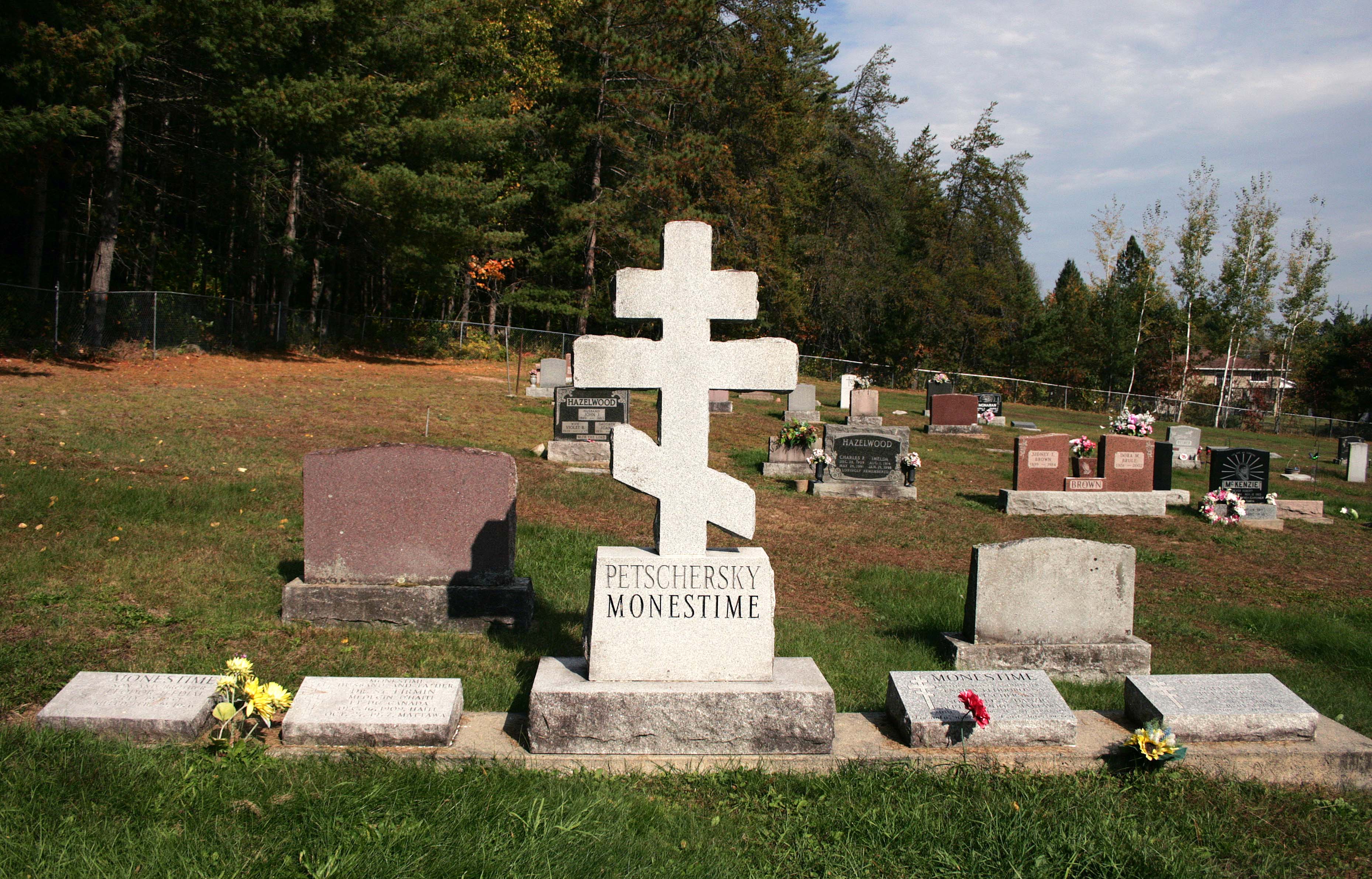
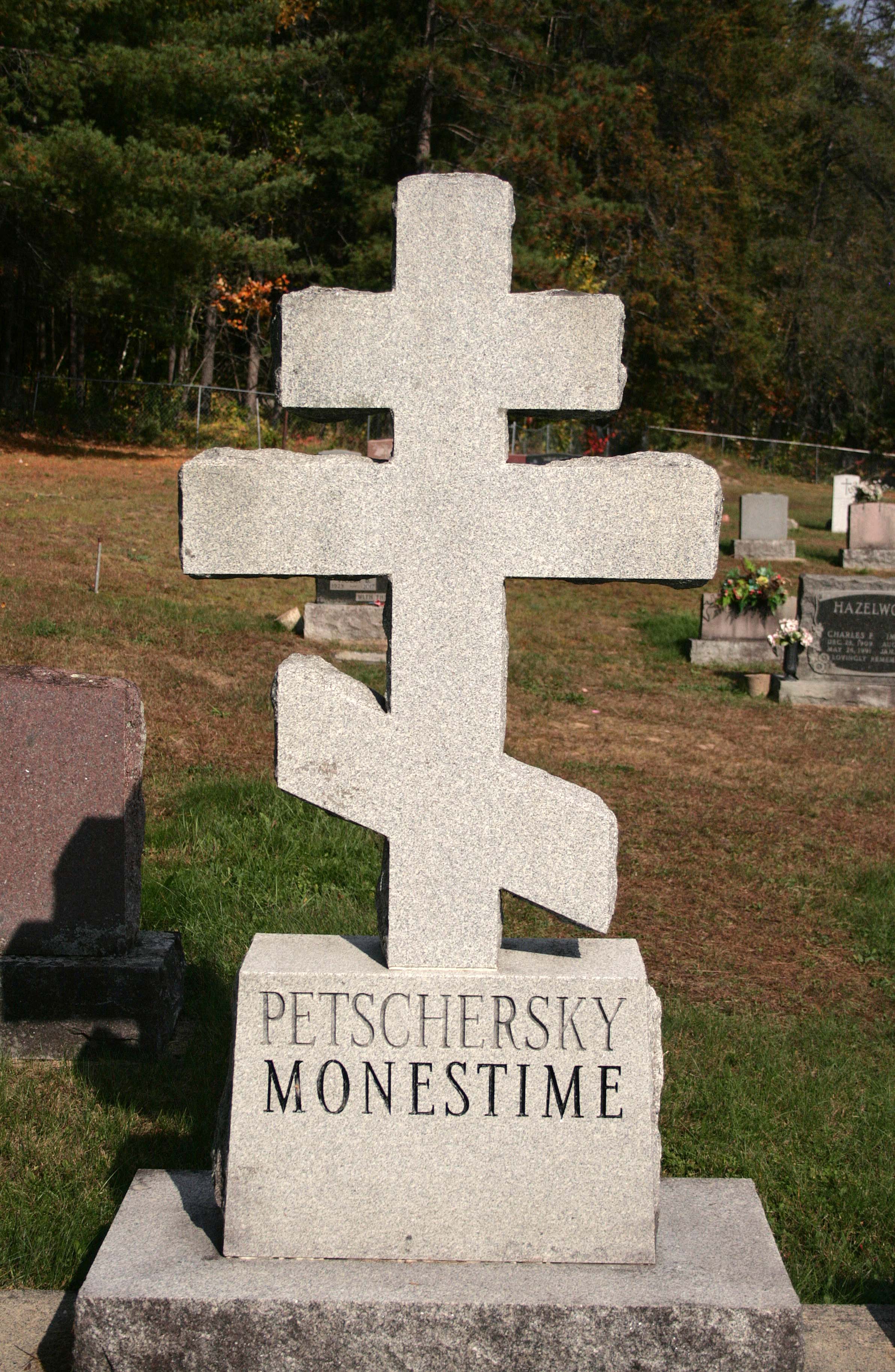
On October 27, 1977, Dr. Monestime passed away at the age of 67, most likely from pancreatic cancer, which he battled multiple times throughout his life. His Russian Orthodox funeral service took place at St. Anne’s Roman Catholic Church in Mattawa.3 He is buried in the Petschersky Monestime family plot at Pine Hill Union cemetery.

He is laid to rest beside his son Fedeor, who sadly was accidentally shot and killed a year earlier on February 29, during an altercation outside of Chez Francois.3 Monestimes’ wife, Zena, and her mother are also laid to rest in the family plot, which features a large Eastern Cross. The Eastern Cross or Orthodox Cross has a tilted bar at the base of the cross; a tilted footrest. This is meant to illustrate that the thief crucified on the left side of Christ, thought to be the wise thief, went up to heaven, while the thief crucified on the right side was thought to be unrepentant, and went down to hell.4
My visit to Mattawa was an eye-opening trip. After exploring the exhibit at the museum, we stopped at the gift shop and spoke with the museum curator after buying a few things. We had a great conversation about the museum contents and how sometimes history is hidden in plain sight. 

If you’re interested in learning more about Dr. Monestime, I highly recommend a visit to the Mattawa Museum and also picking up a copy of Where Rivers Meet by Doug Mackey. It’s a well-researched look at the life of Dr. Monestime and also explores life in Haiti as well as Black history in Canada. 

Thanks for reading!


References:

  1. What About Mattawa? | Town of Mattwa
  2. The Three Crosses | Mattawa Museum
  3. Where rivers Meet: The Story of Dr. S. F. Monestime, Canada’s First Black Mayor by Doug Mackey | Book
  4. Understanding Cemetery Symbols: A Field Guide for Historic Graveyards by Tui Snider | Book

A Collection of Cemetery Statues

For today’s blog post, I wanted to share a collection of cemetery statues. I find this type of funerary art beautiful, and always enjoy finding detailed sculptures. I do often say that cemeteries are open-air art galleries, and statues are just one example of artistic works that can be found when you visit a cemetery. 

Angel statues are sometimes a very common sight in a cemetery, especially in Catholic cemeteries and graveyards. But, you might also find representations of saints, virtues, and other biblical figures. 

To decipher which saints or figures are being depicted, it’s important to look at the details. Little details like something at the statue’s feet, or what they are holding or doing with their hands can be a big indication of who the statue is representing. 

ANGELS

The most common figures you might find in a cemetery are angels. The winged statues can symbolize many things, most commonly that the deceased is now in heaven. They can also represent a connection between earth and heaven, comfort and mourning. 

An angel statue holding a book, for instance, suggests that this statue is a representation of a celestial scribe, a recording angel. Recording angels are thought to be tasked with recording historic events, actions, and prayers of everyone on earth.

You might also come across an angel holding flowers. There are many variations of angels with flowers, ranging from full bouquets to single-stemmed flowers. The flowers are thought to represent how fleeting life is. 

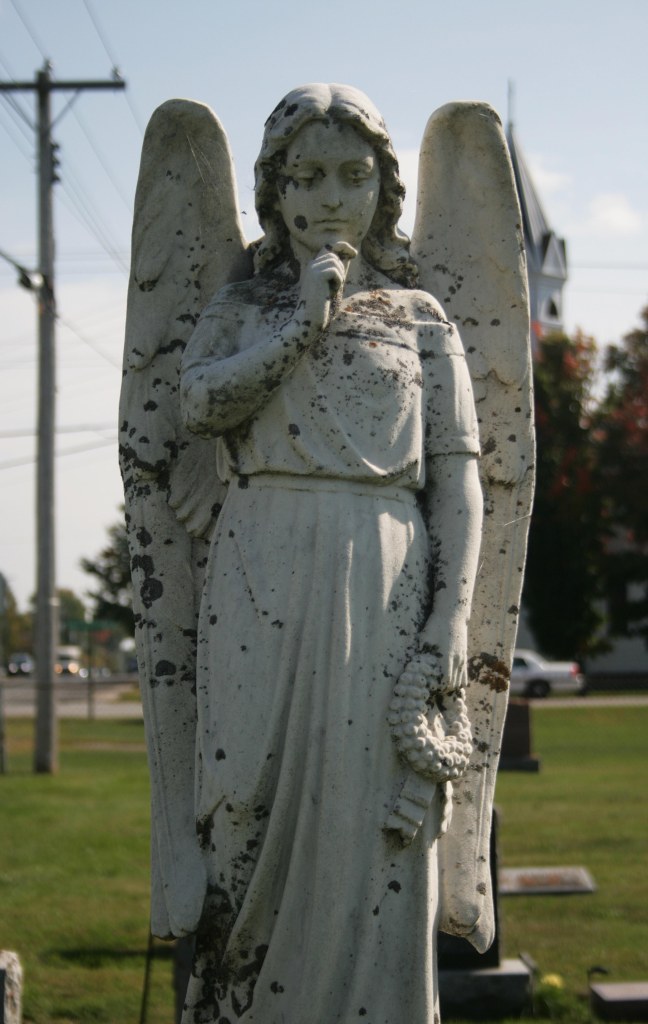
Some angel statues are depicted holding a wreath. This symbolizes memory and eternity, an indication that the deceased will not be forgotten. This example below also shows the angel holding their chin as if they are deep in thought, emphasizing the idea of remembrance. 

Virtues

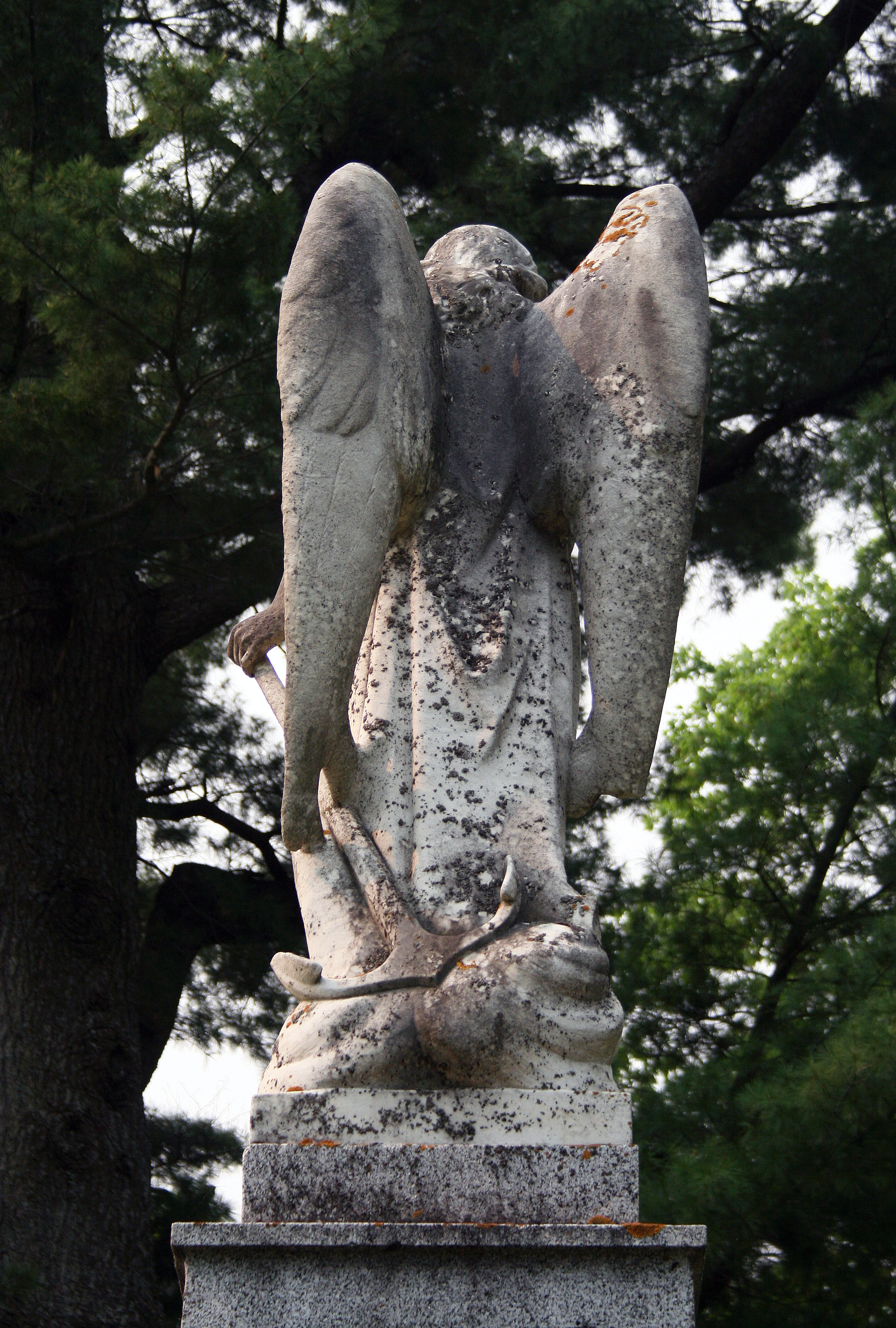
The Seven Virtues are traits that some of those of the Christian faith aspire to. According to Tui Snider’s book Understanding Cemetery Symbols, this list of traits was created by Greek philosophers and then adopted by Christian scholars. Sometimes the virtues are labeled on the statue’s pedestal, but most often you must look closely at their design for clues. In this example, we can tell this is Hope, by the large anchor she is dragging behind her. 

Saints

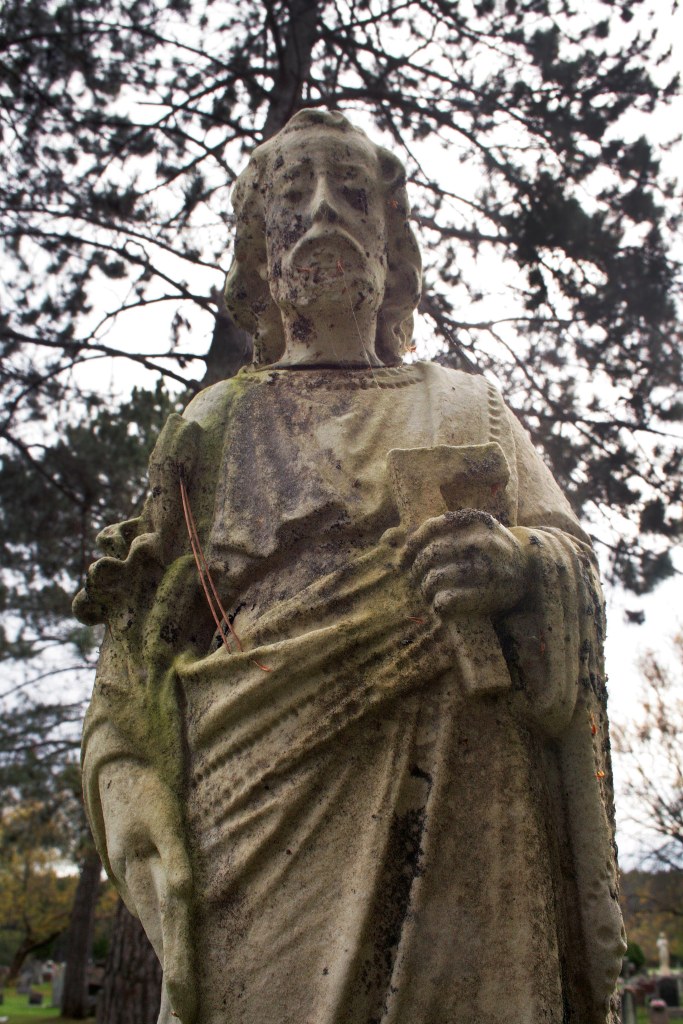
Based on the details, we can tell that this statue is a representation of Saint Joseph. The carpenter’s square represents his trade, as well as the concept of truth. The lilies represent purity. Saint Joseph is the patron saint of many things, including families, fathers, craftsmen, engineers, and common workers.

Jesus

Statues of Jesus can also be a common find in Catholic cemeteries. He is often depicted as a young child or an adult. When depicted as a young child he can sometimes be found in the arms of Saint Joseph. He is also sometimes depicted as a young boy, with both Saint Joseph and the Virgin Mary.

Jesus is also commonly depicted as an adult, his hands pointing to a flaming heart with thorns, that have rays emanating from it in his chest. This is often called the scared heart, and also sometimes has the addition of being topped with a Latin cross. There is a lot of symbolism here to unpack. The flame represents Jesus’ love for God and humanity, while the thorns represent his passion. The rays emanating from it represent the glory of God. Jesus’s hands point towards his heart, encouraging the viewer to look at it and reflect.

One of the more somber depictions of Jesus you might come across is a scene after the crucifixion. A thin and wounded Jesus is cradled in his mother Mary’s arms. He might be still wearing the crown of thorns, or it can sometimes be found lying by his side.

Statuary always seem to stand out to me, when I visit cemeteries. They are beautiful expressions of art and emotion, often made even more moving with the passage of time. Do you have a favorite cemetery statue? I would love to hear about some of your cemetery statue finds in the comments.

Thanks for reading!


References:

  • Understanding Cemetery Symbols: A Field Guide for Historic Graveyards by Tui Snider 
  • Stories in Stone: The Complete Guide to Cemetery Symbolism by Douglas Keister

Stone Stories: Canada’s World War I Flying Ace

Have you ever flown out of the Billy Bishop airport, in Toronto? Were you curious as to who the airport was named after? I was, but I never got around to looking into it, not until I stumbled upon the grave of William Avery “Billy” Bishop.

In the Summer of 2023, My mother and I stumbled across the Bishop family plot, while visiting Greenwood Cemetery in Owen Sound. We had come to Owen Sound to search for the second grave of Tom Thomson, but the trip ended up being just as much about Bishop.

Billy Bishop

William Avery “Billy” Bishop was born in 1894, in Owen Sound, Ontario. During his stint as a cadet at the Royal Military College in Kingston, World War I broke out. He enrolled in the 9th Mississauga Horse, Canadian Expedition Force and later transferred to the Royal Flying Corps.1 He received his pilot’s certificate in 1917, although some considered him a mediocre pilot, he was an expert shot with great shooting skill and extraordinary eyesight.2

Bishop became the first Canadian Airman to be awarded the Victoria Cross, the highest award for acts of bravery in wartime. Bishop was awarded the cross for his solo early morning attack on an enemy airfield in June, 1917.1 He single-handedly attacked a German aerodrome, destroying seven airplanes on the ground and shooting an additional four airplanes down, before running out of ammunition.2 Billy Bishop was the British Empire’s second-highest-scoring flying ace, with 72 official victories.1

Greenwood Cemetery

When we visited Greenwood Cemetery, we didn’t have any specific graves we wanted to see. I visited the cemetery office when we first arrived, as I had read online that they offered a self-guided walking tour. They were very friendly in the office and gave me a brochure with the walking tour details. There are a couple of different tours to choose from, that take you to different areas in the cemetery. 

Greenwood is quite large, covering approximately 40 acres of land in the southwestern part of the city. It also has a long history, having opened to the public in 1854. It’s a traditional cemetery, with both upright and flat markers, a large mausoleum, memorial gardens, and a potter’s field memorial.3 

We unexpectedly came upon the Bishop family plot after getting out of the car. I had parked in the heart of the cemetery. A small Canadian flag marked the grave, the flag blowing in the wind had caught our eye. There is a large upright stone that lists the family members buried there, with names on both sides of the stone. There are smaller flat markers laid in the earth surrounding it, marking where each family member is laid to rest. There is also a Canadian military marker for Bishop that stands apart from the rest. The upright grey granite marker lists his military designations alongside the emblem for the Royal Canadian Air Force and the Victoria Cross.

Bishop passed away at the age of 62, on September 11, 1956, in Palm Beach, Florida. His funeral service was held at the Timothy Eaton Memorial Church in Toronto, the same church that he was married in. 25,000 people lined up outside the church to pay their respects. He was cremated, and his ashes were buried in the family plot, in Greenwood.4 He is laid to rest with his family; including both his parents, his sister Mary, and his brothers Hiram, and Reginald Bishop.

Bishop’s wife Margaret remarried after his death, and is buried with her second husband in Beachwood Cemetery in Ottawa. She passed away in 1981 at the age of 83.5 

The Billy Bishop House

The next morning, we decided at breakfast to visit one more thing before we left Owen Sound. My mother loves history, so I figured she would enjoy touring a historic home, The Billy Bishop House. She loved the suggestion, it seemed only appropriate to stop since we had already paid our respects at his grave. 

The house, built in 1884, is the childhood home of Bishop and has been preserved as a historic site and museum. The first floor has been decorated with period-appropriate antiques and items owned by the Bishops. It looks very similar to what it would have looked like when Bishop was growing up. There is a timeline in the parlor that details all the major milestones in Bishop’s life. I found this floor to be the most interesting. There is a lot of information to take in, but also lots to look at; like Bishop’s uniform, personal items, and a copy of Winged Warfare, a book Bishop wrote in 1918 that details his experiences in the air.2

The second floor looks more modern and houses changing exhibits. When we visited there was an exhibit of interviews with veterans from the war in Afghanistan. In what would have been Bishop’s boyhood room, there is a wooden framed airplane for children to explore, and the room is decorated with film posters and other memorabilia.

The staff are incredibly knowledgeable and friendly. I had a nice chat with them about Bishop, as well as the haunted history of the house. I can’t help but ask when I visit a historic location! They were not phased by my line of questioning at all, and I’m sure it’s something they get asked often. The museum runs a ghost walk in the summer months.

Unfortunately, I wasn’t able to attend one of the walks, but I did get to hear some of the stories. The house is reportedly haunted by two spirits, an older woman and a young child. The spirit of the young child is thought to be Hiram Kilbourn Bishop, who died of diphtheria at the age of 4 years old, in 1892.6 People say they have seen a small child wandering the house, wearing what looks like a dress. Young children, regardless of gender, often wore dresses during that time period, which leads the staff to think it is the spirit of young Hiram. 

We didn’t experience anything paranormal on our visit, but we did enjoy exploring the house and learning more about life in that era, Bishop’s personal life, and his legacy.

My mother and I both love history and getting to explore Bishop’s childhood home was a great way to end our Owen Sound adventure. We traveled to Owen Sound to learn more about art, but we ended up also learning more about our Canadian Military history. That’s one of the reasons why I love road trips, you can plan as much as you want but it’s often the spontaneous finds that end up being the most interesting. What do you think?

Thanks for reading!


References:

  1. Billy Bishop Toronto City Airport | Government of Canada
  2. William Avery “Billy” Bishop | Find a Grave 
  3. Greenwood Cemetery | Owensound.ca
  4. Billy Bishop, VC by W.D. Mathieson | Goodreads
  5. Margaret Eaton Burden Hughson | Find a Grave
  6. Hiram Kilbourn Bishop (1887 – 1892) | WikiTree

Tapho-what?

Are you a taphophile?

If you’re a regular reader of my blog, you very well might be!

You may have noticed that I use this term a lot, and often refer to myself and others in the cemetery community as taphophiles. For today’s blog post, the first of the new year, I wanted to take a closer look at the word, and what it means to be a taphophile.

The origin of the word taphophile comes from the Ancient Greek word taphos and phileTaphos meaning funeral rites, burial, wake, or grave, and phile meaning dear or beloved.1 Curiously, if you look up the word in the Oxford English dictionary or Merriam-Webster online, the word does not come up. Although the latter did bring up the word typophile, similar but not quite right. 

Taphophile is defined as a person who is interested in cemeteries, funerals, and gravestones.2 To me that is a very flat and vague definition, as there is so much it entails. I was curious as to how others in the cemetery community would define the term, so I reached out to a few friends. The responses I received were very mindful and thought-provoking.

Tui Snider, speaker and author of Understanding Cemetery Symbols shared this thoughtful reflection:

“To me, being a taphophile means understanding that cemeteries are for the living. Not only do burial grounds provide a place for grieving, cultural expression, and contemplation, but they offer a direct connection to nature, something that is often missing from people’s lives.

Visiting graveyards throughout the year exposes us to cycles of life and death that are the foundation of our world. Many cemeteries are wildlife corridors that nurture vital pollinators as well as migrating birds and other animals. By visiting cemeteries, taphophiles gain a unique appreciation for all that burial grounds offer, not just to humans but to the plants and animals they sustain as well.”

Tasha Westby Tietz, also known as Graveyard Girl on Facebook shared this insight:

“Being a taphophile means to me, an unusual intense interest in cemeteries and all that is related. A way to remember and respect those that have gone on before. Endless adventures.”

Loren Rhoads, cemetery traveler and author of 199 Cemeteries To See Before You Die shared this interesting perspective:

I don’t really think of myself as a taphophile, because the word seems academic and cold to me.

I’ve always thought of myself as a cemetery aficionado, because my love of burial places is much more about appreciating their beauty and ambience as a whole than it is about studying the stones individually.

To be honest, I love that everyone defines taphophile for themselves.”

I couldn’t agree more! Each of these responses showcases the many reasons why visiting cemeteries is so important. I really appreciate Loren, Tasha, and Tui taking the time, and want to thank them for sharing their thoughts with us.

It makes sense that everyone who would call themselves a taphophile has their own definition of the word since we all have our own unique interests and reasons for visiting cemeteries.

For me, the term taphophile names that connection I feel to those who have come before me and are now laid to rest. It means they will not be forgotten, and that there is still much that they can teach us. It means that I love the experience of wandering through beautiful cemeteries and reading the names out loud. I love to admire the uniqueness and craftsmanship of gravestones, while also learning more about art, architecture, and symbolism. I am curious about the person below the gravestone. I also love the adventure of finding and exploring cemeteries.

I always say that cemeteries are for the living, that they are open-air art galleries and museums, and that they should be explored.

Do you call yourself a taphophile? What is your definition? I would love to keep the discussion going in the comments.

Thanks for reading!

References:

  1. Taphophile | Wikipedia
  2. Taphophile Definition | Your Dictionary

Year in Review – 2023

Can you believe that we made it through another year? 2023 just flew by! I feel like just yesterday it was Halloween, but here we are! It’s been an interesting year, full of ups and downs. So for this week’s blog post, I wanted to carry on the tradition from last year and take a look back at what happened throughout the year. 

2023 was unfortunately the year of COVID for me. I managed to catch it twice, first suffering through two and half weeks of the worst head cold of my life. The second time I caught it, it was mild like a light cold. Unfortunately, the second time I caught COVID, I was also suffering through my first bout of poison ivy. 

Catching poison ivy, from a cemetery visit (of course), was quite the learning experience for me. It was a hard reminder that you should always dress appropriately when out in the field, especially when exploring overgrown cemeteries. Dealing with my bad case of poison ivy put me out of commission for about a month, in the middle of summer. It was not an opportune time and had me itching to get back in the field.

Even though I had more downtime this year, I still managed to have a successful field season, visiting 113 cemeteries. 103 of those cemeteries were first-time visits. I didn’t take a count of how many new photos I added to my archives, but there is a lot to sift through and edit this winter. I can’t wait to share them on my portfolio page, and also add them to Find a Grave

This year also marked another new record for the number of cemeteries visited in one day! A friend and I incredibly visited 25 cemeteries during a day trip to Midland. At the time it didn’t feel like we had visited that many, but the photos don’t lie. We’ll see if we can break this new record in 2024.

Highlights

In April of 2023, I had a great opportunity to participate in a juried photography show, Our Story in Black and White. My cemetery photography was proudly hung beside other great works by local photographers; Caio Higa, Debbie Anzinger Mckay, Debby Trahan-Pero, and Rita Vanderhooft at Gallery 6500. The exhibit ran from April 30th to June 30th. After this initial run, the photography show was moved to the South End Pubic Library and ran for another month. Being part of a group show was such a great experience! I hope I can participate in more photography shows in the future.

Another highlight of 2023 was getting published! 

I was contacted by the Bereavement Authority of Ontario (BAO) which was interested in my photography for their online, quarterly magazine, BeyondA condensed version of my articles about visiting the graves of Tom Thomson was published as the cover story of their October issue, along with some of my photography. That was incredibly exciting, and I hope to work with Beyond and the BAO again the future. 

Statistics

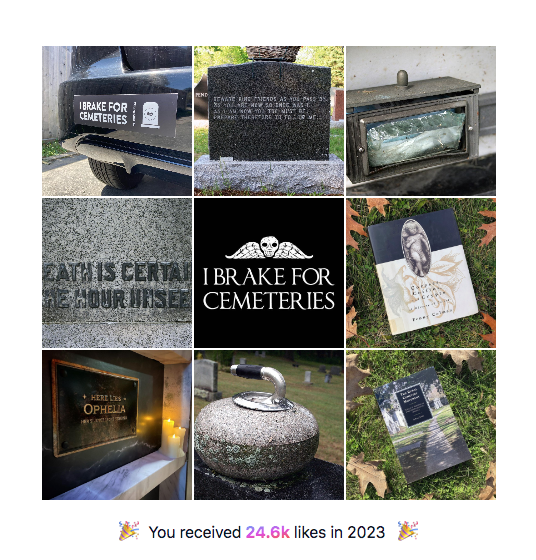
This year was also a great year for growth. On the website, I had 6,805 visitors this year, with 12,793 views. That’s the highest count, since starting this website in 2018. I will note that I didn’t start consistently posting till 2021. Speaking of blog posts, I posted 42 times this year, with a word count of 29.3k. I have been very weary about calling myself a writer, but after seeing that word count I might have to change my mind. There is still work to be done to upgrade my writing skills, but it is kind of fun to think of myself as a cemetery tourism writer. 

I often write articles that I would like to find and read. My favorite articles to write are cemetery tourism pieces, where I talk about visiting cemeteries and related sites. I also really enjoy researching so these pieces are really fun for me to write. I also feel more connected to these sites after learning about them and visiting them in person.

I also have a lot of fun writing cemetery recipe posts. These posts seem to resonate with readers as well, as they are often the most searched-for articles. I do enjoy experimenting with cooking and baking and these posts encourage me to do that, while also having a research element to connect the recipe to the gravestone.

This year the top viewed blog posts are a bit varied, with one post from last year ranking in second place.

Top 5 blog posts of 2023

On social media, my Instagram account is growing as well. At 2,754 followers, it’s my favorite place to interact with followers and share my photos.

Overall it has been an excellent year, full of growth and adventures. As I settle in for the winter, I will put my hiking boots away and focus more on research and photo editing. The winter break is an excellent opportunity for me to update my portfolio, as well as research and write more in-depth blog posts about this year’s cemetery travels. I am currently working on a few stone stories and have plans to start a new blog series of cemetery stories. I also would like to catch up on my reading and post some more cemetery book reviews.

Of course, I have already started thinking about next year’s cemetery adventures as well, and have started some maps and travel plans. I hope to visit some more unique grave sites, cemeteries, and famous graves next year. Maybe even exploring out of province. The possibilities are endless, and I am always finding new and interesting places to visit when I go down the research rabbit hole.

I want to finish this 2023 recap by thanking every one of you for your support and encouragement.

All the comments, likes and shares do not go unnoticed. I love being part of this cemetery community and have met so many amazing new people because of it. I appreciate all of you, and wish you all the best in the coming new year.

Here is to another year full of curiosity and adventure!

As always, thanks for reading!

Happy Holidays

As another year draws to a close, I wanted to share my appreciation for you, the reader, for joining me on my graveyard adventures. At this special time of year, I would like to say thank you, and wish you all a happy holiday season, and a happy new year!

It’s Winter in the Cemetery

Winter is here in Northern Ontario! 

We’ve had a few snowfalls since November, and the temperature has been steadily dropping. I have never been a Winter person really, although I have tried many times to find a winter activity that might make me enjoy it more. Figure skating, ice fishing, snowshoeing—not for me!

I tried again today to see if maybe winter cemetery visits might be something I would enjoy. It doesn’t hurt to try right? I was quickly reminded why I don’t like graving in winter, as soon as I exited my vehicle. 

I hate the cold!

It isn’t even that cold today, but still makes me question why I live somewhere where the air hurts my face. It’s -3°C in Sudbury today, but feels like -8°C with the wind chill. That’s 26.6°F which feels like 17.6°F for my American friends.

Aside from being uncomfortable, the cold isn’t good for my equipment either. The cold can drain the battery life of my DSLR, which would shorten my cemetery trip unexpectedly. I would rather not play that game of roulette. 

Wandering cemeteries in the winter isn’t that safe either, for me or the stones. The snow isn’t that deep yet, but soon it will be a couple of feet deep, which can completely obscure some gravestones. I wouldn’t want to accidentally step on and damage a tombstone. They also become tripping hazards as well. I wouldn’t want to hurt myself tripping over a stone, while also damaging it in the process. Too risky, if you ask me.

I’m sure for some, visiting cemeteries in the winter, is a great past time. If you have the proper outerwear, can tolerate the cold, and come prepared with backup batteries an outing in a snow-covered cemetery sounds delightful.

For me, I see this time of year as a great opportunity to curl up with a good book and a hot beverage or research by the light of my iMac. Reading, scouring the internet, and sifting through my photo archive to work on future blog posts and cemetery trips seems like a much more comfortable use of my time.  

When I visited Civic Cemetery today, I did notice a few beautiful and interesting scenes. Many of the graves were decorated with Christmas ornaments, wreaths, and lights. I also found a small Christmas tree, that looked like it had been recently put up, judging by the tracks in the snow. I also saw some rabbit and possibly dog tracks dotting the fresh snow as well. 

Despite the cold weather, the cemetery was a fairly active place today, with a handful of visitors in the mausoleum, a burial taking place, and a couple of folks just out and about for a walk, dressed warmly in their mitts, toques and snow pants of course.

Cemeteries in the winter sure are pretty though. The starkness created by the grey weather, bare trees, and white snow does create a mood. That being said, cemeteries in Autumn are still my favorite.

So until the snow melts, I’ll stick to online research, book reading, and updating my online portfolio. I do have some upcoming Stone Stories to share with you as well!

Stay warm out there, and thanks for reading! 

Cemetery Book Review: Sacred Ground, Volume Two
I hinted last week that I had been working on another cemetery book review for you. For this month’s book review, I wanted to share Sacred Ground, Loyalist Cemeteries of Eastern Ontario, Volume Two by Stuart Lyall Manson.

Sacred Ground, Volume Two continues the author’s exploration of United Empire Loyalists buried in loyalist cemeteries in Canada. This volume looks at five cemeteries in the Eastern Ontario County of Glengarry, and one other in Cornwall, Ontario. I was very excited when Stuart reached out, asking if I would be interested in reviewing his second book on loyalist cemeteries. You might remember a previous blog post I wrote, reviewing his first book, Sacred Ground: Loyalist Cemeteries of Eastern Ontario, Volume One 

Stuart Lyall Manson is a professional research historian with over 25 years of experience and is also a heritage cemetery advocate.1 His second book Sacred Ground, Volume Two just came out in September of this year. He graciously provided me with a PDF version of his book to review. This book, also available in softcover, is 214 pages and contains color as well as black and white images. 

Here is the book synopsis from Goodreads:

“The second volume of the book series Sacred Ground: Loyalist Cemeteries of Eastern Ontario continues the approach of the first volume, describing notable loyalist cemeteries situated in Eastern Ontario. This volume covers cemeteries in the counties of Stormont and Glengarry. It is a collection of detailed profiles of a selection of these historical locations in the region. In each chapter, the author discusses, in-depth, a single cemetery containing the mortal remains of at least one loyalist. A historical overview is provided of each of these burial grounds, along with biographical information on specific loyalists with particularly remarkable stories. The locations were selected based on geographic distribution, religious diversity, and other factors. The book is based on rigorous primary and secondary source research. It complements other publications that list burials or transcribe tombstone inscriptions. Those publications are important resources. This book supplements that basic data with greater historical context and additional research into the lives and experiences of these men, women, and children who laid the foundations of modern Ontario. This volume includes the following cemeteries:

  • St. Andrew’s United Cemetery (Williamstown)
  • St. John’s Presbyterian Cemetery (Cornwall)
  • Falkner Settlement Cemetery (South Lancaster)
  • Salem United Cemetery (Summerstown)
  • St. Raphael’s Cemetery (St. Raphael’s)
  • Gleninore Cemetery (Charlottenburgh)”

I enjoyed this book. The author digs deep to uncover the lives of those who have been forgotten by many. I liked the fact that the author does not shy away from explaining that this type of research can be quite difficult when many people have the same names and full details are not always written out. I can just imagine the rabbit holes of research one had to go down to pull it all together.

As well as providing life stories and timelines of those buried, Volume Two also looks at the story of the cemeteries themselves. The one that stands out the most to me is St. John’s Presbyterian Cemetery in the city of Cornwall. A beautiful cairn was constructed with the remaining gravestones in the 1930’s. In 2017, with hardly any notice the cairn was demolished, destroying most of the remaining gravestones. Today there is only an empty lot where this cemetery sits. Without this kind of research and documentation, these sites may be lost to time, but the author has done an amazing job of collecting old photographs and piecing together the history of this site for future generations. 

As I’ve mentioned before, I always jump at the chance to read about Canadian cemeteries. There is so much history to be found here, and you don’t have to travel far to find it. Accompanying each chapter is a smattering of maps, letters, and photographs of interesting gravestones and beautiful ruins. At the end of each chapter, I found myself saying “I have to visit this one!”. For this reason, I also loved that the locations of each cemetery were included as an appendix at the back of the book. Cemetery name, location, and even coordinates are included.

Just as I recommended the first book in this series, Volume Two would be a valuable read to anyone interested in learning more about Canadian history and the indelible mark left by United Empire Loyalists. This would also be a good book to pick up if you are planning some cemetery road trips in the future. As I did with Volume One, I have already added these cemeteries to my Google maps for future trip planning. 

Will you be adding this book to your TBR list? Or better yet, have you already read it? I would love to hear what you think in the comments.

Thanks for reading! 


I am always on the hunt for cemetery-related book recommendations. Please feel free to share yours in the comments. If you are an author and have a cemetery-related book you would like me to review, please reach out at hello@chantallarochelle.ca. I would love to hear from you.


References:

  1. Home | Stuart Lyall Manson’s website

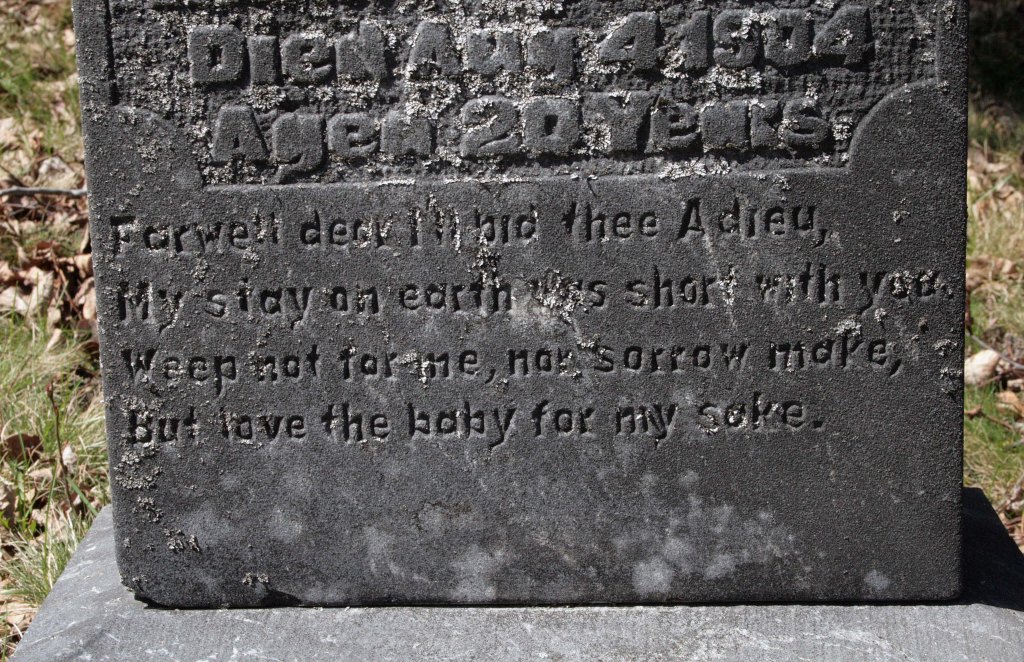
A Collection of Interesting Epitaphs

Can you believe we’re already 3 weeks into November? Field season seemed to just fly by this year! We had our first snowfall last week, which solidified the end of the season for me. 

That being said, it’s time to turn my attention to my photo archive and research. That includes some heavy reading and crawling through the Find a Grave website. I am currently working on my next cemetery book review, but it’s not quite ready yet. So to tide you over this week, I wanted to share a collection of interesting epitaphs. 

An epitaph is an inscription found on a gravestone that accompanies the name, birth, and death dates. These short verses and poems are inscribed to the memory of the deceased. The word epitaph comes from the Greek word “epitaphion” which means funeral oration. “Epi” meaning upon and “taphos” meaning tomb.1

Epitaphs became more popular in the 19th century, as a way to honor and memorialize the dead, but also share a little about the deceased’s life and personality.1 The most common epitaph you will find in a cemetery is the phrase “Rest in Peace”, or the Latin “Requiescat in Pace”. But you might also come across bible verses, poetry, or short sentiments proclaiming everlasting love for the deceased. You might also find a variation of a momento mori poem, a reminder that death is inevitable:

“Remember me as you pass by, / As you are now, so once was I, / As I am now, so you will be, / Prepare for death and follow me.”

So for today’s collection, I wanted to share some of the more interesting epitaphs I have come across on my cemetery travels. 

Have you come across some interesting epitaphs on your cemetery walks? Do you have a favorite? Or maybe you have something you would like written on your own gravestone? I would love to read your thoughts in the comments.

Thanks for reading!


References:

  1. What is an Epitaph? | Columbia Gardens Memorials

2023 Cemetery Scavenger Hunt

What are you up to this Halloweekend? 

That’s right, it’s the last weekend in October before Halloween. Time to get in those last autumn days enjoying some seasonal activities, and getting ready for the ghouls and boils to come knocking on your door for treats.

I have a pretty full weekend planned of pumpkin carving, horror movies, and of course one last visit to a cemetery. 

This Sunday is the fourth annual Halloween Cemetery Scavenger Hunt, organized by Talk Death. If you are not familiar with Talk Death, they are a death-positive collective, whose mission is to encourage positive and constructive conversations around death and dying. 

This annual cemetery scavenger hunt is designed to bring together communities, families, cemetery lovers, and history enthusiasts. It’s a fun way to get outdoors and learn about your local history and art and architecture of different eras.

Want to join the fun?

It’s easy to play along! On Sunday, October 29th, at 2:30 p.m. ET/11:30 a.m. PT visit your favorite local cemetery and tune in to Talk Deaths Instagram page.

Then follow the clues provided to search for gravestones that match the clues, like symbolism, names, and dates. Take a selfie with the stones and submit your finds using the link in their bio. The first 3 people to fill out the form completely, win!

You can visit the TalkDeath 2023 Halloween Cemetery Scavenger Hunt webpage for the full details! 

Although this is meant to be a fun event, please be mindful when visiting any cemetery. Be respectful, and do not disturb the gravestones or grave goods.

That being said, I had a great time participating last year, and l look forward to playing again this year. Last year I visited Park Lawn Cemetery with my Mom. We were the only ones in the cemetery that day, but we still had a lot of fun!

This year, my cemetery of choice is Lasalle Cemetery. It’s a fairly large cemetery and has some older stones. Feel free to join me, if you are in the area!

Regardless of what you get up to this weekend, I hope you have a great one and take some time for a little Halloween fun. 

Happy Halloweekend, and thanks for reading!