
Bicycles often represent freedom and joy, but when painted flat white and placed by the roadside, they carry a much heavier meaning.
These “ghost bikes” mark the sites where cyclists have lost their lives, serving as haunting memorials and powerful reminders of the need for safer streets.

Sudbury’s Ghost Bike, in memory of Dr. Robert D’Aloisio. Sudbury ON ©2025
The History of Ghost Bikes
Ghost bikes are roadside memorials placed at locations where cyclists have been killed in traffic accidents. The bikes, painted entirely white, serve both as a tribute to the fallen and as a warning to motorists to share the road and drive safely.1
The first documented ghost bike appeared in St. Louis, Missouri, in 2003. A cyclist named Patrick Van Der Tuin witnessed a car hit a fellow rider and decided to take action. He placed an old bicycle at the crash site with a sign reading, “Cyclist Struck Here.”2
The idea spread quickly, and soon cities around the world began installing their own ghost bikes in memory of lost cyclists.
Beyond their role as memorials, ghost bikes have become global symbols for cycling advocacy. They are often installed by local organizations or loved ones who want to honour victims and raise awareness about road safety.2
Sudbury’s Ghost Bike
Ghost bikes aren’t unusual in Canada—they mark the tragic losses in communities just like mine. In my hometown of Sudbury, in 2017, a white bicycle appeared in memory of Dr. Robert Santo “Bob” D’Aloisio, a local cyclist who was struck and killed in a tragic accident.
His death deeply affected the community, sparking conversations about road safety and the need for better cycling infrastructure.3
It was a bit of a dreary day when my mother and I went to visit the ghost bike. It’s secured to a parking lot railing outside of an apartment complex on a busy street. I’ve driven by it many times but only really noticed it recently. The white bike blends into the white of the railing, so unless you’re looking for it, you might miss it entirely. That in itself feels symbolic—how easy it is to overlook something so significant if you’re not paying attention.
We kept our visit short since I didn’t want to take up anyone’s parking spot, but I made sure to take a moment to pause and reflect. While I was taking photos, I looked up at the tall apartment buildings surrounding us and thought about how someone could’ve easily witnessed the accident from their window.
Even after nine years, the ghost bike remains—a quiet, persistent reminder of the loss that took place there.

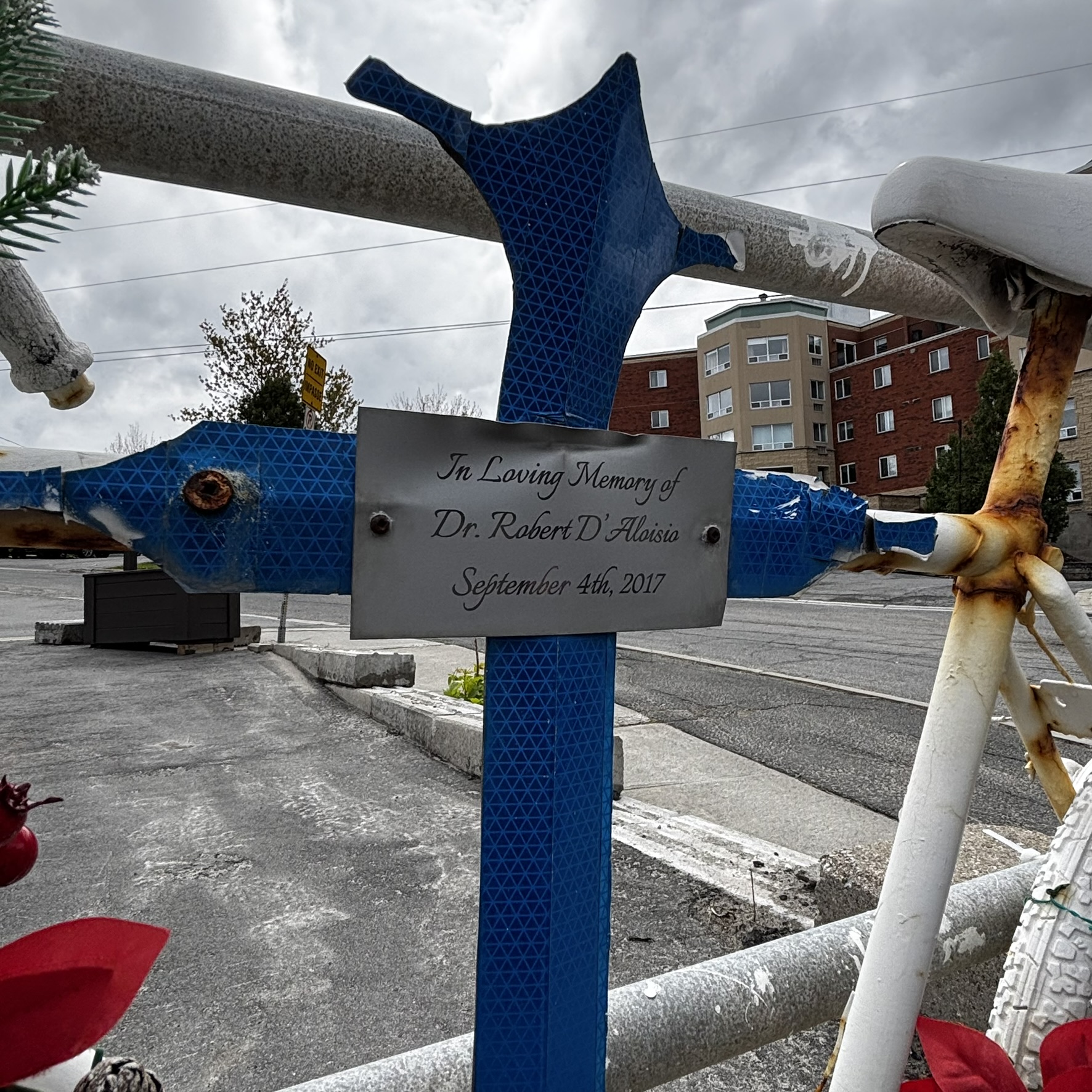

Sudbury’s Ghost Bike, in memory of Dr. Robert D’Aloisio. Sudbury ON ©2025
D’Aloisio’s passing was a devastating loss for his family and the cycling community. His loved ones continue to advocate for greater awareness and protection for cyclists. His story is a haunting reminder of the dangers cyclists face and the responsibility of all road users to ensure their safety.4
Park Lawn Cemetery
After visiting the ghost bike, we headed to our second stop—the cemetery.
Robert D’Aloisio is laid to rest at Park Lawn Cemetery. The cemetery itself is peaceful and tucked away, a contrast to the busy road where his memorial stands. The moment we stepped out of the car, it felt quieter, more reflective. I felt like I needed to visit both sites: the place where his life ended, and the place where he now rests.
The sun was beginning to peek out as we arrived, and the birds were singing. We wandered the gently curving paths for a few minutes before we came upon the D’Aloisio family plot. His gravestone is elegantly simple: polished granite with the family name at the top and a Latin cross separating his name from his wife’s, who is still living.
Visiting his stone, after having just stood at the place where his life was cut short, felt as if the threads of his story had tied together—from tragedy to rest.

Park Lawn Cemetery, Sudbury ON ©2025
Ghost bikes are powerful symbols, but the ultimate goal is to make them unnecessary.
Their presence speaks to the need for safer infrastructure, stricter enforcement of traffic laws, and a cultural shift toward respecting all road users. In Ontario and beyond, cyclists, pedestrians, and drivers must all coexist with caution and compassion.
With the warmer weather returning, more cyclists are hitting the roads. It’s a timely reminder for all of us—whether we’re behind the wheel, on a bike, or on foot—to slow down and share the road.
D’Aloisio’s story, like that of many others, is a call to action. Let’s honour his memory by advocating for safer roads and ensuring that cyclists can ride without fear.
Thanks for reading!
References:
- Ghost Bike FAQ | Advocacy for Respect for Cyclists
- Ghost Bike | Wikipedia
- Sudbury ‘ghost bike’ a haunting reminder | Sudbury Star
- Father’s cycling death haunts Sudbury family | Sudbury Star
 Cemetery Photography by Chantal Larochelle