Some cemeteries feel alive with history, and sometimes with something else entirely!
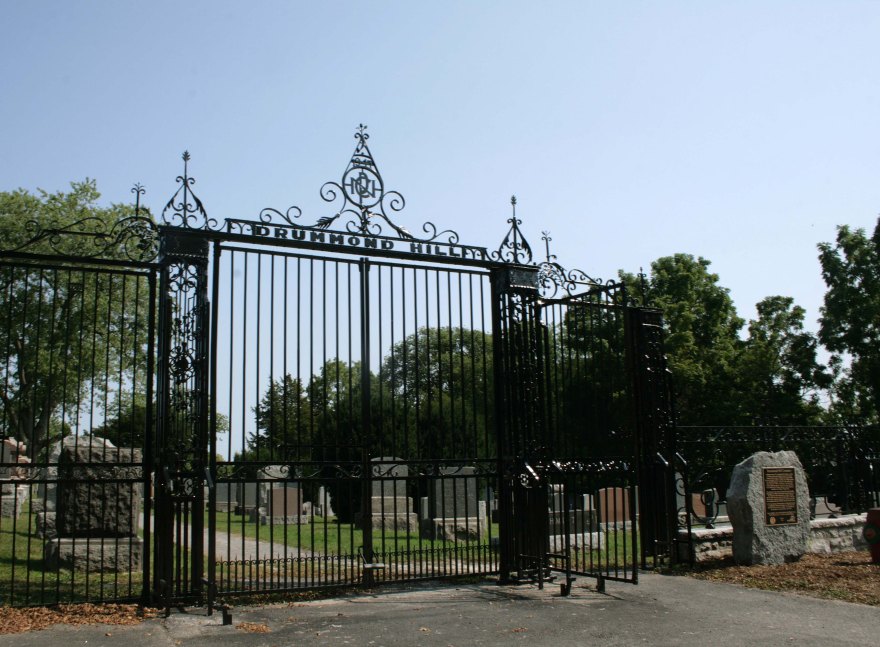
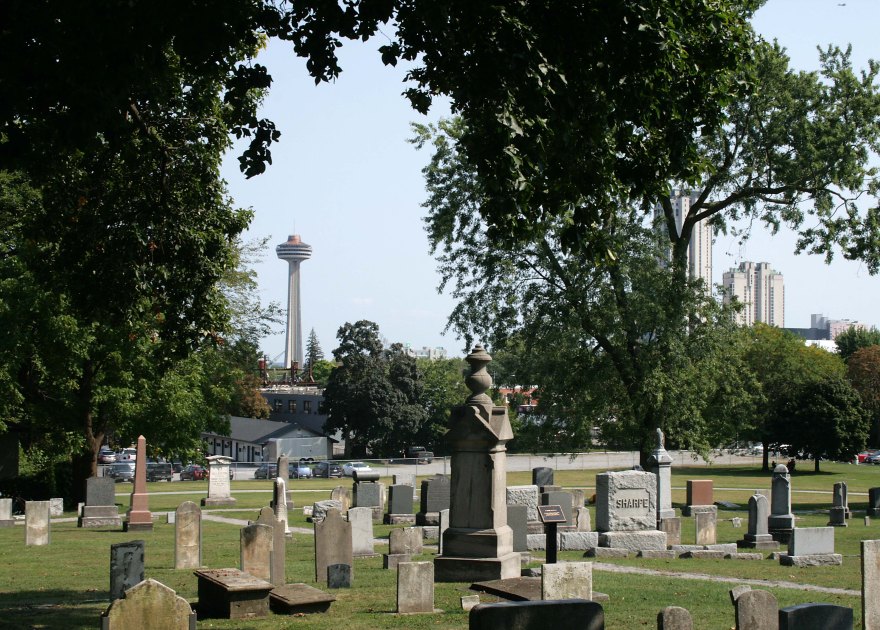
Drummond Hill Cemetery in Niagara Falls is one of those places. Known as the site of one of the fiercest battles of the War of 1812, it’s also considered Canada’s most haunted cemetery.
Long before its haunted reputation took hold, Drummond Hill was a popular tourist stop, even rivalling Niagara Falls. Visitors came for battlefield tours led by veterans eager to share their stories.1
Drummond Hill was once farmland, but on July 25, 1814, it became the site of the Battle of Lundy’s Lane, one of the bloodiest conflicts of the War of 1812.2 The hill’s high ground made it strategically important, and the fighting went on for six hours before darkness and heavy losses brought it to an end.2 Both sides lost more than 800 men, and although each claimed victory, the Americans withdrew the next day, ending their advance into Upper Canada.2
Today, a large stone monument stands on the hill to honour those who fought and to mark the battlefield.3 Beneath it lies a vault containing the remains of 22 British soldiers.3
The first recorded burial at Drummond Hill is John Burch. He was originally buried on his farm in 1797 and re-interred here in 1799.3 That means this ground was already being used as a burial place well before the battle. Over time, the cemetery grew to roughly 4 acres and now contains more than 25,000 burials.4 The site is managed by the City of Niagara Falls and remains semi-active, though plots are no longer for sale.3
Among those buried here are veterans, Loyalist settlers, and many early Niagara families. One of the most visited graves belongs to Laura Secord, the woman who warned British forces of an American attack during the War of 1812.4 Another notable grave is that of Karel Soucek, the daredevil who famously survived his barrel plunge over Niagara Falls.5 You will also find markers and monuments for soldiers and local leaders from the region’s early days.3
With its violent past and long history, it’s no surprise Drummond Hill has a haunted reputation. Many stories connect back to the battle, where soldiers were killed and buried on the grounds.6 Visitors and locals have reported seeing ghostly soldiers walking among the gravestones, or appearing at a distance before fading away.6
It’s said that the cemetery is haunted by two distinct groups of soldiers.1 One group is a troop of five soldiers dressed in Royal Scots uniforms, limping across the former battlefield before vanishing.1 The second group is said to consist of three British Soldiers in red coats, slowly making their way up the hill and settling into a steady march, before disappearing.1
Laura Secord’s monument, which features a lifelike bust, has also been linked to supernatural occurrences. Some visitors say that her statue seems to watch them as they walk by, as if she’s still keeping a watchful eye on things.1 These reports, combined with the age of the cemetery and its battlefield history, make Drummond Hill a place where history and the supernatural feel closely connected.1
When I visited Drummond Hill, I made sure to stop at Laura Secord’s grave. Standing in front of her stone was moving, knowing her bravery has become such a lasting part of Canadian history.
During my visit, I did have one unsettling experience, but it had nothing to do with the supernatural.
I came across someone under the influence, wandering through the cemetery. For the first time in all my cemetery visits, I felt unsafe. It was a harsh reminder of how deeply the opioid crisis has reached into our communities, even historic sites like this. That moment pulled me out of the past and reminded me of the struggles happening right now.
Drummond Hill Cemetery is layered with stories. It carries the weight of the War of 1812, the lives of pioneers and heroes, and the ghostly legends of soldiers who never left. It’s a place where history and mystery meet, and where the past feels close. Visiting left me reflecting not only on the history that shaped this ground, but also on the realities of the present.
Haunted or not, Drummond Hill remains one of Canada’s most fascinating and important cemeteries.
Thanks for reading!
References:
Haunted Cemeteries: True Tales From Beyond the Grave by Edrick Thay | Book
Summer is winding down, but everything still feels full of life.
Trees are lush with green leaves, flowers are in full bloom, and the bees are buzzing all around. Cemeteries reflect that same energy. It’s the time of year when nature is at it’s fullest—and in cemeteries, that adds an extra layer of meaning.
Even in these quiet places, there’s life all around. It reminds me that cemeteries aren’t only about endings—they’re also about remembering lives that were full, loved, and meaningful.
Sometimes, it’s not just the greenery that brings cemeteries to life; it’s the wildlife too, and summer can be the best time to spot them.
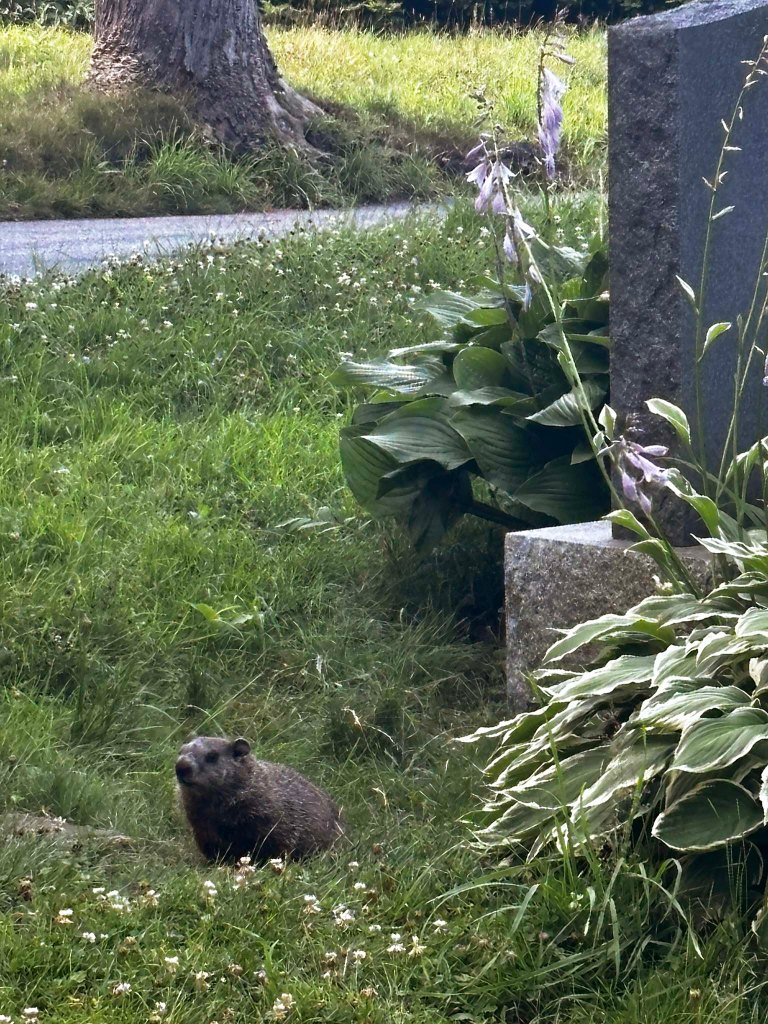
On a recent visit to Notre-Dame-des-Neiges Cemetery in Montréal, I spotted a couple of groundhogs throughout the cemetery who froze in place when they saw me. Like little furry statues, they stared me down until I had passed by. Moments like that make cemeteries feel even more alive, with nature and memory sharing the same space.
Of course, summer cemetery visits do have their challenges. The noonday sun can be intense, and without shade, it can be easy to overheat. On summer road trips, sunscreen and water are a must! Sometimes I’ll even sit down to rest under a tree—a chance to slow down for a minute and also take it all in.
Another thing I love about graving in the summer—especially here in Northern Ontario—is the longer daylight hours. Around this time of year, the sun usually sets between 8:30 and 9 p.m., which gives me lots of time to explore and take photos.
This post wraps up my series exploring how cemeteries change throughout the seasons. If you missed the earlier posts, you can still read about cemeteries in the Fall, Winter, and Spring. Each season really does bring its own mood.
What’s your favourite season to visit cemeteries?
Mine is still Fall. I can’t resist the crunchy leaves, cooler air, and all the moody vibes that come with Halloween season. But honestly, every season has something beautiful to offer, and I’ve enjoyed exploring them all.
But recently, I became curious about what kind of cemetery podcasts might exist. As someone who has always been fascinated by the history, culture, and stories buried within cemeteries, I figured it was time to explore what podcasts had to offer.
From eerie tales of haunted burial sites to deep dives into sustainable burial practices, there’s a whole world of interesting cemetery content out there.
Here are 13 cemetery podcasts you should check out this year.
This short podcast series explores the many ways people have commemorated their dead—whether through gravestones, memorials, or historical markers. Unfortunately, there haven’t been any new episodes since 2019.
Hosted by the Necro Tourist this podcast covers famous graves, infamous hauntings, and all the graveyard gossip. Although there have not been any new episodes since 2023, the early episodes are filled with interesting cemetery stories.
Hosts Lori, Hannah, and Sheena casually chat and share cemetery stories that are sometimes incredible, sometimes eerie, and always interesting. Fair warning though, it can take a while for them to get into the good stuff.
Hosted by Caitlin Howe and Frances Ferland, Grave Escapes brings the voices of the departed back to life. Each episode uncovers a new life story, offering a deep dive into the lives of those now at rest.
Grave Matters dives into the complex connections between death, cemeteries, and culture. Episodes cover sustainable burial practices, the rise of natural burial grounds, and shifts in how we think about death care with thought-provoking discussions.
For those who enjoy a good historical ghost story, The Grim offers well-researched spine-chilling tales of haunted cemeteries and eerie graveyard legends from around the world.
Hosts Jennie and Dianne explore old cemeteries, their preservation, and the lives of those buried there. Their deep dives into these sometimes forgotten histories are both fascinating and informative.
This podcast explores cemeteries and burials worldwide, uncovering the inspiring stories and eerie legends that have grown from these final resting places.
Hosted by Liz Clappin, Tomb With A View offers an insightful exploration of American cemeteries, focusing on their history, preservation, and cultural significance.
This podcast is primarily focused on the funeral industry, Undertaking regularly explores topics involving cemeteries and burial practices. Filled with insightful interviews with industry professionals, each episode offers a unique and cultural look at death.
While these next three podcasts aren’t solely focused on cemeteries, each features episodes that delve into cemetery-related topics or are closely related to cemeteries and graveyards.
Created by The Order of the Good Death, this podcast explores the history of death, burial, and mourning practices across different cultures and eras. While not specifically focused on cemeteries, it often touches on fascinating stories and histories that are closely connected to them.
The official podcast of The Haunted Walk, Haunted Talks explores the paranormal, dark history, and ghostly tales. Some episodes venture into haunted cemeteries and the eerie legends that surround them.
Author J.W. Ocker is all about visiting strange and unusual places. Cemeteries and burial grounds sometimes make their way into episodes, as Ocker visits and explores the stories behind odd and interesting sites.
Whether it’s the history, the stories, or the spooky tales—there’s sure to be a podcast on this list to satisfy your curiosity.
Is there a podcast I should add to the list? Let me know in the comments.
“They might have split up or they might have capsized They may have broke deep and took water And all that remains is the faces and the names Of the wives and the sons and the daughters”1
These lyrics from Gordon Lightfoot’s iconic song The Wreck of the Edmund Fitzgerald have long been etched in the minds of listeners, who like me, have found themselves enthralled by Lightfoot’s masterful storytelling.
This song, along with many of his other hits, like If You Could Read My Mind and Sundown, have created the soundtrack for countless Canadians, evoking the beauty, melancholy, and vastness of our Canadian landscape.
Today on the blog, I want to share my experience from this past September. I had the opportunity to visit the Gordon Lightfoot Sculpture Park and his final resting place in his hometown of Orillia, Ontario.
Gordon Meredith Lightfoot was born on November 17, 19382 in the small town of Orillia, the gateway to the Muskokas.3 From an early age, Lightfoot showed a natural talent for music, learning the piano, teaching himself to play drums, and later picking up the guitar.2 In 1957, Lightfoot left Canada, going to Los Angeles to study jazz orchestration at Westlake College of Music.2 After returning to Canada in the late 1950s, he began to sing folk songs and play guitar around Toronto.2
It didn’t take long for Lightfoot to make his mark on the Canadian music scene. His folk-infused ballads quickly captured the essence of the Canadian spirit. Throughout his career, Lightfoot released over 20 albums and was known for his blend of folk, country, and soft rock—a style uniquely his.2
Lightfoot received numerous prestigious awards throughout his music career, including multiple Juno awards, and was inducted into the Canadian Music Hall of Fame in 1986.2 He also earned honours like the Order of Canada, Order of Ontario, and a Governor General’s Performing Arts Awards.2 Lightfoot was recognized in the Canadian Songwriters Hall of Fame and received a Lifetime Achievement award from SOCAN and the Toronto Music Awards.2
One of my favorite Lightfoot songs is based on a real-life event, the tragic sinking of the S.S. Edmund Fitzgerald. The Wreck of the Edmund Fitzgerald, in my opinion, is one of his most famous and most haunting ballads.
The song is a tribute to all the lives lost in the shipwreck, on November 10, 1975. It’s estimated that between 7:20 and 7:30 p.m. on that fateful day, the ship vanished and sank with 29 men onboard.4
S.S. Edmund Fitzgerald. Photo: United States Army Corps of Engineers, Public domain, via Wikimedia Commons
Gordon Lightfoot Sculpture Park
I knew my visit to Orillia would not be complete without a visit to the Gordon Lightfoot Sculpture Park and walking trail. We visited in late September, and the trees were just beginning to change. A perfect day for a walk.
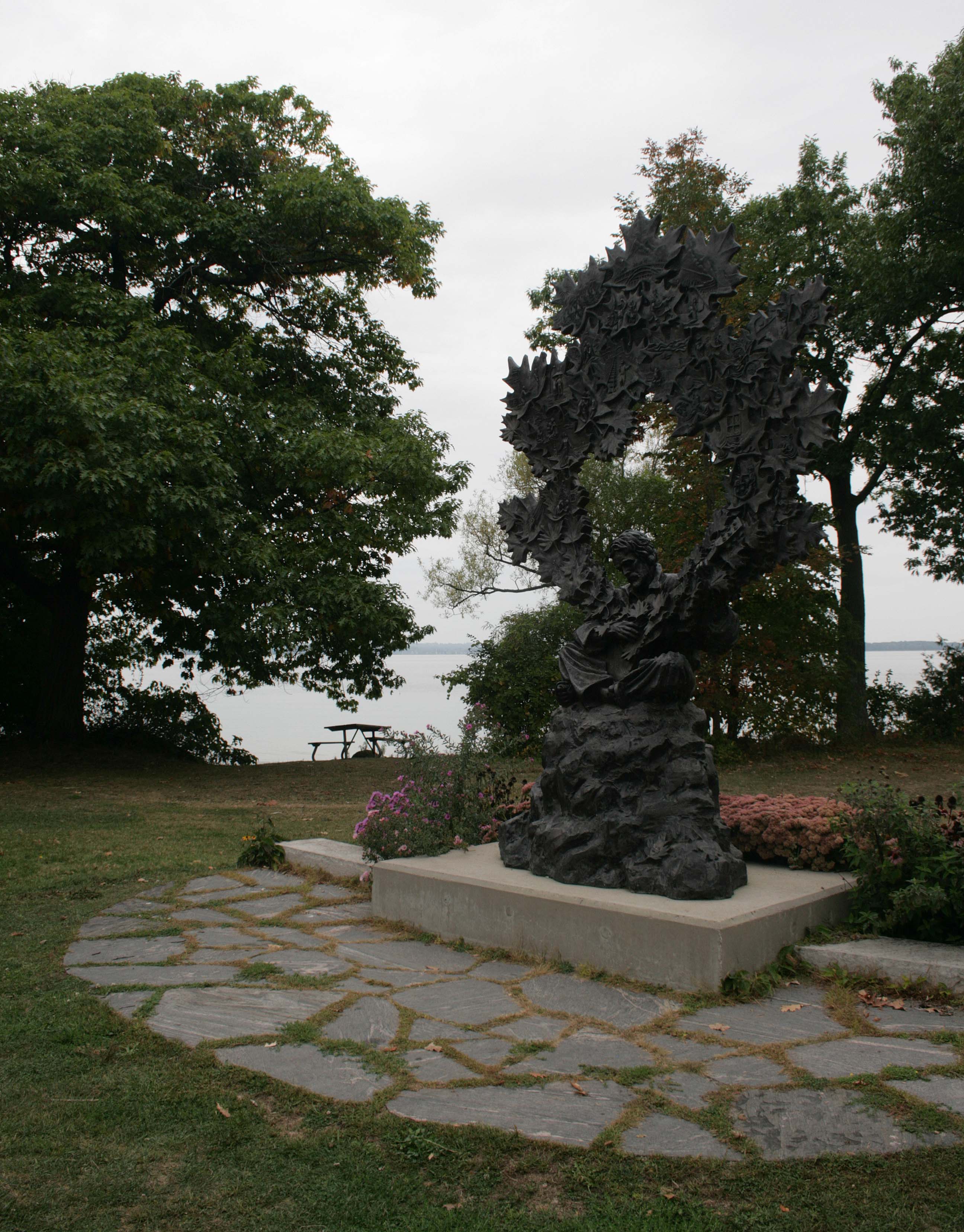
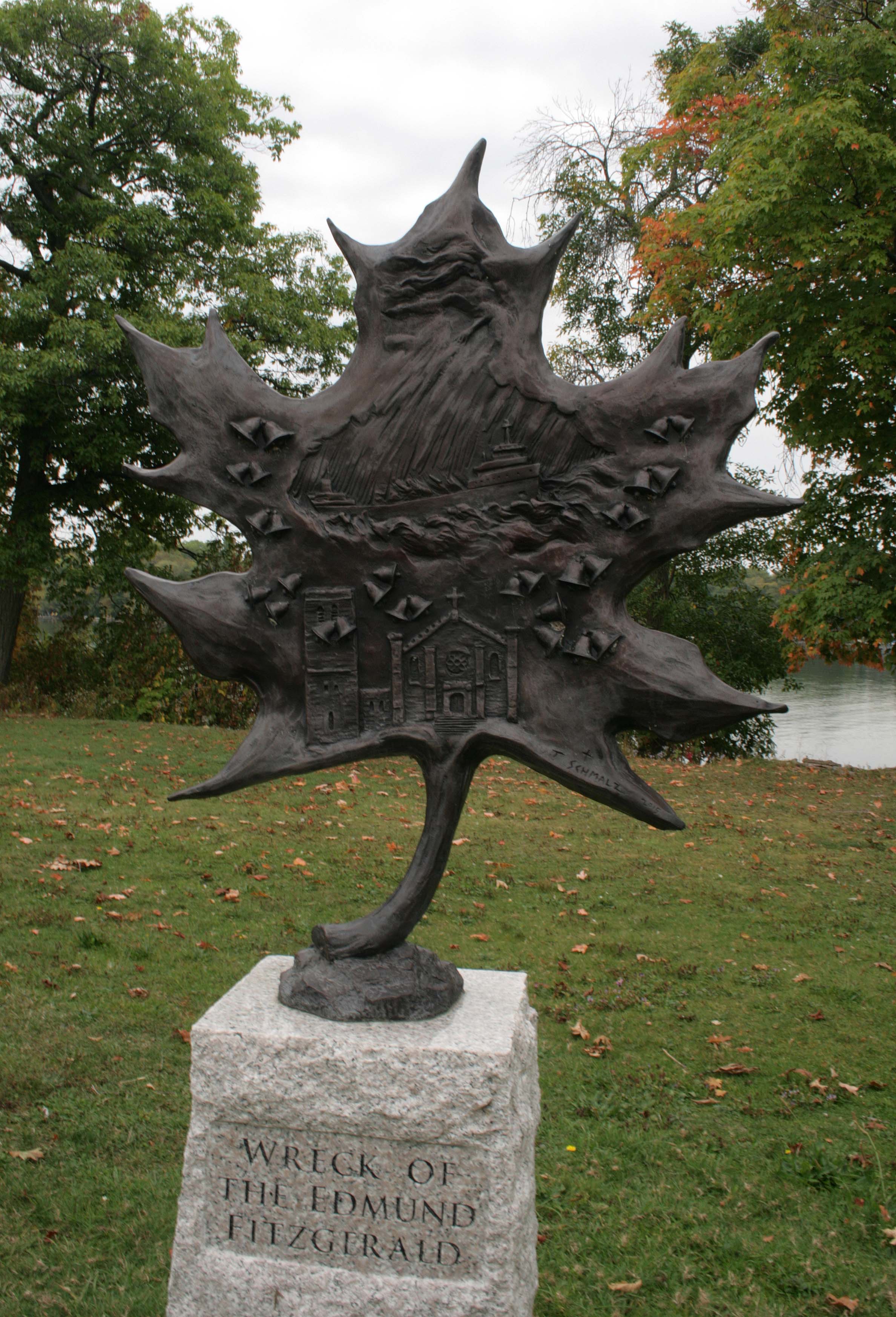
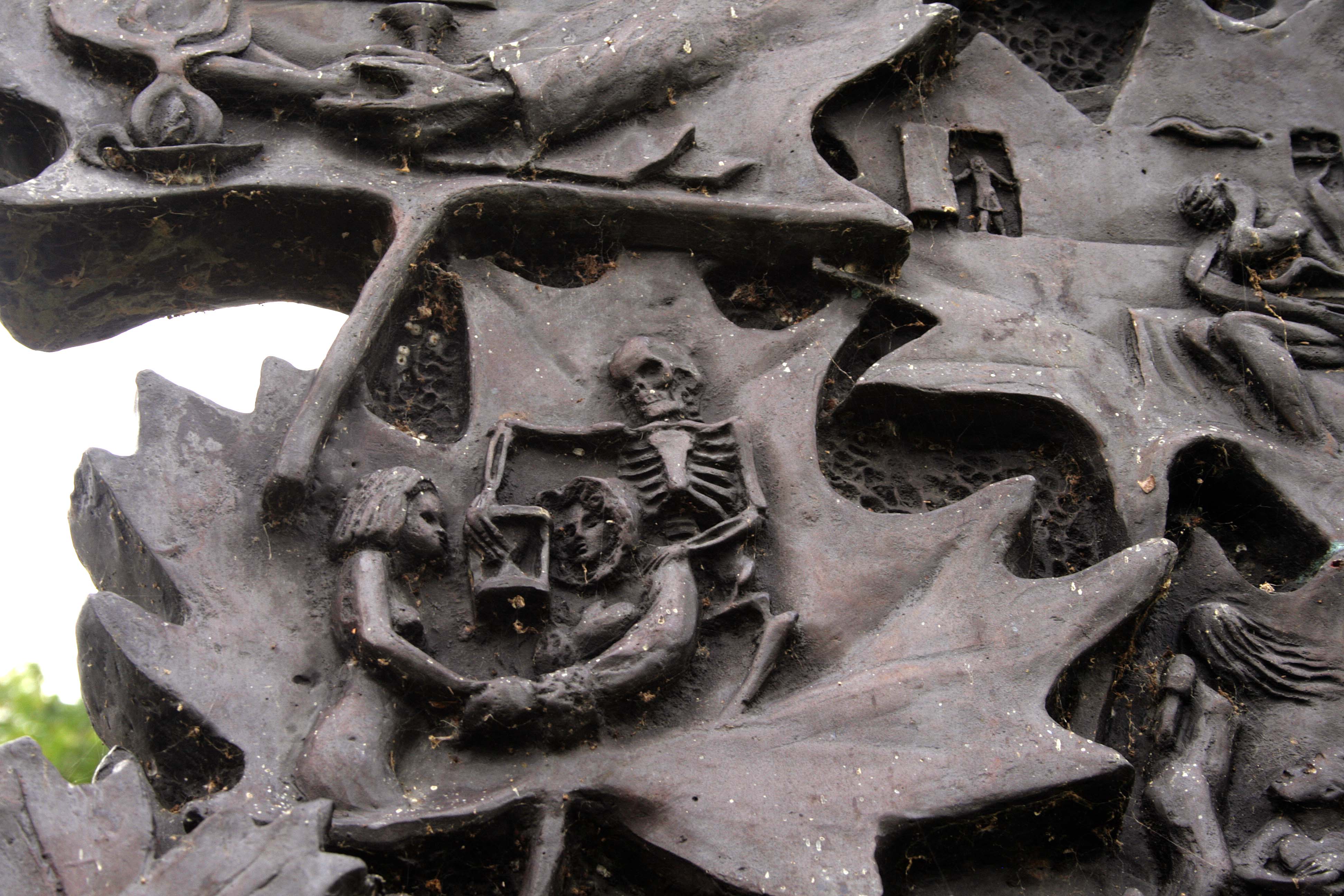
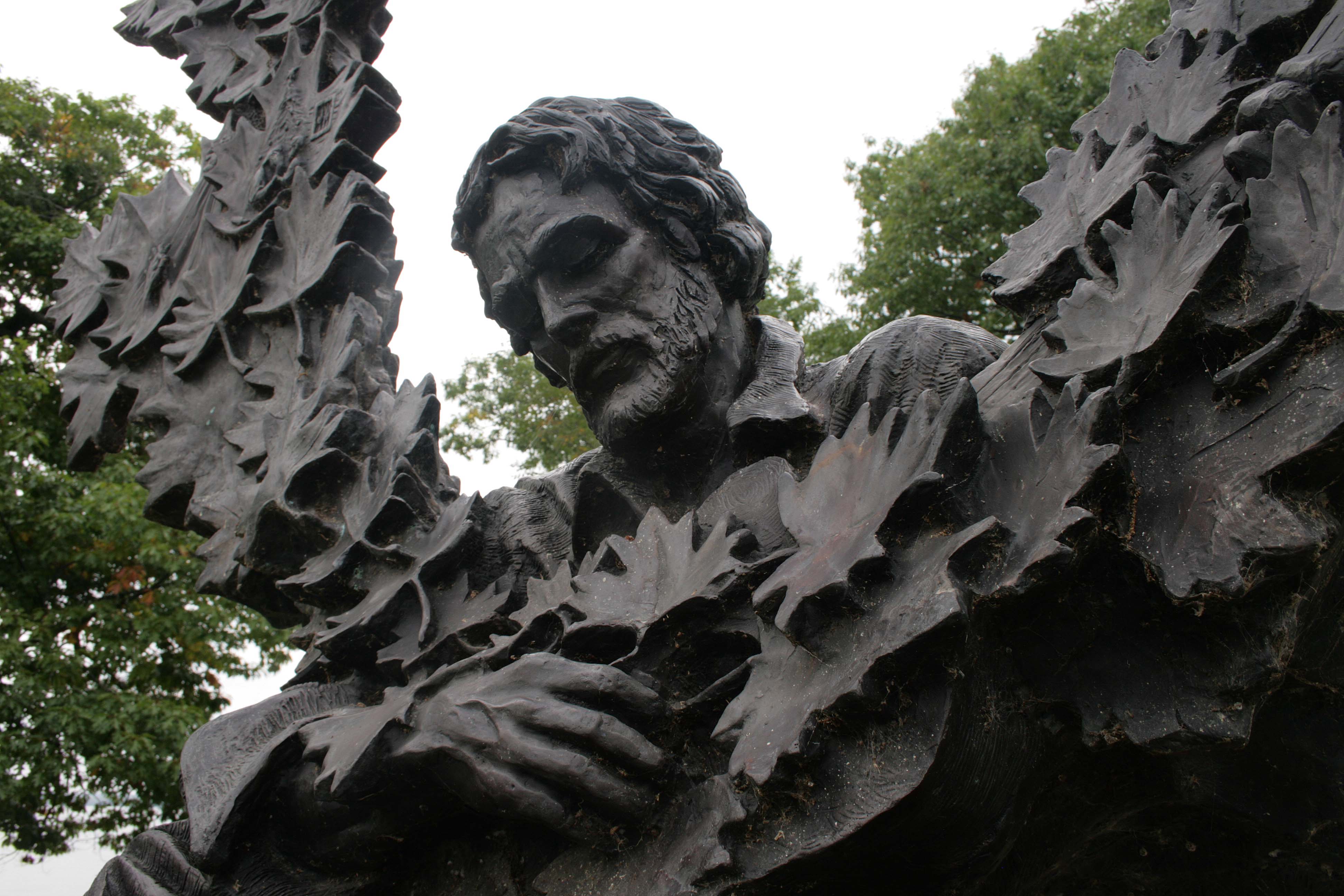
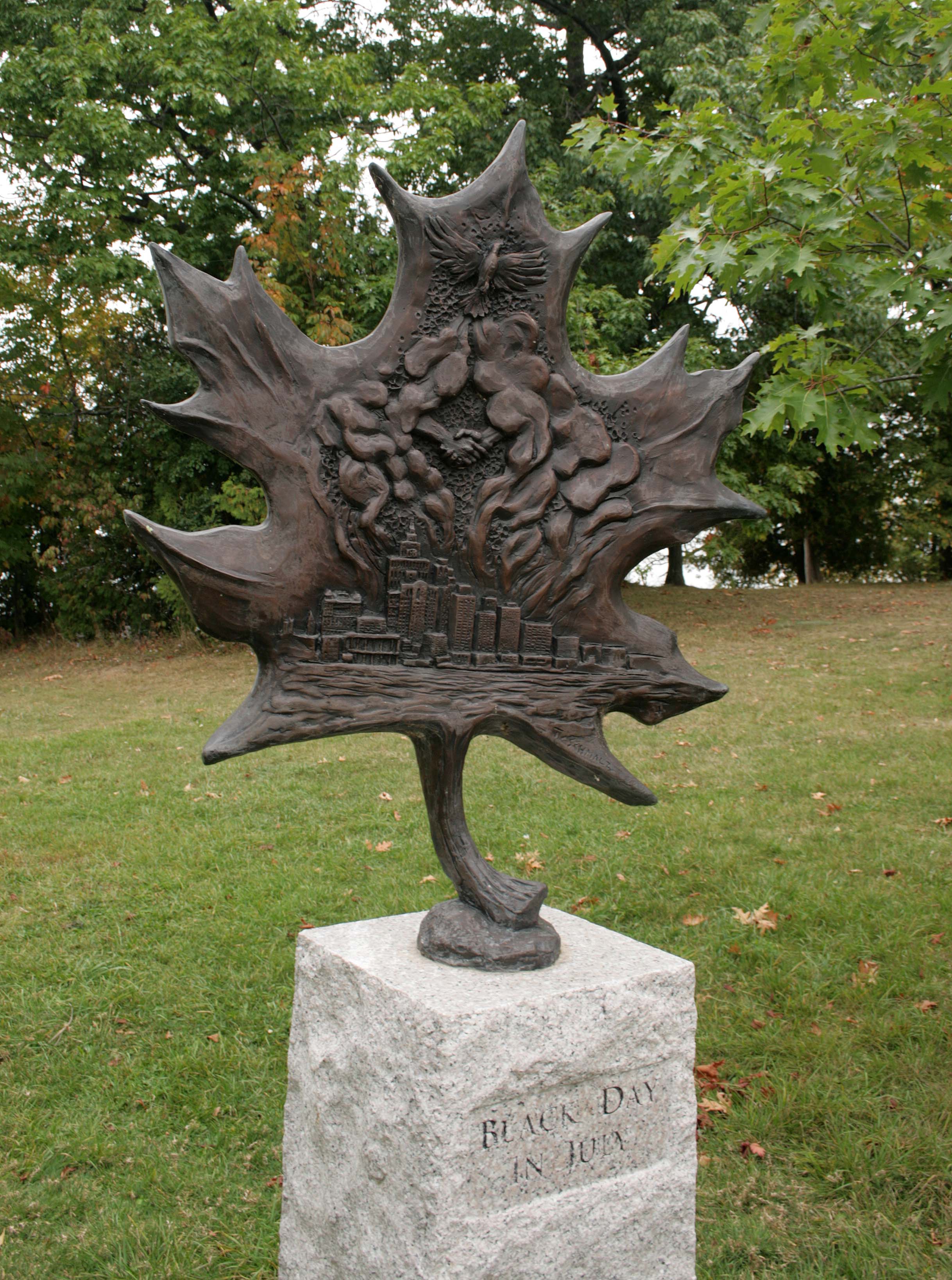
The sculpture park is a beautiful and artistic tribute to Lightfoot’s music and legacy, celebrating both his achievements and his connection to the area. The park’s centerpiece is a striking, larger-than-life bronze sculpture of Lightfoot, sitting cross-legged with his guitar in hand. It captures him in his element, mid-song as his music comes alive around him, depicted on maple leaves that encircle him. I took some time to reflect while standing before the statue. The park is not just a collection of art pieces, but a reflection of Lightfoot’s connection to the land, his music, and the people who grew up listening to his songs.
My mother and I were not the only visitors to the park that day. There were throngs of people walking the trails, many with large cameras in hand. I noticed they all took some time to admire the beautiful sculpture work and reflect on Lightfoot’s life and work as well.
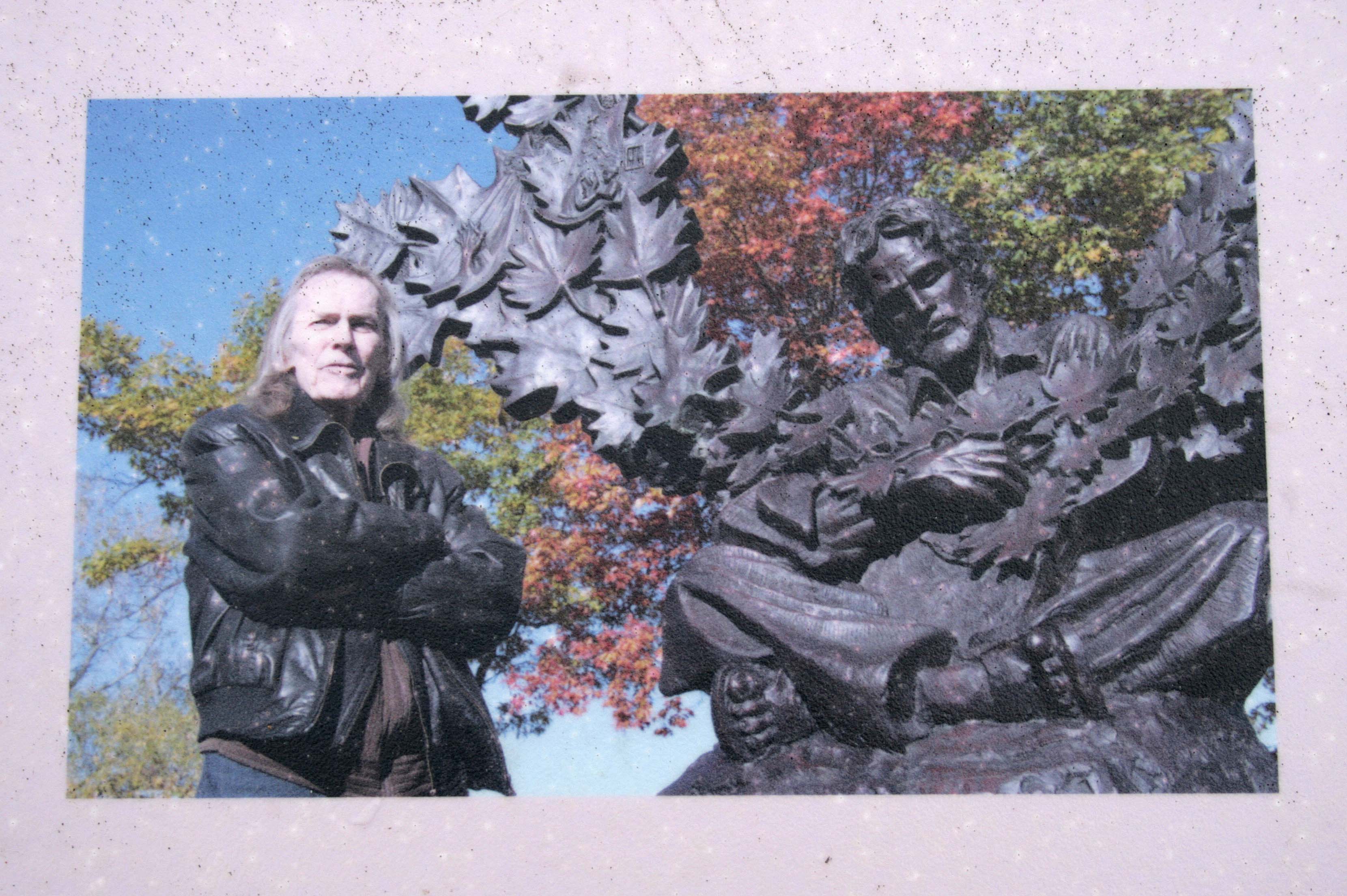
I wondered if Lightfoot himself had known about this sculpture park. I was pleasantly surprised to see a large plaque that showed Lightfoot smiling as he stood beside his younger, bronze self. He was in attendance for the unveiling in 2015, and said humbly “I’m honoured, much more so than any of the honours I’ve received up to this point in time.”5
After walking the entirety of the walking trail loop, my mother and I made our way back to the car. We decided since the area was so nice that we would have our picnic lunch in the sculpture park, before heading to our next destination—the cemetery.
It was a short drive from the park to St. Andrews and St. James Cemetery. The cemetery was quiet and serene, offering beautiful views of the surrounding forest, although we were not the only living souls visiting the cemetery that day. There was an older couple who were also meandering through the cemetery paths.
Gordon Lightfoot passed away of natural causes, in a hospital in Toronto, at the age of 84.6 He was laid to rest in St. Andrews and St. James Cemetery in May of 2023, beside his mother and father. His mother, Jessie Vick Trill Lightfoot passed away in 1998 at the age of 88.7 His father, Gordon Meredith Lightfoot Sr. passed away in 1974 at the age of 63.8
The gravestone is simple, yet elegant—a testament to the quiet humility Lightfoot always embodied, despite his fame. The inscription simply reads “Together Forever”.
Visiting Gordon Lightfoot’s grave and walking the trails at the Sculpture Park in Orillia was a beautiful and memorable experience. I couldn’t help but think about how his music had been woven into the fabric of Canada’s history. More than just melodies, they’re stories that often capture the essence of the Canadian experience.
There is something special about visiting the final resting place of someone whose music has shaped the soundtrack of a country.
As winter settles in, it’s hard to ignore the changing of the seasons. The chilly air, shorter days, and the snow-covered gravestones mark the end of field season for me. I have always seen snow-covered cemeteries as just too risky to explore—both for me and the gravestones.
While the cold usually keeps me indoors for the next couple of months, it brings something special to the cemeteries I love so much. There is a stillness in the air, and cemeteries in winter do offer something unique that cemeteries in the warmer months just don’t have.
Winter is often seen as a time for rest and renewal. Nature takes a break during these colder months, and cemeteries seem to do the same. The chill in the air makes everything feel still.
For me, the winter season is a time to focus on rest and recharging, while also refocusing on photo editing and research. Nothing is more relaxing to me than being curled up on the couch with a good book. But winter is also a time for reflection on life’s cycles. The season reminds us that life, like death, is all part of the same cycle. Nature’s rhythms, whether still still or full of growth are always changing, just like us.
I’ll be honest, winter is not my favorite season, and I don’t have a lot of experience visiting cemeteries in the snow. The bitter cold and early darkness does not appeal to me. But I will admit that cemeteries in winter have an almost haunting beauty that I can’t ignore.
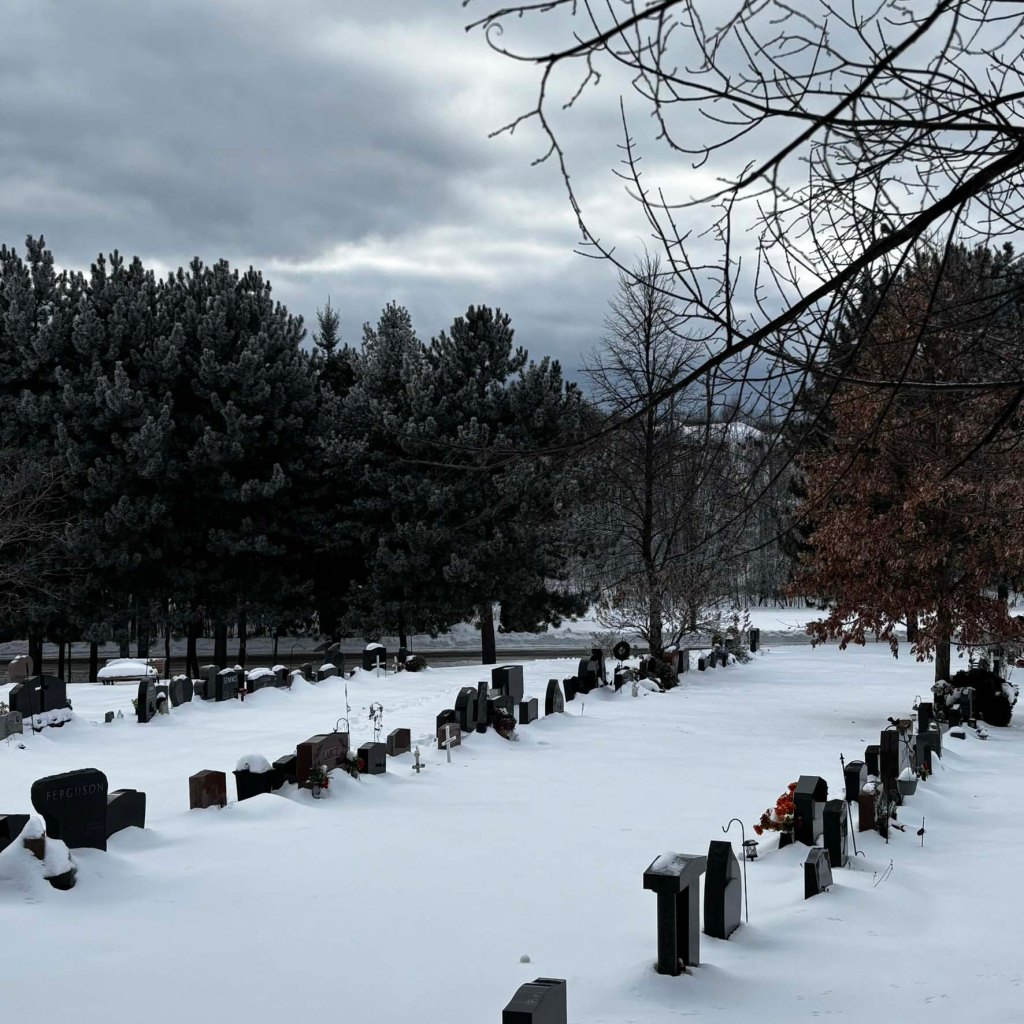
The bare trees against a pale sky, and the contrast between the dark gravestones against white snow, create a mood that’s both peaceful and a bit mysterious. It’s the kind of scene that makes you stop for a moment.
Even though this isn’t the time I usually seek out cemeteries, I made an effort this weekend to stop in to one, to appreciate the unique atmosphere it creates.
One interesting thing I found about cemeteries in the winter is the light. With the sun being lower in the sky, the light creates long and dramatic shadows, adding texture and depth to the landscape. I find the gravestones just look different in the winter light.
The unique angles of the light during winter do make it a great time to play around with shadows and textures. For anyone interested in photography, winter cemeteries offer a chance to capture the landscape in a new way.
As I think about how winter enhances the beauty of cemeteries, I realize that the symbolism of the season offers us an important reminder of the ongoing cycle of life. Winter is a time of rest and reflection, but it’s also a time to prepare for what comes next.
So will you be visiting any cemeteries this winter? Whether you’re stopping by to honor a loved one or just take in the beauty of the season, cemeteries in the winter do have a lot to offer.
A few years ago, my fiancé and I started a new October tradition. We were engaged in October, and to celebrate we planned a cute weekend getaway at a haunted hotel. We visited a haunted pub and enjoyed the small-town charm and fall weather.
We had so much fun that we started thinking about other haunted hotels we could visit—and the tradition was born!
This year, our Haunted Holiday took us to Toronto.
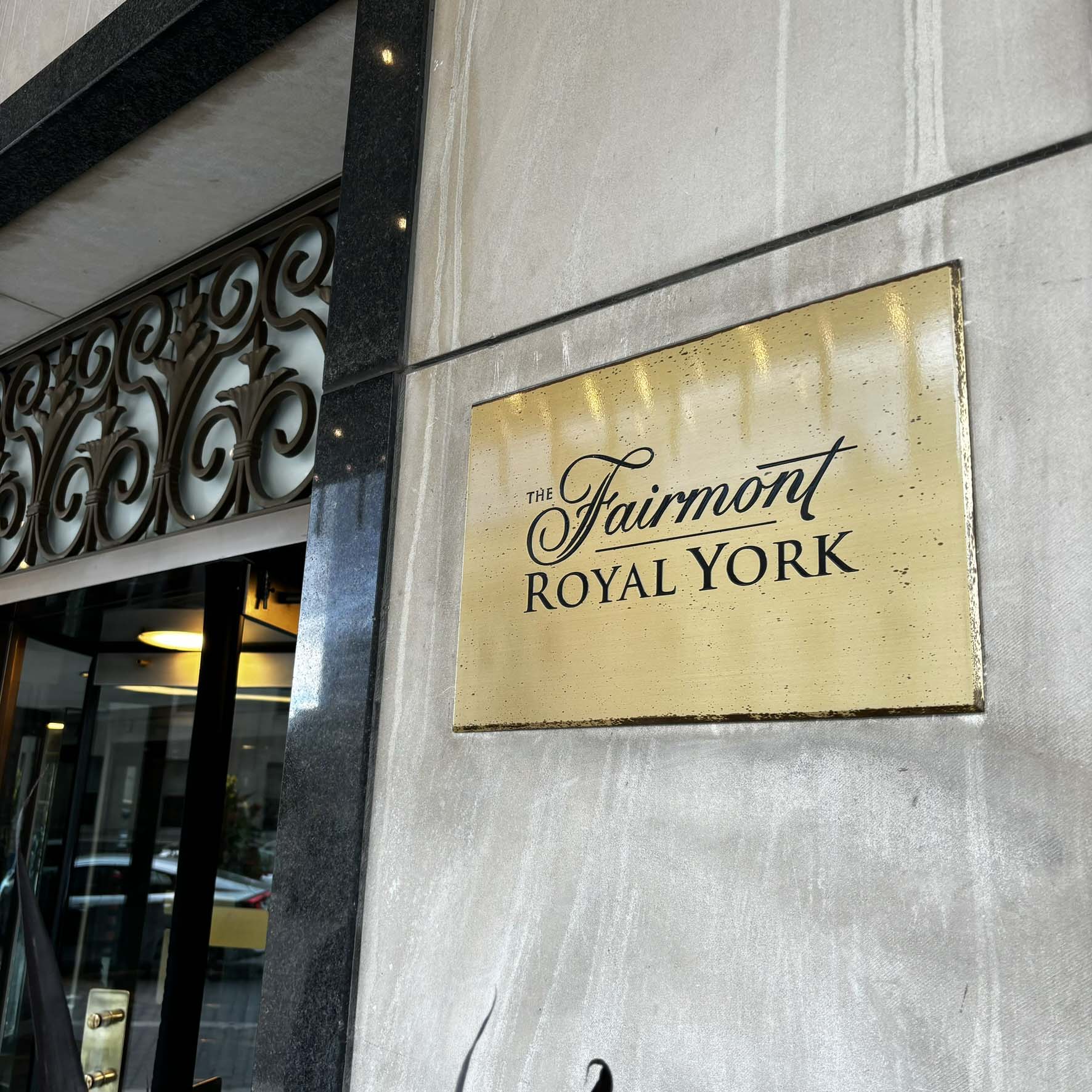
We had tickets to see the iconic heavy metal band Iron Maiden at the Scotia Bank Centre at the end of October, so it made sense to make a weekend trip. I did a bit of research into haunted locations in the city and booked us a room at the Fairmount Royal York. We also made reservations for a romantic dinner at a 157-year-old historic building known today as the Keg Mansion.
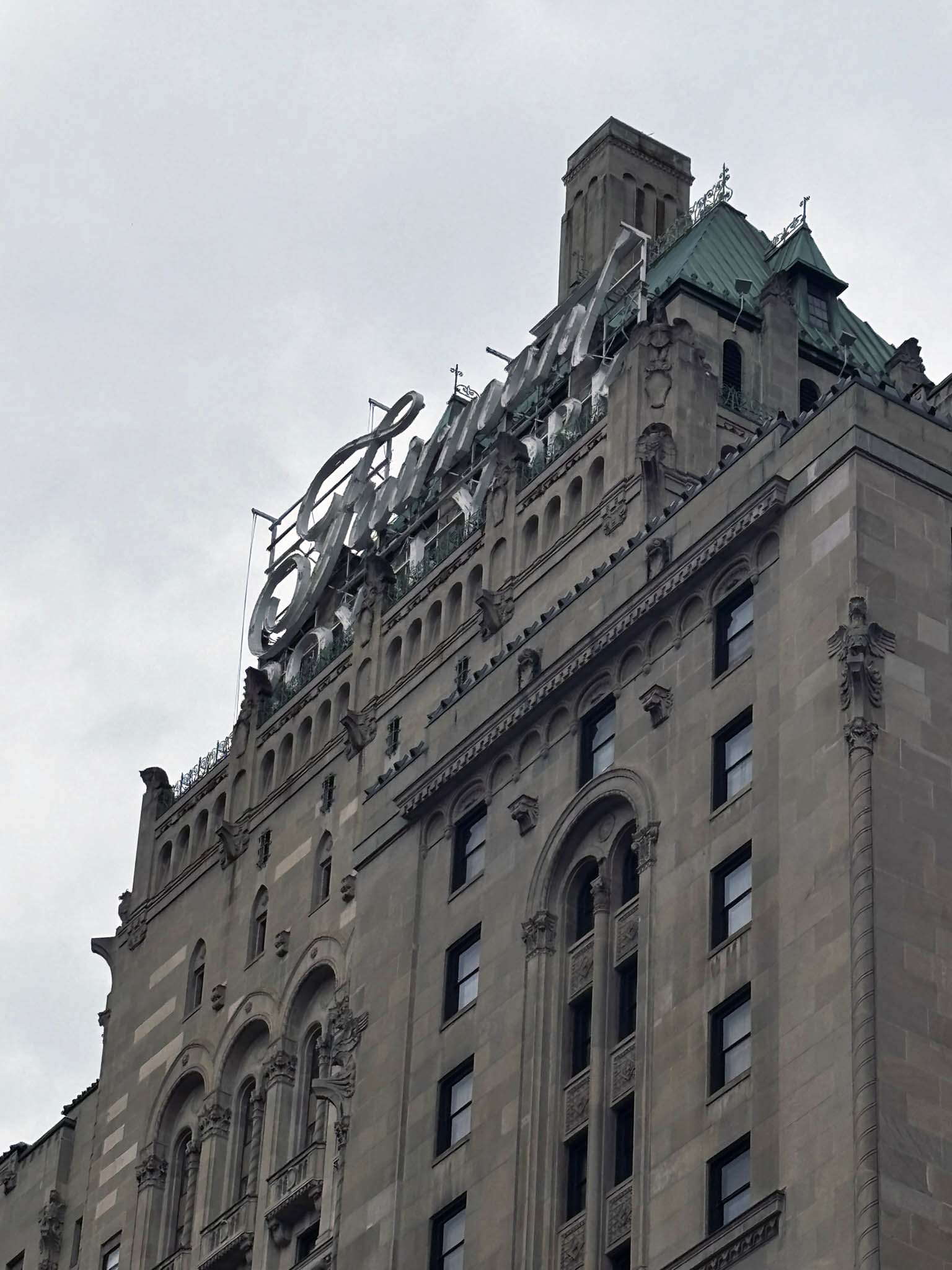
The Royal York Hotel was built in 1928-1929, by the Canadian Pacific Railway as part of its coast-to-coast chain of grand hotels. The skyscraper hotel was the tallest in the British Commonwealth at that time and dramatically altered the Toronto skyline.1
Today it’s one of Toronto’s most famous landmarks.
This stately hotel has played host to many celebrities and dignitaries over the years, such as Louis Armstrong, Ella Fitzgerald, and the Royal family.2 With such a storied past, it’s no surprise that it might also hosts a few ghosts.
The most reported haunting is that of a gentleman who wanders the halls on the 8th floor. He is said to be wearing a purple jacket. This ghostly figure is sometimes seen accompanied by the sounds of children running up and down the halls while laughing. Those who have heard the ghostly children have peeked outside their chamber door to see an empty hallway and find silence. Some have peeked out to see the man in the purple jacket.3
My fiancé and I were eager to chat with someone about the supposed hauntings when we checked in. Unfortunately, we didn’t meet anyone who had any stories to share with us, either being recent hires or as one put it, worked only during the day when nothing spooky happens.
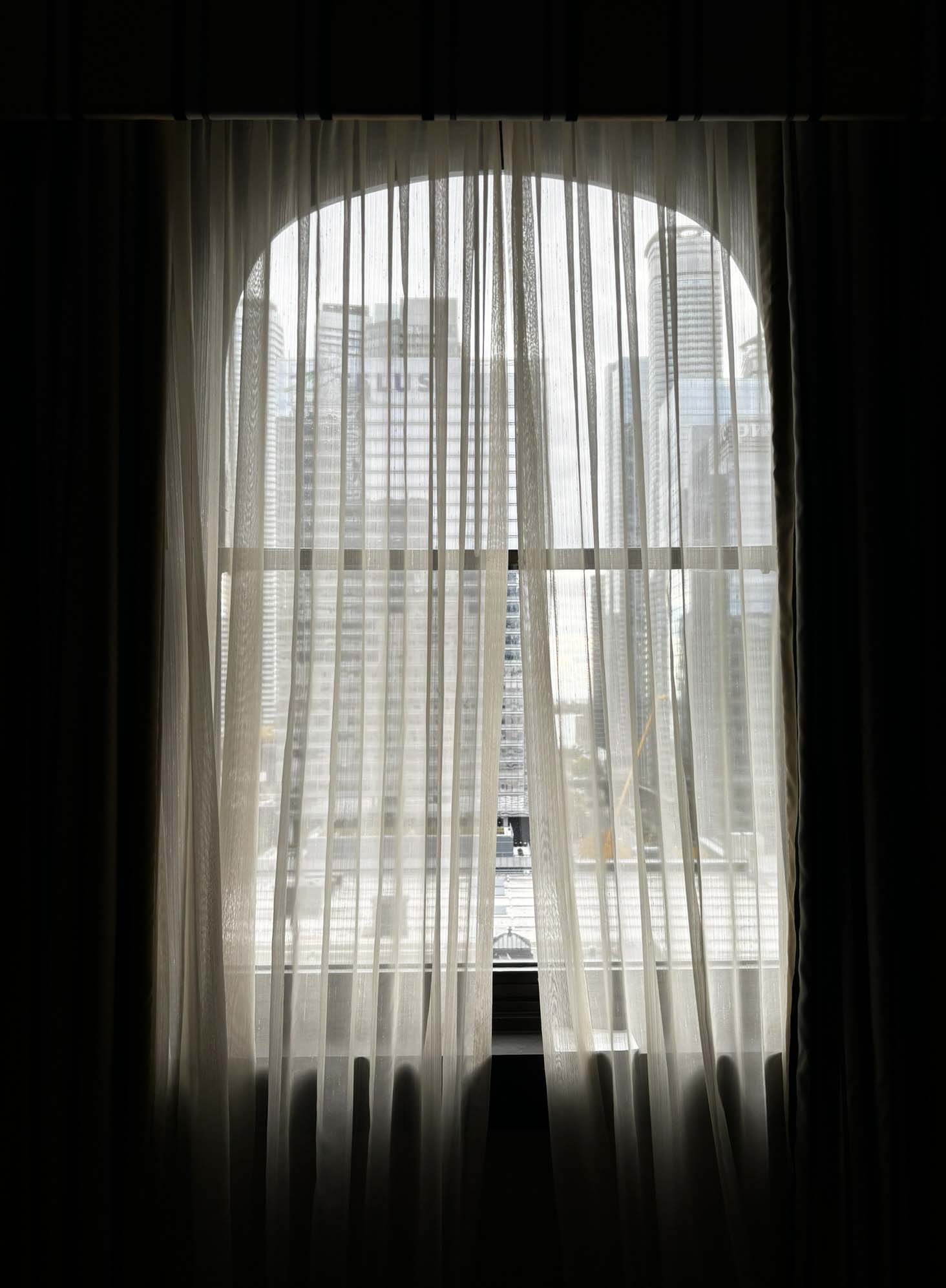
The hotel is immense and beautiful, so we took a bit of time to explore our surroundings while making our way up to our room on the 9th floor.
After dropping off our things and settling into our new home for the night, we had some free time before our dinner reservation. We had just enough time for a cemetery visit, some window shopping, and a drink or two at a pub.
Mount Pleasant Cemetery
Opened in 1876, Mount Pleasant Cemetery is considered one of Canada’s most historic cemeteries. It was designed by Henry Adolph Engelhardt and is a beautiful example of landscape design, inspired by the European and American garden cemeteries of the 19th century.4
Spanning 83 hectares in the middle of the city, the many winding paths provide picturesque views of the park-like landscape.4 Mount Pleasant features one of the finest tree collections in North America and walking and running trails that span 1 km, 3 km, and 5 km routes.5
Mount Pleasant is the final resting place of many prominent Canadians, including former Prime Minister William Lyon Mackenzie King, Nobel Prize winner Frederick Banting, founder of the Eaton’s department store Timothy Eaton, and renowned pianist Glenn Gould.6
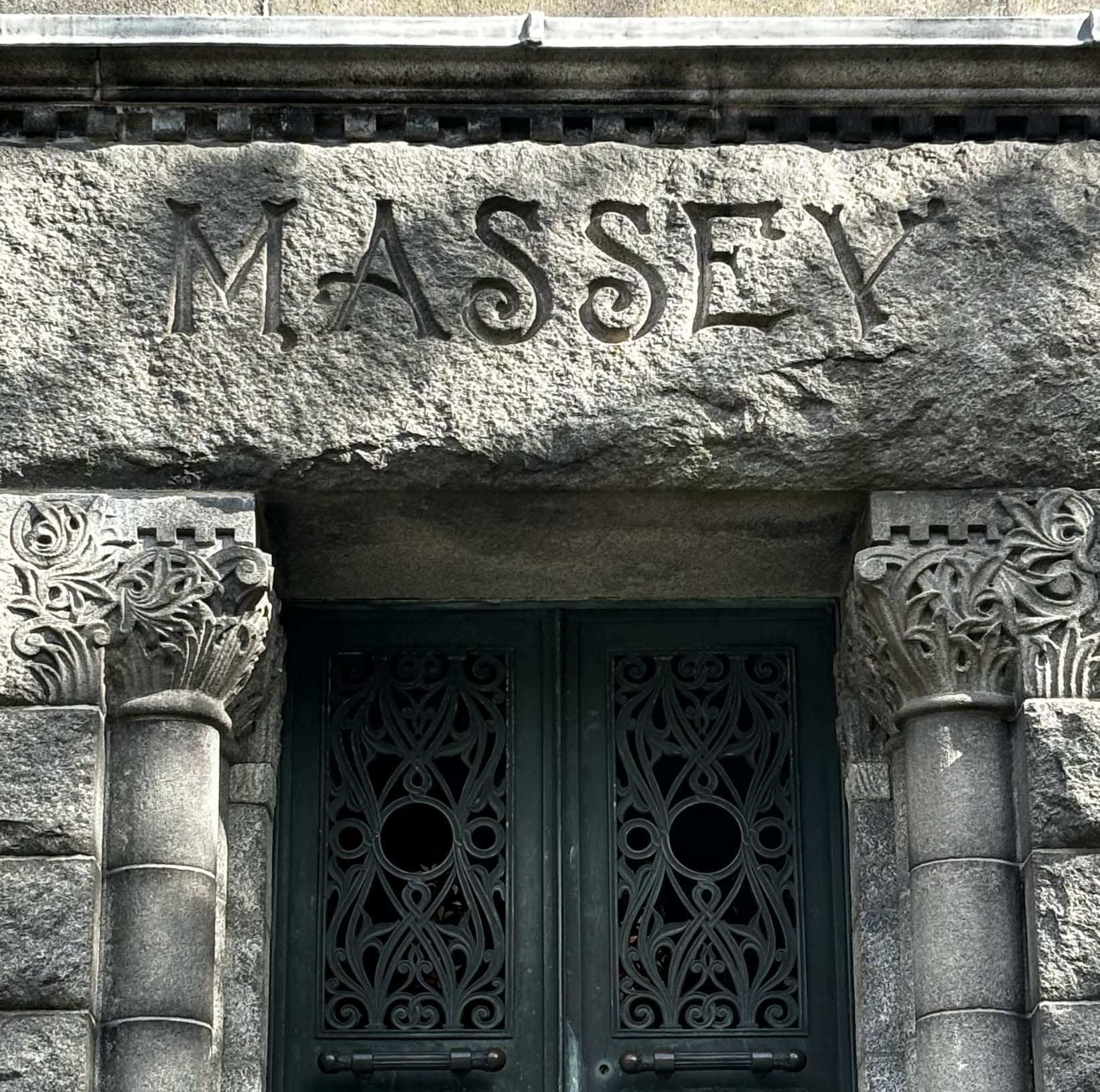
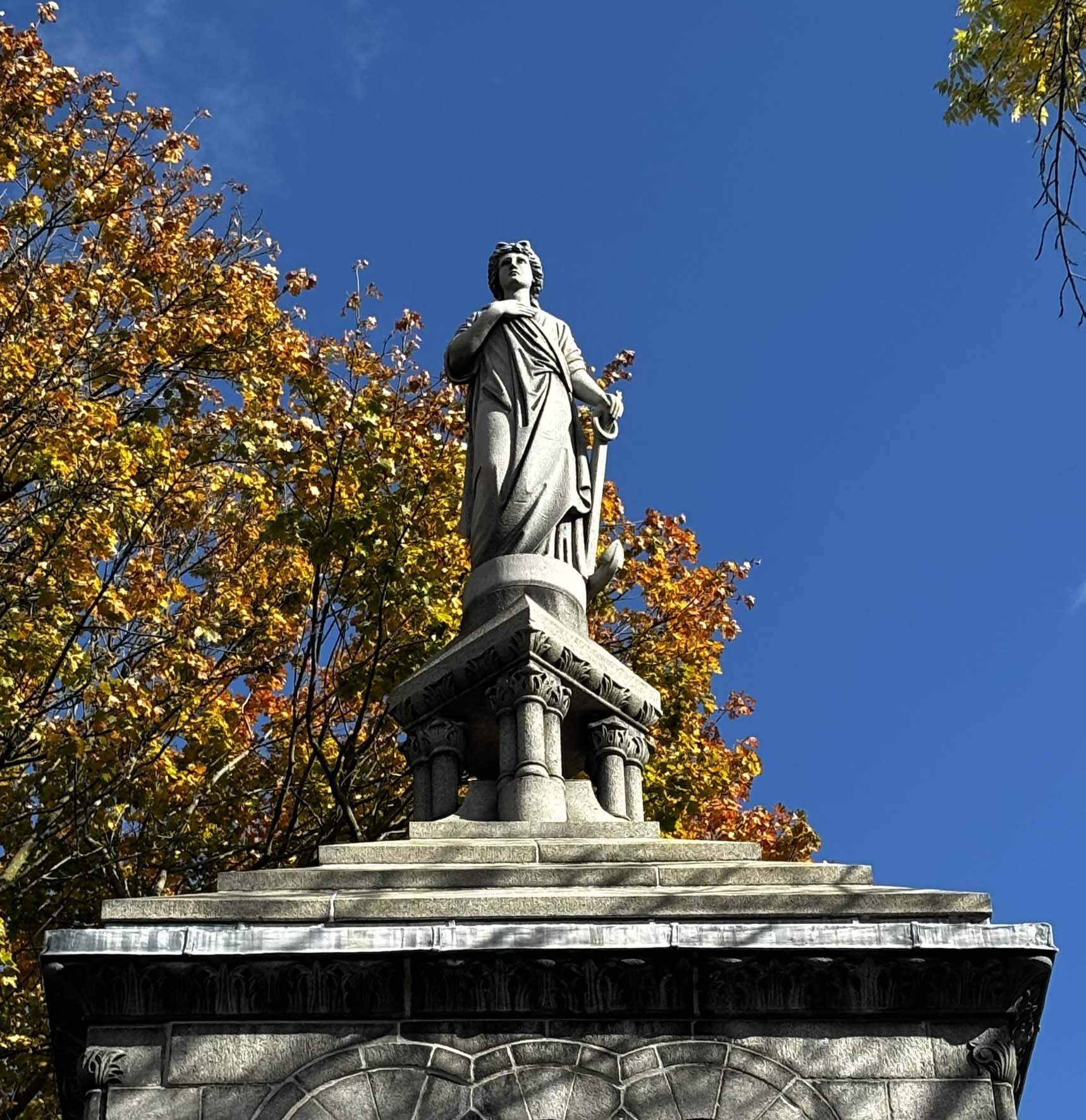
It’s also the final resting place of many members of the prominent Massey Family. The Massey Mausoleum was built in 1891. Designed in the Romanesque style, the family crypt features a tower, a below-grade crypt, and a statue of Hope, one of the seven virtues perched on top of its roof.7 Industrialist and philanthropist Hart Massey rests within the walls of this mausoleum, as well as his wife Eliza Ann Phelps Massey, and some of their children, like Lillian Frances Massey Treble.
I was particularly interested in visiting the final resting place of Lillian, as we would be dining with her ghost later that evening.
The Massey Mausoleum is massive and was easy to spot once I was pointed in the right direction. I will admit I did need to get directions from a groundskeeper as the cemetery is quite large and easy to get lost in. Especially when you are easily distracted by gravestones, like me.
Standing in front of the immense family crypt, I was in awe of the wealth and stature of this family, which I assume is one of the reasons for building such a massive final resting place.
I peeked inside and admired the beautiful stained glass, in the small sepulchre. The shaft of light coming from the stained glass windows in the ceiling lit the inside of the tomb just enough to make out the nameplates marking the shelves within the crypt. It felt like a special privilege to be able to see inside this final resting place of such a prominent Toronto family.
After paying my respects and taking a few more photos, I made my way back to my waiting fiancé. I excitedly showed him my photos as I described everything I saw during my short walk in the cemetery.
After a short rest and an iced pumpkin spice latte, we continued on our walk down Yonge Street stopping in at a shop here and there. We eventually sat down at a nice little pub called The Quail, where we enjoyed a few drinks and chatted with the owner. Now that I think about it, we completely forgot to ask the owner if he had any ghost stories to share.
But not to worry, we would get our fill of ghost stories at supper time!
The Keg Mansion
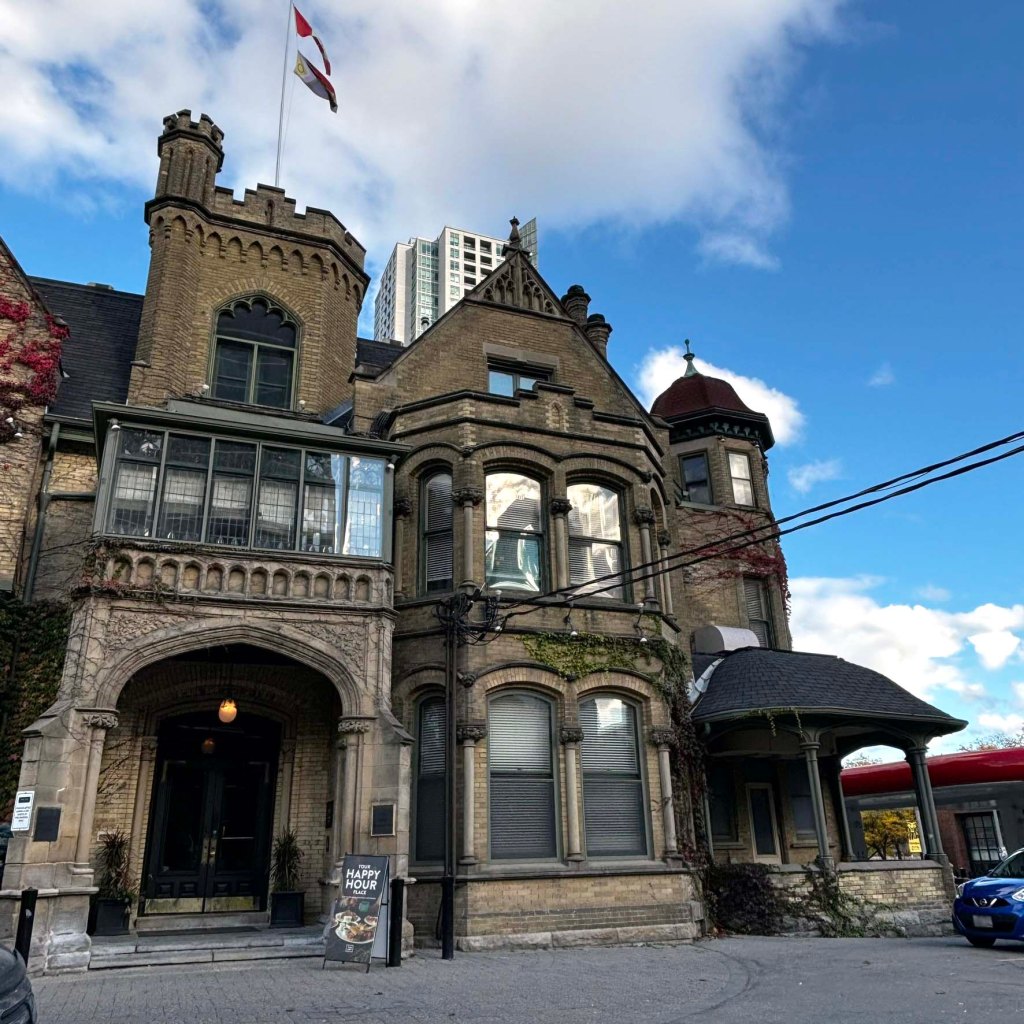
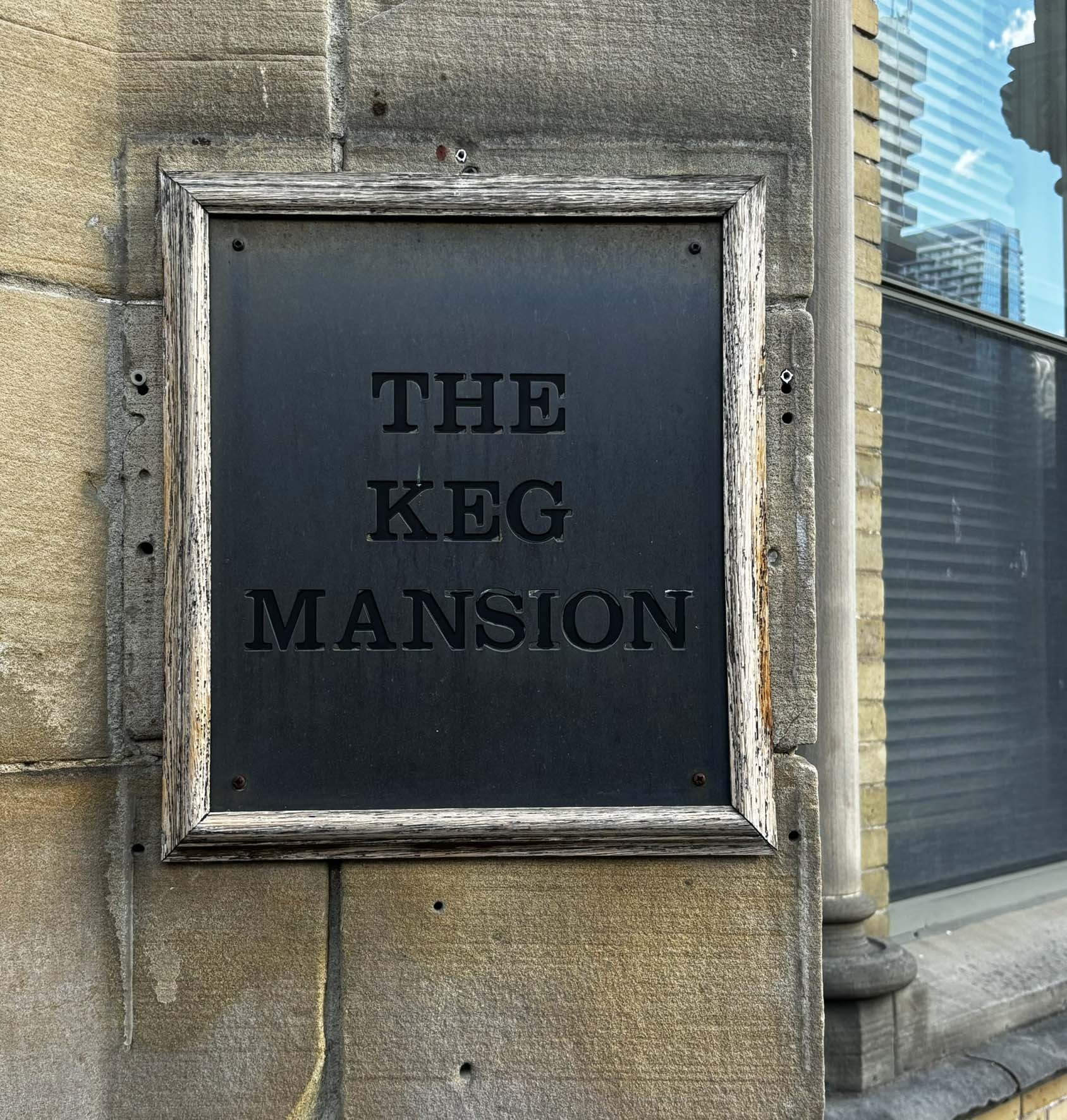
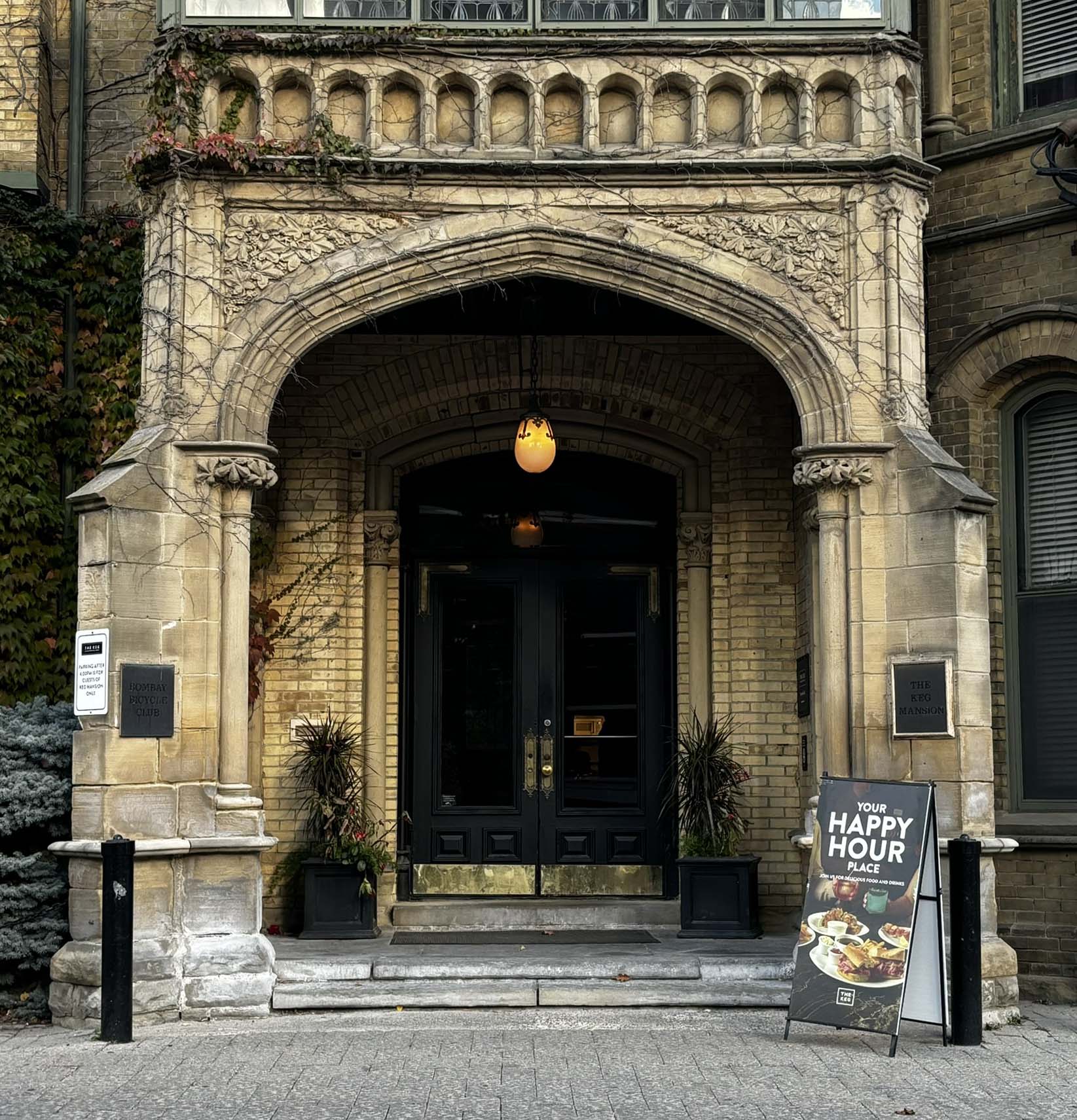
Our dinner reservation brought us to the Keg Mansion, a former home of the Massey family. Built in 1867, this elaborate mansion housed 26 different rooms and 17 fireplaces.8 The home was purchased in 1882 by Hart Massey, a Cleveland agricultural equipment salesman, and his wife. They would make additions to the ornate mansion by adding a turret, verandah, and a greenhouse.8
After Hart Massey passed away in 1896, at the age of 72, the estate was taken over by his daughter Lillian Massey. She would name the Mansion Euclid Hall, and reside there until her death. After her passing, the house was entrusted to the University of Toronto, serving as the home for many different establishments over the years. In 1975, the building received heritage status, and in 1976 became the home of The Keg Steakhouse + Bar. Today, it’s known as the Keg Mansion.8
The Keg Mansion does not shy away from its ghostly history. When we arrived for our reservations we were quietly seated on the second floor. Of course, we asked right away if our server had had any ghostly encounters to share. She didn’t have any stories of her own to tell, but she kindly offered to bring over the “ghost book”, a collection of reported hauntings by staff and restaurant patrons.
I was happy to peruse the reported hauntings while they brought out our drinks. Some of the stories I was familiar with, like the story of Lillian Massey and her maid. Lillian passed away in the house in 1915, at the age of 61. Lillian was beloved by her staff, and her maid in particular took her death very hard. The story goes that after learning of Lillian’s death, her maid, distraught with grief brought a length of rope with her upstairs to the oval vestibule, where she fashioned a noose and hung herself.9
The vestibule is still a feature in the Mansion today, just outside the washrooms on the second floor. People have reported seeing Lillian’s spirit as well as the spirit of her maid, in various rooms throughout the house. The washrooms, in particular the women’s washroom, are thought to be one of the most haunted areas in the Mansion. Patrons have reported feeling cold spots, and even capturing ghostly images in photographs taken in a mirror above the fireplace in that washroom.
The stories I found most fascinating though were the sightings of the ghost of a young boy.
Throughout our meal, my fiancé and I couldn’t help eavesdropping on the conversations happening around us. The ghostly phenomenon happening at the Mansion is well known, and we were not the only ones asking questions about ghosts.
One server stopped by our table and told us a story about a mother and son who had come to the Mansion for supper. The little boy went to the bathroom, and on his return told his mother that there had been another little boy in the bathroom, all alone. Worried, the mother told her server who in turn told a manager. The manager went to the bathroom right away to see if the little boy needed help, but there was no one there.
We would learn later in the evening that there had been a young Massey boy, who also died in the house, who was around 10 years old. His playful ghost is also often reported.
Geoff, the Bar Manager stopped by our table after our meal and told us about his encounter with the child ghost. He had been walking with a tray of drinks past the front door area, where the large staircase is when he overheard a little girl telling her mother she wanted to play with the trains. The mother, confused, asked her daughter what she meant. In response, the little girl pointed to the empty staircase and said she wanted to play trains with the little boy. She was quite emphatic saying that he was playing with the trains and that she wanted to play too.
Except there was no one on the stairs, no little boy, and no toy trains!
Geoff assured us that even though the ghosts were very active, no one had experienced anything malicious. My fiancé and I hoped we would have an encounter of our own, but alas we didn’t experience anything. We both made it a point to visit the washrooms, and I did take a few selfies in the bathroom mirror, but I didn’t capture anything.
What we did have was a lovely evening of good wine, good food, and ghost stories.
After dinner we made our way back to the hotel to freshen up, then it was off to the Scotia Bank Centre for an evening of heavy metal. Iron Maiden put on an excellent show!
After a couple of hours of rocking out, we walked back to our hotel, stopping on the 8th floor to take a look around. It was quiet on that floor, so we returned to our own room for the night.
Although we didn’t get to experience any hauntings ourselves, we both agreed that it was a great weekend. You can’t go wrong with romance, ghost stories, and heavy metal. It was definitely a haunted holiday for the books.
Did you know that not all Witches are found in Salem?
Folktales and legends of witches can be found worldwide, even in small towns in Ontario. This truth led me down a few rabbit holes that uncovered some fascinating stories about a darker side of Canada’s history—a history of stigma, politics, and strong women.
One such strong woman was Jane Elizabeth Martin Barnes, also known as Mother Barnes. This summer, I was fortunate to visit her homestead and pay my respects at her final resting place.
Every good witch legend exists in mystery, and the Witch of Plum Hollow is no different. Some details of her story are uncertain, like the date of her birth. Some sources note her date of birth as 1794, as engraved on her tombstone, while others note November 15, 1800.
What we do know, is that she was born in Cork, Ireland. Her father was an Irish landowner, and her mother was of Spanish Gypsy descent.1 Facing an arranged marriage, Elizabeth and her lover, a military man, left for North America where they would elope.1
The young couple would have one child together before misfortune struck. Elizabeth’s husband passed away tragically, leaving the young mother alone to raise their child.1 Four years later, she would marry David Barnes, a shoemaker. Together they had nine children, six sons and three daughters.1
In 1843, the Barnes family moved to Sheldon’s Corners, near Athens, Ontario.1 They raised seven of their children in the small wood cabin, that today is known as the Mother Barnes Homestead. Eventually, Elizabeth’s husband grew tired of farm life and left, taking their youngest son with him.1 Elizabeth was left with a house full of children to mind on her own.
To support her family, Elizabeth turned to fortune-telling.
She credited her Spanish Gypsy ancestry and the fact that she was the seventh daughter of a seventh daughter as the source of her second sight.2 She charged 25 cents for a reading and soon became well known for her accuracy.2
At this time, she began to be known as the Witch of Plum Hollow, respected by some and feared by others.1 People visited from everywhere for a reading from Mother Barnes. She became increasingly involved with local lost & found cases, finding lost items and missing livestock.2 She was also instrumental in a disappearance case, directing the searchers straight to the missing body.2
Her most famous visitor was a Kingston lawyer with political aspirations. Mother Barnes foretold that this man would become the leader of a new country and that its capital would be in Bytown.2
Today, Bytown is known as Ottawa and is the capital of Canada. That lawyer was John A. Macdonald, who became the first Prime Minister of Canada in 1867.2
Mother Barnes Homestead
The small log cabin that had so many visitors in the past sat for a time in utter disrepair. Over time, the wood rotted, and the roof sagged, the derelict state made worse by vandals’ damage.
The property, which includes; two acres, the original cabin, an abandoned well, and a deteriorating barn, was eventually purchased by descendants of Mother Barnes in the 1980s. They worked hard to try and bring the little cabin back to life.3
Newspaper clipping, The Ottawa Citizen, Thursday, October 28, 1982, page 23
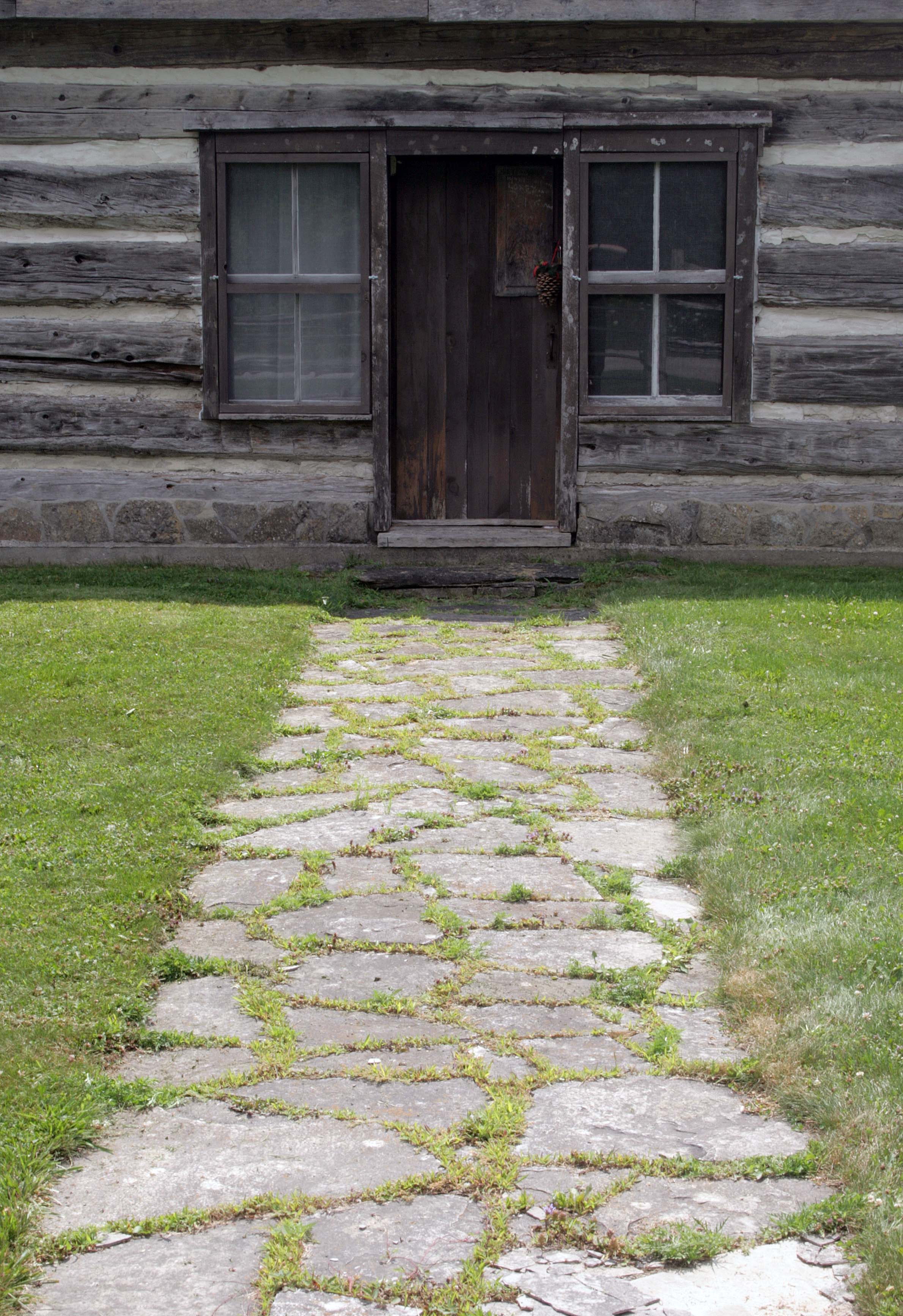
Today the log cabin has been restored by new owners. A green sign with large gold script declares the site as the “Mother Barnes Homestead”. Beside the sign sits a large boulder with an indent suggesting there was once something attached to it. This once commemorative boulder had a sign that read “Home of Mother Barnes”. The sign was removed to preserve it from further damage, as it had been used as target practice.1
The property is now well maintained and sits behind a wooden fence, that is dotted with no trespassing signs.
The day I visited the Mother Barnes Homestead I was hoping there would be someone on the property to talk to, and maybe get a tour of this historic house. Unfortunately, the property was deserted. The no-trespassing signs were enough of a deterrent to keep me from trying to sneak a peek inside the windows.
I would have loved to be able to explore the attic, where Elizabeth was known to perform her tea readings. I hope one day the property will be opened as a historic house and museum.
Jane Elizabeth Martin Barnes died on February 4th, 1891 at the age of 90 after falling ill with pneumonia.5 She is laid to rest in Sheldon Cemetery, not far from her homestead.
Originally her grave was unmarked, that is until local Cheesemakers Claude and Ella Flood decided to erect a monument in her memory. Curiously, the dates on the stone are incorrect, listing her year of death as 1886.5
The stone itself was not placed on her actual gravesite either, I would learn. The stone sits beneath the cemetery sign arch near the cemetery entrance. When I visited, the arch was completely overgrown and obscured with vines. The gravestone reads: “Burial Place / of / Mother Barnes / 1794—1886”
While visiting another cemetery in the area, I met two women who pointed out some interesting graves for me to photograph. After showing me the graves, they asked if I had been to visit the Witch of Plum Hollow. I said yes, to which they replied that she wasn’t buried beneath the stone.
The unmarked grave of Mother Barnes lies at the back of the cemetery on the left-hand side.
The woman also shared that there is a pipe sticking out of the ground in that area, very close to the grave. They continued to tell me a story about the pipe, and how it was plugged for a very long time, to keep the witch’s spirit in. But, sometime in the 1980s, the pipe was unplugged and the spirit of the Witch was released. I was surprised to hear a negative tone in the woman’s voice as she told the story, and how she thought the pipe should have remained plugged.
It was interesting to see that the stigma behind the term witch was still alive, well over 100 years later.
But was Elizabeth Barnes really a witch?
By all accounts she was just a single mother, using kind advice and honest predictions to provide for her family. Predictions that very often came true.
Earlier this month, two friends and I traveled to Oakville, Ontario for another birthday cemetery road trip. It was a bit ambitious, with us hitting the road at the crack of dawn. We planned to beat the traffic, but also to get a head start on the day since it would be a four-hour drive, each way.
Since it would be such a long drive, we wanted to give ourselves as much time as possible to tour the town and sight-see. And yes, of course, visit cemeteries. There was one stop that was very high on our list—the final resting place of American actor and tap-dancing legend, Gregory Hines.
Gregory Oliver Hines was born February 14, 1946, in New York, New York. Hines began tap lessons at the age of four and would spend much of his childhood practicing and performing alongside his older brother, Maurice Hines.1
The Hines Brothers performed their song-and-dance act all over the United States. In 1963, their father joined them, turning the duo into a trio. They continued to make a name for themselves, making countless TV appearances.1 But in 1973, Hines recognized that tap dancings popularity was declining and left the act to pursue a musical career and start a band. This was short-lived though, and Hines soon returned to New York and the stage.1
In the early 80’s, Hines made the transition to Television and film actor. His first feature film credit is his portrayal of Josephus in the comedy/musical Mel Brook’s History of the World Part I (1981). Known for his accomplished choreography and tap dancing, many of Hines’ films showcase his dancing. He starred alongside veteran tap dancer Sammy Davis Jr. in the 1989 film Tap. Credited with 49 acting roles, Hines was a successful and versatile actor. Some of his most successful films are Running Scared (1986), Renaissance Man (1994), and Waiting to Exhale (1995). I would be remiss if I didn’t also list his cameo in the fan favorite, The Muppets Take Manhattan (1984).2
In 2002, Hines was diagnosed with liver cancer. He kept his diagnosis private, sharing his health struggle with only family and close friends. A year later, Hines succumbed to the illness en route to the hospital, from his home in Los Angeles.3Gregory Hines passed away on August 9, 2003, he was 57.
Hines is remembered by his two children, a son, and daughter, from two previous marriages. His memorial service took place on August 13, 2003, at Saint Monica’s Catholic Church in California. Based on the photographs I found online, it looks like it was an emotional service, with many Hollywood stars in attendance. Hines is laid to rest in Saint Volodymyr Ukrainian Cemetery in Oakville, Ontario, beside his fiancé Negrita Maria Truszyk Jayde.
Saint Volodymyr Ukrainian Cemetery, also known as West Oak Memorial Gardens, is owned and operated by St. Volodymyr Cathedral. It was founded in 1984, and sits on 100 acres of property that overlooks Sixteen Mile Creek. Today, it’s thought to be the largest Ukrainian cemetery in Canada.4
It was a beautiful sunny day when we visited Saint Volodymyr. Right away, we noticed how busy the cemetery was. Many people were visiting loved ones, cleaning gravesites, and paying their respects.
I knew before we arrived that the cemetery was a large one, so I had come prepared. I wanted to make sure we had plenty of time to pay our respects and wouldn’t spend all our time searching. With coordinates in hand, we were able to drive directly to the grave of Gregory Hines.
I’m not sure if it was done on purpose, or if it is just because of the sheer size of the cemetery, but there was a perfect parking space just off the path. Just big enough for one vehicle, across from the famous grave.
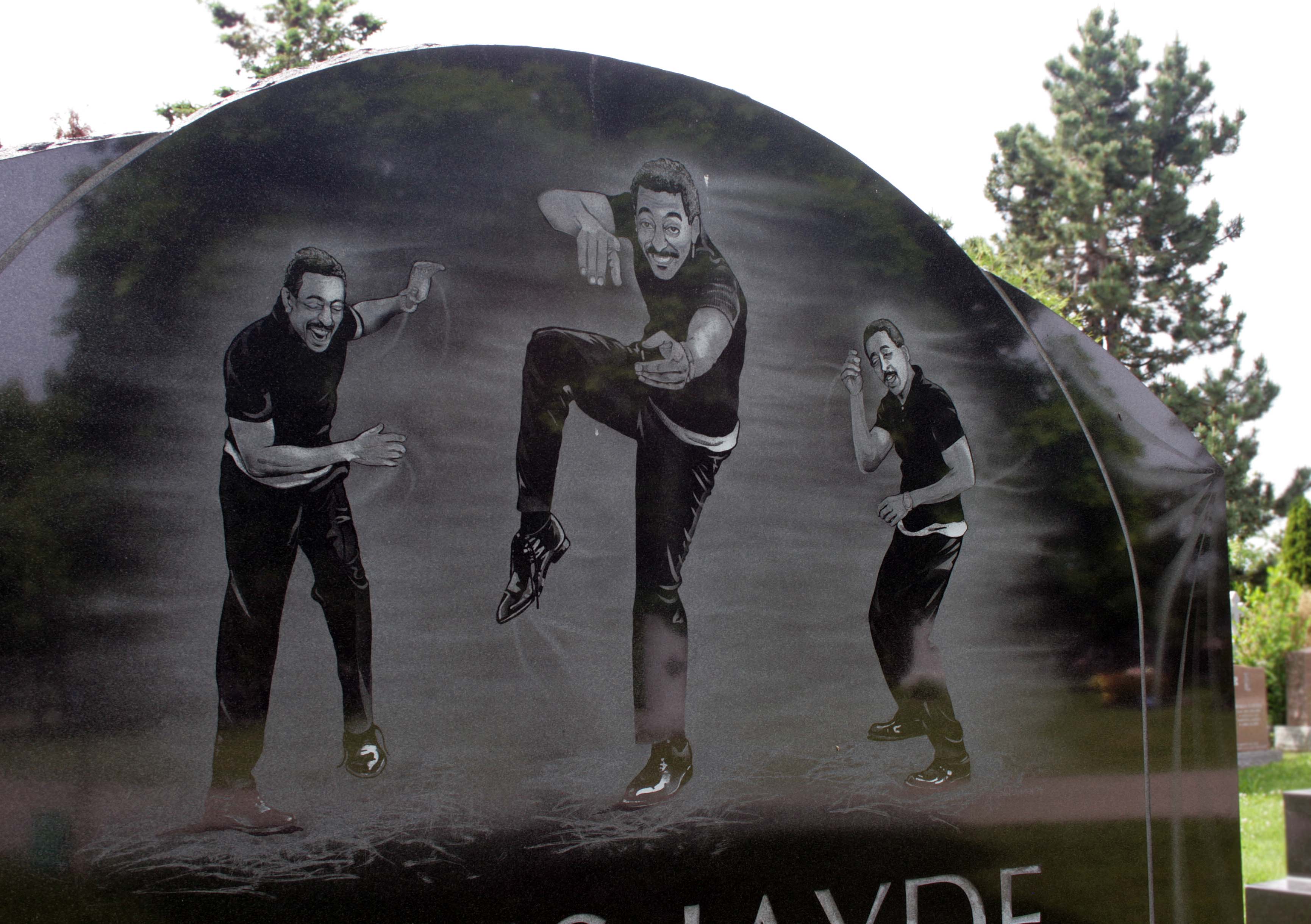
The Hines-Jayde gravestone is a beautiful monument, made from black granite. At the top of the stone is a sandblasted engraving of Hines dancing, framed by what looks like curtains on either side of the stone. He is depicted with a look of joy and happiness on his face. It’s a lovely representation of what he is best known for, and what was such a large part of his life.
“Hines Jayde / Gregory Oliver / Hines / Feb. 14, 1946 / Aug. 9, 2003 / Together Forever / Negrita Maria / Hines Jayde / July 5, 1958 / Aug. 28, 2009 / So all sing in their festive dance. / “Within you is my true home” Psalms 87:7”
It was easy to tell that we were not the only ones who had made a trip to visit this gravesite. There were many grave goods left behind on the day we visited. These included stones, candles, and oil lamps. There was also a heel and toe plate placed at the base of the gravestone. These plates are mounted to the bottom of a shoe and used to tap dance.
After paying our respects we wandered the cemetery a little bit, exploring the meandering paths. It’s a beautiful cemetery with its trees creating some beautiful dappled light across the gravestones. I noticed that there were many black granite stones, in some sections that were even the same style.
I also noticed many oil lamps left at graves. It reminded me of the Jewish practice of leaving pebbles on top of gravestones. Some graves had only one of two oil lamps, while others had handfuls of them surrounding the stones. I can just imagine how beautiful they would look at night with all of the lamps lit up.
You might be asking yourself how an American-born actor came to be buried in a Canadian cemetery. I had the same question.
It looks like the reason is because of Hines’ fiancé Negrita Jayde, who is Canadian. A celebrity in her own right, Jayde was an athlete and an author. She was an award-winning professional bodybuilder from Toronto, Ontario, and wrote two books about the subject. She was also an actor, having starred in the action/sci-fi film Safety Zone in 1996.5
Although Hines and Jayde did not get the chance to get legally married before his death, Jayde did take Hines’ last name.6 When Jayde passed away six years, later in 2009 from cancer, she she was laid to rest beside him.
I’m very happy I was able to help one of my best friends pay her respects to one of her favorite actors. I’m also happy that I had the chance to pay my respects as well. Visiting famous graves is always an interesting experience because so often we feel so connected to them, even though we don’t know them on a personal level. TV and film actors, in particular, can feel like our best friends because of how invested we can get into their characters or their careers. So getting the chance to pay our respects at their gravestone can sometimes be a surreal experience.
Have you ever visited a famous grave? I would love to read about your experience in the comments.
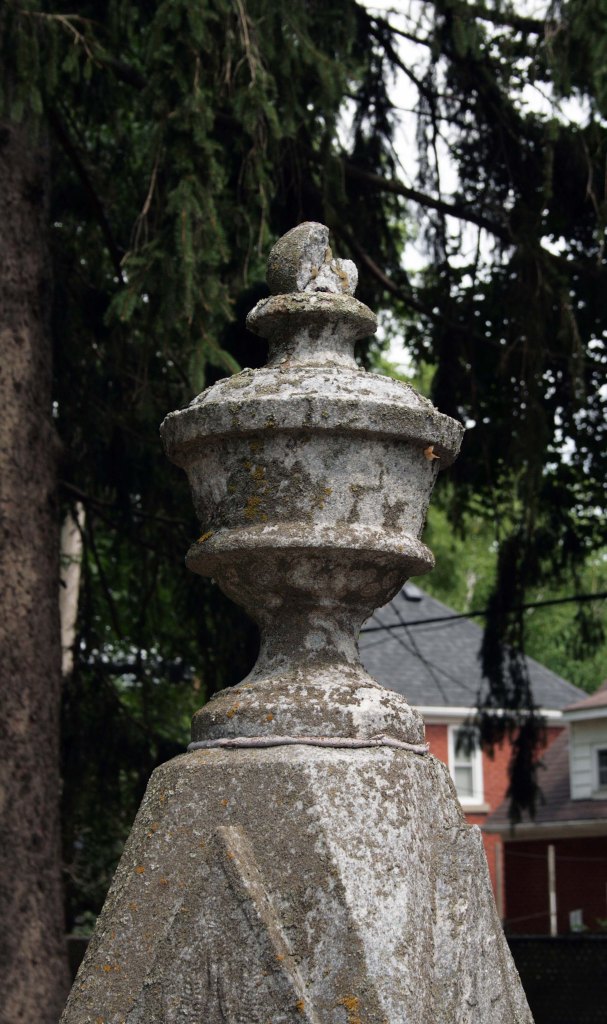
If you spend a lot of time in cemeteries you will often start to notice the repetition of certain cemetery symbols and motifs. In Ontario, more so in southern Ontario, urns tend to be a common gravestone symbol.
Although cremation was rarely practiced in North America at the time, the urn became a popular symbol in the Victorian era. Urns as a funerary symbol were adapted from Ancient Greece. Cremation was commonly practiced by the Ancient Greeks, who used ceremonial urns. As a gravestone symbol, the urn represents the body reduced to its most basic elements and the ascension of the spirit to heaven. Today cremation is a common practice, having started its climb to popularity in the 1980s.
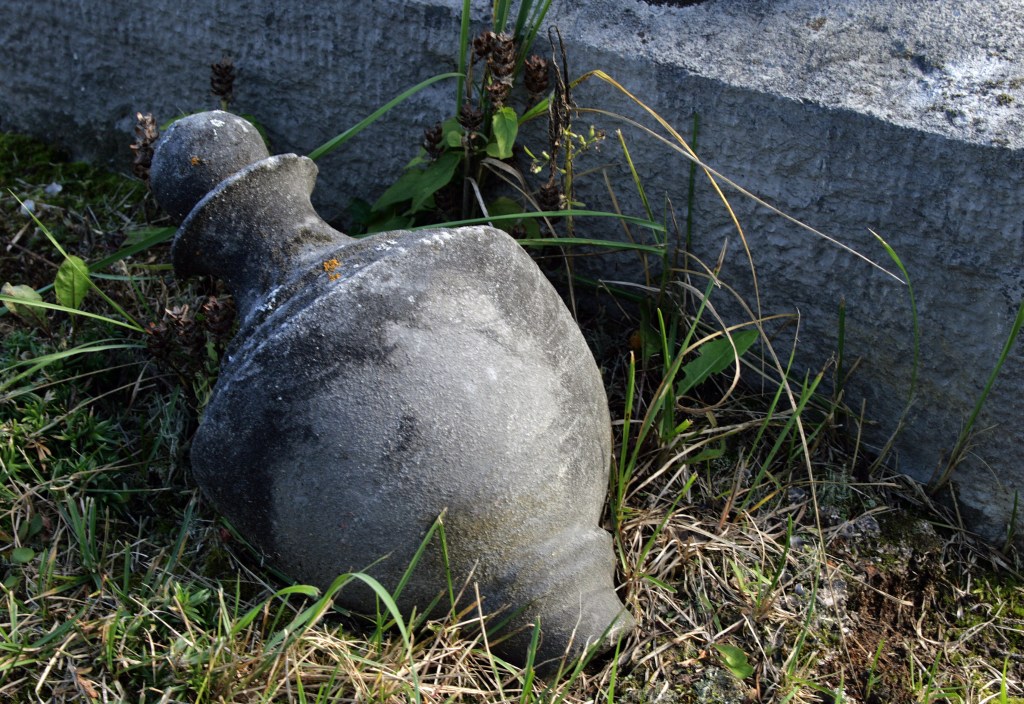
I have found and photographed many urns during my cemetery walks, so today I wanted to share some of them with you.
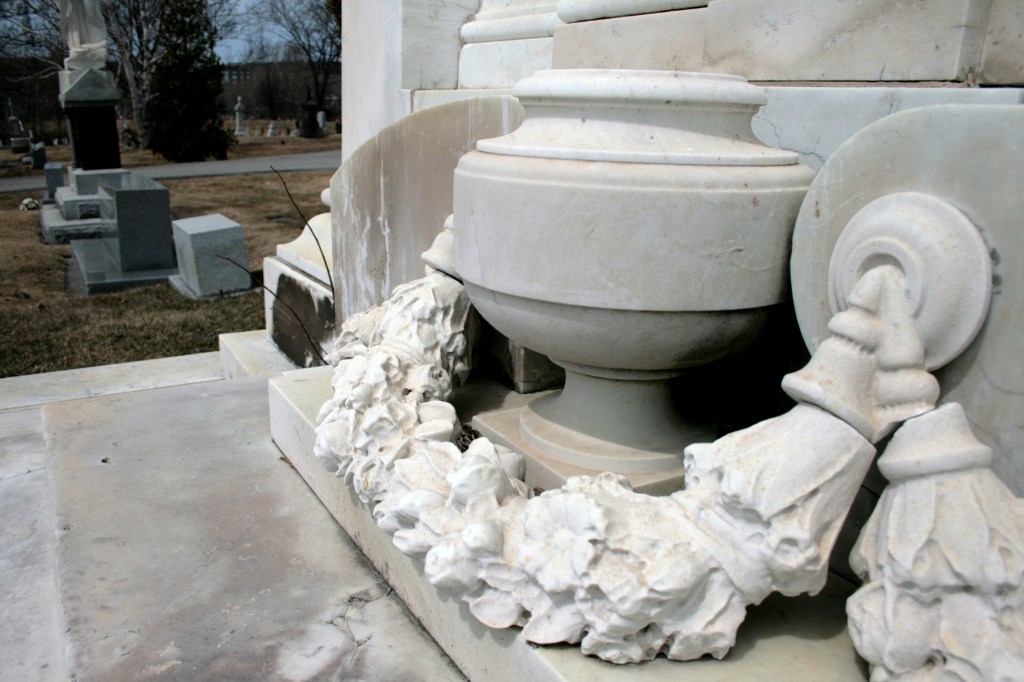
Like many graveyard symbols, the urn can be found depicted in a variety of ways. Each version of the symbol has a slightly different meaning. This is one of the reasons I find cemetery symbolism so interesting. It is a language unto itself.
The Victorians were very fond of drapery, and you might come across what looks to be a fabric made of stone draped over an urn. Fabric draped over a gravestone is often thought to symbolize the veil between life and death. The fabric might also represent the shedding of earthly clothes as the deceased moves from this life to the afterlife.
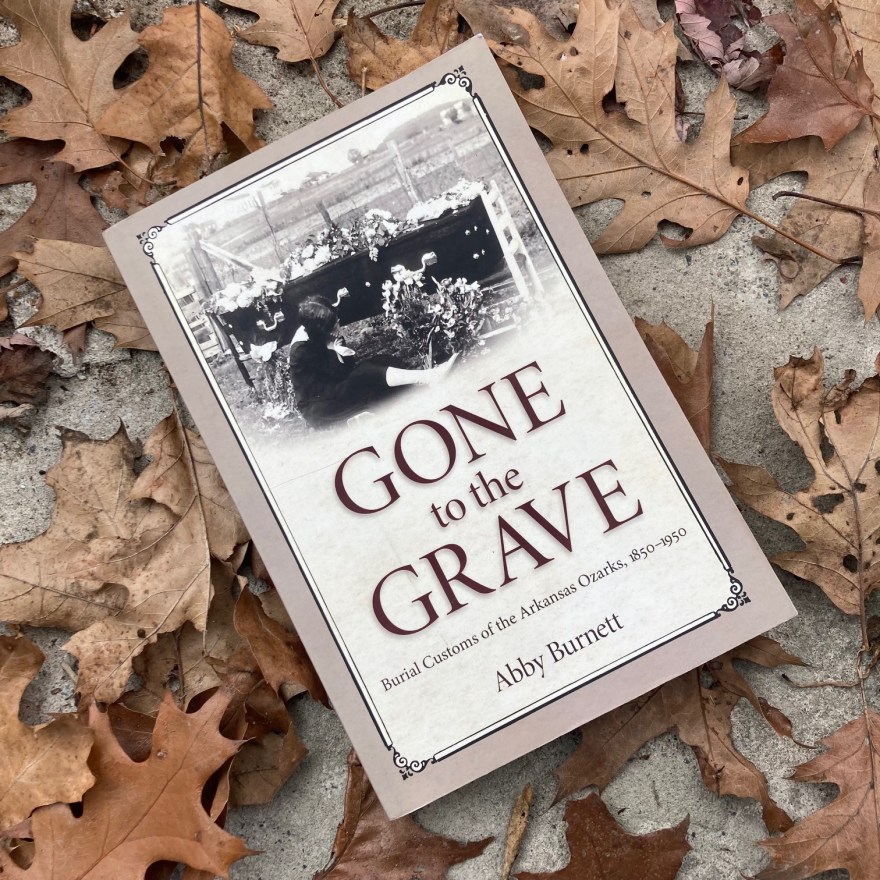
Being a Canadian, I am not 100% familiar with American history and customs. Luckily, there are MANY books written about it, and I do love to read. This month’s cemetery book review is Gone to the Grave: Burial Customs of the Arkansas Ozarks, 1850—1950 by Abby Burnett. I first learned about this book through the AGS Book Club, as this book was the pick for July 2023.
Published in 2014 by University Press of Mississippi, Gone to the Grave is written by Abby Burnett, a former freelance newspaper reporter and columnist for The Springdale News. At one time, her writing was food-focused, about understanding food and learning how to cook. Over time, her focus has shifted to death and burial practices.1In an article for the Arkansas Democrat-Gazette Burnett said,
“I’ve always loved cemeteries, and started seriously exploring ones in the Arkansas Ozarks about 25 years ago.”
Gone to the Grave is a collected work, the culmination of years of lectures, short newspaper articles, historical society journals, Arkansas Encyclopedia entries, and Gravestone Studies publications.1 It’s a very well-researched look into not only the burial customs of the residents of the Arkansas Ozarks, but also an in-depth look into deathcare and undertaking practices, health, and community life between 1850—1950.
Here is part of the book synopsis, from Goodreads:
“Gone to the Grave, a meticulous autopsy of this now vanished way of life and death, documents mourning and practical rituals through interviews, diaries and reminiscences, obituaries, and a wide variety of other sources. Abby Burnett covers attempts to stave off death; passings that, for various reasons, could not be mourned according to tradition; factors contributing to high maternal and infant mortality; and how loss was expressed through obituaries and epitaphs. A concluding chapter examines early undertaking practices and the many angles funeral industry professionals worked to convince the public of the need for their services.”
Gone to the Grave: Burial Customs of the Arkansas Ozarks, 1850-1950 by Abby Burnett
This book is fairly dense, but not the heaviest read I have come across recently. I am not going to lie, it did take me some time to work my way through it. It’s filled with black and white photos, including some post-mortem photographs. A big part of the author’s research includes diaries and interviews, with snippets printed verbatim to reveal what it was like to be a part of the funerals and burials at the time. I found these first-hand accounts fascinating. Death is a part of life, and reading about how a community would come together to sit up with the sick and dying, and everything that comes after a passing is eye-opening. Today, death is such a taboo that it’s not talked about, and we forget that it’s something that everyone goes through.
Learning more about these practices emphasizes how much things have changed. My uncle passed away in his home a few years ago. He had cancer and was spending his last days at home with his family. Two of my aunts went over to visit him, unknowingly on the day that he passed away. They knocked on his door, and his wife told them that he had just passed. They stayed to console his wife and visit with him one last time. Both of my aunts found the whole experience very surreal, as they had only ever visited deceased loved ones in a funeral home. But, that’s how wakes and funerals were done in the past, set up in the parlor of the deceased’s own home.
The practices discussed in the book are associated very specifically with the Arkansas Ozarks, it would be interesting to compare how different the practices are from other parts of the world. I often wondered as I read, if the customs described would have been much different than what customs were like here in Ontario around the same time.
Overall, I enjoyed this book. It covers a lot of information, but I found it was well-connected and flowed together well. This book is a deep dive, and as such might be too heavy for a casual reader. I read some reviews where people compared it to a textbook, which understandably might not be for everyone. I wouldn’t go that far, but it does get close to that territory. So, if you are looking for that kind of in-depth, high-level information, this may be the perfect book for you.
Have you read Gone to the Grave? What did you think? I would love to read your thoughts in the comments.
Thanks for reading!
I am always on the hunt for cemetery-related book recommendations. Please feel free to share yours in the comments. If you are an author and have a cemetery-related book you would like me to review, please reach out at hello@chantallarochelle.ca. I would love to hear from you.






























 Cemetery Photography by Chantal Larochelle