In honor of the Spooky season, I wanted to do a sort of spooky show-and-tell. For today’s blog post, I want to talk about some of the creepier grave goods I have come across while exploring and photographing cemeteries.
Grave goods is a term used for items left behind at a grave. I have always found it fascinating what people leave behind. There are a variety of reasons someone might leave grave goods; to pay their respects, to honor their loved one, this list goes on.
The most common grave goods I see in my cemetery travels are flowers, but I have also found coins, toys, figurines, and pieces of clothing such as hats or gloves. I have even found alcohol and cigarettes left on gravestones.
But there have been a couple of times where I have found some pretty creepy things. I would say maybe even sinister grave goods.

A Horse Skull
One of the first creepy grave goods I ever came across was a skull hanging from a tree. I believe this is a horse skull, although I don’t know for certain. A horse skull would make sense for the area where it was found, in Verner Public Cemetery. Verner is a rural area, dotted with farmland.
How the skull ended up in the tree is another question entirely. I remember it was hanging on a tree at the edge of the tree line. Was it found in the forested area? Was it brought from an adjoining farm?
The questions will always remain…

A horse skull. Verner Public Cemetery, Verner ON ©2010
A Creepy Doll
I never expected to come across a creepy doll, the day I entered Blezard Valley Cemetery. It was in late May, that I discovered this one.
A creepy plastic doll, the kind where the eyes close when you tilt it backward. Except this one has a push pin pushed into its plastic eyeball. It was also painted black. I found it leaning up against the backside of a granite gravestone.
How it ended up there, I can’t even speculate. Was it bored teenagers? Or was it left behind with more sinister intentions? I took many photos but left the doll where I found it.
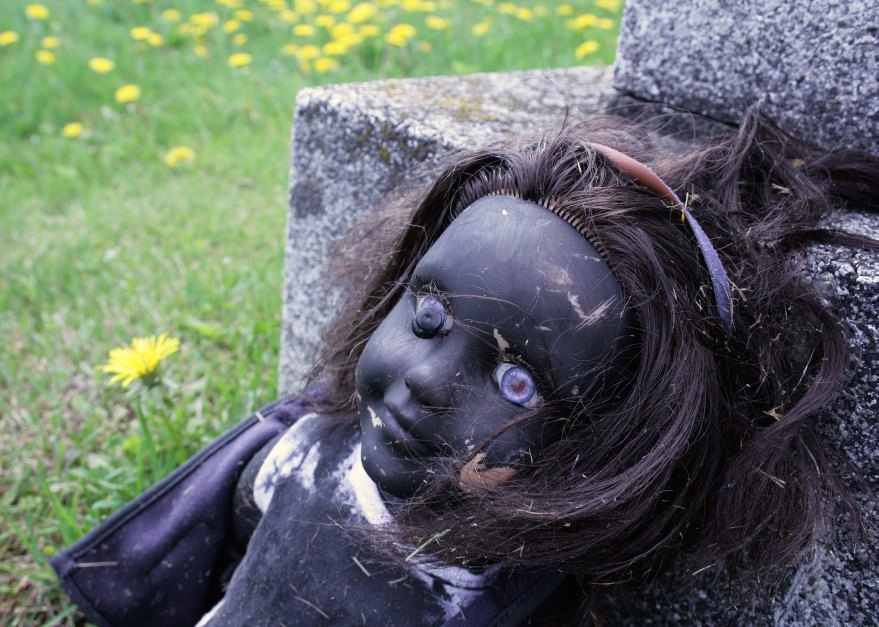
A creepy doll left at a grave. Blezard Valley Cemetery, Blezard Valley ON ©2021
A Ouija Board
I think this is one of my favorite spooky finds! Technically my mom found it. We had gone off on our own, in separate directions, meandering among the gravestones. She called me over when she spotted this unique grave good.
Laying above a small flat stone marker was this hand-made ouija board. It was painted by hand onto a small canvas. I wasn’t able to locate what had been used as a planchette. My guess is they used a glass or cup of some sort, and made sure to return it to where it came from.
From the looks of it, this hand-made board had been sitting outside for some time. Being an avid Ouija board collector myself, I enjoyed finding this one. But of course, I left it where it was found.

A hand-made ouija board. St. Jacques Cemetery, Hanmer ON ©2021
I have written in the past about the cemetery etiquette I follow when visiting cemeteries. I do sometimes clear away debris to get a clearer picture or stand-up fallen grave goods that have been knocked over. But, I would never remove anything from a gravestone, or cemetery for that matter.
Did you enjoy my round-up of the top three spookiest grave goods I have found in a cemetery? It’s one of my favorite things about cemeteries, you never know what you might find!
Have you ever found anything strange left behind in a cemetery? I would love to read about it in the comments.
Thanks for reading!


 Cemetery Photography by Chantal Larochelle