Have you ever heard of best friends being buried together?
That’s exactly what four women in Toronto chose to do. They lived in the same neighbourhood, supported one another, and made sure they’d stay side by side long after their time on earth. Their story is heartwarming, inspiring, and a little unexpected.
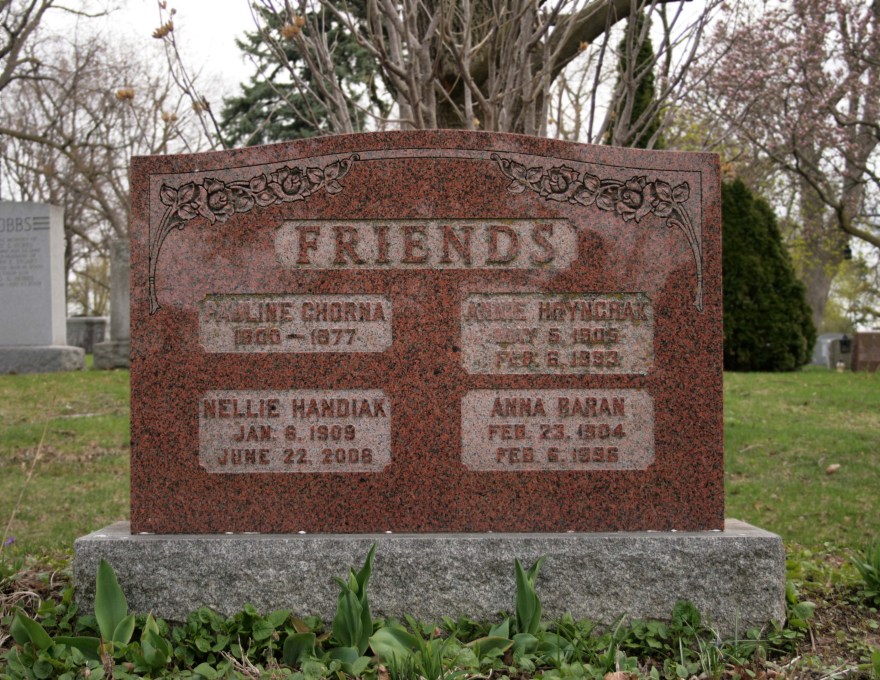
In the heart of Toronto’s Prospect Cemetery sits a shared gravestone marked with one simple word: Friends. The four women behind that stone, Pauline Chorna, Annie Hrynchak, Nellie Handiak and Anna Baran, might not be famous, but their story has captured hearts across Canada and beyond.
These women, friends in life and now in death, chose to be buried together as chosen family. Their decision, made decades ago, quietly reflects a lifestyle that’s now becoming more common, one that embraces shared housing and friendship as a way to age with dignity and connection.1
At a time when most people were buried with relatives, choosing to be buried with friends was unusual and incredibly meaningful, which is part of why their gravestone stands out so much today.
Long before the Golden Girls TV show aired in 1985, these four women had already built full lives rooted in friendship and community. All four were immigrants from the Carpathian Mountains, part of a wave of 20th-century migration driven by difficult economic times2. Some say they may have met on the ship that brought them to Canada.2
They each married and raised families, but no matter where life took them, they stayed close. They met regularly to play cards and catch up at the Carpatho-Russian cultural centre, building a bond that lasted decades and continued beyond their lifetimes.
This kind of friendship, and now living arrangement, is part of a growing movement in Canada known as the Golden Girls model. It’s a new way for seniors to share homes instead of moving into care facilities. It helps fight loneliness and can make housing more affordable. In 2019, a bill called the Golden Girls Act was introduced in Ontario to make shared housing easier and more protected by law.3
The movement has grown beyond Toronto, too. In my hometown of Sudbury, for example, a group of women created the Golden Girls Network to help seniors learn more about shared housing. They want people to know that this way of living can offer friendship, safety, and support. It’s not just about saving money, it’s also about finding joy and community in later life.4
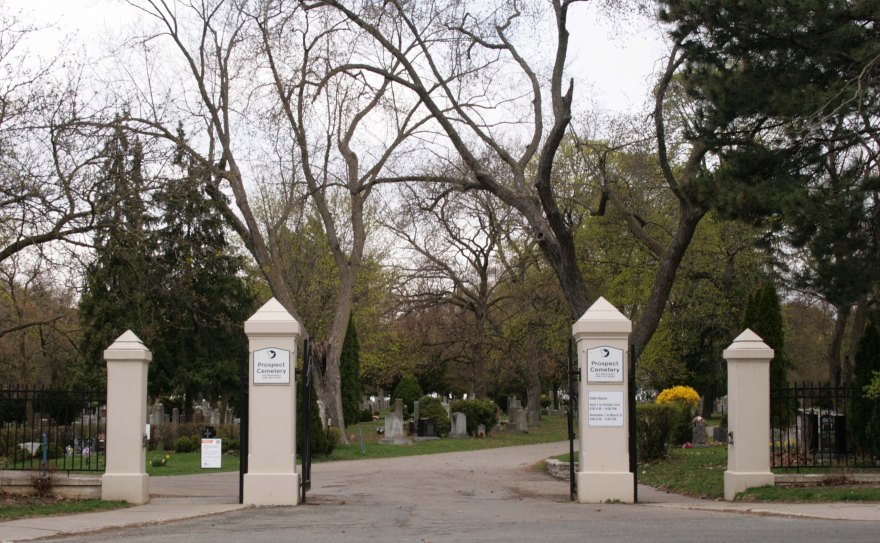
Prospect Cemetery opened in 1890 and has been part of Toronto’s landscape ever since, with peaceful paths and historic stones that reflect more than a century of stories.5
We visited on a chilly, grey day in late April 2025. My fiancé and I were staying in Toronto with friends, and they suggested we take a stroll through the cemetery. The cemetery is quite large, and many locals use it for dog walks, bike lessons and quiet strolls.
Our friends were more than happy to show us around, especially to show us the grave of the well-known Golden Girls.
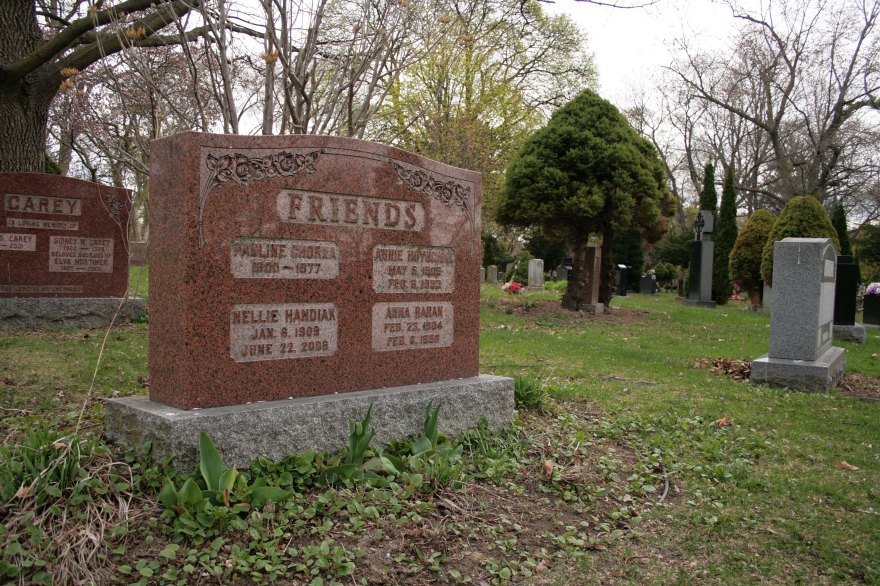
We found their final resting place easily. The red granite stone sits right along the path. At the top, where a family name would usually be, is the word “Friends”, followed by the names and dates for each woman.
Pauline Chorna was the first to pass away on January 30, 1977.
Annie Hrynchak followed on February 6, 1993, at the age of 87.
Anna Baran also passed away on February 6, 1996, 3 years later, at the age of 91.
Nellie Handiak, who had purchased the cemetery plot back in 1968, was the last of the group to pass away.2 She died on June 22, 2006, at the age of 97.
Handiak’s daughter, Jeannie, honoured one of her mother’s final wishes by slipping a deck of cards into her casket.2
When Handiak first told her daughter that everything had already been arranged, even the headstone, Jeannie was taken aback. “Oh, we got that too. We’re gonna be ‘friends’”, her mother had said.2 When asked why, her answer was simple: cards. So when Jeannie placed that deck of cards in the casket, she made sure the four friends could carry on their favourite card games in the afterlife.2
Their story continues to be shared online and in local news, and their gravestone has become a small point of interest for visitors who are moved by their friendship.
So, if you ever find yourself wandering through Prospect Cemetery, take a moment to visit their grave. It might leave you thinking differently about getting older and about how powerful true friendship can be.
A few weeks ago, I took a trip to Little Canada in Toronto. While most people go there to see the miniature landmarks, I was there with a slightly different goal in mind: finding the cemeteries!
Little Canada is a truly unique attraction that shrinks down the Great White North into incredibly detailed miniature scenes. Using intricate models and lighting effects, this ever-growing miniature world brings Canadian landmarks, cities, and culture to life. It’s a love letter to the country, built on a foundation of storytelling.
On our visit, my fiancé and I were lucky enough to get a personal tour from Heidi, a senior leader in marketing, who shared behind-the-scenes insights that made the experience even more special.
The story behind Little Canada is charming in its own right. On our tour, we met the founder, Jean-Louis Brenninkmeijer who was inspired to start this project after helping his son with a school assignment about Canada. That seed of an idea grew into the sprawling, detailed world you can visit today.Everything in the exhibit—from the fishing boats in Little East Coast to the recognizable Parliament buildings in Little Ottawa—is designed with storytelling in mind. Even the hidden details, like the many Easter Eggs scattered throughout each scene, tell their own whimsical stories.
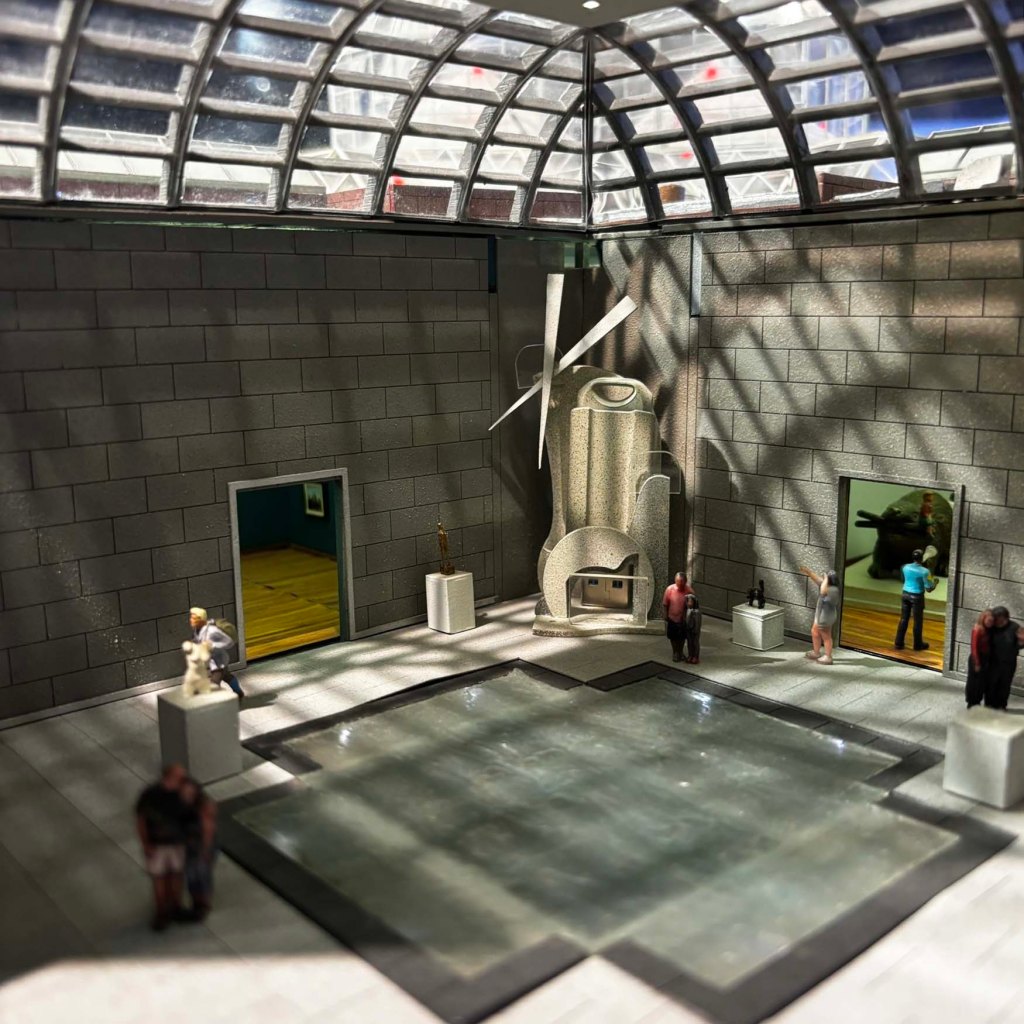
What’s my favourite Easter Egg? Besides Bigfoot? (Look for him in Little Quebec!) I’d have to say the time capsule that is hidden in the National Gallery in Little Ottawa. Jean-Louis shared the story behind this Easter Egg with me.
The day before Little Canada opened its doors, the entire team contributed something to a USB stick, and sealed it away in this tiny gallery space, masquerading as a sculpture. The plan is to open this tiny time capsule when the building lease is up—20 to 30 years from now! I love the idea of a time capsule, it’s a moment frozen in time, much like a cemetery is.
Speaking of cemeteries, Heidi was very kind, making sure to point them out as we travelled through all the exhibits.
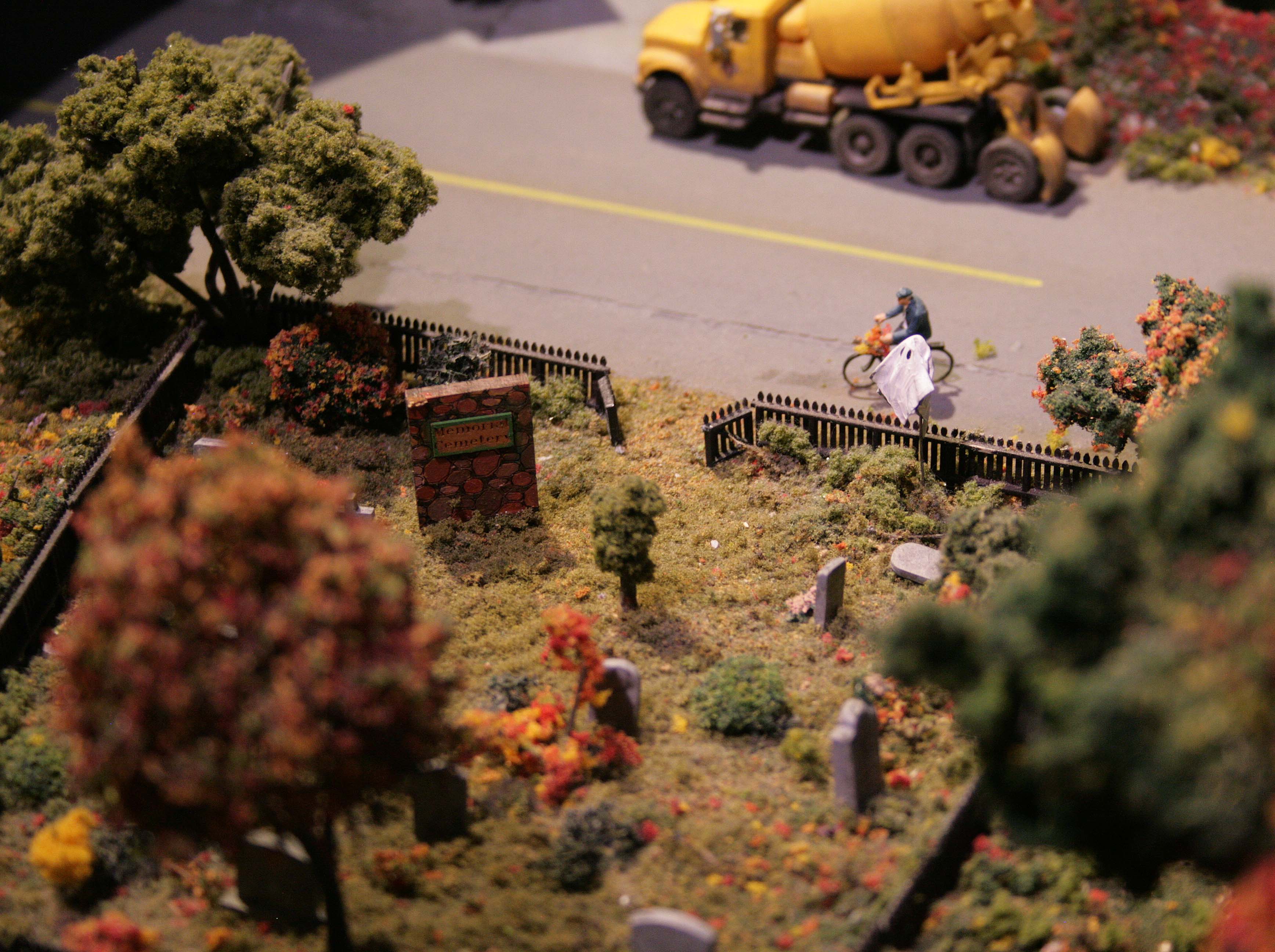
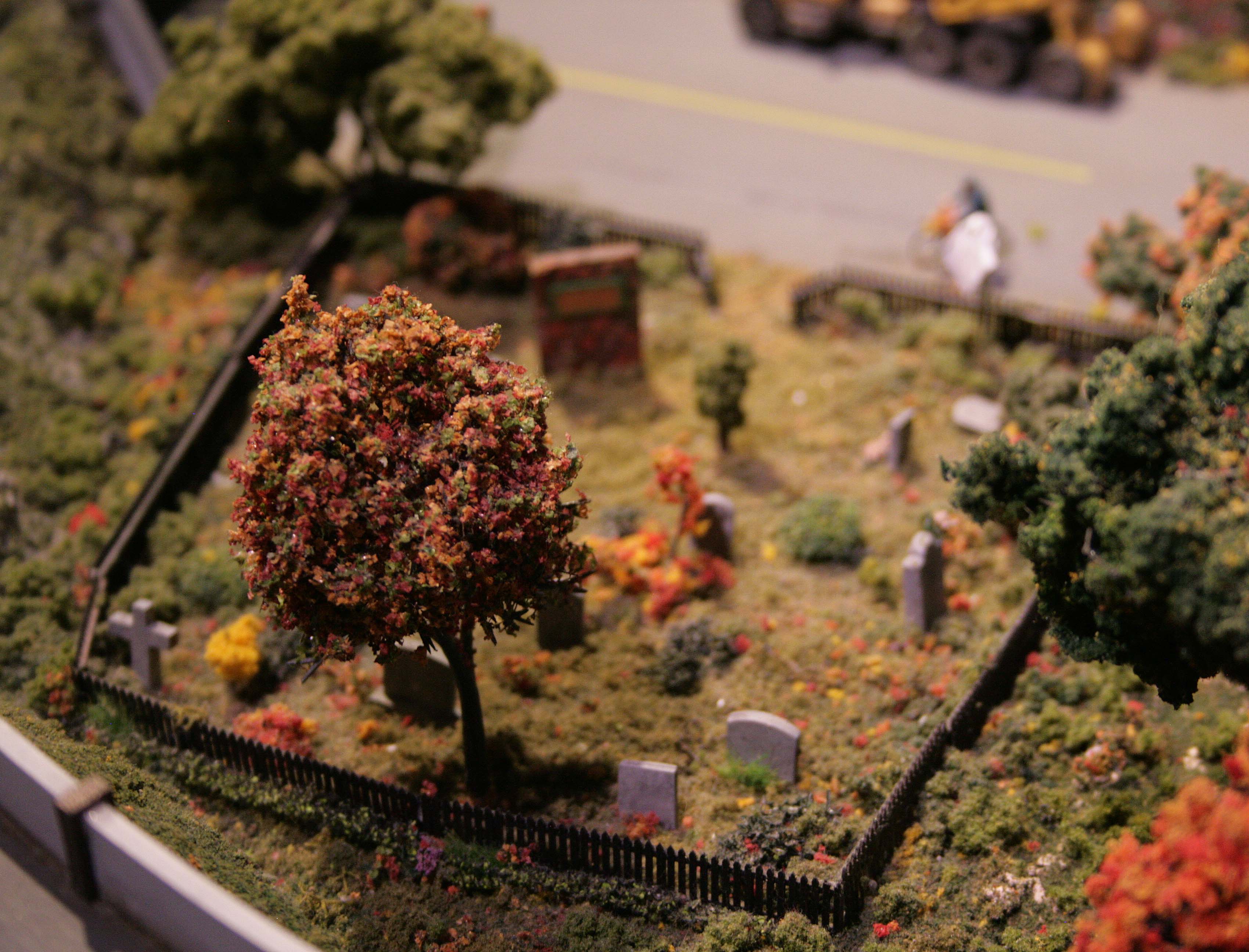
The first cemetery was tucked in among the highway in the Little Golden Horseshoe. A little stone cairn sits at the entrance, with the name Memory Cemetery carved into it. A handful of gravestones sit within a fence, surrounded by trees in full autumn colours. This little cemetery is not based on any real-world cemetery but is an example of a small rural cemetery, with its own resident ghost that sits on one of the fence posts. A good example of some of the whimsy that can be found throughout Little Canada.
Memory Cemetery in Little Canada
The second cemetery we found was in Little East Coast. This rural cemetery is based on Cavendish Community Cemetery, in Prince Edward Island. It features a replica gravestone of Lucy Maud Montgomery, the Canadian author best known for her Anne of Green Gables book series. Surrounded by fall colours and marked by a replica cemetery sign, that even includes “Resting Place of L.M. Montgomery” in impossibly small type. This cemetery is also a busy one, with some people paying their respects, and others having what I first thought was a picnic—until I looked closer at my photos and realized it was a Ouija board session! Another example of the unexpected storytelling hidden in these tiny scenes.
Both of the cemeteries were small, but incredibly detailed—down to the engraved names and the uneven ground. I can’t say I ever photographed a cemetery in a 1:87 scale before!
Cavendish Community Cemetery in Little Canada
Scattered throughout all the little scenes were also tiny monuments and war memorials, similar to what you would find while wandering a small town or city. It’s interesting to note how prevalent these places of memorial and remembrance really are.
As we explored the display wall, where some of the 5-inch Little Me figures are displayed, there is also a small section devoted entirely to the Vimy Ridge Memorial. Even scaled down, it’s a striking memorial. Designed to commemorate Canadians who fought and died in World War I, the real Vimy Ridge Memorial in France is a place of reflection and national pride. I was struck by the thought that cemeteries and monuments—no matter their size—inspire memory, honour, and connection.
Vimy Ridge Memorial in Little Canada
It’s easy to see how much heart goes into every scene and detail. At the Maker’s Window, we had the chance to speak to some of the lovely women who bring these miniature scenes to life. The attention to detail, and at such a small scale, is amazing! Talking to them made me realize that this isn’t just about scale and architecture. It’s about the people behind the scenes, pouring care, creativity, and pride into every tiny building, street, and story.
Of course, I couldn’t visit Little Canada without getting Littlized!
The Littlization process allows you to have a 3D scan of yourself turned into a miniature figurine, a Little Me, to take home or be placed somewhere in the display. It’s a fun nod to personal storytelling and a reminder that all these little pieces make up something much bigger.
We spent about three hours exploring the exhibits, and I could easily see myself going back again and still not spotting every detail. There’s history, humour, sentimentality, and a strong sense of community behind it all.
Little Ottawa in Little Canada
Little Canada may be small in scale, but its message is big: Canadian stories matter. Whether that’s the story of a national battle memorial, a hidden USB time capsule, or a tiny cemetery, each piece tells us something about who we are, and what we value.
And, if you’re someone like me, drawn to hidden stories, Little Canada has no shortage of tiny wonders to explore.
A few years ago, my fiancé and I started a new October tradition. We were engaged in October, and to celebrate we planned a cute weekend getaway at a haunted hotel. We visited a haunted pub and enjoyed the small-town charm and fall weather.
We had so much fun that we started thinking about other haunted hotels we could visit—and the tradition was born!
This year, our Haunted Holiday took us to Toronto.
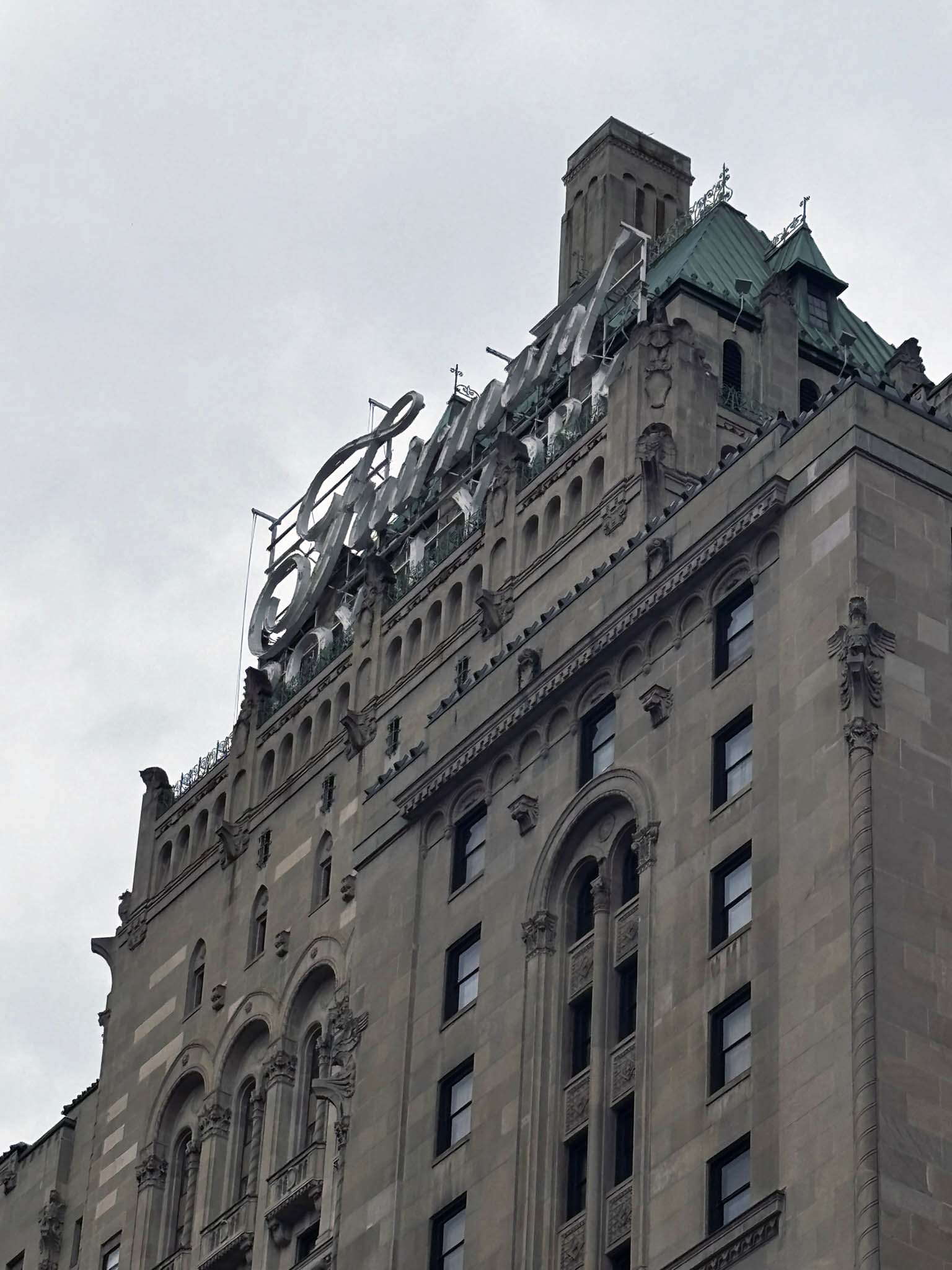
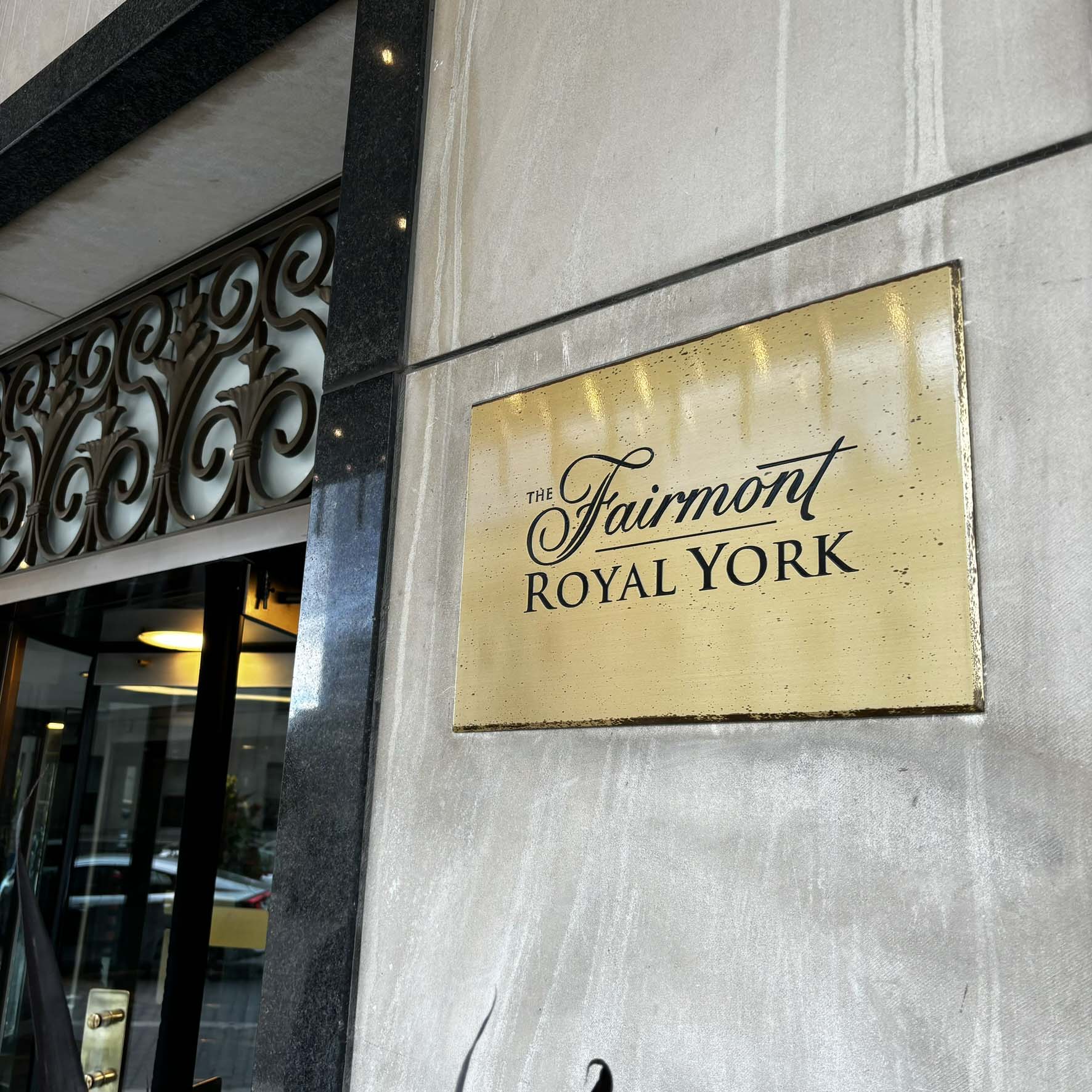
We had tickets to see the iconic heavy metal band Iron Maiden at the Scotia Bank Centre at the end of October, so it made sense to make a weekend trip. I did a bit of research into haunted locations in the city and booked us a room at the Fairmount Royal York. We also made reservations for a romantic dinner at a 157-year-old historic building known today as the Keg Mansion.
The Royal York Hotel was built in 1928-1929, by the Canadian Pacific Railway as part of its coast-to-coast chain of grand hotels. The skyscraper hotel was the tallest in the British Commonwealth at that time and dramatically altered the Toronto skyline.1
Today it’s one of Toronto’s most famous landmarks.
This stately hotel has played host to many celebrities and dignitaries over the years, such as Louis Armstrong, Ella Fitzgerald, and the Royal family.2 With such a storied past, it’s no surprise that it might also hosts a few ghosts.
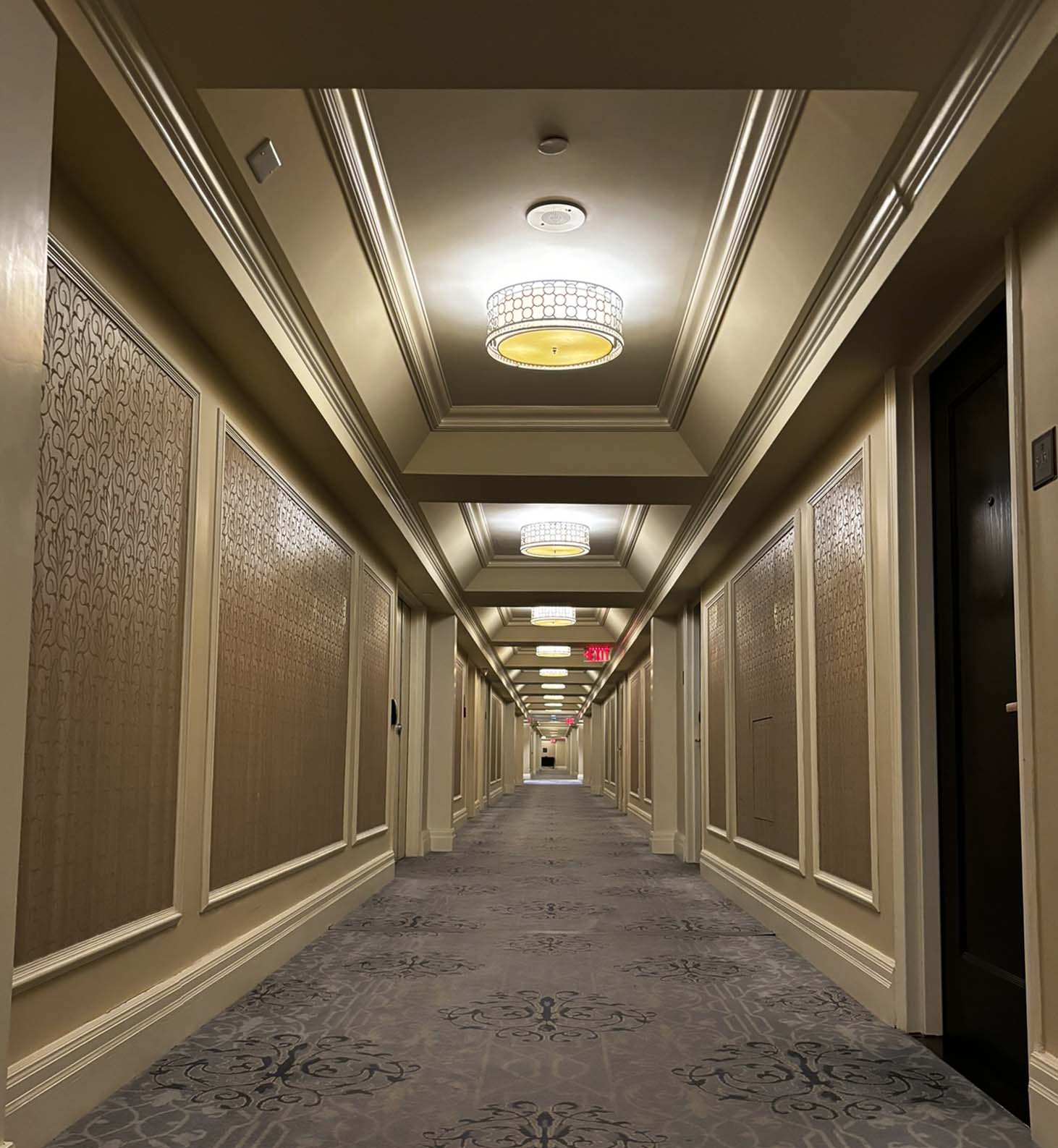
The most reported haunting is that of a gentleman who wanders the halls on the 8th floor. He is said to be wearing a purple jacket. This ghostly figure is sometimes seen accompanied by the sounds of children running up and down the halls while laughing. Those who have heard the ghostly children have peeked outside their chamber door to see an empty hallway and find silence. Some have peeked out to see the man in the purple jacket.3
My fiancé and I were eager to chat with someone about the supposed hauntings when we checked in. Unfortunately, we didn’t meet anyone who had any stories to share with us, either being recent hires or as one put it, worked only during the day when nothing spooky happens.
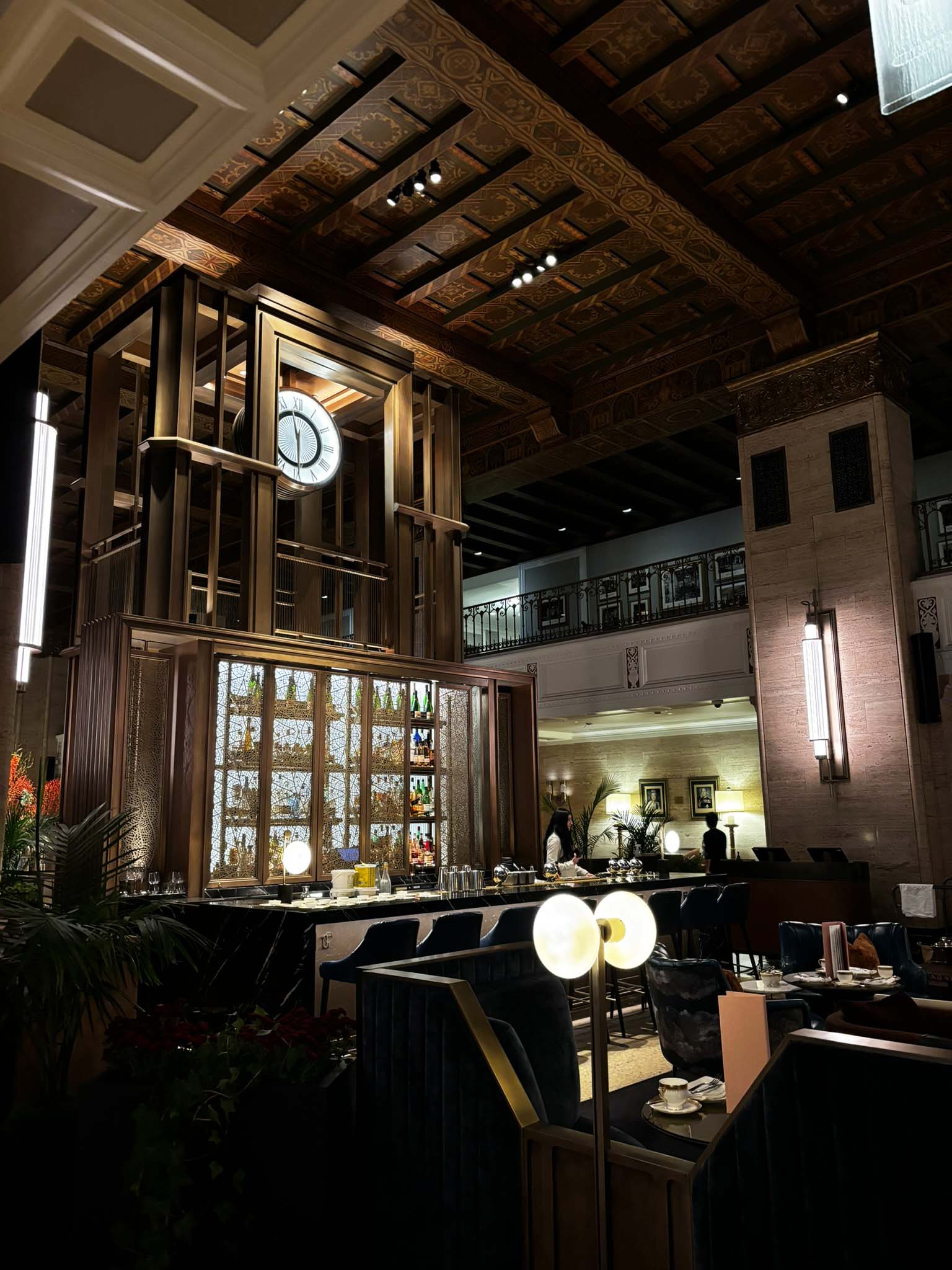
The hotel is immense and beautiful, so we took a bit of time to explore our surroundings while making our way up to our room on the 9th floor.
After dropping off our things and settling into our new home for the night, we had some free time before our dinner reservation. We had just enough time for a cemetery visit, some window shopping, and a drink or two at a pub.
Mount Pleasant Cemetery
Opened in 1876, Mount Pleasant Cemetery is considered one of Canada’s most historic cemeteries. It was designed by Henry Adolph Engelhardt and is a beautiful example of landscape design, inspired by the European and American garden cemeteries of the 19th century.4
Spanning 83 hectares in the middle of the city, the many winding paths provide picturesque views of the park-like landscape.4 Mount Pleasant features one of the finest tree collections in North America and walking and running trails that span 1 km, 3 km, and 5 km routes.5
Mount Pleasant is the final resting place of many prominent Canadians, including former Prime Minister William Lyon Mackenzie King, Nobel Prize winner Frederick Banting, founder of the Eaton’s department store Timothy Eaton, and renowned pianist Glenn Gould.6
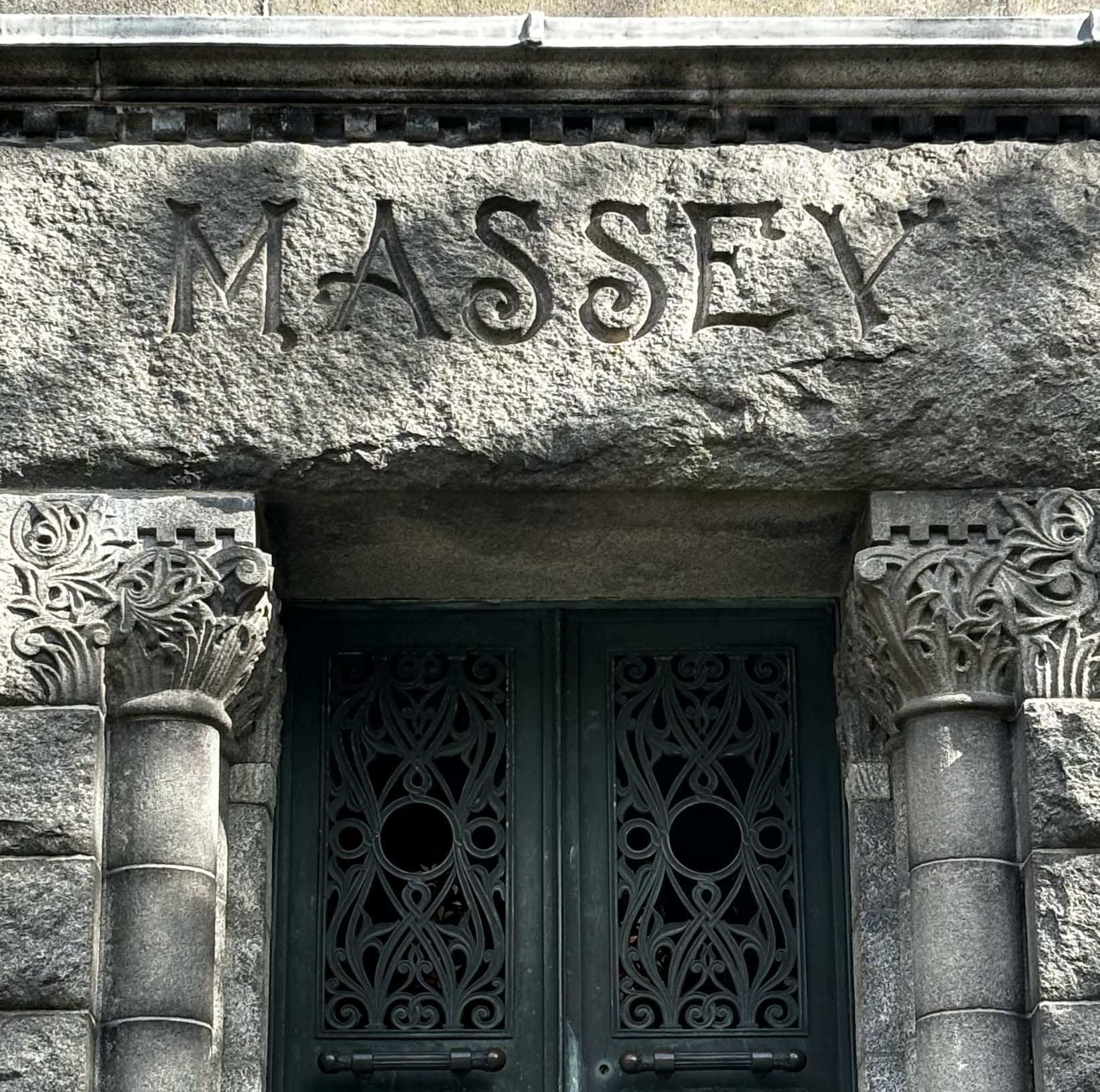
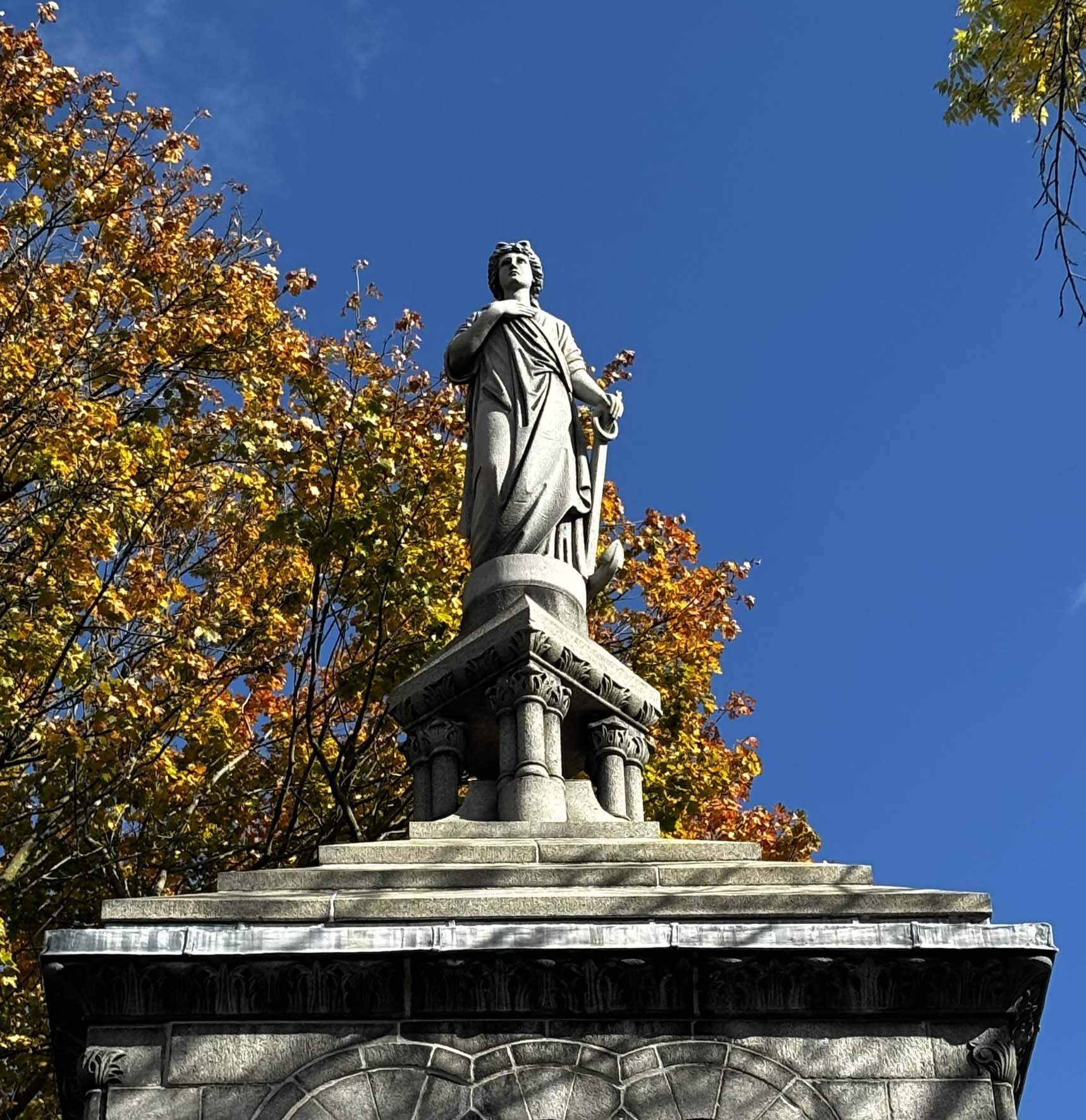
It’s also the final resting place of many members of the prominent Massey Family. The Massey Mausoleum was built in 1891. Designed in the Romanesque style, the family crypt features a tower, a below-grade crypt, and a statue of Hope, one of the seven virtues perched on top of its roof.7 Industrialist and philanthropist Hart Massey rests within the walls of this mausoleum, as well as his wife Eliza Ann Phelps Massey, and some of their children, like Lillian Frances Massey Treble.
I was particularly interested in visiting the final resting place of Lillian, as we would be dining with her ghost later that evening.
The Massey Mausoleum is massive and was easy to spot once I was pointed in the right direction. I will admit I did need to get directions from a groundskeeper as the cemetery is quite large and easy to get lost in. Especially when you are easily distracted by gravestones, like me.
Standing in front of the immense family crypt, I was in awe of the wealth and stature of this family, which I assume is one of the reasons for building such a massive final resting place.
I peeked inside and admired the beautiful stained glass, in the small sepulchre. The shaft of light coming from the stained glass windows in the ceiling lit the inside of the tomb just enough to make out the nameplates marking the shelves within the crypt. It felt like a special privilege to be able to see inside this final resting place of such a prominent Toronto family.
After paying my respects and taking a few more photos, I made my way back to my waiting fiancé. I excitedly showed him my photos as I described everything I saw during my short walk in the cemetery.
After a short rest and an iced pumpkin spice latte, we continued on our walk down Yonge Street stopping in at a shop here and there. We eventually sat down at a nice little pub called The Quail, where we enjoyed a few drinks and chatted with the owner. Now that I think about it, we completely forgot to ask the owner if he had any ghost stories to share.
But not to worry, we would get our fill of ghost stories at supper time!
The Keg Mansion
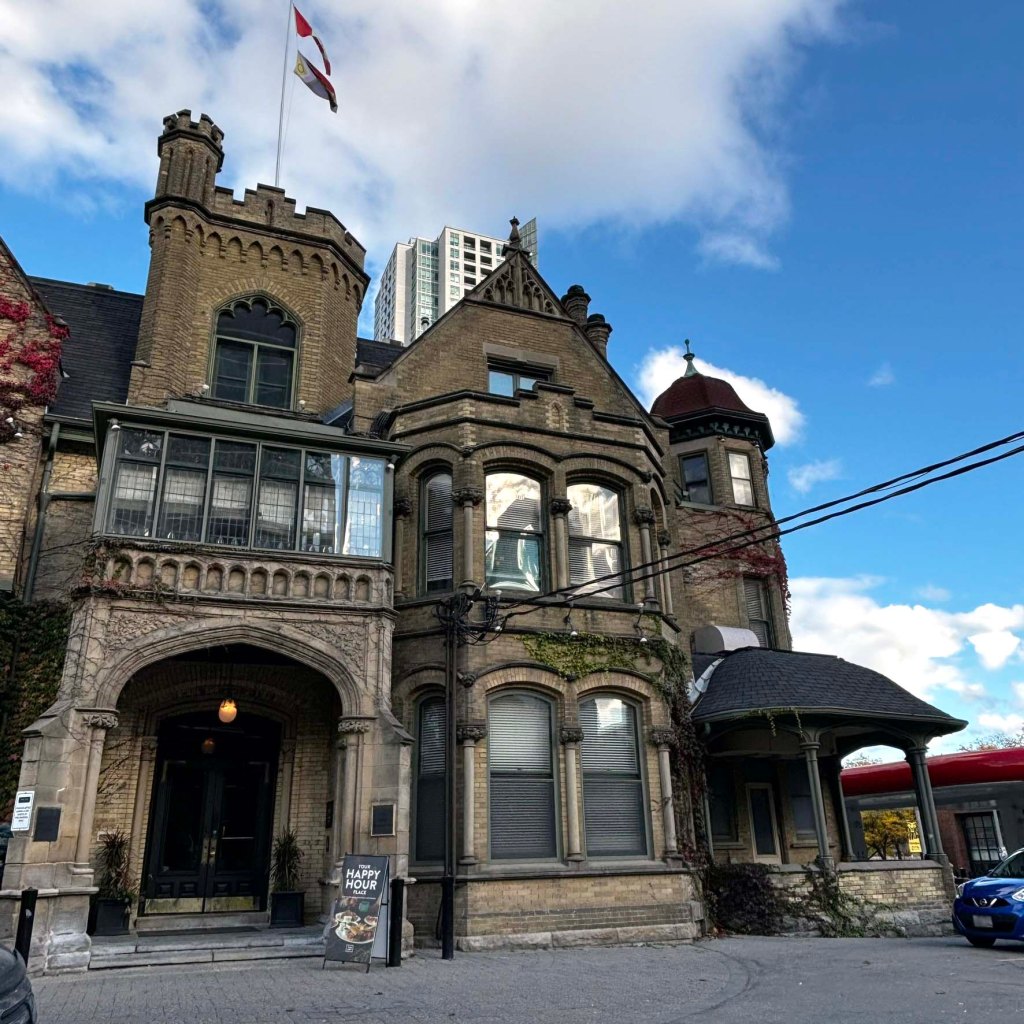
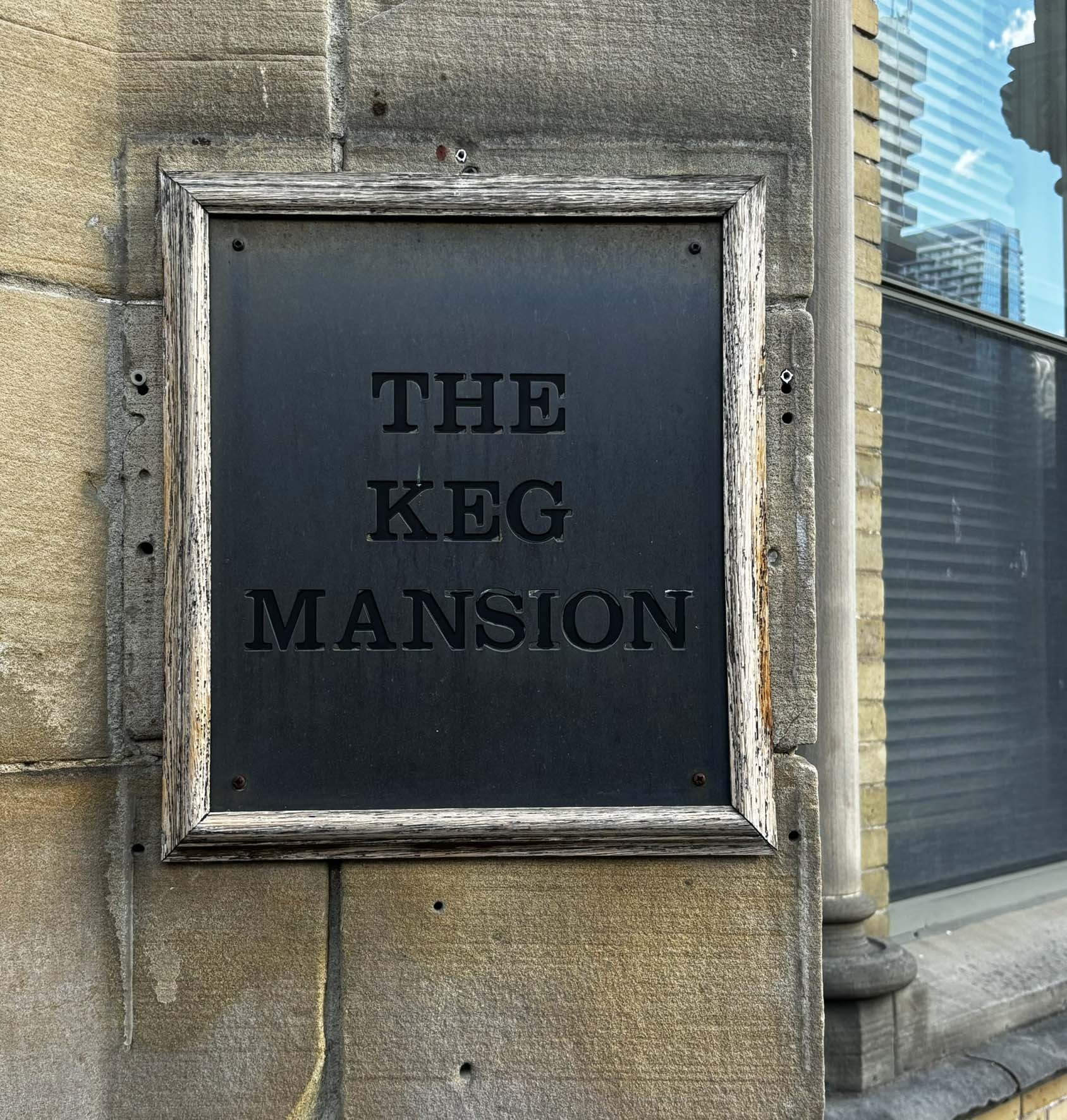
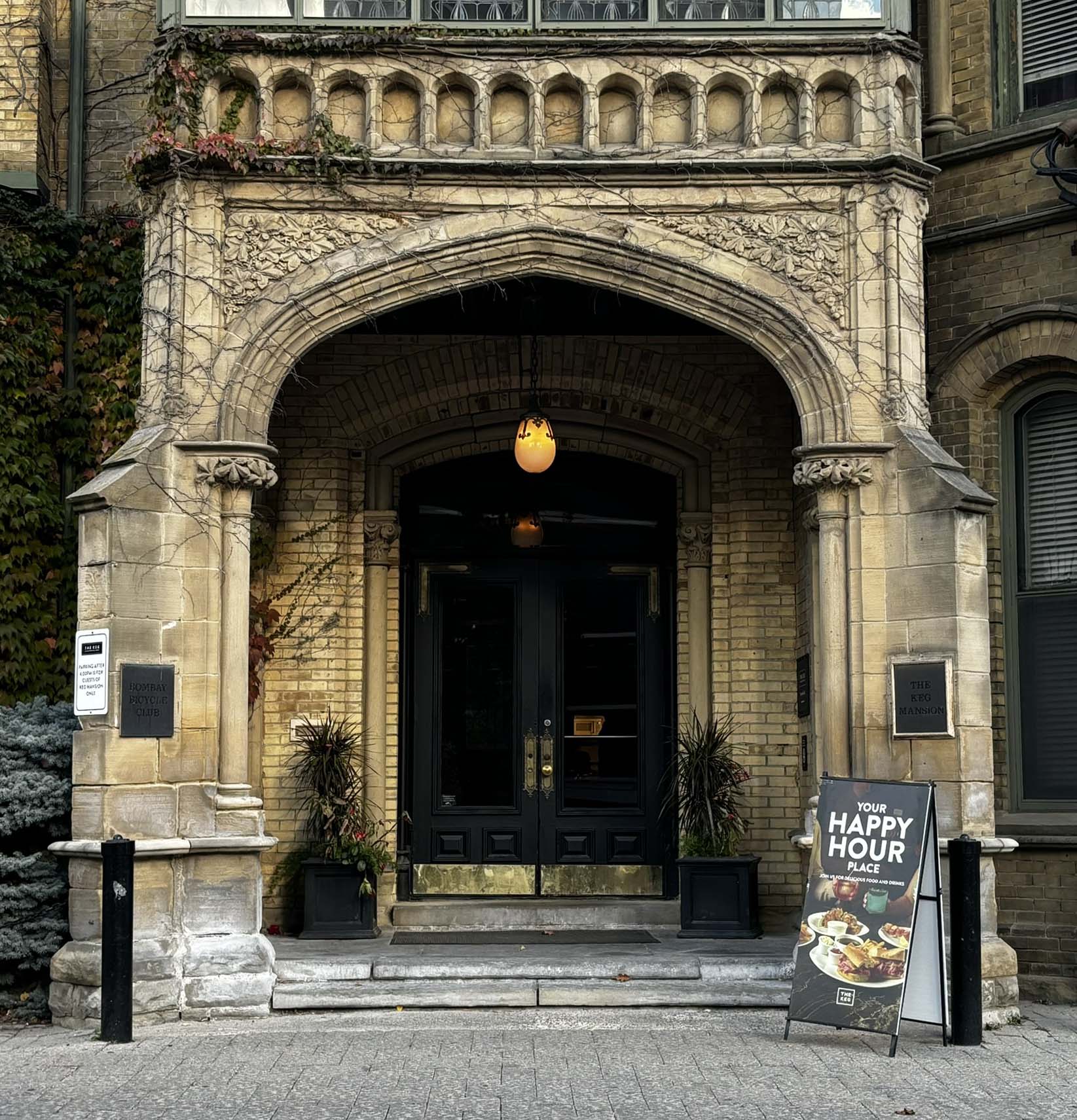
Our dinner reservation brought us to the Keg Mansion, a former home of the Massey family. Built in 1867, this elaborate mansion housed 26 different rooms and 17 fireplaces.8 The home was purchased in 1882 by Hart Massey, a Cleveland agricultural equipment salesman, and his wife. They would make additions to the ornate mansion by adding a turret, verandah, and a greenhouse.8
After Hart Massey passed away in 1896, at the age of 72, the estate was taken over by his daughter Lillian Massey. She would name the Mansion Euclid Hall, and reside there until her death. After her passing, the house was entrusted to the University of Toronto, serving as the home for many different establishments over the years. In 1975, the building received heritage status, and in 1976 became the home of The Keg Steakhouse + Bar. Today, it’s known as the Keg Mansion.8
The Keg Mansion does not shy away from its ghostly history. When we arrived for our reservations we were quietly seated on the second floor. Of course, we asked right away if our server had had any ghostly encounters to share. She didn’t have any stories of her own to tell, but she kindly offered to bring over the “ghost book”, a collection of reported hauntings by staff and restaurant patrons.
I was happy to peruse the reported hauntings while they brought out our drinks. Some of the stories I was familiar with, like the story of Lillian Massey and her maid. Lillian passed away in the house in 1915, at the age of 61. Lillian was beloved by her staff, and her maid in particular took her death very hard. The story goes that after learning of Lillian’s death, her maid, distraught with grief brought a length of rope with her upstairs to the oval vestibule, where she fashioned a noose and hung herself.9
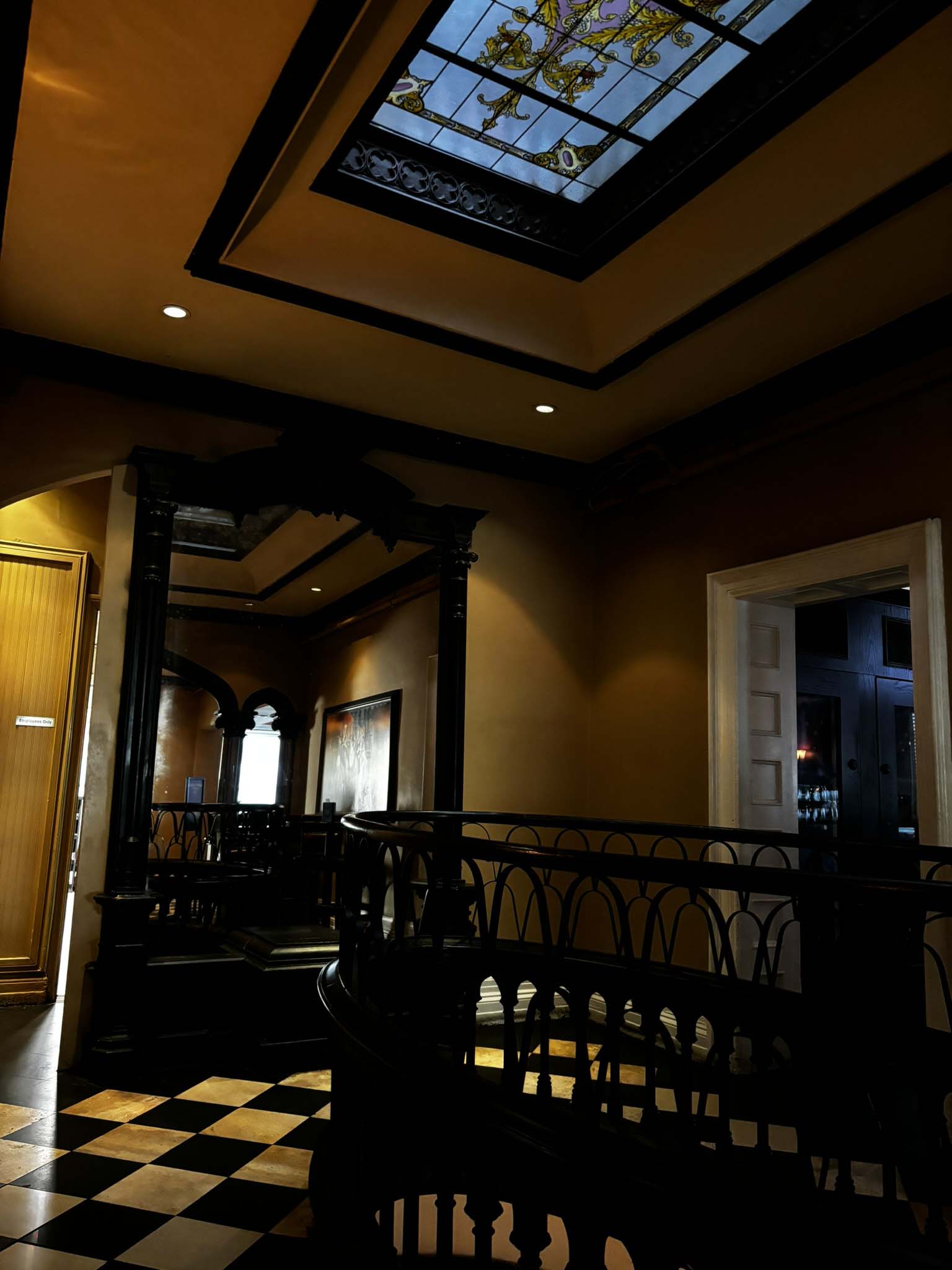
The vestibule is still a feature in the Mansion today, just outside the washrooms on the second floor. People have reported seeing Lillian’s spirit as well as the spirit of her maid, in various rooms throughout the house. The washrooms, in particular the women’s washroom, are thought to be one of the most haunted areas in the Mansion. Patrons have reported feeling cold spots, and even capturing ghostly images in photographs taken in a mirror above the fireplace in that washroom.
The stories I found most fascinating though were the sightings of the ghost of a young boy.
Throughout our meal, my fiancé and I couldn’t help eavesdropping on the conversations happening around us. The ghostly phenomenon happening at the Mansion is well known, and we were not the only ones asking questions about ghosts.
One server stopped by our table and told us a story about a mother and son who had come to the Mansion for supper. The little boy went to the bathroom, and on his return told his mother that there had been another little boy in the bathroom, all alone. Worried, the mother told her server who in turn told a manager. The manager went to the bathroom right away to see if the little boy needed help, but there was no one there.
We would learn later in the evening that there had been a young Massey boy, who also died in the house, who was around 10 years old. His playful ghost is also often reported.
Geoff, the Bar Manager stopped by our table after our meal and told us about his encounter with the child ghost. He had been walking with a tray of drinks past the front door area, where the large staircase is when he overheard a little girl telling her mother she wanted to play with the trains. The mother, confused, asked her daughter what she meant. In response, the little girl pointed to the empty staircase and said she wanted to play trains with the little boy. She was quite emphatic saying that he was playing with the trains and that she wanted to play too.
Except there was no one on the stairs, no little boy, and no toy trains!
Geoff assured us that even though the ghosts were very active, no one had experienced anything malicious. My fiancé and I hoped we would have an encounter of our own, but alas we didn’t experience anything. We both made it a point to visit the washrooms, and I did take a few selfies in the bathroom mirror, but I didn’t capture anything.
What we did have was a lovely evening of good wine, good food, and ghost stories.
After dinner we made our way back to the hotel to freshen up, then it was off to the Scotia Bank Centre for an evening of heavy metal. Iron Maiden put on an excellent show!
After a couple of hours of rocking out, we walked back to our hotel, stopping on the 8th floor to take a look around. It was quiet on that floor, so we returned to our own room for the night.
Although we didn’t get to experience any hauntings ourselves, we both agreed that it was a great weekend. You can’t go wrong with romance, ghost stories, and heavy metal. It was definitely a haunted holiday for the books.
This is one of my favorite movie quotes, and it comes from the 1968, black-and-white independent horror classic, Night of the Living Dead. I even have a small piece of the Evans City Chapel framed on my wall. The chapel sits in Evans City Cemetery, which is where the opening scene of the film was shot.
This horror classic was written and directed by George Romero, the father of zombie films. This summer, I had the chance to visit the final resting place of this iconic director.
George Andrew Romero was born in New York City on February 4, 1940, and grew up in the Bronx. His interest in film began at an early age and he would go on to enroll at Carnegie Mellon University, in Pittsburgh.1
After graduating in 1960, Romero began shooting short films and TV commercials, including an early short for the popular children’s show Mister Rogers Neighborhood.1
Romero’s break-out film Night of the Living Dead was revolutionary for the horror genre, and today is a staple of any horror film addict’s collection. This film completely reinvented the image of one of today’s most popular movie monsters.
Romero created the rules for a new kind of zombie. Now portrayed as reanimated corpses who hunger for living flesh. They are slow and shambling, with only one purpose. Silent, aside from their eerie moaning as they get closer to their prey. There is only one way to stop them—a violent strike to the head.
The film’s explicit violence and gore garnered negative reviews at its release, but today the film has amassed a cult following. In 1999, the film was deemed culturally and historically significant by the Library of Congress and has been preserved by the National Film Registry.2 In part for its social commentary during the 1960’s.
Romero would go on to write and direct other films, even directing a romantic comedy, but he always gravitated back toward the undead. He would go on to create a whole series of films set in the Dead universe; Dawn of the Dead, Day of the Dead, Land of the Dead, Diary of the Dead, and Survival of the Dead—his last film.
After falling in love with the city, Romero moved to Toronto, Ontario in 2004. He would shoot a lot of his later films in the city. In 2009, he acquired his Canadian citizenship, becoming a dual Canadian-American citizen.
In 2017, George Romero died in his Toronto home of lung cancer. He was 77.3 Romero is laid to rest in Toronto Necropolis Cemetery and Crematorium.
The Toronto Necropolis Cemetery and Crematorium is one of the city’s oldest and most historic cemeteries, dating back to 1850.4 The fully restored cemetery entrance features high Victorian Gothic architecture which also makes it one of the most scenic cemeteries in the area.4
I was enthralled the minute we stepped out of the Uber. The grand cemetery entrance sets the tone for the beautifully forested cemetery within. It was my first time visiting this enchanting cemetery. Being unfamiliar with its layout, I used Google Maps to lead us. Of course, I was easily distracted by the elaborate and historic gravestones we passed along our route.
As we approached a densely forested section, we heard the screeching of a hawk. It sounded close and didn’t seem to like us encroaching on its territory. Luckily the grave we were searching for was a bit farther back in the cemetery. My fiancé stuck to the meandering paths that snaked around the grounds while I ventured into the rows to read the graves.
Although not quite accurate, Google Maps led me to the general area we were searching for. Surrounded by tablet stones and obelisks, sits the mirror-like black granite stone of George A. Romero.
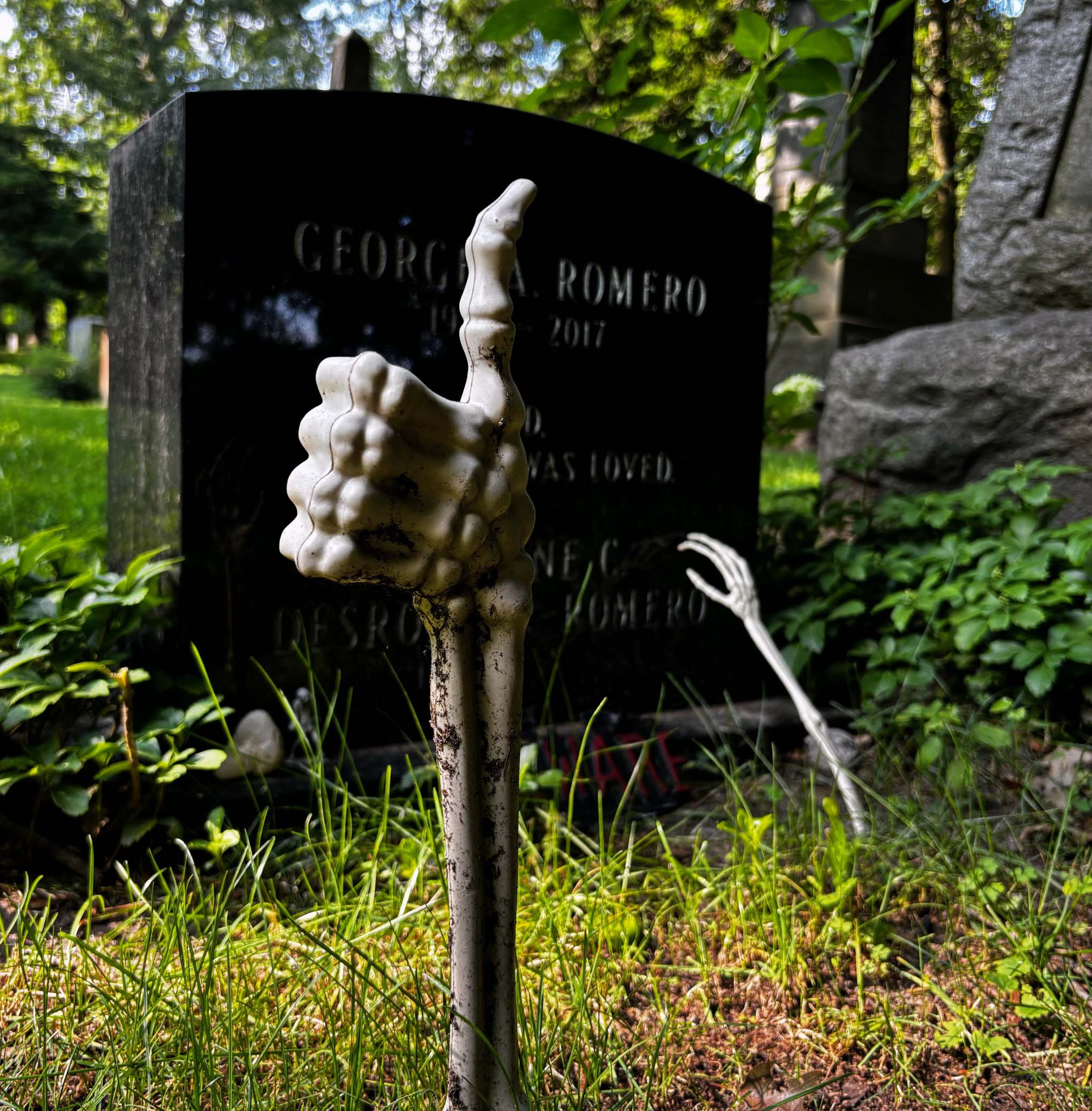
The epitaph reads, “George A. Romero / 1940 – 2017 / He Loved, / And Was Loved.”
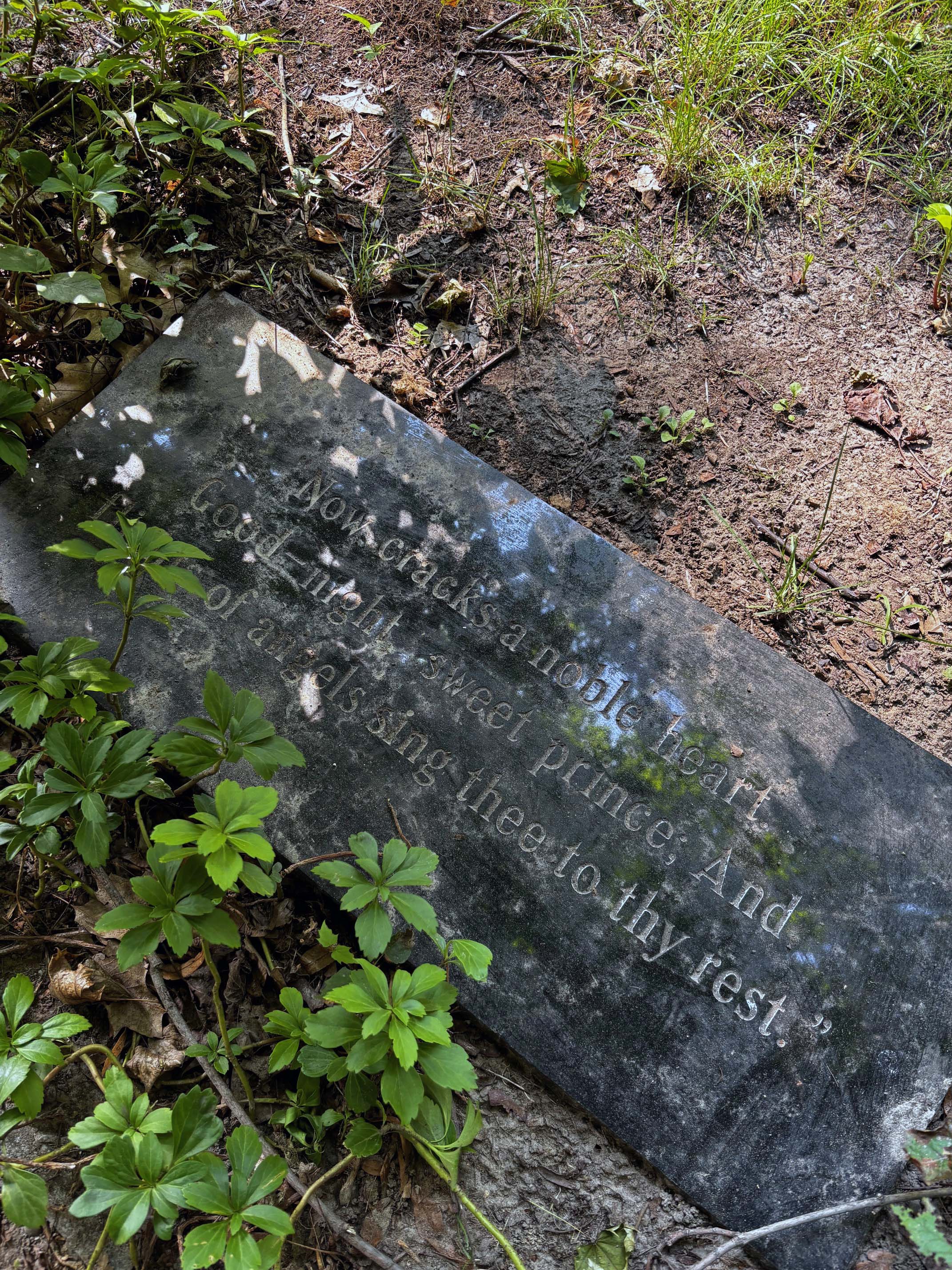
On the footstone is inscribed a quote from Shakespeare’s Hamlet, “Now cracks a noble heart. / Good-night sweet prince; And / flights of angels sing thee to thy rest.”
Although the cemetery was quiet that day, we could tell that many had come before us to pay their respects. Someone had planted two skeleton hands at the base of the grave, reaching up towards the inscription. Another skeleton hand, giving a thumbs up was also planted near the gravestone. Someone also left a little miniature zombie figure. The gravesite looked decorated for Halloween, even though we visited at the end of July!
Years ago, while collaborating with a community group dedicated to screening cult classics for charity, I envisioned hosting an event that would bring Romero to my small Northern Ontario town for a screening of one of his legendary films. Unfortunately, that dream never came true.
Although I never had the chance to meet him in person, to thank him for all the scares, visiting his grave and paying my respects was a profound and memorable experience for me.
Have you ever heard the term cemetery tourism before? Visiting cemeteries may not be at the top of your list when on vacation, but it should be!
In recent years cemetery tourism has become more and more popular. But, I would argue that it has always been. In today’s blog post, I wanted to talk a little bit about cemetery tourism and share a few upcoming cemetery tours happening in Ontario.
During the COVID-19 pandemic, some of the only open places around were cemeteries. They afforded people an outdoor space to take walks and get fresh air, revealing their importance alongside parks and other green spaces. This also gave people a chance to appreciate cemeteries as more than just places of sorrow and remembrance, but also places of art, history, and culture.
Since then, visiting cemeteries and graveyards has become an increasingly popular trend, not only among taphophiles and genealogists but also among general tourists. Wandering around cemeteries in new places is a great way to learn about the history and heritage of an area, and to also see examples of local art and architecture.
But cemetery tourism really isn’t anything new!
For decades people have been traveling the world specifically to visit tombs and mausoleums. The pyramids of Giza see over 14 million visitors each year, making them one of the most popular tombs in the world.1Granted, the Pyramids are one of the seven wonders of the world, they are also tombs that were built over 4500 years ago by the ancient Egyptians to honor their dead.2
Another popular example is the Taj Mahal, a white marble mausoleum that was built in memory of an emperor’s wife.3 It sees approximately 7 to 8 million visitors per year.4Visitors flock to this site, not only to experience the exquisite architecture but to also experience the reverence this tomb represents.
Closer to home, I find it’s common to see cemetery stops marked along motorcycle and cycling routes. Not only are cemeteries and graveyards perfect places to stop and stretch your legs on a long bike trip, but they also make interesting points of interest where you can learn more about the history of an area.
Another way cemetery tourism is becoming more prevalent is the creation of cemetery tours. I see more tours offered every year in local or nearby city cemeteries. Not only are they great ways for cemeteries to fundraise, and bring more people into the cemetery. It’s a perfect way to highlight the cemetery’s history, showcase important people, and make history come alive.
Generally, cemetery tours can be done at any time of year. You can often find them happening in the summer months. But, I find October is the best time of year for a cemetery walk. The atmosphere is perfect, with the crisp air and crunchy leaves. It’s a beautiful backdrop to explore history and learn about the past. October cemetery tours can be a fun activity to do if you are looking for something different to do for Halloween. Often, some of the history shared is on the darker side, creating an eerie atmosphere as you stroll among the graves.
Want to add a cemetery walk to your list of activities this month? Here is a small round-up of cemetery tours that are happening in Ontario. I would suggest booking your tickets fast as October is almost over!
Saturday, October 28 at 11 a.m. This is a free event. Roughly 2 hours in duration.
A lively, informative tour of selected grave sites in historic Hamilton Cemetery. Each tour will introduce you to some of Hamilton’s more interesting personalities and its rich history.
Monday, October 23 to Monday, October 30. Tours run at 8 p.m. and 8:15 p.m. every night. There is an extra tour time of 8:45 p.m. on Saturday, October 28. Tours are roughly 75 minutes in duration.
A one-of-a-kind evening filled with storytelling and chills. Experience the darker history of the cemetery’s early days and the ghost stories connected to some who rest there—including strange reports from staff that continue to this day.
Saturday, October 28 at 1 p.m. and Sunday, October 29 at 1 p.m. Both tours are identical and will be roughly 2 hours in duration. This is a free event.
Park Lawn Cemetery is considered an oasis in the West End of Toronto; complete with lush greenery and winding walking paths. Its grounds also contain the earthly remains of some notable—and less notable—Toronto residents whose stories helped shape the city and the country.
If the above dates don’t work for you, or you would rather wander the cemetery at your own pace, some cemeteries offer self-guided cemetery tours. These types of tours can be done at any time of year. You can sometimes find handouts for self-guided tours at the cemeteries office, that include maps, directions, and information about the more notable or interesting things found in the cemetery. There are also sometimes resources online at the cemetery’s website that can be downloaded onto your phone for a mobile-guided experience.
Have you been on a cemetery tour before? Will you include one on your bucket list the next time you are on vacation? I would love to hear about your bucket list destinations or any cemetery tours you would recommend.
It’s my favorite time of year again, October! I love crisp sweater weather and crunchy leaves on the ground. Dead leaves are one of my absolute favorite smells. It’s also the best time for leaf peeping, and of course, visiting cemeteries.
This is also the time that you will see Cemetery Tours being advertised. The gorgeous fall colors are a lovely contrast to the beautiful grey tombstones. Cemetery Tours are a great opportunity to photograph a new cemetery, learn about local history and take a nice cemetery stroll. You may even hear a ghost story or two.
Cemetery Tours are usually put on by local Museums or Historical Groups. The tour guide will lead you through the cemetery, explaining the history of the place as well as highlighting the stories of historical figures buried within it. Sometimes they will also talk about famous and infamous graves. Some tours have guides that dress up and use a lantern to light the way, while other tours have actors dressed in period clothing that will tell the life stories from the deceased’s graveside. Some tours are self-guided. On this type of tour, you will be provided with a map with points of interest marked on it. You can do these tours at your own pace.
I love cemetery tours! You can learn a lot about the history of your local cemeteries, and notable graves and may even learn some obscure trivia along the way. It’s also lots of fun to meet people with similar interests on these tours.
So for today’s blog post, I wanted to share some Cemetery Tours that are happening this fall in Ontario.
It’s that time of the year where everyone loves hearing scary stories, but real history holds some of the scariest and unnerving stories. Join us as we take a trip through the real history of the House of Industry and Refuge and explore some of the more unsettling stories of inmates and staff that called this place home.
The Museum which is housed in the Old Poorhouse building still looks after the graves and these tours are an opportunity to tell the stories of those that lived, died, and still remain on the site.
Enjoy a lantern lit tour of the Wellington County House of Industry and Refuge (or Poorhouse) Cemetery. Between 1877-1947 the building was the Wellington County Poorhouse and over 600 people died on site during those years. Those that had no family or friends to claim their body were buried here, and 271 burials took place over those years.
Please be aware there are no accessibility routes for this tour. This tour is designed for a 14+ audience.
Tours begin at 7:00 pm and 9:00 pm on the front steps of the Wellington County Museum.
Tour Queen’s Lawn Cemetery by lantern light and hear true eerie stories of past Grimsby residents. 3 tour dates available:
Wednesday, October 5 at 7 p.m.
Wednesday, October 12 at 7 p.m.
Wednesday, October 19 at 7 p.m.
Pre-registration is required and limited space is available. Groups are kept small to ensure a quality tour. Tours are approximately 1 to 1.5 hours and are recommended for ages 12+.
Tours will be held rain or shine. The tour will be canceled in the case of extreme weather and refunds will be sent if the museum does have to cancel.
Please contact the Grimsby Museum for any questions you may have at museum-public@grimsby.ca or 905-945-5292. *This event is subject to a minimum registration.
The Stories in the Stones Tours tell fascinating stories through free guided walking tours at Hamilton Cemetery each Saturday between May to November.
Local historian and storyteller Robin McKee guides you through historic Hamilton Cemetery with various themed tours he has created. Themed tours will include early settlers such as Robert Land and George Hamilton, victims of the Desjardins Railway Disaster.
Tours start at 11 a.m. at the Cemetery Gatehouse (777 York Blvd.) across from Dundurn Castle and run for approximately 1.5 hours. Tours take place rain or shine and tours and dates are subject to change.
They also offer a History Unearthed historical walking tour.
Come and explore the dark side of Kenora’s past in the largest graveyard in Northern Ontario— the Lake of the Woods Cemetery.
The tour looks at Kenora’s history through the lens of true crime tales, and murder mysteries, the Ontario-Manitoba border war, sickness and disease, and one of the most famous (and grisliest) bank robberies in Canadian history. These true stories of real people combine to give a history of Kenora like you’ve never heard before.
We’ll explore these topics and more on this guided tour in Kenora’s silent city of the dead.
Takes place on Saturday, October 8 and Sunday, October 9.
1 p.m., 2 p.m. and 3 p.m. start times. $15 / person
Join us at the historic Mount Pleasant Cemetery for a tour diving into the history of the cemetery’s architecture and the unique ecosystem that make the grounds beautiful and serene. Learn details about the culture of death during the Victorian era, and the art and architecture carved into the monuments and gravestones at the Mount Pleasant site.
October 15, 16, 22, 23 at 2 p.m., 3 p.m., and 4 p.m.
These tours offer a unique opportunity to discover Niagara Falls through a visit to one of the most historic cemeteries in Canada. Led by a costumed guide, the human drama unfolds as guests wander the grounds and happen upon theatrical performances that provide a glimpse into the lives of some of the people from our City’s history.
Ticket price $12 per person or $10 per museum member. Tickets must be purchased in advance; rain or shine and they are non-refundable.
Post tour refreshments and open house are offered at Battle Ground Hotel Museum just across the street.
This tour features only dark history and strange stories of Canada’s Prettiest Town, Niagara-on-the-Lake.
Featuring the true villain of the 1813 burning, a disgruntled British politician. With a disappearance that almost ended Freemasonry, the lover’s public execution and standing up to slavery with violence. This tour includes a leisurely walk through Ontario’s oldest cemetery, stories of Niagara’s daredevils and a hidden historic fort.
Greenwood Cemetery, “The People’s Cemetery,” is home to many of Owen Sound’s luminaries, from political leaders, ship captains, and Victoria Cross winners to remarkable women, African Americans, athletes, pioneers, and religious, business, and medical leaders. It was established in 1858.
The four self-guided walking tours available are Tour 1, 2, and 3 in Greenwood Cemetery and The People’s Cemetery tour.
The Beechwood Cemetery Stroll is a guided historical tour through Beechwood, the National Cemetery of Canada.
Tours are given on the last Sunday of each month, rain or shine, and begin at 1 p.m. Tours start from the Beechwood National Memorial Centre, located just off the Beechwood Avenue entrance.
The Beechwood Cemetery Stroll is led by trained volunteers and focuses on local history and notable features and sections within this National Historic Site. The tour is free of charge, and is family friendly. The route for the Stroll is a gentle 1.5 hour walk and is wheelchair accessible.
Tour St. James on the Lines Cemetery by lantern encountering many spirits of Penetanguishene’s past. Discover the significant history of the church. Light refreshments to be served after your tour.
Tickets are $10 per person for this one-night-only event, happening October 14. There are two start times to choose from; 7 p.m. and 8 p.m. At the time of this writing, the 8 p.m. tour is sold out, but there are a few tickets left for the 7 p.m. tour.
Re-living history through guided tours of Toronto’s beautiful, historic cemeteries. Cemetery tours are announced regularly on their Facebook page.
This is just a small selection of the cemetery tours being offered this year in Ontario. Some events will be announced closer to their event date and may be a one-night-only affair. I would recommend searching often for cemeteries near you so you don’t miss out on a fun opportunity. The other option is to do your own self-guided tour, by doing the research beforehand on historical, infamous, and famous graves.
Have you been on a cemetery walking tour? What was your experience? I would love to read about it in the comments.
For this month’s cemetery book review, I wanted to share an old favourite of mine. I first found out about Charles Wilkins’s book In the Land of Long Fingernails: A Gravedigger’s Memoir, in the book section of Rue Morgue Magazine. Rue Morgue has always been a great resource for discovering new authors.
This book, first published in 2008, is a coming-of-age memoir set in a Toronto cemetery in 1969. It’s filled with weird-but-true events, that could only happen while working in a cemetery.
Here is the full book synopsis: “During the hazy summer of 1969, Charles Wilkins, then a student at the University of Toronto, took a job as a gravedigger. The bizarre-but-true events of that time, including a midsummer gravediggers’ strike, the unearthing of a victim of an unsolved murder, and a little illegal bone-shifting, play out amongst a Barnum-esque parade of mavericks and misfits in this macabre and hilarious memoir of mortality, materialism, and the gradual coming-of-age of an impressionable young man.” – Goodreads.com, In the Land of Long Fingernails
In the Land of Long Fingernails: A Gravedigger’s Memoir by Charles Wilkins.
I enjoyed this book immensely, I couldn’t put it down! It’s a very easy read with great pacing. I found I devoured it quickly. I think it also helped that I felt a connection to this story because it takes place so close to me, in Toronto, Ontario. The specific Toronto cemetery is never named in the book, but being that I live about 4 hours away, I know I can visit it someday. There are some incredibly funny moments, but also some somber ones, creating a balance between the anecdotal stories. It’s a fascinating memoir but also a great insight into the everyday work life of a gravedigger in the late 60s.
I highly recommend this book if you’re looking for a light read, that could also fall into the feel-good read category. It’s also a quick read, which would make it a perfect choice if you need a break from heavier or academic content.
I am always on the hunt for cemetery-related book recommendations. Please feel free to share yours in the comments. If you are an author and have a cemetery-related book you would like me to review, please reach out at hello@chantallarochelle.ca. I would love to hear from you.















 Cemetery Photography by Chantal Larochelle