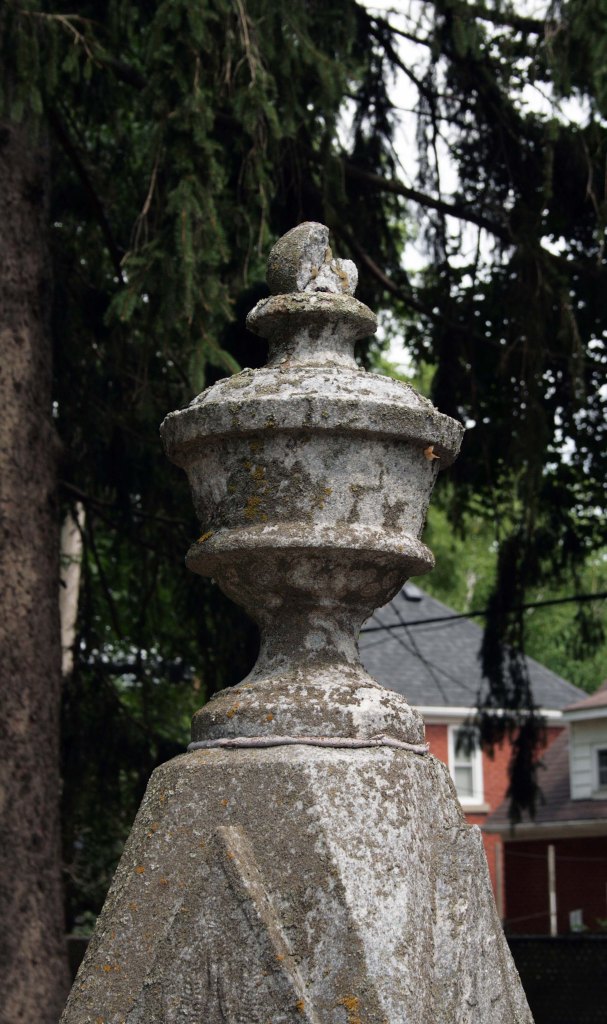
If you spend a lot of time in cemeteries you will often start to notice the repetition of certain cemetery symbols and motifs. In Ontario, more so in southern Ontario, urns tend to be a common gravestone symbol.
Although cremation was rarely practiced in North America at the time, the urn became a popular symbol in the Victorian era. Urns as a funerary symbol were adapted from Ancient Greece. Cremation was commonly practiced by the Ancient Greeks, who used ceremonial urns. As a gravestone symbol, the urn represents the body reduced to its most basic elements and the ascension of the spirit to heaven. Today cremation is a common practice, having started its climb to popularity in the 1980s.
I have found and photographed many urns during my cemetery walks, so today I wanted to share some of them with you.
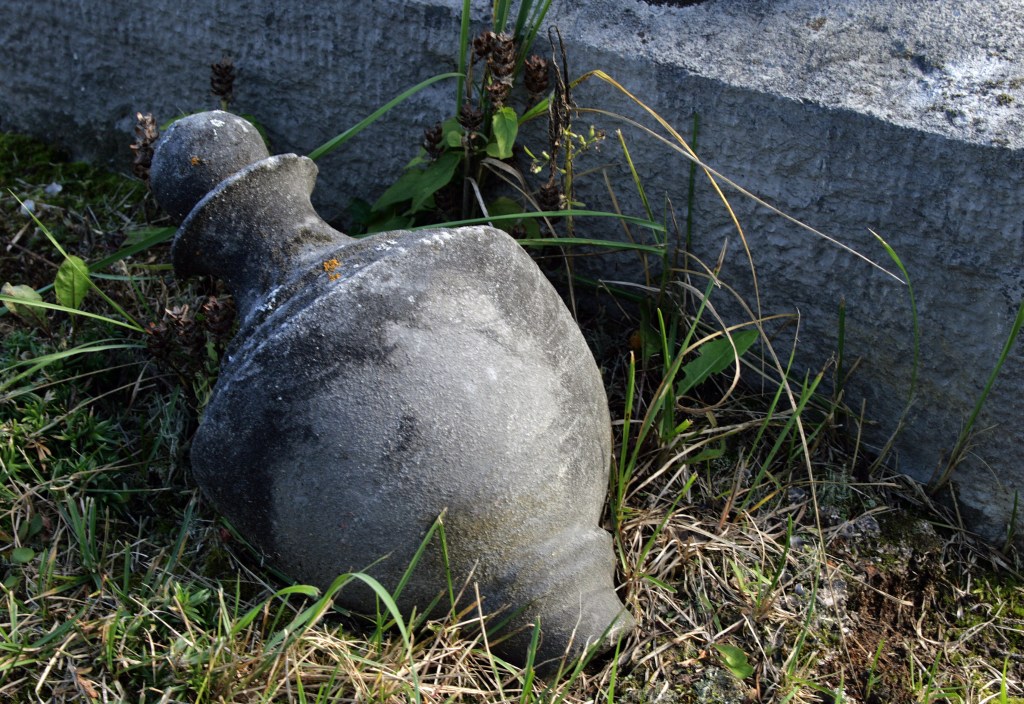
Like many graveyard symbols, the urn can be found depicted in a variety of ways. Each version of the symbol has a slightly different meaning. This is one of the reasons I find cemetery symbolism so interesting. It is a language unto itself.
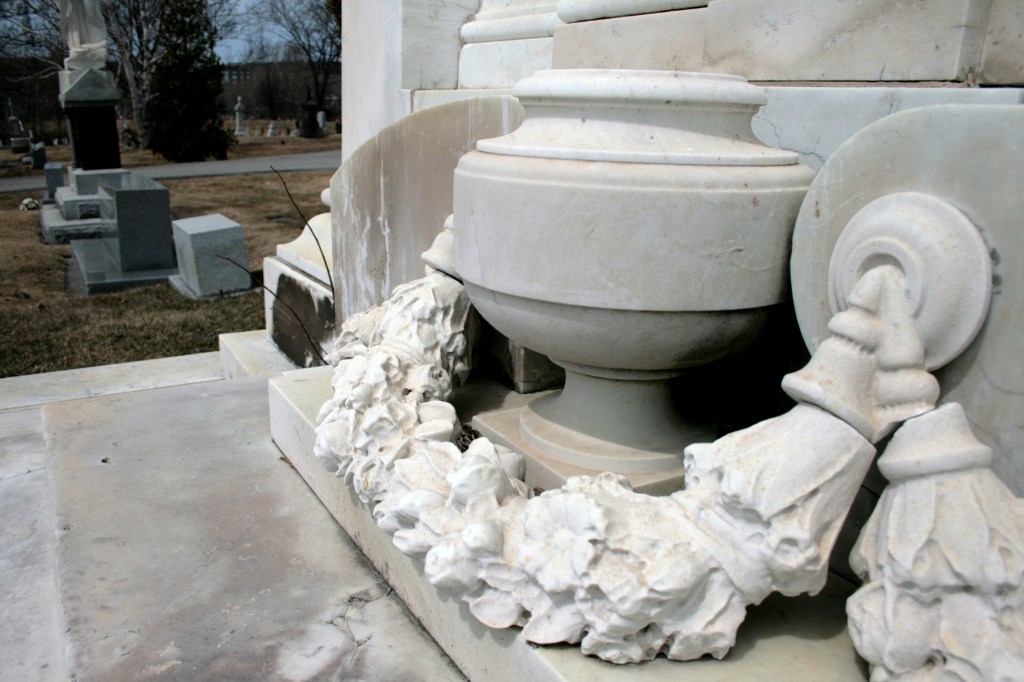
The Victorians were very fond of drapery, and you might come across what looks to be a fabric made of stone draped over an urn. Fabric draped over a gravestone is often thought to symbolize the veil between life and death. The fabric might also represent the shedding of earthly clothes as the deceased moves from this life to the afterlife.
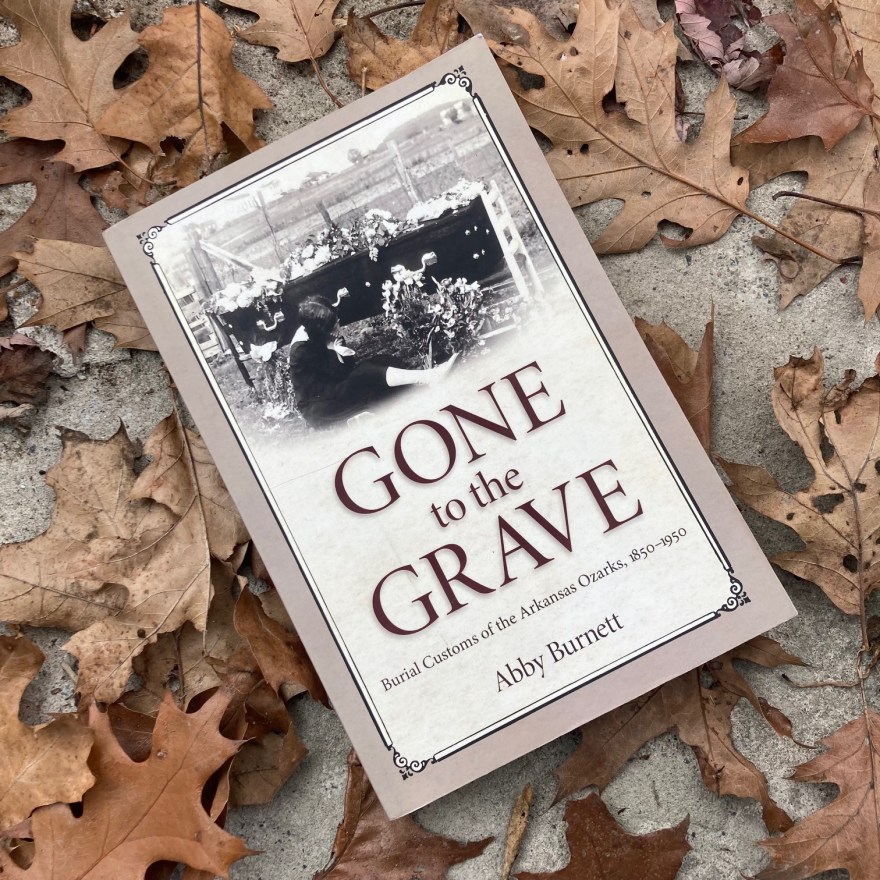
Being a Canadian, I am not 100% familiar with American history and customs. Luckily, there are MANY books written about it, and I do love to read. This month’s cemetery book review is Gone to the Grave: Burial Customs of the Arkansas Ozarks, 1850—1950 by Abby Burnett. I first learned about this book through the AGS Book Club, as this book was the pick for July 2023.
Published in 2014 by University Press of Mississippi, Gone to the Grave is written by Abby Burnett, a former freelance newspaper reporter and columnist for The Springdale News. At one time, her writing was food-focused, about understanding food and learning how to cook. Over time, her focus has shifted to death and burial practices.1In an article for the Arkansas Democrat-Gazette Burnett said,
“I’ve always loved cemeteries, and started seriously exploring ones in the Arkansas Ozarks about 25 years ago.”
Gone to the Grave is a collected work, the culmination of years of lectures, short newspaper articles, historical society journals, Arkansas Encyclopedia entries, and Gravestone Studies publications.1 It’s a very well-researched look into not only the burial customs of the residents of the Arkansas Ozarks, but also an in-depth look into deathcare and undertaking practices, health, and community life between 1850—1950.
Here is part of the book synopsis, from Goodreads:
“Gone to the Grave, a meticulous autopsy of this now vanished way of life and death, documents mourning and practical rituals through interviews, diaries and reminiscences, obituaries, and a wide variety of other sources. Abby Burnett covers attempts to stave off death; passings that, for various reasons, could not be mourned according to tradition; factors contributing to high maternal and infant mortality; and how loss was expressed through obituaries and epitaphs. A concluding chapter examines early undertaking practices and the many angles funeral industry professionals worked to convince the public of the need for their services.”
Gone to the Grave: Burial Customs of the Arkansas Ozarks, 1850-1950 by Abby Burnett
This book is fairly dense, but not the heaviest read I have come across recently. I am not going to lie, it did take me some time to work my way through it. It’s filled with black and white photos, including some post-mortem photographs. A big part of the author’s research includes diaries and interviews, with snippets printed verbatim to reveal what it was like to be a part of the funerals and burials at the time. I found these first-hand accounts fascinating. Death is a part of life, and reading about how a community would come together to sit up with the sick and dying, and everything that comes after a passing is eye-opening. Today, death is such a taboo that it’s not talked about, and we forget that it’s something that everyone goes through.
Learning more about these practices emphasizes how much things have changed. My uncle passed away in his home a few years ago. He had cancer and was spending his last days at home with his family. Two of my aunts went over to visit him, unknowingly on the day that he passed away. They knocked on his door, and his wife told them that he had just passed. They stayed to console his wife and visit with him one last time. Both of my aunts found the whole experience very surreal, as they had only ever visited deceased loved ones in a funeral home. But, that’s how wakes and funerals were done in the past, set up in the parlor of the deceased’s own home.
The practices discussed in the book are associated very specifically with the Arkansas Ozarks, it would be interesting to compare how different the practices are from other parts of the world. I often wondered as I read, if the customs described would have been much different than what customs were like here in Ontario around the same time.
Overall, I enjoyed this book. It covers a lot of information, but I found it was well-connected and flowed together well. This book is a deep dive, and as such might be too heavy for a casual reader. I read some reviews where people compared it to a textbook, which understandably might not be for everyone. I wouldn’t go that far, but it does get close to that territory. So, if you are looking for that kind of in-depth, high-level information, this may be the perfect book for you.
Have you read Gone to the Grave? What did you think? I would love to read your thoughts in the comments.
Thanks for reading!
I am always on the hunt for cemetery-related book recommendations. Please feel free to share yours in the comments. If you are an author and have a cemetery-related book you would like me to review, please reach out at hello@chantallarochelle.ca. I would love to hear from you.
A cemetery is filled with many interesting stories, stories of the souls that are laid to rest within its gates. But often the cemetery itself has an interesting story to tell.
Today on the blog I want to introduce a new series called Cemetery Stories. For these blog posts, I plan to focus on the story of individual cemeteries. I have visited a lot of cemeteries over the years, and many of them have interesting stories and historical significance. So for this series, I want to look a little deeper into history, geography, notable graves, and all the different elements that make them unique.
For today’s cemetery story, I thought I would look at Greenwood Cemetery in Owen Sound.
Greenwood Cemetery was created in 1858 when land surveyor Charles Rankin submitted a plan to the town council for a new public cemetery. At the time the plan was for 5 acres of land, divided into 27 blocks, including space for vaults.1Today the cemetery is quite large, sitting on approximately 40 acres of land.2Greenwood is also sometimes called “The People’s Cemetery” because, in those early days, the land was purchased using the people’s money.1The cemetery contains 26,700+ burials.1
The oldest home in Owen Sound can be found in Greenwood Cemetery. The house is dated from the 1840s1and is used as the cemetery office.2There is also a red brick burial chapel on the cemetery grounds. Built-in 1905, it served as both a chapel and a receiving vault. There is a trap door built into the floor that a coffin could be lowered through, into the storage racks below, to rest until the Spring when the remains could be interred. The chapel stopped being used for burials in the 1930s when the mausoleum opened. The chapel was converted and used as an office space for a time, until the early 90s. Today the building looks to be mostly empty.3
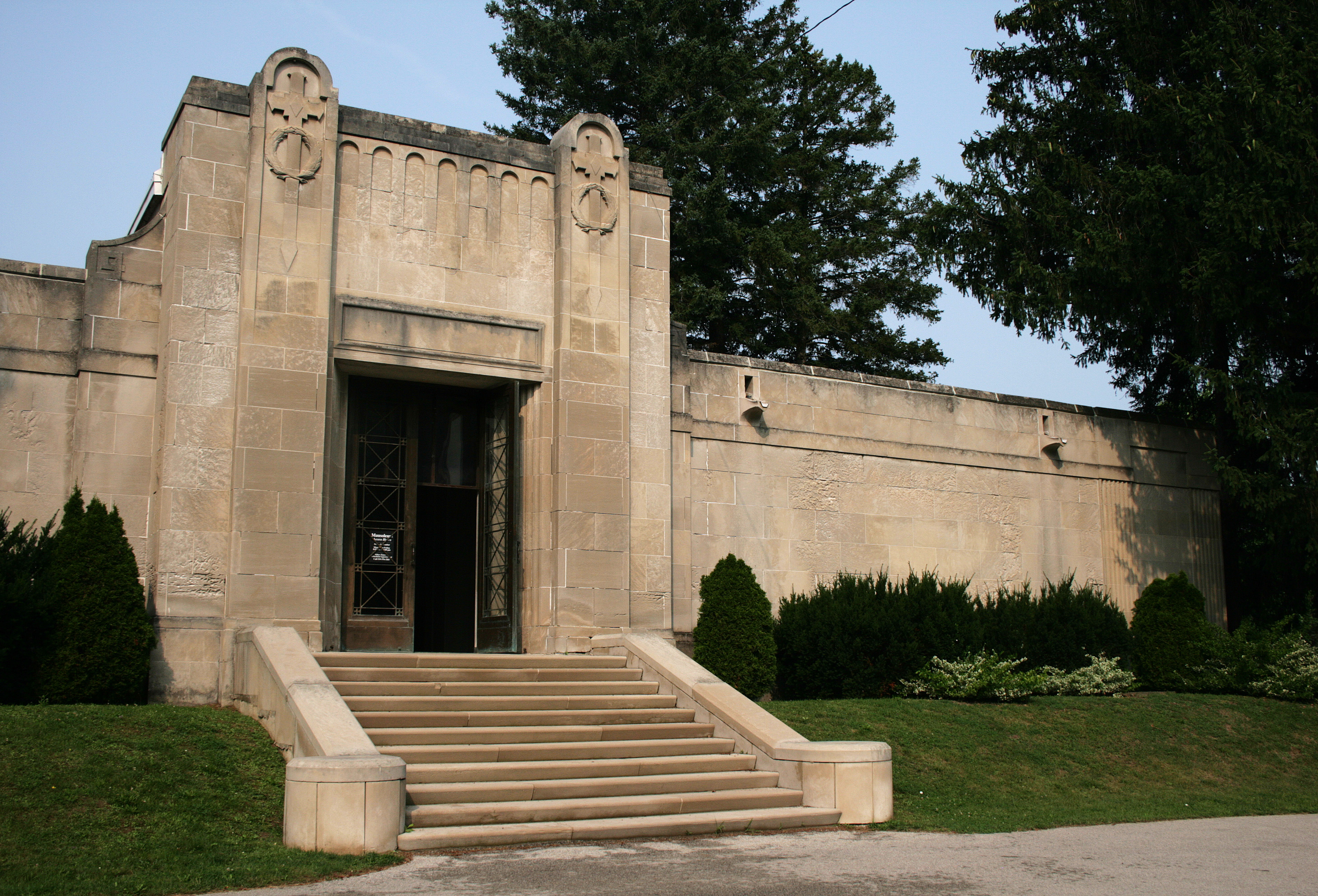
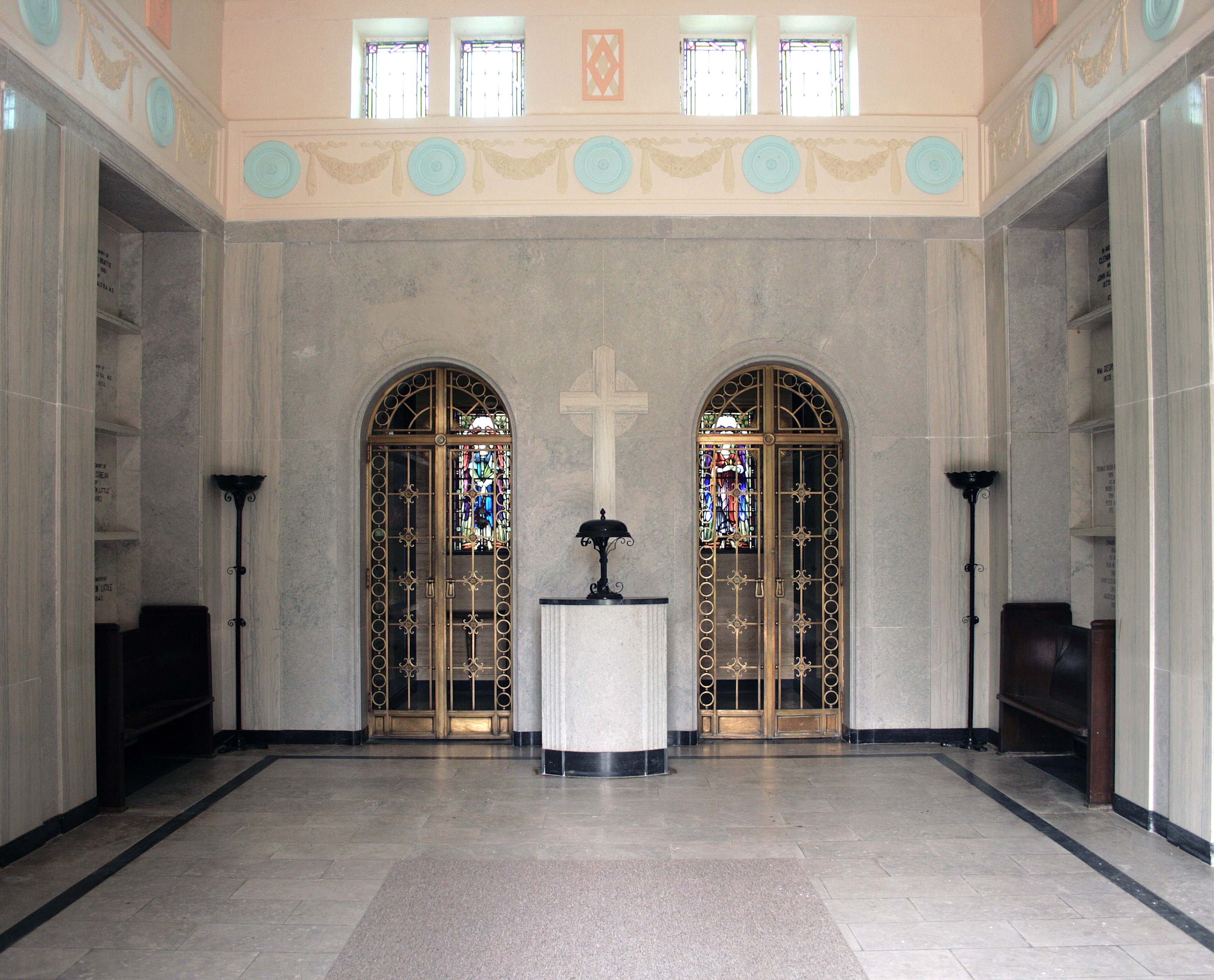
Greenwood is also home to a beautiful mausoleum. Construction of the large mausoleum began in 1927. The Art Deco-inspired exterior is covered in Indiana limestone, while the interior is finished with Italian marble. It also features some lovely stained glass windows and has a large central chapel that is used year-round.1
The cemetery is dotted with a variety of gravestone styles, and there are three memorial garden sections. It also has a section for members of the fraternal organization, The Independent Order of Odd Fellows (IOOF), that features a large stone cairn with IOOF symbolism.
Greenwood also has a Potter’s Field and memorial. The memorial honors the more than 1,000 women, children, and men who were buried in unmarked graves between 1858 and 1989. A potter’s field, also known as poor grounds, stranger’s plot, or indigent plot, is a section of a cemetery where those who are impoverished are buried.4 1,242 people are thought to be buried in Greenwood’s potter’s field4, all unmarked aside from the memorial and one lonely gravestone that sits close to the tree line at the back of the indigent plot. According to an article in the Northern Terminus: The African Canadian History Journal, many of the unknown graves are Black pioneers. Only a small few have been identified.
Among the unidentified graves lies an infant, who in 1889 was found in Victoria Park, wrapped in white cloth. The transcription in the cemetery records, simply reads “Unknown, child found dead”.4
Greenwood Cemetery is the final resting place of a few notable memorials. William Avery “Billy” Bishop, Canada’s World War I Flying Ace rests here. There are also two other Victoria Cross recipients buried here; LTC David Vivian Currie (World War II) and Thomas Holmes (World War I).
Speedskater and world-record holder Lela Brooks is also laid to rest here, as well as professional hockey player, Harry “Apple Cheeks” Lumley. Margaret and John Thomson, parents of famous Canadian painter Tom Thomson, are also buried here.
There are many more notable pioneers and local celebrities buried here, like Charles Rankin, who submitted the cemetery plan and helped bring the cemetery into reality. The best way to pay your respects is with a self-guided walking tour. The cemetery offers three tours that take you to different areas within the large cemetery and highlights all the notable members of the community who are laid to rest at Greenwood. You can pick up the printed tour guides at the cemetery office. The guides include a map, directions, and a little history for each stop on the tour.
We visited the cemetery twice on our trip to Owen Sound. Because it’s so large we felt we had to. Our first visit was late in the day, so the mausoleum had been locked up for the night. We were losing light quickly, and every turn on the winding paths revealed new sections I wanted to explore further. We visited again the next morning and were able to explore the Mausoleum and walk the sections at our leisure.
Greenwood was full of life during both our visits. In the evening we saw folks paying respects at graves, but also saw families taking advantage of the safe, paved pathways. Two young children were learning to ride their bikes between the rows.
The next day, we saw many walkers enjoying the scenery, both young and old. We also saw folks walking their dogs and running into others they knew who were doing the same. It was lovely to see a green space in use but also used respectfully.
Last October, My mother and I took a little road trip to Mattawa. We planned on doing some hiking, visiting cemeteries, and enjoying the fall colors. We always like to visit local museums when we visit new places, and the Mattawa Museum did not disappoint. We had a great time touring the grounds and learned a lot about the history of the city, including that it has the distinction of having Canada’s first elected Black mayor.
Mattawa, located in northeastern Ontario is a little over two hours drive from me. Mattawa is located where the Mattawa and Ottawa Rivers merge, in Nipissing District. The name Mattawa means “Meeting of the Waters” in Ojibwa.1 It is the oldest settlement in the Nipissing District, and today showcases that historic past with beautiful wooden sculptures. Many wooden sculptures of historic figures, important to Mattawa’s history, can be found scattered throughout the town.1
It was an overcast day when we visited Mattawa, but it didn’t deter us from exploring. We admired the two wooden sculptures on the museum grounds and looked for the three white crosses, that stand high on Québec Hill across the Mattawa river. The three crosses were erected in 1686 by missionary priests to mark the place where the two rivers meet.2
Inside the museum, we found a treasure trove of artifacts; paintings by a well-known Mattawa painter, many indigenous artifacts, and a large exhibit about Canada’s first Black Mayor, Dr. S. F. Monestime. The exhibit features large panels with many photos and a history of what brought Monestime to Mattawa, and how he changed the community for the better. The exhibit also includes some of his personal items, like his signature fedora and a medical skull used in his practice. My Mother and I were both interested in this exhibit the most, and were surprised that we had never heard of him before. We made it a point to pay our respects at the cemetery.
Saint Firmin Monestime was born in Cape Haitian, Haiti in December of 1909. Monestime grew up during the United States occupation of Haiti, which took place from 1916 to 1935. He graduated with a medical degree from the University of Haiti Medical School, and after graduation was named Medical Officer for the International Route between Haiti and the Dominican Republic.3 He experienced a lot during his medical career in Haiti, living through mass casualty events. He received the Knight of the National Order of Honor and Merit, awarded to those of distinguished excellence. He wrote four books around this time, about rural medicine.3
After becoming frustrated with the politics and what he called “deplorable conditions”, Monestime quietly left Haiti for Quebec. He was part of the first small group of Haitian professionals to come to Quebec in the 1940s. Unfortunately, this meant starting over as he had to train and intern for several years to get his full Canadian medical accreditation.3
Monestime found his way to Mattawa almost by chance. He and another colleague were traveling through Mattawa on their way to Timmins to see about setting up a medical practice. They stopped in for lunch at Chez Francois in Mattawa, and it just so happened that the restaurant owner recognized Dr. Monestime, as he had been operated on by the Doctor in Ottawa. The timing was right. The long-standing doctor in Mattawa had recently passed away and the town needed a new doctor. The restaurant also had a vacant room to rent and office space. Monestime agreed to stay, temporarily, but ended up staying indefinitely.3
Monestime found the community to be very welcoming and their generosity encouraged him to stay. His medical practice was booming with a busy office as well as on-call work with the hospital. That’s not to say that he didn’t experience racism in his time there.3 In 1972, he was asked by a reporter if race ever came into play, Monestime replied:
“My practice was booming in no time and from then until now I’ve had no serious problems. You might find a very few—and not the most intelligent—who may say they won’t come to see me because of my race. But very few.”3
Three months after Dr. Martin Luther King gave his “I Have a Dream” speech in 1963, Dr. St. F. Monestime also made history by being elected the first Black mayor in Canada. An active political figure in good standing within the community, regarded for his sense of justice and equality, he was elected mayor nine times.3 Today, the legacy of Dr. Monestime continues and is still felt vibrantly within the community as his family continues to do good works. The most notable of these works is the Algonquin Nursing Home, a project championed by Monestime in his last years.
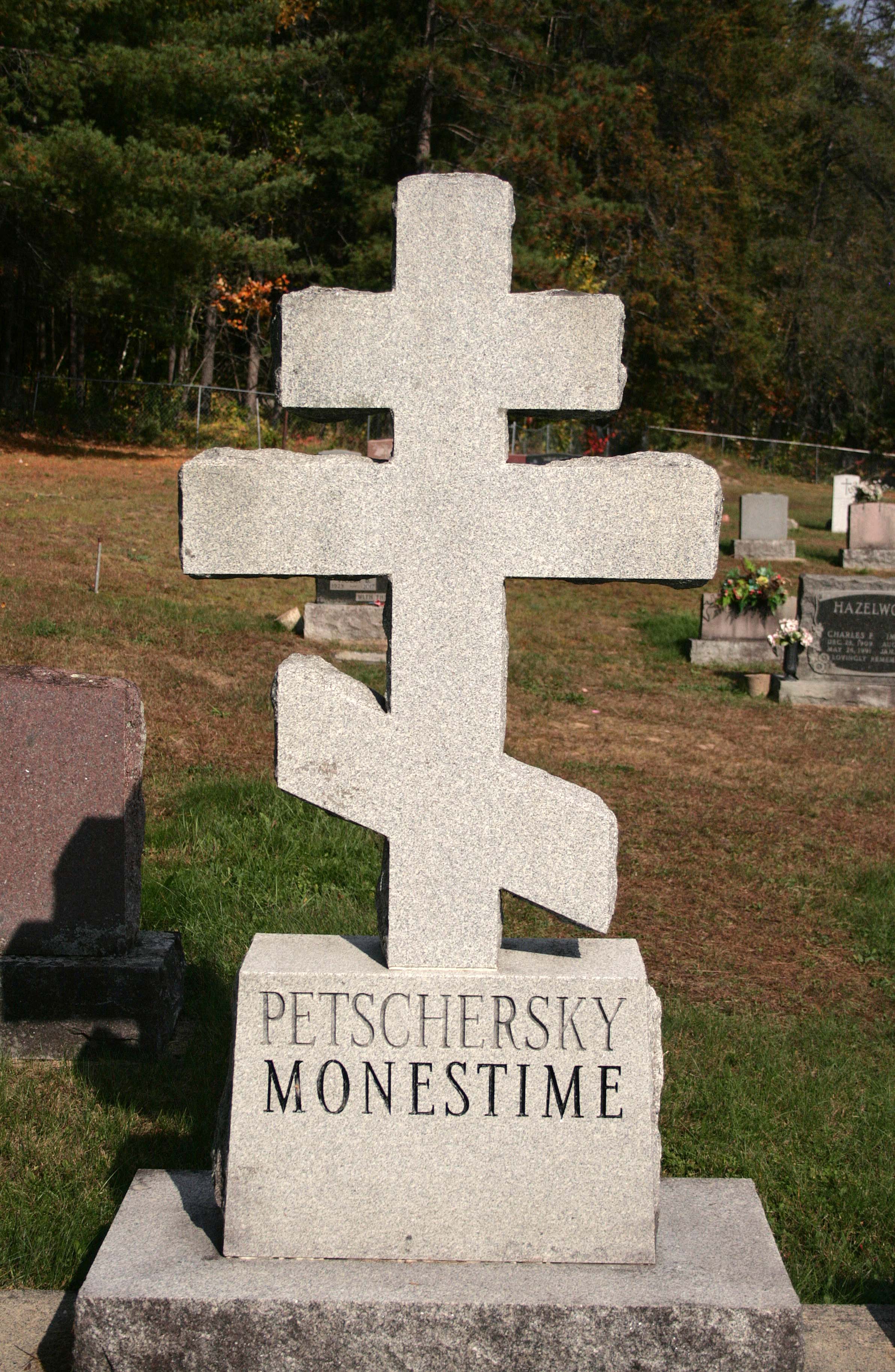
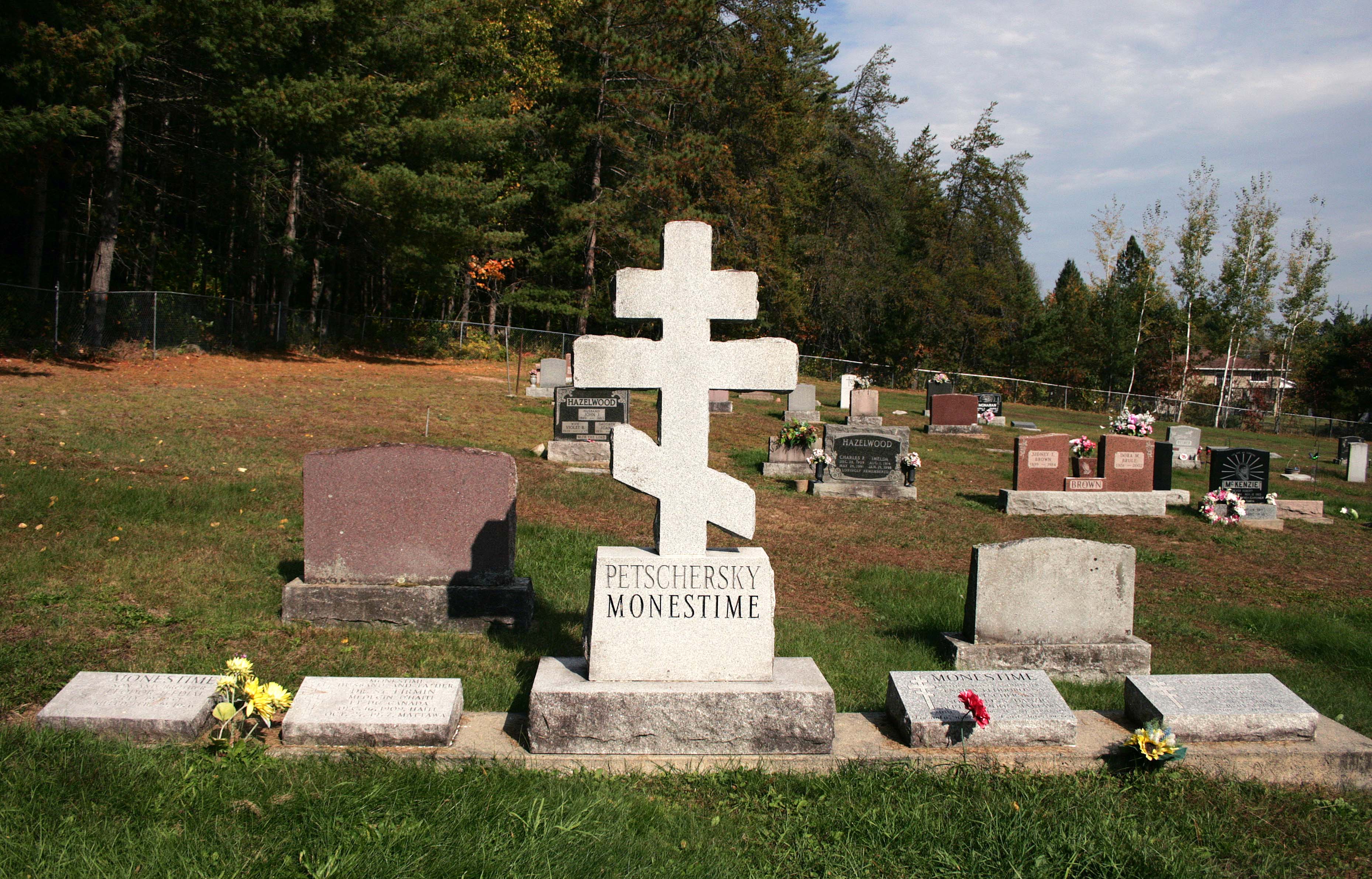
On October 27, 1977, Dr. Monestime passed away at the age of 67, most likely from pancreatic cancer, which he battled multiple times throughout his life. His Russian Orthodox funeral service took place at St. Anne’s Roman Catholic Church in Mattawa.3 He is buried in the Petschersky Monestime family plot at Pine Hill Union cemetery.
He is laid to rest beside his son Fedeor, who sadly was accidentally shot and killed a year earlier on February 29, during an altercation outside of Chez Francois.3Monestimes’ wife, Zena, and her mother are also laid to rest in the family plot, which features a large Eastern Cross. The Eastern Cross or Orthodox Cross has a tilted bar at the base of the cross; a tilted footrest. This is meant to illustrate that the thief crucified on the left side of Christ, thought to be the wise thief, went up to heaven, while the thief crucified on the right side was thought to be unrepentant, and went down to hell.4
My visit to Mattawa was an eye-opening trip. After exploring the exhibit at the museum, we stopped at the gift shop and spoke with the museum curator after buying a few things. We had a great conversation about the museum contents and how sometimes history is hidden in plain sight.
If you’re interested in learning more about Dr. Monestime, I highly recommend a visit to the Mattawa Museum and also picking up a copy of Where Rivers Meet by Doug Mackey. It’s a well-researched look at the life of Dr. Monestime and also explores life in Haiti as well as Black history in Canada.
Have you ever flown out of the Billy Bishop airport, in Toronto? Were you curious as to who the airport was named after? I was, but I never got around to looking into it, not until I stumbled upon the grave of William Avery “Billy” Bishop.
In the Summer of 2023, My mother and I stumbled across the Bishop family plot, while visiting Greenwood Cemetery in Owen Sound. We had come to Owen Sound to search for the second grave of Tom Thomson, but the trip ended up being just as much about Bishop.
William Avery “Billy” Bishop was born in 1894, in Owen Sound, Ontario. During his stint as a cadet at the Royal Military College in Kingston, World War I broke out. He enrolled in the 9th Mississauga Horse, Canadian Expedition Force and later transferred to the Royal Flying Corps.1 He received his pilot’s certificate in 1917, although some considered him a mediocre pilot, he was an expert shot with great shooting skill and extraordinary eyesight.2
Bishop became the first Canadian Airman to be awarded the Victoria Cross, the highest award for acts of bravery in wartime. Bishop was awarded the cross for his solo early morning attack on an enemy airfield in June, 1917.1 He single-handedly attacked a German aerodrome, destroying seven airplanes on the ground and shooting an additional four airplanes down, before running out of ammunition.2 Billy Bishop was the British Empire’s second-highest-scoring flying ace, with 72 official victories.1
Major William Avery “Billy” Bishop VC, DSO and Bar, MC, RFC 1917
Greenwood Cemetery
When we visited Greenwood Cemetery, we didn’t have any specific graves we wanted to see. I visited the cemetery office when we first arrived, as I had read online that they offered a self-guided walking tour. They were very friendly in the office and gave me a brochure with the walking tour details. There are a couple of different tours to choose from, that take you to different areas in the cemetery.
Greenwood is quite large, covering approximately 40 acres of land in the southwestern part of the city. It also has a long history, having opened to the public in 1854. It’s a traditional cemetery, with both upright and flat markers, a large mausoleum, memorial gardens, and a potter’s field memorial.3
We unexpectedly came upon the Bishop family plot after getting out of the car. I had parked in the heart of the cemetery. A small Canadian flag marked the grave, the flag blowing in the wind had caught our eye. There is a large upright stone that lists the family members buried there, with names on both sides of the stone. There are smaller flat markers laid in the earth surrounding it, marking where each family member is laid to rest. There is also a Canadian military marker for Bishop that stands apart from the rest. The upright grey granite marker lists his military designations alongside the emblem for the Royal Canadian Air Force and the Victoria Cross.
Bishop passed away at the age of 62, on September 11, 1956, in Palm Beach, Florida. His funeral service was held at the Timothy Eaton Memorial Church in Toronto, the same church that he was married in. 25,000 people lined up outside the church to pay their respects. He was cremated, and his ashes were buried in the family plot, in Greenwood.4 He is laid to rest with his family; including both his parents, his sister Mary, and his brothers Hiram, and Reginald Bishop.
Bishop’s wife Margaret remarried after his death, and is buried with her second husband in Beachwood Cemetery in Ottawa. She passed away in 1981 at the age of 83.5
The Billy Bishop House
The next morning, we decided at breakfast to visit one more thing before we left Owen Sound. My mother loves history, so I figured she would enjoy touring a historic home, The Billy Bishop House. She loved the suggestion, it seemed only appropriate to stop since we had already paid our respects at his grave.
The house, built in 1884, is the childhood home of Bishop and has been preserved as a historic site and museum. The first floor has been decorated with period-appropriate antiques and items owned by the Bishops. It looks very similar to what it would have looked like when Bishop was growing up. There is a timeline in the parlor that details all the major milestones in Bishop’s life. I found this floor to be the most interesting. There is a lot of information to take in, but also lots to look at; like Bishop’s uniform, personal items, and a copy of Winged Warfare, a book Bishop wrote in 1918 that details his experiences in the air.2
The second floor looks more modern and houses changing exhibits. When we visited there was an exhibit of interviews with veterans from the war in Afghanistan. In what would have been Bishop’s boyhood room, there is a wooden framed airplane for children to explore, and the room is decorated with film posters and other memorabilia.
The Billy Bishop House & Museum
The staff are incredibly knowledgeable and friendly. I had a nice chat with them about Bishop, as well as the haunted history of the house. I can’t help but ask when I visit a historic location! They were not phased by my line of questioning at all, and I’m sure it’s something they get asked often. The museum runs a ghost walk in the summer months.
Unfortunately, I wasn’t able to attend one of the walks, but I did get to hear some of the stories. The house is reportedly haunted by two spirits, an older woman and a young child. The spirit of the young child is thought to be Hiram Kilbourn Bishop, who died of diphtheria at the age of 4 years old, in 1892.6 People say they have seen a small child wandering the house, wearing what looks like a dress. Young children, regardless of gender, often wore dresses during that time period, which leads the staff to think it is the spirit of young Hiram.
We didn’t experience anything paranormal on our visit, but we did enjoy exploring the house and learning more about life in that era, Bishop’s personal life, and his legacy.
My mother and I both love history and getting to explore Bishop’s childhood home was a great way to end our Owen Sound adventure. We traveled to Owen Sound to learn more about art, but we ended up also learning more about our Canadian Military history. That’s one of the reasons why I love road trips, you can plan as much as you want but it’s often the spontaneous finds that end up being the most interesting. What do you think?










 Cemetery Photography by Chantal Larochelle