My Cemetery Bucket List

I just finished reading 199 Cemeteries to see before you die by Loren Rhoads. It’s a great read, showcasing beautiful and unique cemeteries all over the world. It has me thinking a lot about travel lately. Unfortunately, travel isn’t really in my future at the moment. We are currently in Step 3 of the Ontario Reopening Plan due to COVID-19. Restrictions have lifted a little and life is getting a little bit back to normal. But, I am not quite ready to do any major traveling just yet. This past year and a half have been hard, and my mind has wandered a lot—daydreaming of visiting far-off places and new cemeteries. 

Reading 199 Cemeteries to see before you die has been helping curb that wanderlust. A little bit. It’s been a nice escape, but my bucket list of cemeteries to visit just seems to be getting longer and longer!

Here are my current top 5 cemeteries I want to see before I die:

Sleepy Hollow Cemetery

Located in Sleepy Hollow, New York. This cemetery is 85 acres, and is most notably the resting place of Washington Irving, the author of The Legend of Sleepy Hollow. This cemetery might be best known for its fictional dead people—as the namesakes for characters in The Legend of Sleepy Hollow come from this burial ground. Supposedly even the grave of the Headless horseman can be found here. This cemetery also offers walking tours; The Original Knickerbocker: Washington Irving & The Legend of Sleepy Hollow and The Classic Evening Lantern Tour. You can also pick up a free legal-sized map at the Cemetery office, or purchase a full color 17 x 20 map for self-guided tours.

Website link: Sleepy hollow Cemetery

The Old Burying Point Cemetery

Located in Salem, Massachusetts. It is also known as the Charter Street cemetery. It’s the oldest cemetery in Salem, and holds some connections to the witchcraft trials that took place there in 1692-1693. It has many beautiful slate and sandstone grave markers. I would love to see the detailed deaths heads in person. Some of the more notable people buried here are: Salem witch trial judge John Hathorne, and a passenger on the Mayflower, Capt. Richard More. There is also a memorial to the men and women who were killed during the witch trials. 

Website link: Salem.org

Fairview Lawn Cemetery

Located in Halifax, Nova Scotia. This cemetery holds the graves of over 121 victims of the sinking of the RMS Titanic, that happened on April 15, 1912. They are memorialized with granite markers, laid out in the subtle outline of a ship’s hull. There is also a mass grave for the victims of the Halifax explosion that happened in 1917 and war graves of commonwealth personnel from World War I and World War II.

Website link: Atlasobscurea.com

Toronto Necropolis

Necropolis means “city of the dead” in Greek. This historic cemetery in Toronto Ontario, opened in 1850 and is the final resting place of many notable Canadians such as Toronto’s first Mayor, William Lyon Mackenzie and Dr. Roy Dafoe, of the Dionne Quintuplets fame. It is also the final resting place of George A. Romero, director of the horror movie classic Night of the Living dead. This large cemetery also contains a cremation chapel. The chapel was erected in 1872, with the crematorium added later, in 1933. 

Website link: Mount Pleasant Group

Saint Louis Cemetery No. 1

Located in New Orleans, this cemetery opened in 1789, it’s the oldest and most famous in New Orleans. Most of the graves are above-ground vaults, following Spanish custom due to the area having a high water table. The most notable graves here may be the Voodoo Priestess Marie Laveau, and notorious slave owner Delphine LaLaurie. You can also find the future final resting place of Nicholas Cage here.

Website link: The French Quarter.com

Do you have a cemetery bucket list? Tell me about it in the comments.

Thanks for reading!
World Photography Day

Today is World Photography Day! This annual day of recognition celebrates the art, science, and history of photography.

“A photograph has the ability to capture a place; an experience; an idea; a moment in time. For this reason, it’s said that a picture is worth a thousand words. Photographs can convey a feeling faster than, and sometimes even more effectively than words can. A photograph can make the viewer see the world the way the photographer sees it.” – worldphotographyday.com

I absolutely love photography. It’s been a hobby of mine for quite a while. To me, taking a photo is capturing a moment from my point of view. I have dabbled in many different forms of photography; wedding, portrait, food, landscape, and more. My niche is cemetery photography. I have always been drawn to cemeteries. I love being able to show others how I see them. I love using my lens to showcase minute details, rolling hills dotted with stones, curious creatures who call cemetery’s home and so much more.

So how can you celebrate World Photography Day?

  • Learn a little something about the history of photography
  • Discover some new photographers on Instagram
  • Share your photos
  • Visit worldphotographyday.com

But most importantly – Get out there and shoot!

Discovering a New Cemetery

There is a bit of a thrill in discovering a new cemetery.

While doing some photo editing of some photos I took on my vacation, I discovered a cemetery in Sturgeon Falls that I did not know existed. I noticed in my photo files that I had the name of the Sturgeon Falls cemetery entered incorrectly. While looking into the appropriate cemetery name, I discovered there is another hidden cemetery in Sturgeon Falls—Union Cemetery.

This is super exciting to me because I had thought that I had photographed all of the cemeteries close to me. And this gives me an excuse to go on yet another mini road trip!

By using Google Maps and street view, I was able to locate the entrance and get a glimpse of what the cemetery actually looks like. The cemetery grounds look quite large! The entrance also looks like it’s a little bit tucked away, so it will be very interesting to find this location in person and photograph it.

Images from Google Maps

Discovering a new cemetery can be just as exciting as actually visiting it. I can’t wait till the next time I am in Sturgeon Falls!

Thanks for reading!

Cemetery Etiquette

“Take nothing but pictures, leave nothing but footprints.” – Chief Seattle.

This sentiment embodies my mindset when visiting cemeteries. They are beautiful places to visit. But you must always be mindful that cemeteries are resting places for lost loved ones, and deserve respect. I always keep that in mind when visiting cemeteries. I would never want to intrude on someone’s grieving, interrupt a funeral service or meddle with someone’s memorial items. Because of this, I tend to follow my own set of etiquette rules when visiting a cemetery.

When encountering people I always try to keep my distance

It doesn’t mean that you should turn around and leave if you see mourners. But realize that your presence there might not be understood or wanted. For these reasons, and out of respect of the mourners, I will spend my time in other areas of the cemetery to not bother them. This does not mean you should always stay away from people though. In my travels, I have found the groundskeepers to be very friendly, and will sometimes point out interesting stones. They are very proud of their work maintaining the grounds and some of them love to chat.

Always leave with what you brought in

It’s completely fine to bring food with you for a snack in the graveyard, or to walk your dog. As I’ve said before, cemeteries are a beautiful place for a walk. Just make sure you pick up after yourself and your furry friend! Some cemeteries do have trash bins that are accessible, but when visiting older hidden away locations, there may not be any. I always carry a plastic bag in my camera bag just in case.

Do nothing that would harm or destroy a tombstone or memorial

I would never displace or move around memorial objects or grave goods. I always leave things as they are for my photos. I find that the found objects are more meaningful that way.

Be respectful

I sometimes clear away debris from stones; leaves and dirt that obscure the inscription. I also sometimes pick up over-turned items if they have fallen. If items are far away from a tombstone, I find it better to leave them where they are, just in case you accidentally place them on the wrong grave. I think that cleaning tombstones (with water and chemicals) should be left to professionals. There are resources out there to help you get started in the right way if that is something you are interested in getting into, and ALWAYS get permission before you start.

A note about gravestone rubbings and castings

These seem like a fun idea to get a nice souvenir but some of the methods used for rubbings and castings can be very damaging to stones. If the stone is too fragile it can break. Castings are also dangerous to stones as it can remove pieces of the stone while also leaving stains and residue that is hard to remove. I’m sure there are resources out there on how to do this kind of thing safely, but I would be very cautious and make sure your technique is perfected before trying it in the wild. And again, ALWAYS get permission before you start.

Do you have any questions about cemetery etiquette? Or do you have any unwritten rules that you follow when visiting a cemetery? Please share in the comments!

Thanks for reading!

The road so far…

I recently started reading the book 199 cemeteries to see before you die by Loren Rhoads.

It’s a beautiful book, that can be used as a travelogue, that lists must-see cemeteries all over the world. It highlights the history that makes each of them unique. The descriptions are accompanied by beautiful photos as well. I get wanderlust just looking at them! 

It got me thinking about what my tally actually is for visited cemeteries. When I was younger, in the early days of my cemetery traveling, I did not document my cemetery photos that well, and have actually lost a large amount of those photos. They would have been taken with film cameras and an old digital point-and-shoot camera. I may still have the negatives somewhere. 

I remember getting lost in the large cemetery in Guelph, Ontario, but don’t have the photos to prove it. I also remember chatting with the caretaker at the old cemetery in Amos, Quebec, and how excited he was to show me some of the more interesting stones there. I don’t have the photos from that trip either. That is one I really regret, as my Mother is from Amos. In that cemetery, it was amusing to see her turn around in circles, amazed at all the family that was buried there. I really wish to go back to visit there again someday. 

So based on my folders of properly labeled and dated photos, here is the breakdown of how many cemeteries I have visited, so far:

  • Sudbury – 19
  • Ontario – 56
  • Other Provinces:
    • Quebec – 6 
    • Saskatchewan – 2
  • United States:
    • New York City – 2
  • Total – 85 cemeteries

My record for the number of cemeteries visited in one day is 13. Maybe one day that record will be broken, but it has been standing since 2019.

Thanks to 199 cemeteries to see before you die, I have added a large number of cemeteries to my bucket list. Due to the pandemic though, those won’t be added to my tally anytime soon. For now, I will focus on continuing to visit cemeteries close to me. Maybe by the end of the summer, I will have hit 100?

Do you have a running tally of visited cemeteries? What is your number? 

Thanks for reading!

Symbolism and Iconography

Cemeteries are full of symbolism.

I find it fascinating and love trying to decipher the symbols and iconography I find. Symbolism can be found adorning tombstones and mausoleums. These symbols can range from simple designs to very elaborate ones. The meaning of symbols is a language in itself, and you can tell a lot about a person by what is on their tombstone. Religion, hobbies, clubs, and organizations can all be found represented, among other things, by symbols and icons within a cemetery.

Whenever I spot a symbol I have not seen before, I always turn to my handy reference books. If I can’t find what I am looking for there, the internet is the next best place to look. My go-to reference book is Stories in Stone: A field guide to cemetery symbolism and iconography by Douglas Keister. I have had this book forever, and always go back to it when I see something new. It’s a very in-depth look at what can be found in a cemetery. It covers architecture, sculpture, symbols, as well as acronyms and initials. I highly recommend it!

I recently added another reference book to my library, Understanding Cemetery Symbols: A field guide for historic graveyards by Tui Snider. I have just started getting into this one and I can tell right away it will be a great resource. It has some really in-depth sections on hand symbolism as will as crosses and even statuary.

So what kind of symbols and iconography can you find in your local cemeteries? For the most part religious symbolism is very common. Below are some examples of some common and not-so-common symbols you can find in Canadian cemeteries:

I love finding hands on a tombstone. Hands are shown in many different forms; pointing downward, pointing up, shaking hands, etc. the list goes on! And all of these different positions have different meanings. One of my favorite examples of hands was found in Terrace Lawn Cemetery in North Bay. These stones have weathered beautifully. This hand is pointed downward, with a finger extended which can symbolize God reaching down to collect a soul. The extended finger can mean a sudden or unexpected death. This hand below, is also holding a chain. A broken link in the chain can represent a family or marriage broken by death.

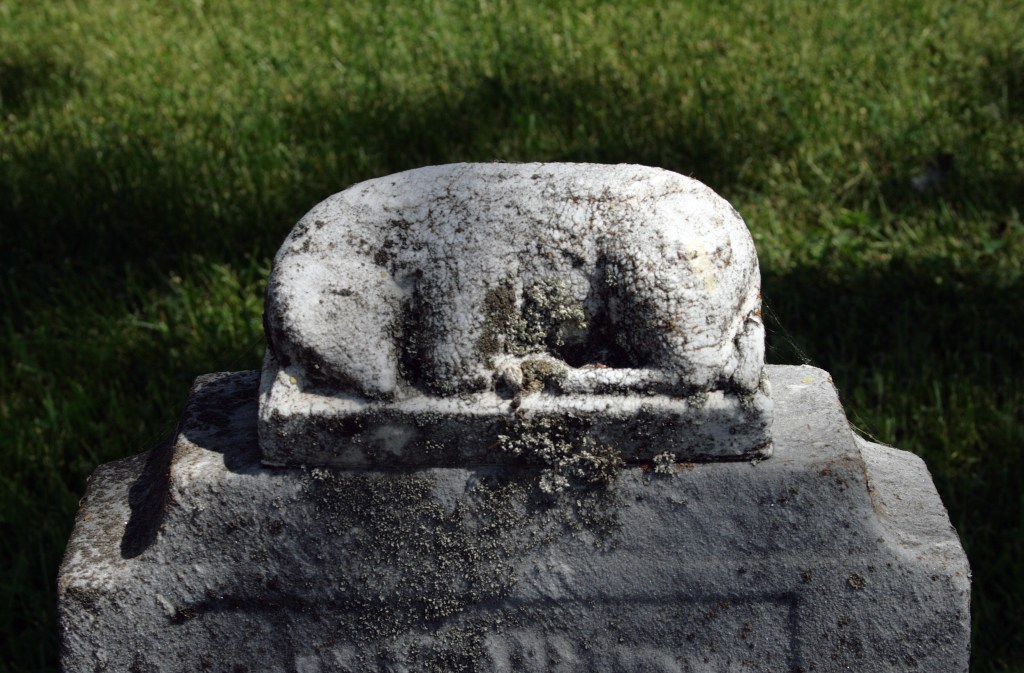
Lambs are a very common sight in cemeteries. These are sometimes accompanied by a tree stump, implying a life cut short. The Lamb itself represents “the lamb of God” and innocence. Sadly, lambs are most often found at the grave of a young child or infant.

Skulls are very rare to come by in my local Canadian cemeteries. I have only found two in all of my local travels, but I am always on the look out for them. They are more commonly found in other places of the world, like the United States and Europe. Most obviously a skull represents death. A skull found at the base of a cross is thought to be symbolic of the skull of Adam.

I have many great examples of symbols and iconography in my photography. If you are interested in seeing more and learning about their meanings, I share them every Friday on Instagram and Facebook.

I would also love to hear about the symbols you have found on your cemetery travels. Do you have a favorite? I would love to read about them in the comments.

Thanks for reading!


References:

  1. Understanding Cemetery Symbols: A field guide to historic cemeteries by Tui Snider
  2. Storie in Stone: A field guide to cemetery symbolism and iconography by Douglas Keister

Crosses for Change

A few weekends ago I visited Crosses for Change, a large roadside memorial that has been making headlines in the local news. 

It started with one white wooden cross, representing a life taken by opioid addiction. More and more white crosses are added almost every day. 

This sea of white crosses can be found in the downtown core, on the corner of a busy intersection. It stands as a memorial to those lost to the current opioid crisis.

This haunting memorial has definitely made an impression on people, in some very different ways. For some it stands as a call to action against the opioid crisis. For others, it is a place of mourning—a place to grieve for lost loved ones. For our cities homeless population, it is a grim and constant reminder of their current struggles. 

I am reminded of a quote I heard a long time ago, although I don’t remember where I heard it from; “Cemeteries are not for the dead, they are for the living”. I think about this almost every time I visit a cemetery. This roadside memorial to me, is a good example of this. These crosses represent the memory of a person, but there are no bodies here. They are buried in cemetery plots, within cemetery gates. But this little field of white crosses, for all intents and purposes is a cemetery—in downtown Sudbury. 

For further reading on Crosses for Change and the opioid crisis in Sudbury:

Cemetery Appreciation Month

I just found out today that May is Cemetery Appreciation Month!

It’s not an official declaration by any means, but those in cemetery circles have been celebrating; and that is good enough for me! Cemeteries are often seen as taboo, so seeing them celebrated makes me very happy. 

Cemeteries are a beautiful place to visit and right now with COVID-19 ravaging the world, cemeteries are a great place to social distance as they are not often bustling with people. 

So in honour of Cemetery Appreciation Month, I have created a little bucket list for myself.

Volunteer some time to fulfill some photo requests in my area for Find A Grave.com – This is a great way to explore, take some photos and help others. Using Find a Grave, anyone can request photos of a particular grave. This is usually used in research, most commonly genealogy.

Visit a cemetery I have not visited before – This is a great opportunity to take a little road trip.

Visit my favourite local cemetery – It’s been at least a year since I have been to Eyre cemetery, here in Sudbury. This is a great opportunity to pay another visit.

Have a picnic in a cemetery – I am taking a cue from a new Instagram account I follow for this one – cemeterylunches “Promoting death positivity one meal at a time”.

Happy Cemetery Appreciation Month!

April showers bring May cemetery flowers

Spring always makes me think of cemetery flowers.

Flowers may not be the first thing on your mind when visiting cemeteries, unless of course you are bringing in an arrangement. But you may start to notice them more and more, dotting the graves, as well as the green spaces in between. Wild flowers can be found snaking through the grass and reaching into all corners of a cemetery plot.

Abandoned cemeteries are usually filled with wild flowers as there has not been anyone to weed or tend to the ever growing vines. They add a lovely pop of colour to a green space.

I have seen some plots completely filled with wild flowers, where families have made the entire plot a flower bed. I imagine their loved one must have been an avid gardner.

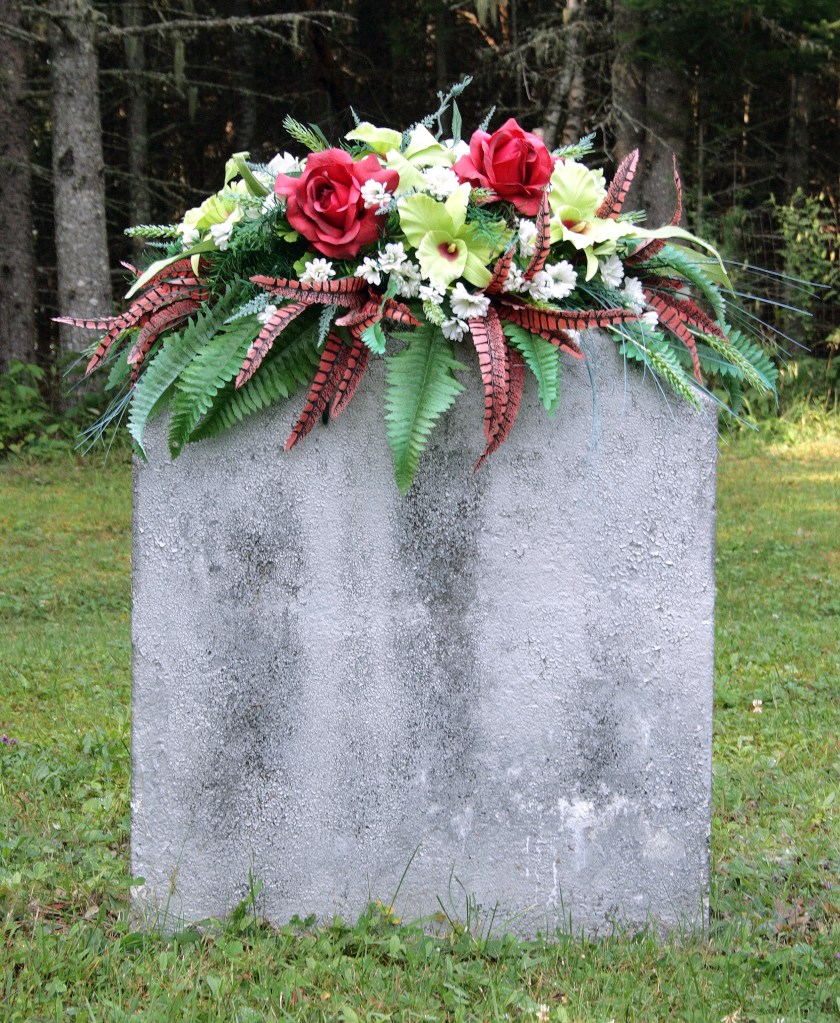
You might also see fabric or plastic flower arrangements. These must have been so beautiful when they were first placed; clean and bright. Over time these arrangements take on a different kind of beauty— weathering the elements and time.

Springtime also means that the snow is melting, making cemeteries more accessible. Trudging through the snow is never fun. I have been slowly making plans for some road trips this spring and summer to visit some new-to-me places as well as some of my favourite spots.

Thankfully cemeteries are not usually a bustling place so being able to physically distance while exploring is great.

Thanks for reading!