Stone Stories: Canada’s Cancer Nurse

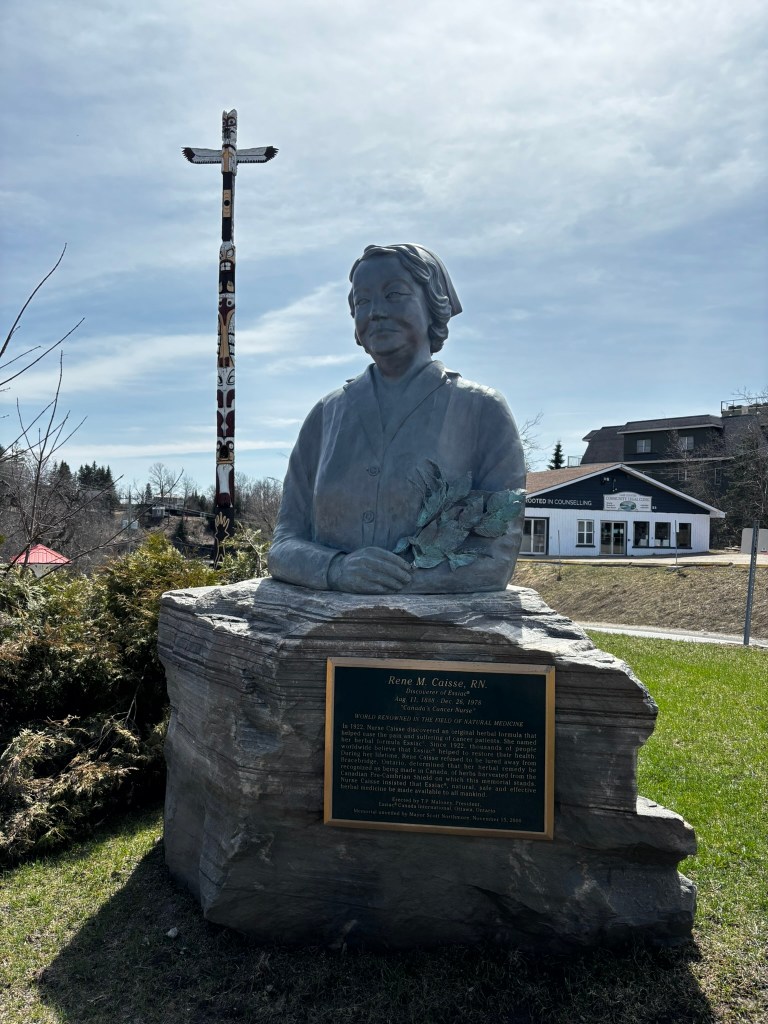
I first learned about René M. Caisse by chance during a visit to downtown Bracebridge, Ontario. The restaurant I had planned to visit with my Mom was closed, as was most of the downtown core, because it was Easter Monday. Only one place was open, and it just so happened to be across the street from a statue of René M. Caisse.

After reading the plaque, I pulled out my phone and did a quick search to discover that she was the woman behind the herbal remedy known as ESSIAC.

I had never heard of Caisse before, or ESSIAC, for that matter. The more I read, the more I had to know.

What exactly was ESSIAC, and how did this small-town nurse end up known around the world? A little more searching revealed that her final resting place was also in Bracebridge, so I added a stop to our trip to pay our respects. By the end of the day, I would find myself standing beside her gravestone, reflecting on how one small discovery downtown had turned into a much larger story.

René M. Caisse

René M. Caisse was born on August 11, 1888, in Bracebridge.1 Trained as a nurse, she developed an herbal formula for patients that she later named “ESSIAC”, her last name spelled backwards.2 The formula included roots, bark, and leaves of plants such as burdock root, sheep sorrel, slippery elm, and rhubarb root.3

In her manuscript, I Was “Canada’s Cancer Nurse”: The Story of ESSIAC, Caisse described how she first learned about the herbs that would later shape her life’s work. In the mid-1920s, while serving as head nurse at the Sisters of Providence Hospital in northern Ontario, she encountered an elderly patient who had once been diagnosed with advanced cancer.4 According to Caisse, the woman told her that decades earlier, a local Indigenous medicine man had offered her an herbal remedy. The woman chose to follow his instructions, preparing a daily tea from the specific plants he identified in the region. When Caisse met her nearly thirty years later, she seemed to be in remission.4

Caisse wrote that at the time, a cancer diagnosis often felt like a death sentence.4 The patient’s story stayed with her. She recorded the names of the herbs and later began refining the formula, eventually combining several plants into what would become known as ESSIAC.4

Caisse maintained that she never claimed to have discovered a guaranteed cure for cancer, explaining that her goal was to control the disease and pain relief.4

A bronze statue in the Bracebridge downtown core honours her work. The sculpture, created by Huntsville artist Brenda Wainman-Goulet, stands on a stone base near where her clinic once operated.5 During the 1930s and early 1940s, thousands of patients travelled to the Muskoka region hoping to visit her clinic.2
But, along with the attention came controversy.

The medical establishment questioned the effectiveness of her remedy, and government reviews in Canada concluded there was no clinical evidence to support ESSIAC as a treatment for cancer.5 Some studies even indicated it could cause possible harm.3 Caisse, for her part, believed powerful interests stood in the way of broader acceptance. She wrote that it would make established research foundations “look pretty silly if an obscure Canadian nurse discovered an effective treatment for cancer.”4

Even so, people still seek out ESSIAC, drawn by word of mouth and the hope that this herbal blend might offer relief when other options feel limited. Her legacy remains visible in Bracebridge and beyond, through her statue, a theatre named in her honour, and through the many stories of those who came to her clinic in search of help.5

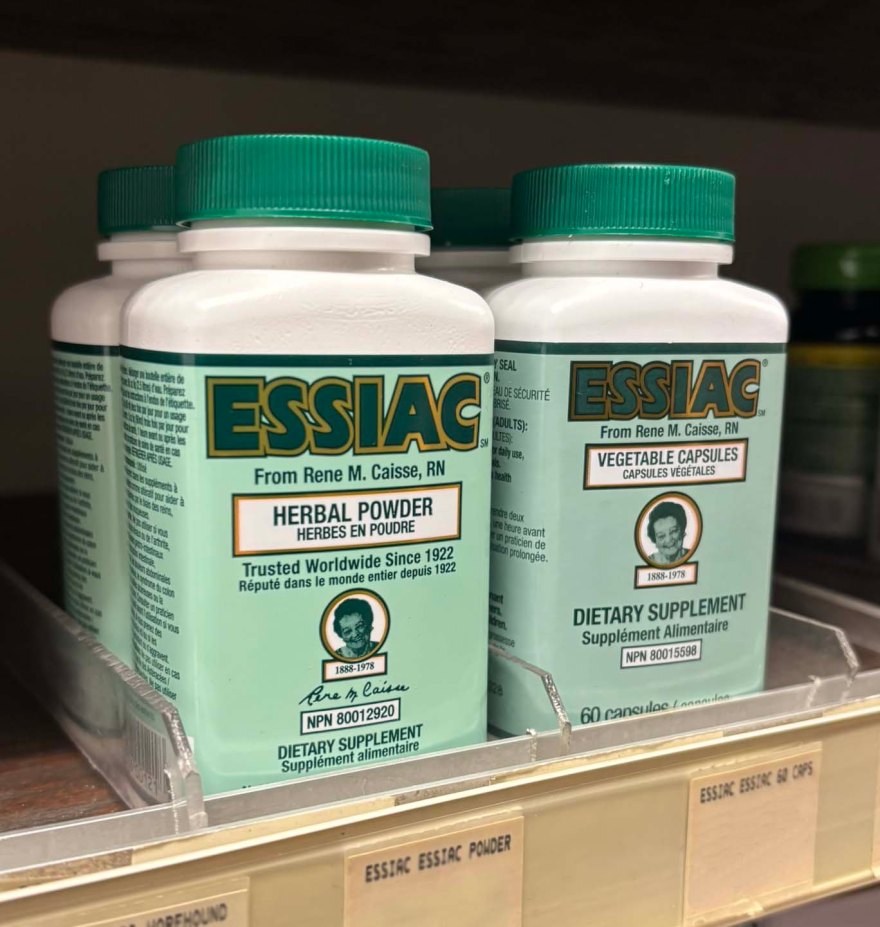
Beyond Caisse’s time, the remedy has been commercialized and repackaged. For example, the company ESSIAC®, through ESSIAC Canada International, touts its herbal blend as “trusted since 1922,” with marketing of powdered, capsule, and liquid extract forms.6 Meanwhile, Resperin Canada Limited claims to prepare “Resperin’s Original Caisse Formula Tea” using Caisse’s original herbal recipe.7

Even with all the marketing around it today, independent sources still say there’s no reliable evidence that ESSIAC works as a cancer treatment.3

Months after our trip to Bracebridge, the story followed me home. I was pleasantly surprised to discover that my local natural food store carries a version of ESSIAC. Standing in the aisle and seeing her name and likeness on a bottle nearly a century later made the story feel less like history and more like something still unfolding.

Curious, I asked what forms they carried and ended up purchasing a small sample of the four main herbs that make up ESSIAC. The store sells it as loose herbs, herbal powder, in capsule form, and as a pre-mixed blend packaged in a large bag. The clerk told me ESSIAC is popular and they always keep it in stock. She mentioned that sales tend to come in waves, and that often people who have just received a cancer diagnosis come in looking for it.

It’s interesting to see how Caisse’s legacy still lives on the shelves of health shops nearly a century later, with people continuing to turn to it in moments of uncertainty. Whatever conclusions science has reached, the hope attached to her name has clearly endured.
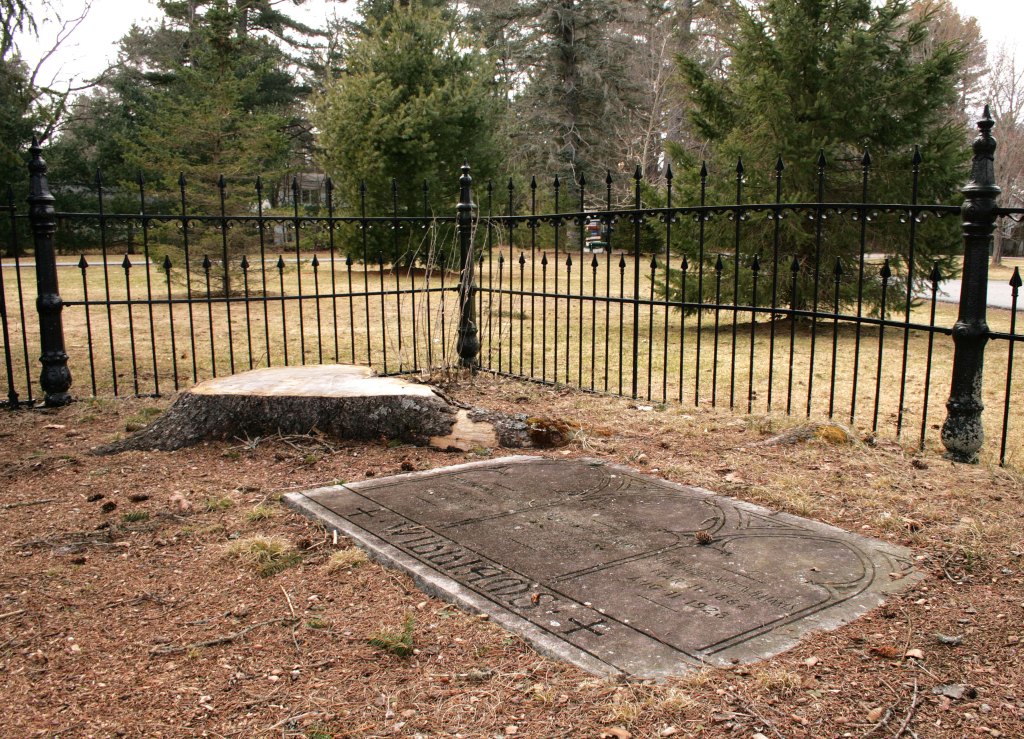
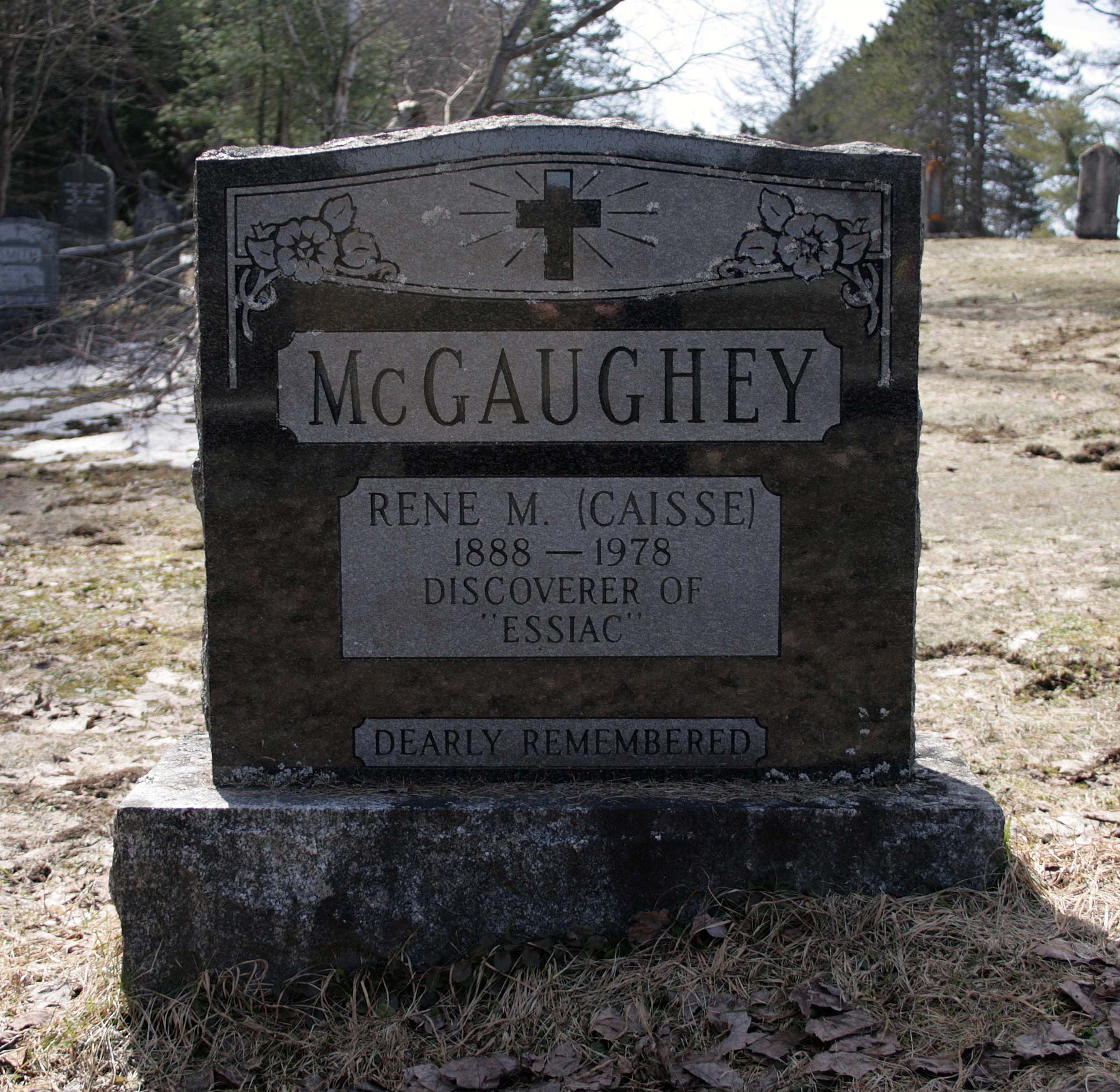
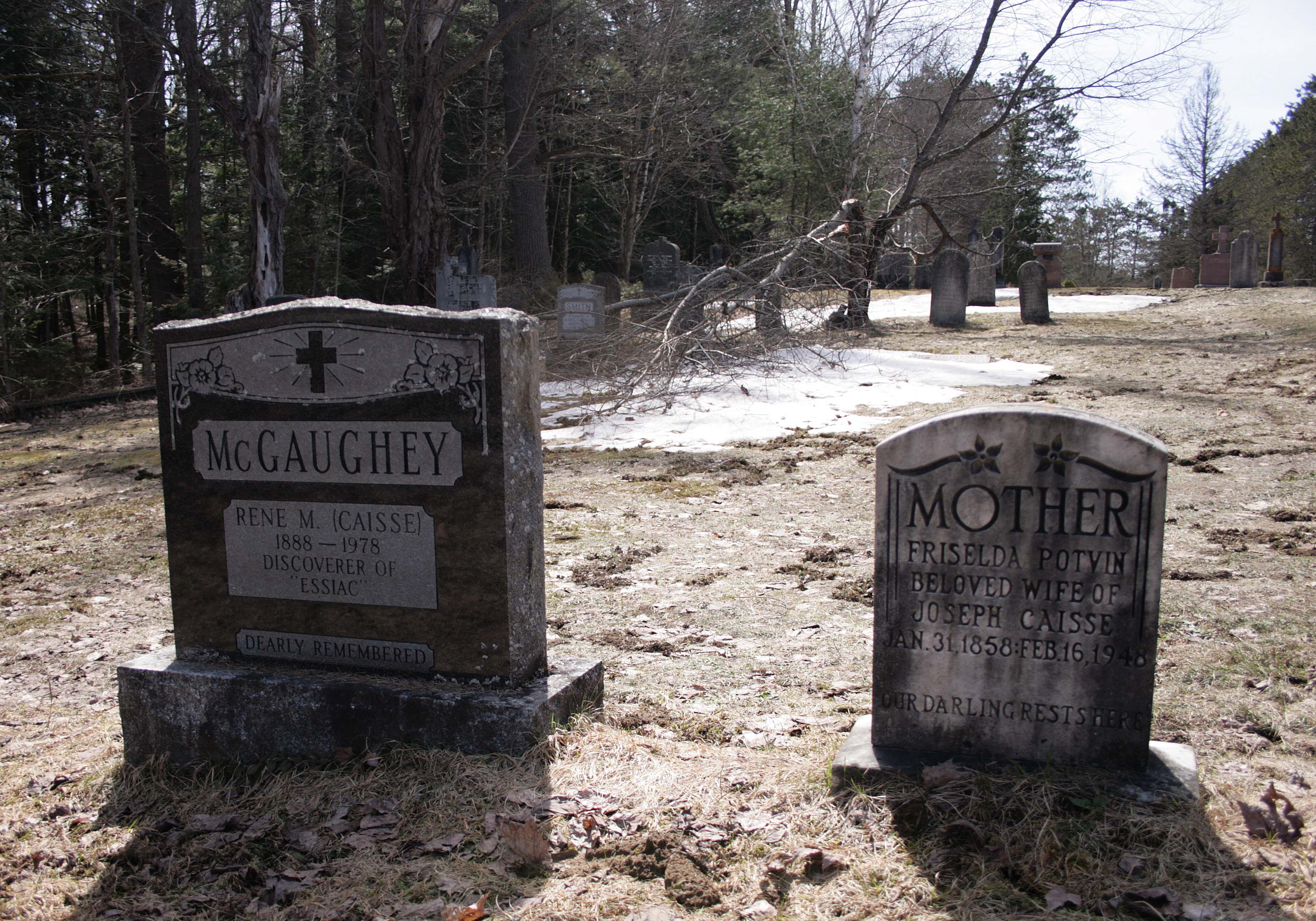
René M. Caisse McGaughey suffered a broken leg after a fall at her home, from which she never recovered.8 Five weeks later, on December 26, 1978, she passed away at the age of 90.8 Although she received tempting offers to establish clinics in the United States, she chose to remain in Canada. In her writings, she explained that her ancestors had come to Canada from France in the 1700s and that she was determined to prove the merit of ESSIAC in Canada so the country would receive the credit.4 Not far from the statue that first caught my eye, Caisse now rests in Saint Joseph’s Roman Catholic Cemetery in Bracebridge.

Finding her grave felt like the final piece of the story. From spotting the statue downtown, to learning about her work, to standing at her grave, the story had come full circle. Her gravestone, which acknowledges her as the “Discoverer of ESSIAC” is simple yet powerful.

Walking among the rows of gravestones, I reflected on how her story is deeply rooted in this place. She is remembered not only because she lived and worked in Bracebridge, but because the community continues to honour her in visible and lasting ways.

In many ways, this visit brought together local history, public memory, and my own curiosity, all meeting at her final resting place.
René Caisse’s life offers a fascinating mix of determination, controversy, and local remembrance. She stands out as a woman from a small town who believed in an herbal remedy, faced bureaucracy, and left a legacy that is still visible today.

While the scientific verdict on ESSIAC is still debated, the story of its creator remains part of Canadian medical history.3

Visiting her statue in downtown Bracebridge, noticing her name on a product shelf, and standing beside her grave reminded me that remembrance takes many forms. Sometimes it’s cast in bronze, sometimes printed on packaging, and sometimes it’s etched in stone, just waiting for someone to notice.

Thanks for reading!


References:

  1. Timeline of Essiac History | Rene Caisse Revolutionary Nurse & Holistic Pioneer
  2. Who was Rene Caisse? | ESSIAC Info
  3. Questionable Cancer Therapies | Quackwatch
  4. I Was “Canada’s Cancer Nurse”: The Story of ESSIAC by René M. Caisse, R.N. | Manuscript
  5. Honoured in Bracebridge | ESSIAC Info
  6. ESSIAC Rene Caisse | ESSIAC Canada International
  7. The 4 Herbs in René Caisse’s Formula | Resperin Canada Limited
  8. René M. Caisse McGaughey | Find a Grave

October Stone Stories: The Bird Family and Woodchester Villa

Even though Halloween has just passed, it still feels like a perfect time to share another ghost story.

One that stands out is the tale of the Bird family of Bracebridge, Ontario, and the mysterious history of Woodchester Villa. A house known for both its striking architecture and its lingering ghostly rumours.

In April of 2024, my mother and I took a trip to Bracebridge to explore this unique historic site. It was Easter weekend and our first road trip of the season. The Spring thaw had come early, but spring itself hadn’t quite arrived yet. The trees were bare, and the grass was still brown, giving the whole day an autumn feel.

It was fitting, since we were there to visit ghosts.

Henry James Bird

Built in 1882, Woodchester Villa was the dream home of Henry James Bird, a successful wool mill owner who made his mark in Bracebridge, Ontario.1 Henry was born on January 3, 1842, in Woodchester, England, the youngest of eleven children.2 He learned the wool trade in his home country before spending time in Australia and the United States, eventually settling in Canada in 1867.2

Before finding his footing in Bracebridge, Henry worked for the Rosamond Woollen Company in Lanark County.2 A few years later, he bought a mill in Glen Allan, but after a terrible flood damaged the property, he decided it was time for a change.2 Tragically, before he could make the move north, his first wife, Sarah Jane Fraser, and their two young children died of tuberculosis.2 In 1872, Henry moved to Bracebridge, where he opened the Bird Woollen Mill beside the falls.2

Henry quickly became a respected businessman and community leader. He served on the town council and helped bring new public utilities to the growing town, including its first water and fire protection systems.2 His success and civic pride eventually led him to build his grand home, naming it “Woodchester” after the village where his story began.2

Woodchester Villa

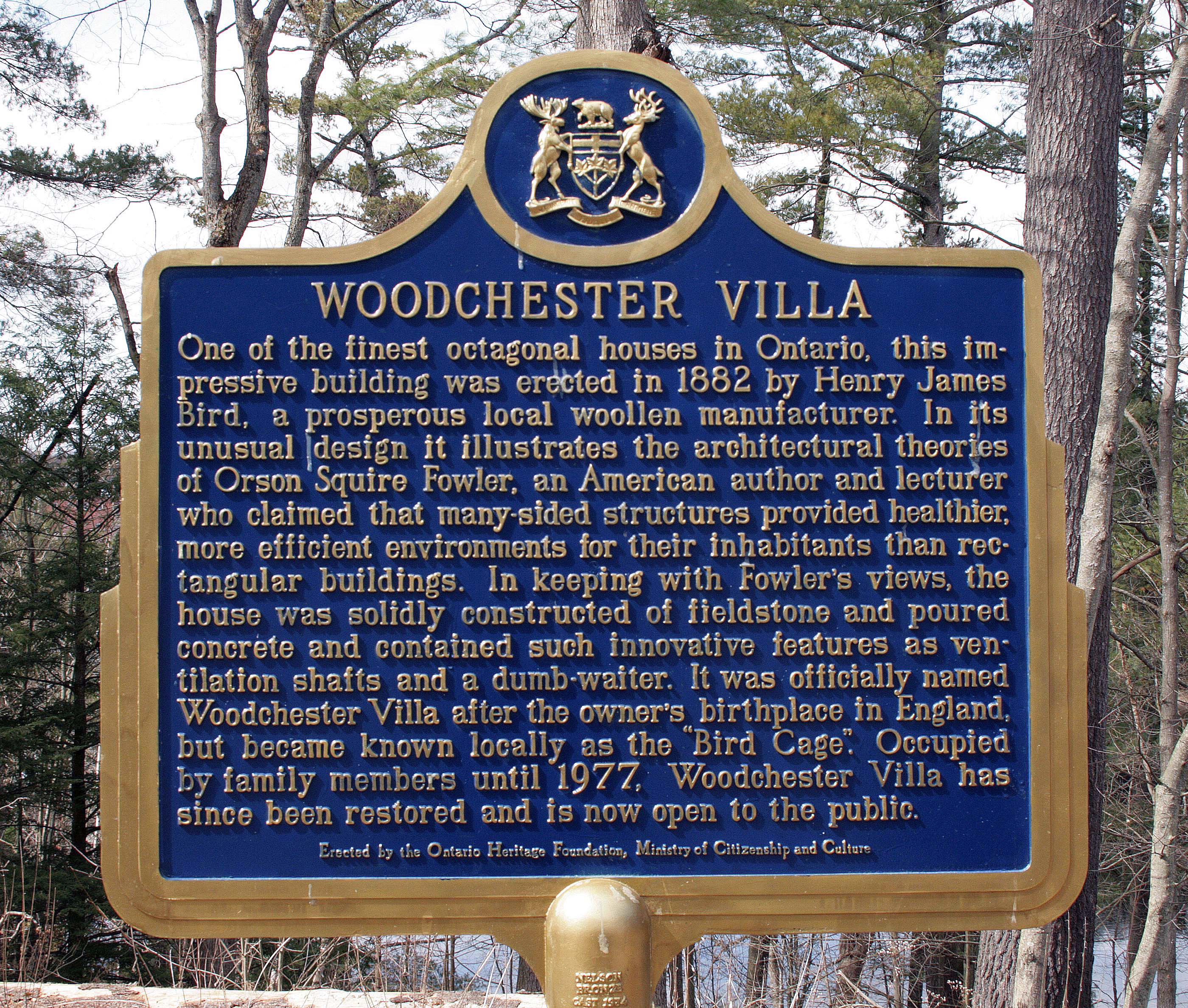
Although Woodchester Villa was ahead of its time, it’s also long been tied to strange happenings that add to its eerie charm. The house was closed during our visit, but we spent plenty of time admiring its design and reading the educational panels scattered around the property. They helped us picture what life might have been like for the Bird family living within those walls.

I wandered around the grounds with my camera, hoping to catch a flicker of movement from inside. We didn’t see any spirits, but the landscape itself felt charged, as if the past still lingered quietly on that secluded hilltop.

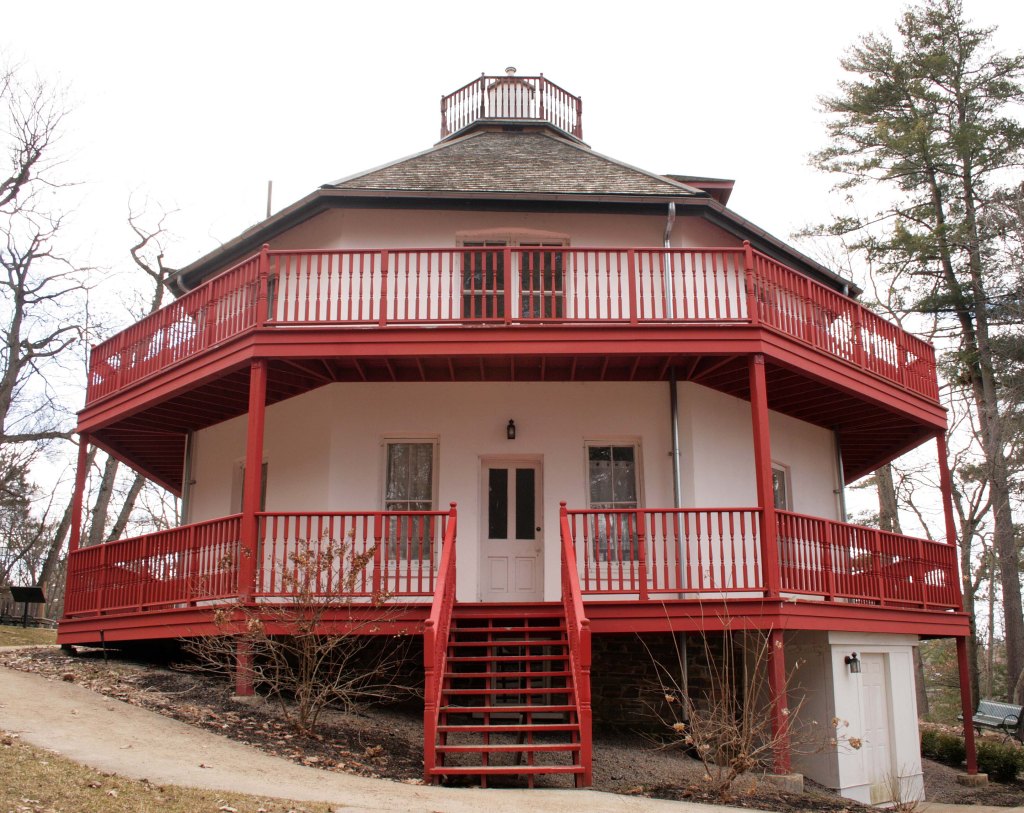
Woodchester Villa is one of Ontario’s finest examples of an Octagonal house.1 The eight-sided design was inspired by Orson Squire Fowler, an American phrenologist and author who believed octagon homes were healthier and more efficient than traditional square houses.1 Bird fully embraced this philosophy, creating a three-storey home that blended innovation with comfort.2

Inside, the villa featured some impressive amenities for the late 1800s, like indoor plumbing supplied by rainwater tanks on the second floor, a ventilation system that circulated air throughout the house, and even electric lighting, which was rare for the time.2

For all its beauty and history, Woodchester Villa has a reputation for being one of the most haunted spots in Bracebridge. Behind its restored walls, many believe something otherworldly lingers.3

Stories tell of a spectral woman and two ghostly children who seem to wander the rooms.3 Visitors and staff have reported hearing the soft cries of a baby, the quick steps of little feet on the upper floors, and the faint sound of a woman’s voice singing somewhere in the distance.3 Cold spots are often felt throughout the house, especially near the basement stairs. Some have also described the air growing so cold they could see their breath, even in the middle of summer.3

While no one can say for sure who these spirits are, many believe the ghostly woman could be Henry Bird’s first wife, Sarah Jane, accompanied by their two young children.3 All three died of tuberculosis before Henry moved to Bracebridge. Perhaps, as Andrew Hind suggests in Muskoka’s Most Haunted 2, their sudden, tragic deaths left them unable to rest, and they followed Bird north to the home he would later build.3

The idea is both eerie and oddly touching. If the spirits truly belong to Henry’s lost family, Woodchester may represent the life they were meant to share, their love quietly echoing through the halls, long after death.

Bracebridge United Cemetery

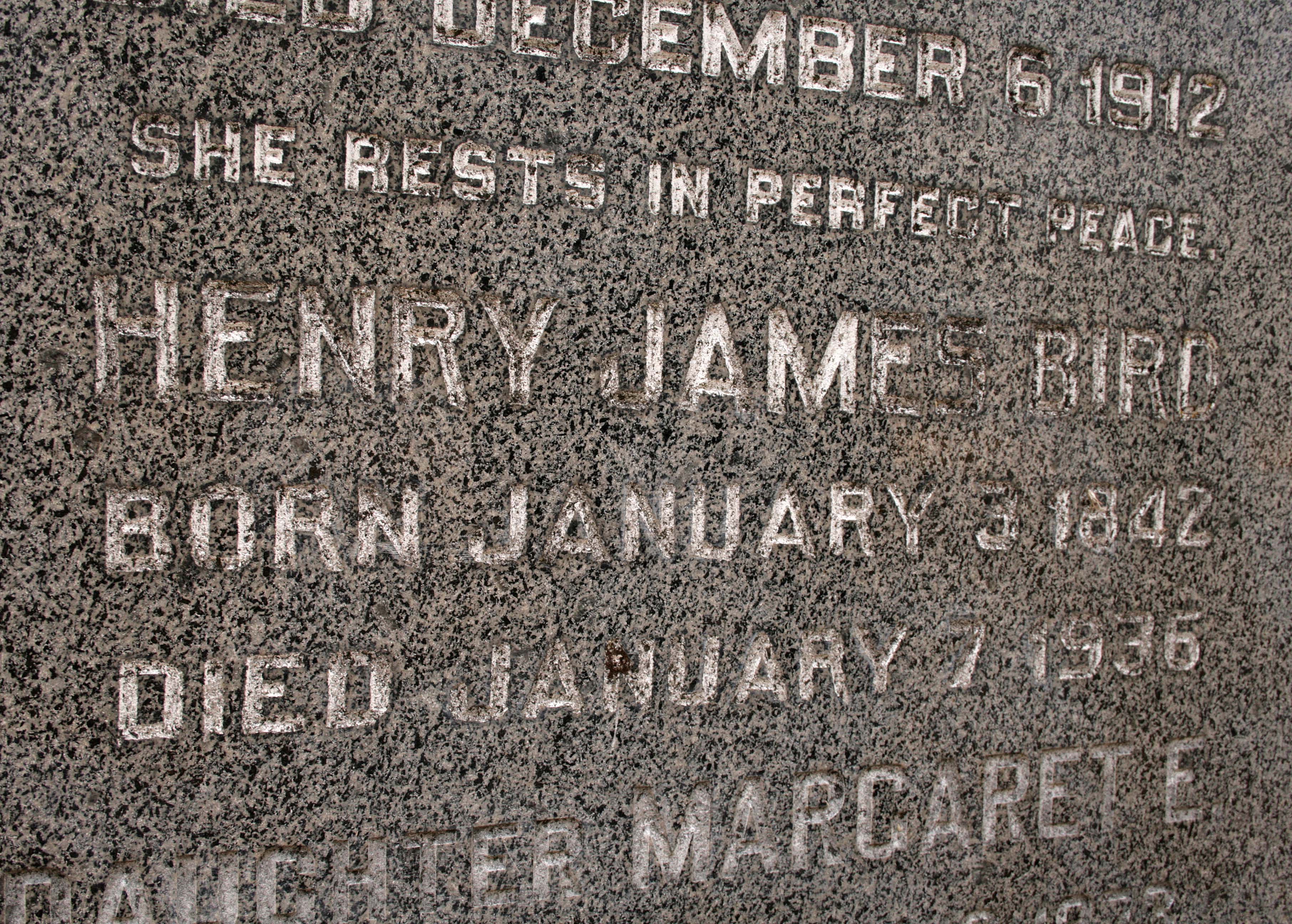
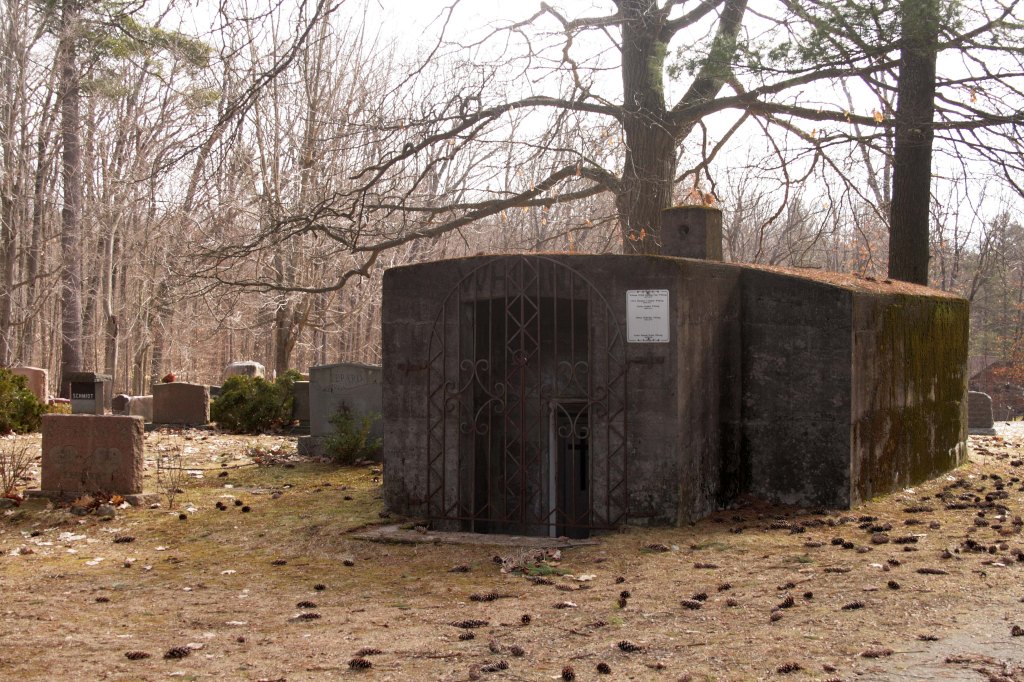
After exploring the villa grounds, we visited the nearby Bracebridge United Cemetery, where Henry James Bird and his family are buried.

After some searching, we found the graves of Henry, his second wife Mary Matilda Bird, and several of their children, including Margaret Elizabeth and Catherine.

The cemetery was quiet and calm, yet the connection between the villa and the family’s final resting place added an eerie layer to our visit. Standing at Henry’s grave, I felt surrounded by history and maybe something more. Whether it’s the family’s hardships or the strange energy tied to their home, the Bird story seems to linger beyond the grave.

The Bird family’s story and their haunted home remind us how easily history and mystery can intertwine. Whether or not you believe in ghosts, there’s something about Woodchester Villa that still feels alive with the past.

For anyone interested in cemetery tourism or dark local history, this hauntingly beautiful site is well worth the visit.

Thanks for reading!


References:

  1. Woodchester Villa, Bracebridge | Ontario Heritage Trust
  2. Woodchester History | Bracebridge The heart of Muskoka
  3. Muskoka’s Most Haunted 2 by Andrew Hind | Book

Cemetery Road Trip: The Muskokas

It’s graving season again in Northern Ontario!

Two weeks ago, I went on my first cemetery road trip of 2024. I was inspired by a book I read at the end of March, called Muskoka’s Most Haunted 2 by Andrew Hind. I have read a few of Hind’s books that have inspired some cemetery road trips, but this one was a bit serendipitous. I was already planning a trip to the Muskokas this summer and had a few cemeteries mapped out, one of which just so happened to be featured in the book. I took that, and the warmer weather, as a sign it was time to get back in the field. 

The Muskoka District is located north of Lake Simcoe and extends from the southeast shore of Georgian Bay to Algonquin Provincial Park.1 Sometimes referred to as cottage country, the Muskoka area is well known for its beautiful landscapes and rugged shorelines.

The Muskokas are also home to many charming small towns. They dot the landscape among picturesque parks. It is so well known, that many celebrities spend their summer vacations here. In 2023, Shaquille O’Neal, Mark Wahlberg, and Victoria & David Beckham were all spotted in the Muskokas enjoying everything the summer has to offer.2

Small towns are usually accompanied by cemeteries. For this trip, I planned a route that would take us up and around Lake Muskoka. There are many cemeteries in the area, so I was uncertain how many we would actually be able to visit. 

We left bright and early on the morning of Easter Monday, stopping for our obligatory road trip coffee before officially getting on the road. We planned to visit as many cemeteries as we could, while also visiting any attractions that may be open, and of course, stopping for a meal. That second item on the list was a little uncertain as the holiday meant that some places would be closed.

Our first cemetery stop, after enjoying the winding views in Bala, was Torrance Union Cemetery. Since it was so early in the morning, it was a bit chilly out but we still took our time exploring. We spent quite a bit of time at this cemetery, but I don’t want to go into too much detail just yet about our visit. This cemetery has some very interesting stories attached to it that I want to explore a little more in October.

Our next stop was the larger town of Gravenhurst. We made another stop for coffee and then stopped in at the three cemeteries within the city limits. We will have to go back to Gravenhurst sometime in the summer to take in the views of the waterfront and visit some attractions. That’s always the downfall of visits on a statutory holiday—everything is closed.

After a leisurely lunch at Chuck’s Roadhouse in Bracebridge, we decided to change things up a bit. Our next stop was the Woodchester. This beautiful octagonal home is a historic site, that is also an event space. It too was closed when we visited, but many walking trails surround it. Some of the trails have historical plaques that tell the story of the house and its previous owners. We were able to walk the circumference of the house and look at building maps that show what the layout of the inside looked like, when it was lived in. 

The Bracebridge walking trails meander alongside the Muskoka River and waterfalls. The waterfalls were strong and thundering when we visited. Unfortunately, part of the trail was closed off, most likely due to possible flooding, so we didn’t get to enjoy the full trail. The views were still lovely though and it was a nice way to break up our day. 

After that little pit stop, we visited three more cemeteries. The Annie Williams Memorial Cemetery was the smallest cemetery we visited that day. Only three people rest in that cemetery, which sits in the middle of a park and playground. This tiny gated cemetery sits under some large trees, only a few feet away from an active playground that often hears the boisterous sounds of children playing. It also sits a foot or two away from a popular little library, that was bursting at the seams with books.

As the day waned, it was time to start making our way back home. But we couldn’t help but stop at one more cemetery. Our last cemetery stop of the day was Port Carling Cemetery. That marked the end of our loop around Lake Muskoka.

This trip was a lot of fun! We ended up visiting a total of eight cemeteries, not bad for a first-time out after the cold of winter. We had beautiful weather that warmed up as the day went on which made our visits comfortable. Which means the weather can only get better from here. I look forward to my next outing and seeing where cemeteries take me. 

Thanks for reading!


References: 

  1. Muskoka | Destination Ontario
  2. This Canadian Town Is A Magnet For A-Listers On Vacation— Here Are 8 Celebs That Were Spotted There This Summer | Buzzfeed

Cemeteries:

  1. Torrance Union Cemetery also known as Whitting Family and Church Cemetery, Torrance
  2. St. James Anglican Cemetery, Gravenhurst
  3. Lakeview Cemetery, Gravenhurst
  4. Mickle Memorial Cemetery, Gravenhurst
  5. Bracebridge United Cemetery, Bracebridge
  6. Annie Williams Memorial Cemetery, Bracebridge
  7. Saint Thomas Cemetery, Bracebridge
  8. Port Carling Cemetery, Port Carling