Stone Stories: A Tap Dancing Legend

Earlier this month, two friends and I traveled to Oakville, Ontario for another birthday cemetery road trip. It was a bit ambitious, with us hitting the road at the crack of dawn. We planned to beat the traffic, but also to get a head start on the day since it would be a four-hour drive, each way.

Since it would be such a long drive, we wanted to give ourselves as much time as possible to tour the town and sight-see. And yes, of course, visit cemeteries. There was one stop that was very high on our list—the final resting place of American actor and tap-dancing legend, Gregory Hines.

Gregory Hines

Gregory Oliver Hines was born February 14, 1946, in New York, New York. Hines began tap lessons at the age of four and would spend much of his childhood practicing and performing alongside his older brother, Maurice Hines.1 

The Hines Brothers performed their song-and-dance act all over the United States. In 1963, their father joined them, turning the duo into a trio. They continued to make a name for themselves, making countless TV appearances.1 But in 1973, Hines recognized that tap dancings popularity was declining and left the act to pursue a musical career and start a band. This was short-lived though, and Hines soon returned to New York and the stage.1

In the early 80’s, Hines made the transition to Television and film actor. His first feature film credit is his portrayal of Josephus in the comedy/musical Mel Brook’s History of the World Part I (1981). Known for his accomplished choreography and tap dancing, many of Hines’ films showcase his dancing. He starred alongside veteran tap dancer Sammy Davis Jr. in the 1989 film Tap. Credited with 49 acting roles, Hines was a successful and versatile actor. Some of his most successful films are Running Scared (1986), Renaissance Man (1994), and Waiting to Exhale (1995). I would be remiss if I didn’t also list his cameo in the fan favorite, The Muppets Take Manhattan (1984).2

In 2002, Hines was diagnosed with liver cancer. He kept his diagnosis private, sharing his health struggle with only family and close friends. A year later, Hines succumbed to the illness en route to the hospital, from his home in Los Angeles.3 Gregory Hines passed away on August 9, 2003, he was 57.  

Hines is remembered by his two children, a son, and daughter, from two previous marriages. His memorial service took place on August 13, 2003, at Saint Monica’s Catholic Church in California. Based on the photographs I found online, it looks like it was an emotional service, with many Hollywood stars in attendance. Hines is laid to rest in Saint Volodymyr Ukrainian Cemetery in Oakville, Ontario, beside his fiancé Negrita Maria Truszyk Jayde.

Saint Volodymyr Ukrainian Cemetery

Saint Volodymyr Ukrainian Cemetery, also known as West Oak Memorial Gardens, is owned and operated by St. Volodymyr Cathedral. It was founded in 1984, and sits on 100 acres of property that overlooks Sixteen Mile Creek. Today, it’s thought to be the largest Ukrainian cemetery in Canada.4 

It was a beautiful sunny day when we visited Saint Volodymyr. Right away, we noticed how busy the cemetery was. Many people were visiting loved ones, cleaning gravesites, and paying their respects.

I knew before we arrived that the cemetery was a large one, so I had come prepared. I wanted to make sure we had plenty of time to pay our respects and wouldn’t spend all our time searching. With coordinates in hand, we were able to drive directly to the grave of Gregory Hines. 

I’m not sure if it was done on purpose, or if it is just because of the sheer size of the cemetery, but there was a perfect parking space just off the path. Just big enough for one vehicle, across from the famous grave. 

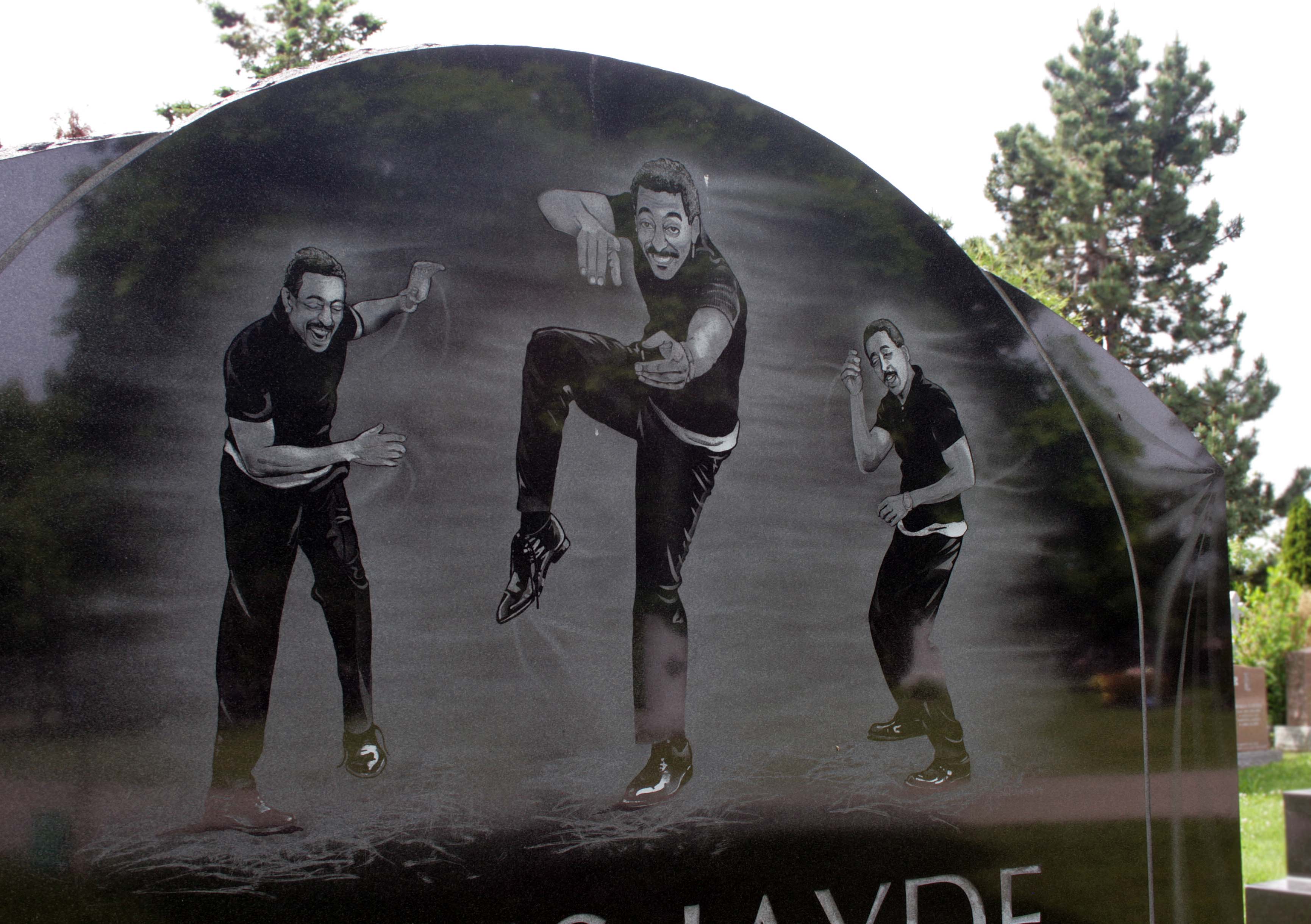
The Hines-Jayde gravestone is a beautiful monument, made from black granite. At the top of the stone is a sandblasted engraving of Hines dancing, framed by what looks like curtains on either side of the stone. He is depicted with a look of joy and happiness on his face. It’s a lovely representation of what he is best known for, and what was such a large part of his life. 

“Hines Jayde / Gregory Oliver / Hines / Feb. 14, 1946 / Aug. 9, 2003 / Together Forever / Negrita Maria / Hines Jayde / July 5, 1958 / Aug. 28, 2009 / So all sing in their festive dance. / “Within you is my true home” Psalms 87:7”

It was easy to tell that we were not the only ones who had made a trip to visit this gravesite. There were many grave goods left behind on the day we visited. These included stones, candles, and oil lamps. There was also a heel and toe plate placed at the base of the gravestone. These plates are mounted to the bottom of a shoe and used to tap dance. 
After paying our respects we wandered the cemetery a little bit, exploring the meandering paths. It’s a beautiful cemetery with its trees creating some beautiful dappled light across the gravestones. I noticed that there were many black granite stones, in some sections that were even the same style. 

I also noticed many oil lamps left at graves. It reminded me of the Jewish practice of leaving pebbles on top of gravestones. Some graves had only one of two oil lamps, while others had handfuls of them surrounding the stones. I can just imagine how beautiful they would look at night with all of the lamps lit up. 

You might be asking yourself how an American-born actor came to be buried in a Canadian cemetery. I had the same question. 

It looks like the reason is because of Hines’ fiancé Negrita Jayde, who is Canadian. A celebrity in her own right, Jayde was an athlete and an author. She was an award-winning professional bodybuilder from Toronto, Ontario, and wrote two books about the subject. She was also an actor, having starred in the action/sci-fi film Safety Zone in 1996.5

Although Hines and Jayde did not get the chance to get legally married before his death, Jayde did take Hines’ last name.6 When Jayde passed away six years, later in 2009 from cancer, she she was laid to rest beside him.

I’m very happy I was able to help one of my best friends pay her respects to one of her favorite actors. I’m also happy that I had the chance to pay my respects as well. Visiting famous graves is always an interesting experience because so often we feel so connected to them, even though we don’t know them on a personal level. TV and film actors, in particular, can feel like our best friends because of how invested we can get into their characters or their careers. So getting the chance to pay our respects at their gravestone can sometimes be a surreal experience.  

Have you ever visited a famous grave? I would love to read about your experience in the comments.

Thanks for reading!


References: 

  1. Gregory Hines | Britannica
  2. Gregory Hines | IMDB
  3. Gregory Hines | Wikipedia
  4. Saint Volodymyr Ukrainian Cemetery | Find a Grave
  5. Negrita Maria Truszyk Jayde | Find a Grave 
  6. Negrita Jayde Trivia | IMDB

Cemetery Book Review: Country Churchyards

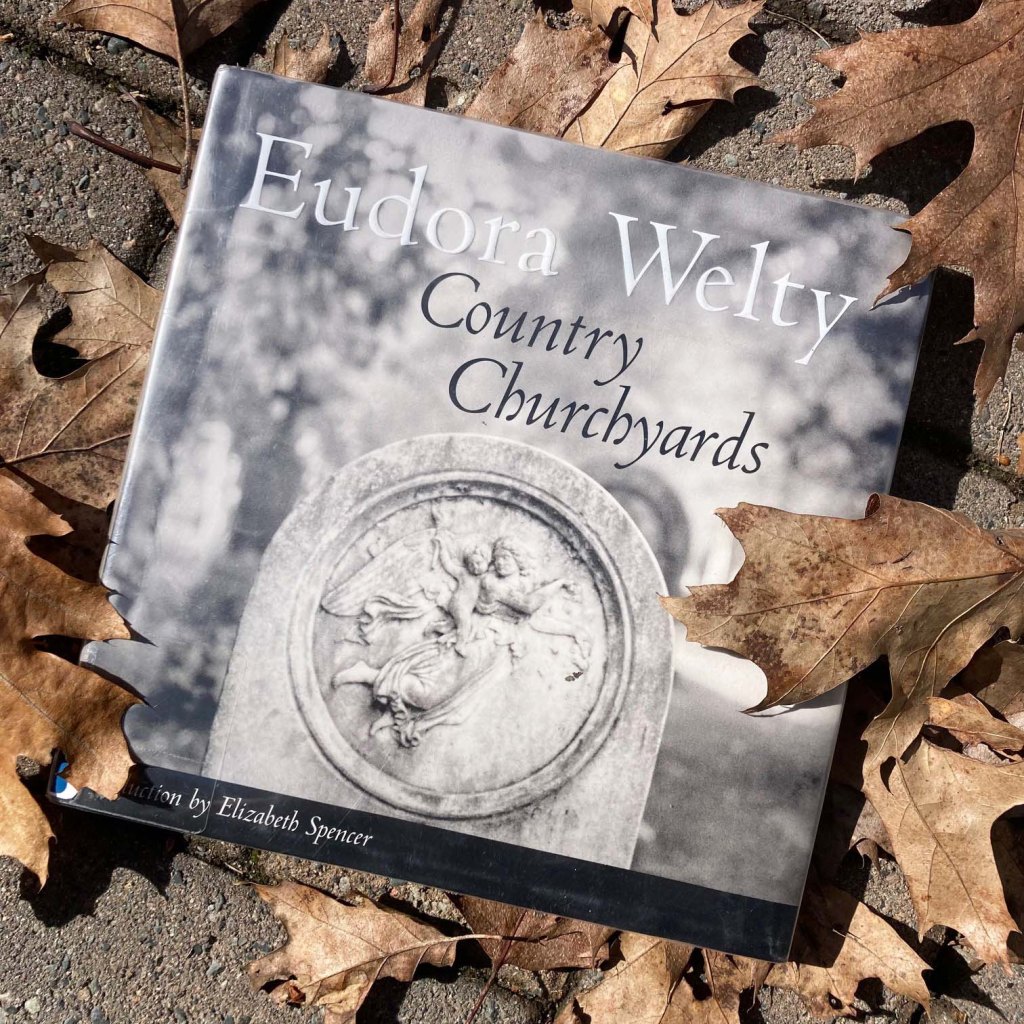
For this month’s cemetery book review, I wanted to talk about Country Churchyards by Eudora Welty. I first heard about this book through the Association for Gravestone Studies book club. I was not familiar with Welty’s work, but this book was a nice introduction. 

Eudora Welty is a Pulitzer Prize-winning author, known for her short stories and novels that are focused primarily on the American South during the mid-20th century. Some of her works include the short story Death of a Traveling Salesman and the novel, The Optimist’s Daughter1.

Welty had long wished to produce a photography book about country churchyards, and at the age of 91, this dream project came to fruition.2 In July 2001 at the age of 92, she passed away due to natural causes at her family home in Jackson, Mississippi. She is buried in Greenwood Cemetery in Jackson.1

Her grey granite gravestone reads:

“Eudora Alice / Welty / April 13, 1909 / July 23, 2001 / Daughter of / Christian & Chestina Welty / For her life, any life she had / to believe, was nothing but the / continuity of its love. / The Optimist’s Daughter”

Country Churchyards features 90 photographs captured by Welty in Mississippi. Accompanying these beautiful black and white photos are Welty’s memories and impressions of her time visiting these cemeteries in the 1930s and 40s. The book also features select passages about cemeteries and funerals from her short stories and novels.

My copy of Country Churchyards, purchased from Thrift Books is a well-loved library book from Topeka, Kansas. Even with the well-worn cover, and light water stains, the beauty of this book shines through.

The book is filled with gorgeous black-and-white photos showcasing unique gravestones, symbolism, and cemetery landscapes. The introductions by Hunter Cole and Elizabeth Spencer paint a lovely picture of Eudora Welty and her underlying passion for cemeteries. This, accompanied by excerpts of Welty’s writing, highlights how influenced she was by the heartfelt sentiment found in cemeteries.

I find cemetery symbols fascinating, and it’s interesting to see what common and unique cemetery motifs are found throughout the book. I often found myself comparing my area’s common symbols to those within the pages as I read through it. I did take my time with this book, really examining the photos and all of the details.

It’s a beautiful little book and a nice break from the heavier reading I have been doing lately. This is a book I would leave out on my coffee table.

Have you read Country Churchyards? Are you familiar with Eudora Welty’s work? I would love to read your thoughts in the comments. 

Thanks for reading!


I am always on the hunt for cemetery-related book recommendations. Please feel free to share yours in the comments. If you are an author and have a cemetery-related book you would like me to review, please reach out at hello@chantallarochelle.ca. I would love to hear from you.


References:

  1. Eudora Welty | Find a Grave 
  2. Country Churchyards | Goodreads

A Collection of Mourning Figures

One of my favorite things about cemeteries is the variety of symbolism you can find. After so many years wandering cemeteries, I have noticed some common motifs. An interesting thing I have also noticed is that depending on where you are in Northern Ontario, those common symbols will be different. I’d wager that the same could be said for other parts of the world as well.

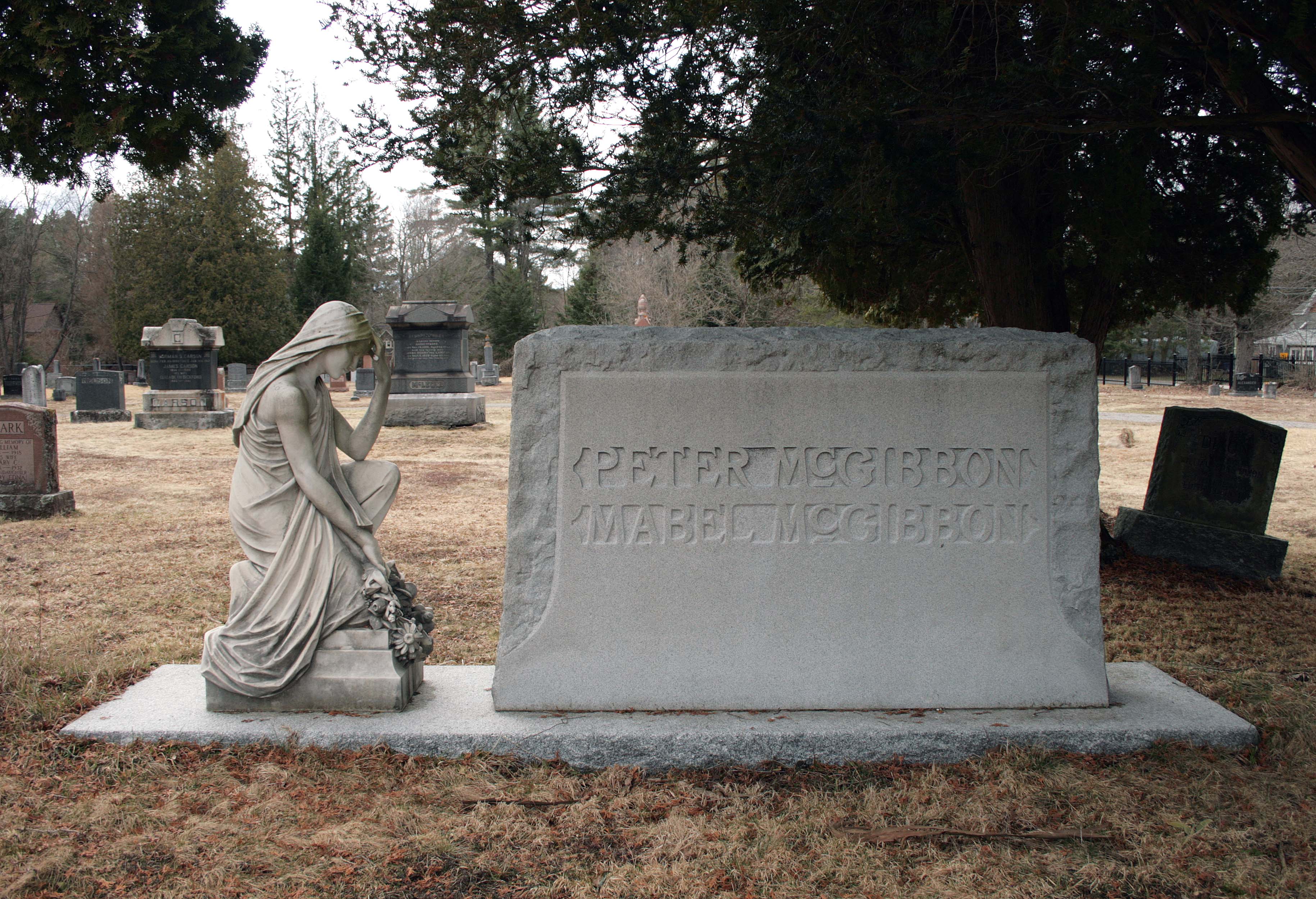
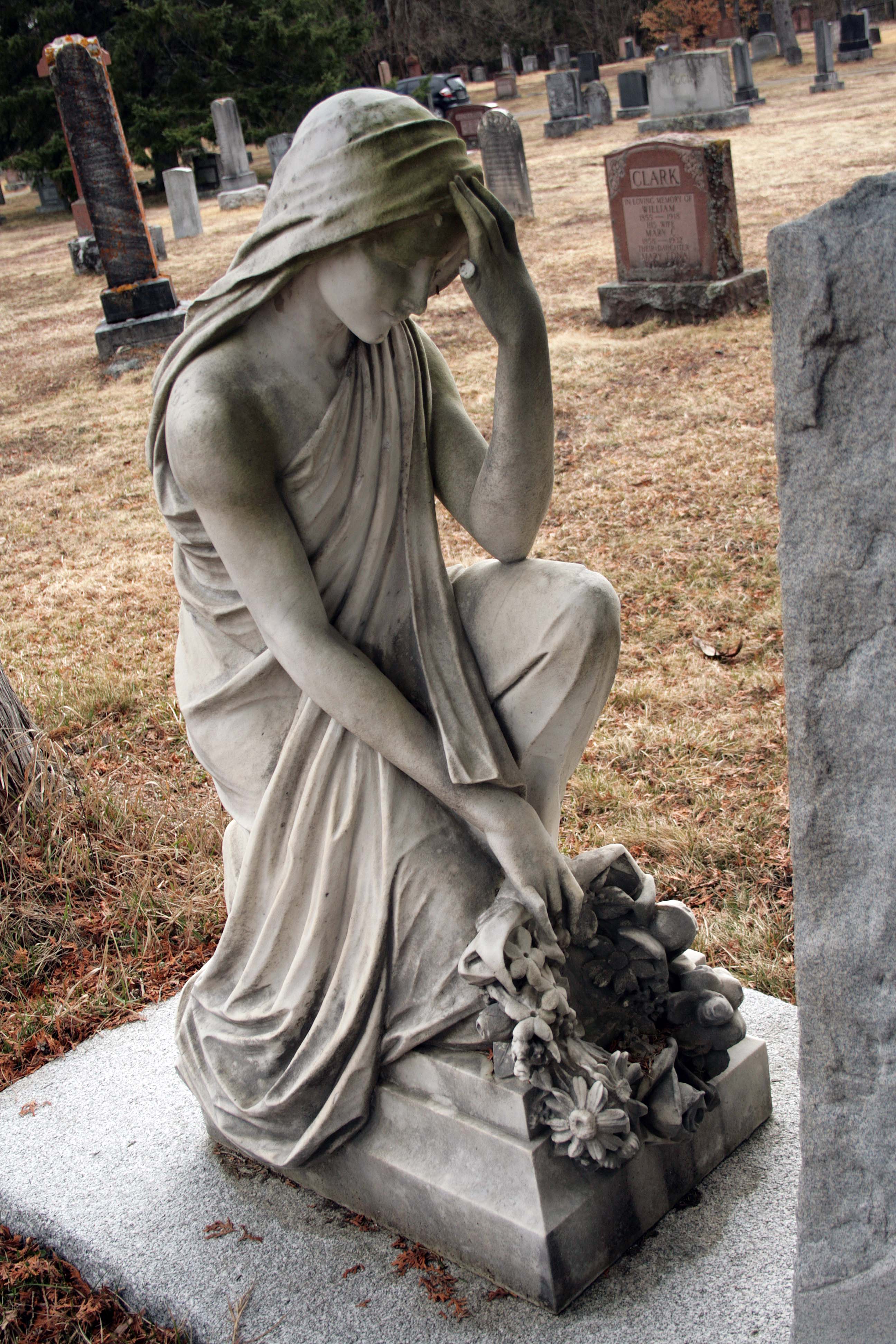
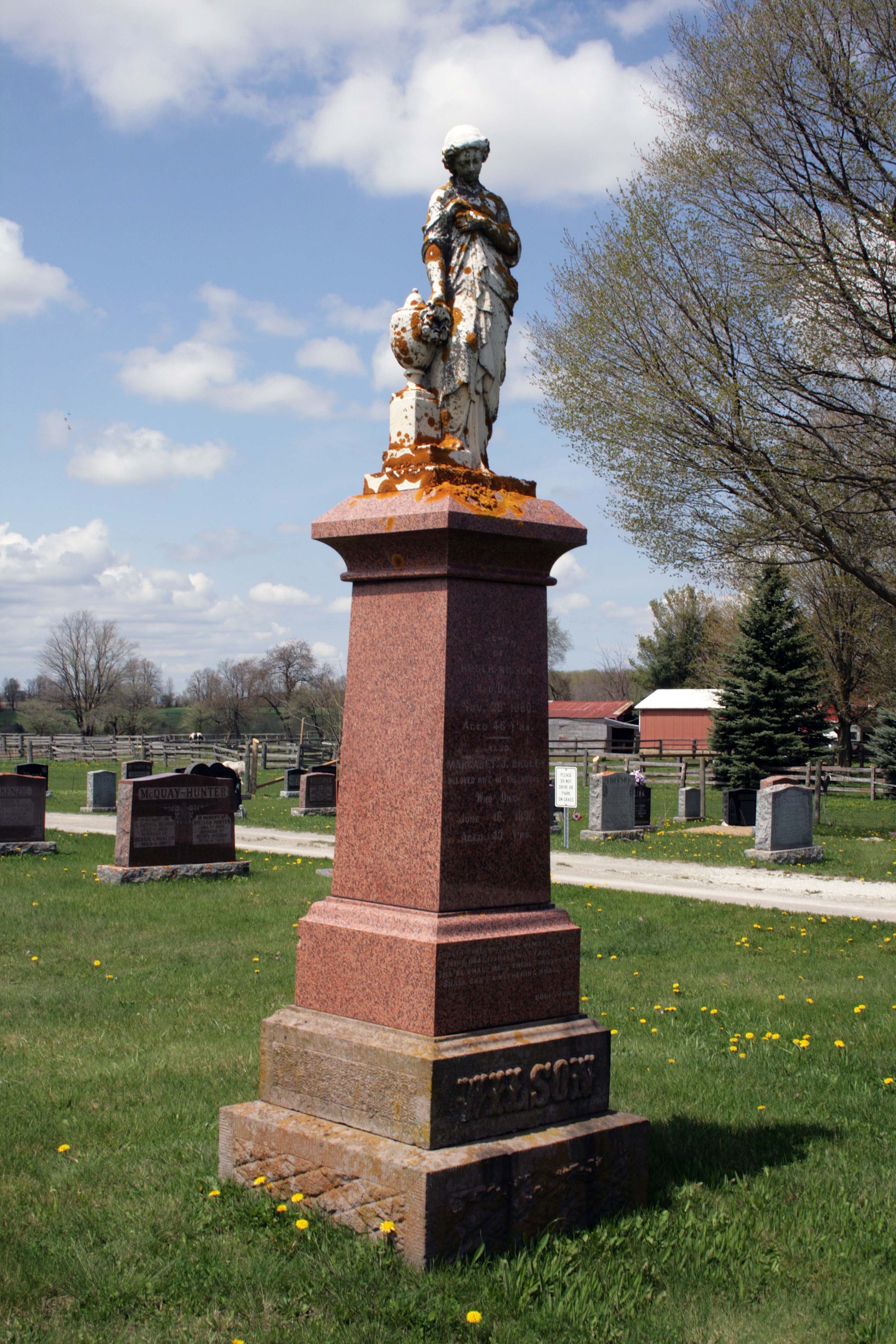
On some recent cemetery road trips in Simcoe County and the Muskokas, I noticed many different forms of mourning figures. This symbol is not very common in my local cemeteries. So today on the blog, I wanted to look deeper at this symbol and share some of the examples I have come across so far this year.

Grief and mourning were popular grave motifs in the Victorian era. As death was such a big part of life in that time, it affected everything from fashion and jewelry to of course funeral practices and gravestones.1 

One of the many ways that grief was expressed was through the use of mourning or weeping figures. These figures were often depicted as kneeling or standing over a grave in a display of deep grief and mourning. Sometimes a mourning figure can also symbolize an early or sudden death.

Mourning figures are sometimes depicted holding wreaths or flowers. Flowers are thought to represent that life is fleeting, while the circular wreath is thought to symbolize eternal memory and immortality.2

Urns are another common Victorian grave symbol that sometimes accompanies a mourning figure. Borrowed from the Ancient Greeks who often cremated their deceased, urns represent the physical body being reduced to its barest elements as the soul ascends to Heaven.2

Sometimes weeping willows also appear with mourning figures. Weeping willows are strongly associated with grief and mourning, as their name suggests. They are another grave symbol adapted from the Ancient Greeks.2

I am always in awe and inspired by the art I find in cemeteries. It’s one of the reasons I love walking among the gravestones.

Have you come across any similar mourning figures in your local cemeteries? I would love to read about your findings in the comments.

Thanks for reading!


References:

  1. Cemetery Symbolism: What Do Those Mysterious Monuments Mean? | Laurel Hill
  2. Understanding Cemetery Symbols: A Field Guide for Historic Graveyards by Tui Snider

Cemetery Stories: Greenwood Cemetery

A cemetery is filled with many interesting stories, stories of the souls that are laid to rest within its gates. But often the cemetery itself has an interesting story to tell. 

Today on the blog I want to introduce a new series called Cemetery Stories. For these blog posts, I plan to focus on the story of individual cemeteries. I have visited a lot of cemeteries over the years, and many of them have interesting stories and historical significance. So for this series, I want to look a little deeper into history, geography, notable graves, and all the different elements that make them unique.

For today’s cemetery story, I thought I would look at Greenwood Cemetery in Owen Sound. 

History

Greenwood Cemetery was created in 1858 when land surveyor Charles Rankin submitted a plan to the town council for a new public cemetery. At the time the plan was for 5 acres of land, divided into 27 blocks, including space for vaults.1 Today the cemetery is quite large, sitting on approximately 40 acres of land.2 Greenwood is also sometimes called “The People’s Cemetery” because, in those early days, the land was purchased using the people’s money.1 The cemetery contains 26,700+ burials.1

The oldest home in Owen Sound can be found in Greenwood Cemetery. The house is dated from the 1840s1 and is used as the cemetery office.2 There is also a red brick burial chapel on the cemetery grounds. Built-in 1905, it served as both a chapel and a receiving vault. There is a trap door built into the floor that a coffin could be lowered through, into the storage racks below, to rest until the Spring when the remains could be interred. The chapel stopped being used for burials in the 1930s when the mausoleum opened. The chapel was converted and used as an office space for a time, until the early 90s. Today the building looks to be mostly empty.3

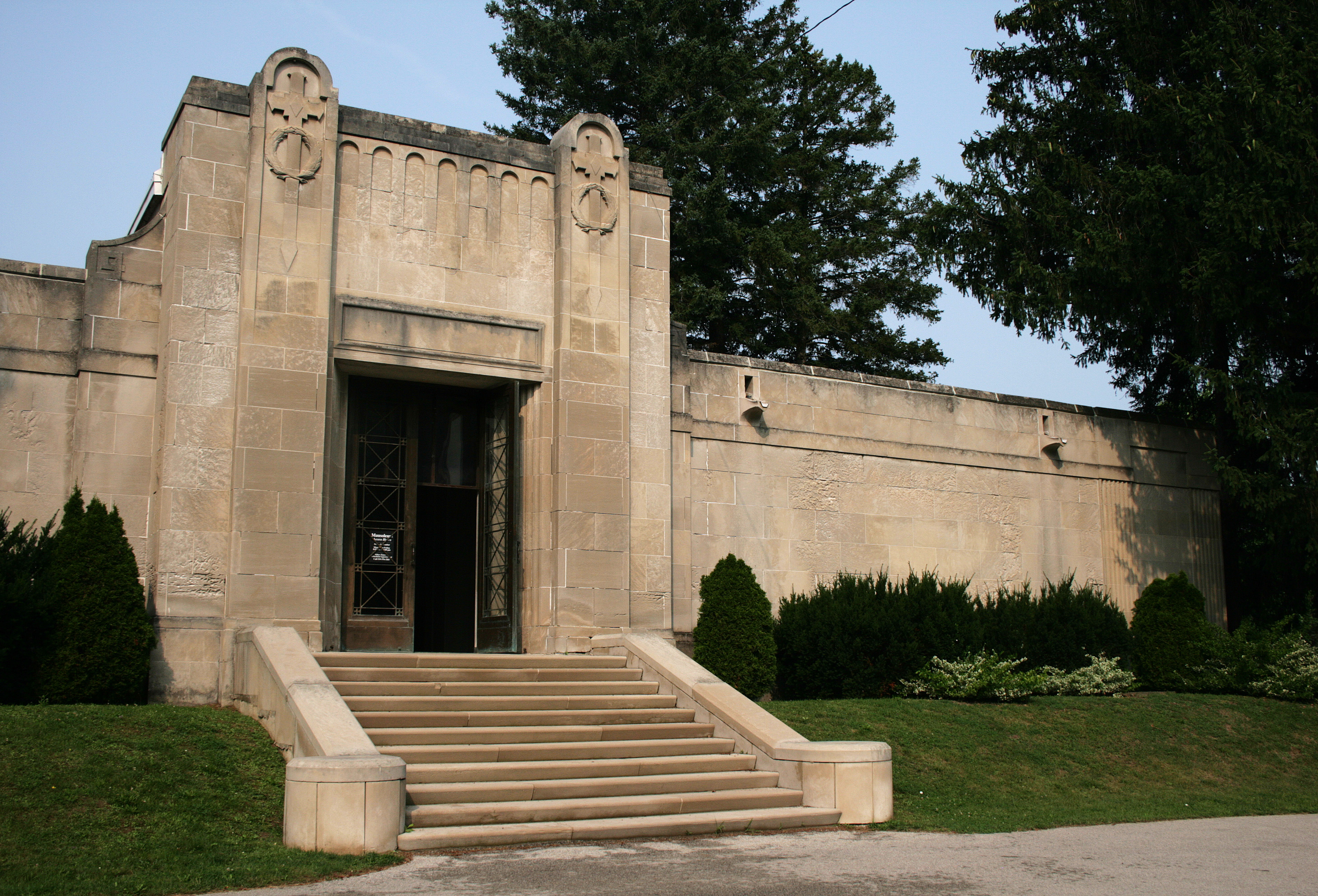
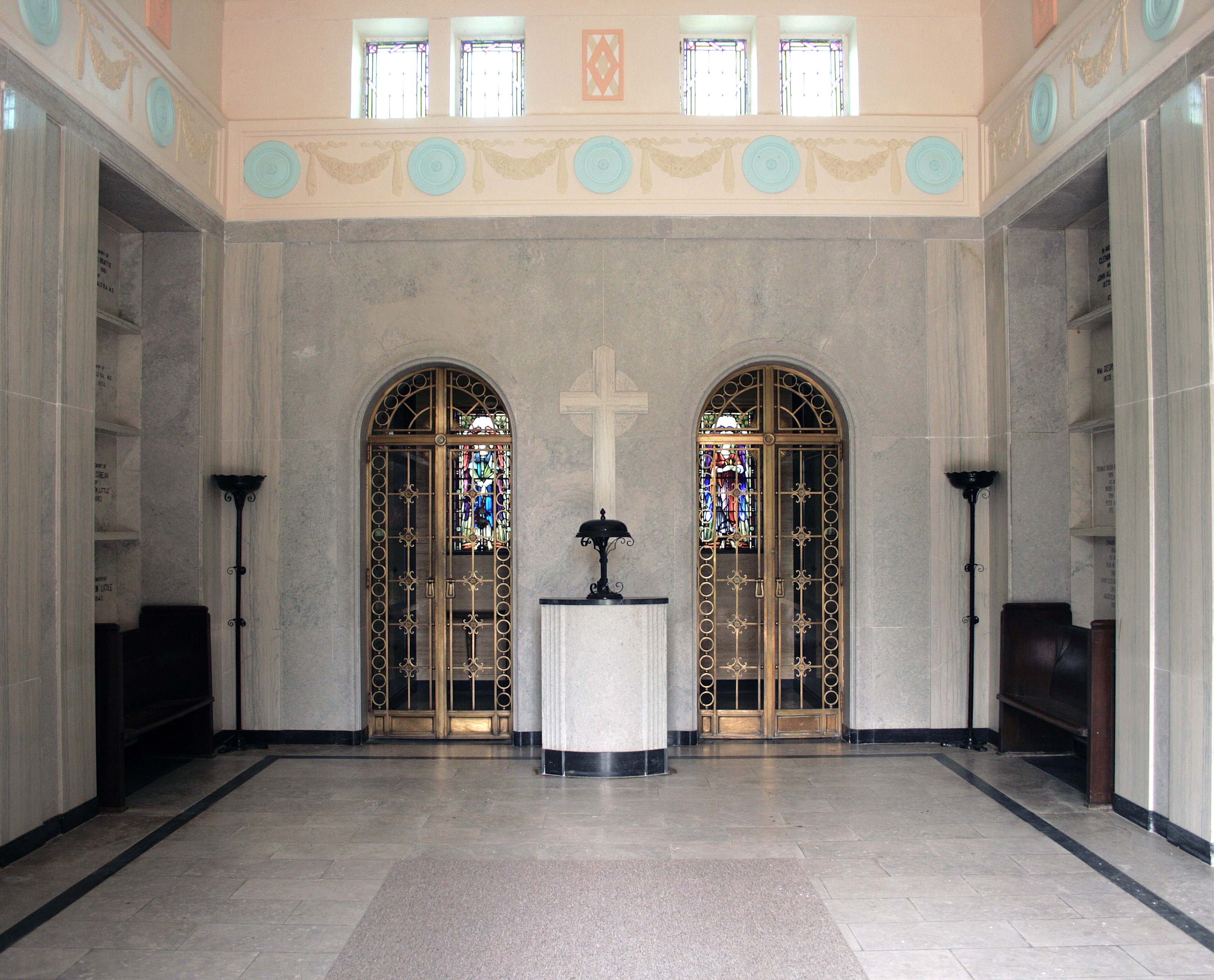
Greenwood is also home to a beautiful mausoleum. Construction of the large mausoleum began in 1927. The Art Deco-inspired exterior is covered in Indiana limestone, while the interior is finished with Italian marble. It also features some lovely stained glass windows and has a large central chapel that is used year-round.1

The cemetery is dotted with a variety of gravestone styles, and there are three memorial garden sections. It also has a section for members of the fraternal organization, The Independent Order of Odd Fellows (IOOF), that features a large stone cairn with IOOF symbolism.

Greenwood also has a Potter’s Field and memorial. The memorial honors the more than 1,000 women, children, and men who were buried in unmarked graves between 1858 and 1989. A potter’s field, also known as poor grounds, stranger’s plot, or indigent plot, is a section of a cemetery where those who are impoverished are buried.4 1,242 people are thought to be buried in Greenwood’s potter’s field4, all unmarked aside from the memorial and one lonely gravestone that sits close to the tree line at the back of the indigent plot. According to an article in the Northern Terminus: The African Canadian History Journal, many of the unknown graves are Black pioneers. Only a small few have been identified.

Among the unidentified graves lies an infant, who in 1889 was found in Victoria Park, wrapped in white cloth. The transcription in the cemetery records, simply reads “Unknown, child found dead”.4

Notable Graves

Greenwood Cemetery is the final resting place of a few notable memorials. William Avery “Billy” Bishop, Canada’s World War I Flying Ace rests here. There are also two other Victoria Cross recipients buried here; LTC David Vivian Currie (World War II) and Thomas Holmes (World War I). 

Speedskater and world-record holder Lela Brooks is also laid to rest here, as well as professional hockey player, Harry “Apple Cheeks” Lumley. Margaret and John Thomson, parents of famous Canadian painter Tom Thomson, are also buried here. 

There are many more notable pioneers and local celebrities buried here, like Charles Rankin, who submitted the cemetery plan and helped bring the cemetery into reality. The best way to pay your respects is with a self-guided walking tour. The cemetery offers three tours that take you to different areas within the large cemetery and highlights all the notable members of the community who are laid to rest at Greenwood. You can pick up the printed tour guides at the cemetery office. The guides include a map, directions, and a little history for each stop on the tour. 

We visited the cemetery twice on our trip to Owen Sound. Because it’s so large we felt we had to. Our first visit was late in the day, so the mausoleum had been locked up for the night. We were losing light quickly, and every turn on the winding paths revealed new sections I wanted to explore further. We visited again the next morning and were able to explore the Mausoleum and walk the sections at our leisure.

Greenwood was full of life during both our visits. In the evening we saw folks paying respects at graves, but also saw families taking advantage of the safe, paved pathways. Two young children were learning to ride their bikes between the rows. 

The next day, we saw many walkers enjoying the scenery, both young and old. We also saw folks walking their dogs and running into others they knew who were doing the same. It was lovely to see a green space in use but also used respectfully.

Thanks for reading!


References:

  1. Greenwood Cemetery Walking Tour “The People’s Cemetery” | Print brochure
  2. Greenwood Cemetery | Owen Sound
  3. The Chapel, Historical Owen Sound | Plaque on the cemetery grounds
  4. Owen Sound’s Greenwood Cemetery “A Land for the Living” | Terri Jackson

Year in Review – 2023

Can you believe that we made it through another year? 2023 just flew by! I feel like just yesterday it was Halloween, but here we are! It’s been an interesting year, full of ups and downs. So for this week’s blog post, I wanted to carry on the tradition from last year and take a look back at what happened throughout the year. 

2023 was unfortunately the year of COVID for me. I managed to catch it twice, first suffering through two and half weeks of the worst head cold of my life. The second time I caught it, it was mild like a light cold. Unfortunately, the second time I caught COVID, I was also suffering through my first bout of poison ivy. 

Catching poison ivy, from a cemetery visit (of course), was quite the learning experience for me. It was a hard reminder that you should always dress appropriately when out in the field, especially when exploring overgrown cemeteries. Dealing with my bad case of poison ivy put me out of commission for about a month, in the middle of summer. It was not an opportune time and had me itching to get back in the field.

Even though I had more downtime this year, I still managed to have a successful field season, visiting 113 cemeteries. 103 of those cemeteries were first-time visits. I didn’t take a count of how many new photos I added to my archives, but there is a lot to sift through and edit this winter. I can’t wait to share them on my portfolio page, and also add them to Find a Grave

This year also marked another new record for the number of cemeteries visited in one day! A friend and I incredibly visited 25 cemeteries during a day trip to Midland. At the time it didn’t feel like we had visited that many, but the photos don’t lie. We’ll see if we can break this new record in 2024.

Highlights

In April of 2023, I had a great opportunity to participate in a juried photography show, Our Story in Black and White. My cemetery photography was proudly hung beside other great works by local photographers; Caio Higa, Debbie Anzinger Mckay, Debby Trahan-Pero, and Rita Vanderhooft at Gallery 6500. The exhibit ran from April 30th to June 30th. After this initial run, the photography show was moved to the South End Pubic Library and ran for another month. Being part of a group show was such a great experience! I hope I can participate in more photography shows in the future.

Another highlight of 2023 was getting published! 

I was contacted by the Bereavement Authority of Ontario (BAO) which was interested in my photography for their online, quarterly magazine, BeyondA condensed version of my articles about visiting the graves of Tom Thomson was published as the cover story of their October issue, along with some of my photography. That was incredibly exciting, and I hope to work with Beyond and the BAO again the future. 

Statistics

This year was also a great year for growth. On the website, I had 6,805 visitors this year, with 12,793 views. That’s the highest count, since starting this website in 2018. I will note that I didn’t start consistently posting till 2021. Speaking of blog posts, I posted 42 times this year, with a word count of 29.3k. I have been very weary about calling myself a writer, but after seeing that word count I might have to change my mind. There is still work to be done to upgrade my writing skills, but it is kind of fun to think of myself as a cemetery tourism writer. 

I often write articles that I would like to find and read. My favorite articles to write are cemetery tourism pieces, where I talk about visiting cemeteries and related sites. I also really enjoy researching so these pieces are really fun for me to write. I also feel more connected to these sites after learning about them and visiting them in person.

I also have a lot of fun writing cemetery recipe posts. These posts seem to resonate with readers as well, as they are often the most searched-for articles. I do enjoy experimenting with cooking and baking and these posts encourage me to do that, while also having a research element to connect the recipe to the gravestone.

This year the top viewed blog posts are a bit varied, with one post from last year ranking in second place.

Top 5 blog posts of 2023

On social media, my Instagram account is growing as well. At 2,754 followers, it’s my favorite place to interact with followers and share my photos.

Overall it has been an excellent year, full of growth and adventures. As I settle in for the winter, I will put my hiking boots away and focus more on research and photo editing. The winter break is an excellent opportunity for me to update my portfolio, as well as research and write more in-depth blog posts about this year’s cemetery travels. I am currently working on a few stone stories and have plans to start a new blog series of cemetery stories. I also would like to catch up on my reading and post some more cemetery book reviews.

Of course, I have already started thinking about next year’s cemetery adventures as well, and have started some maps and travel plans. I hope to visit some more unique grave sites, cemeteries, and famous graves next year. Maybe even exploring out of province. The possibilities are endless, and I am always finding new and interesting places to visit when I go down the research rabbit hole.

I want to finish this 2023 recap by thanking every one of you for your support and encouragement.

All the comments, likes and shares do not go unnoticed. I love being part of this cemetery community and have met so many amazing new people because of it. I appreciate all of you, and wish you all the best in the coming new year.

Here is to another year full of curiosity and adventure!

As always, thanks for reading!

Happy Holidays

As another year draws to a close, I wanted to share my appreciation for you, the reader, for joining me on my graveyard adventures. At this special time of year, I would like to say thank you, and wish you all a happy holiday season, and a happy new year!

Spooky Grave Goods

In honor of the Spooky season, I wanted to do a sort of spooky show-and-tell. For today’s blog post, I want to talk about some of the creepier grave goods I have come across while exploring and photographing cemeteries.

Grave goods is a term used for items left behind at a grave. I have always found it fascinating what people leave behind. There are a variety of reasons someone might leave grave goods; to pay their respects, to honor their loved one, this list goes on.

The most common grave goods I see in my cemetery travels are flowers, but I have also found coins, toys, figurines, and pieces of clothing such as hats or gloves. I have even found alcohol and cigarettes left on gravestones.

But there have been a couple of times where I have found some pretty creepy things. I would say maybe even sinister grave goods.

A Horse Skull

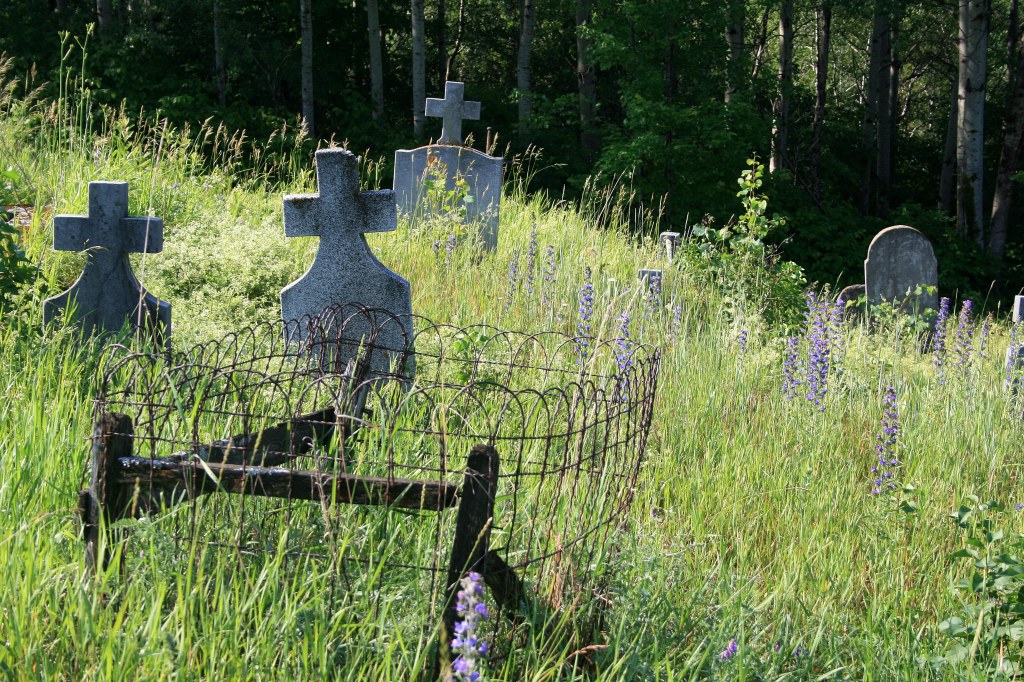
One of the first creepy grave goods I ever came across was a skull hanging from a tree. I believe this is a horse skull, although I don’t know for certain. A horse skull would make sense for the area where it was found, in Verner Public Cemetery. Verner is a rural area, dotted with farmland.

How the skull ended up in the tree is another question entirely. I remember it was hanging on a tree at the edge of the tree line. Was it found in the forested area? Was it brought from an adjoining farm?

The questions will always remain…

A Creepy Doll

I never expected to come across a creepy doll, the day I entered Blezard Valley Cemetery. It was in late May, that I discovered this one.

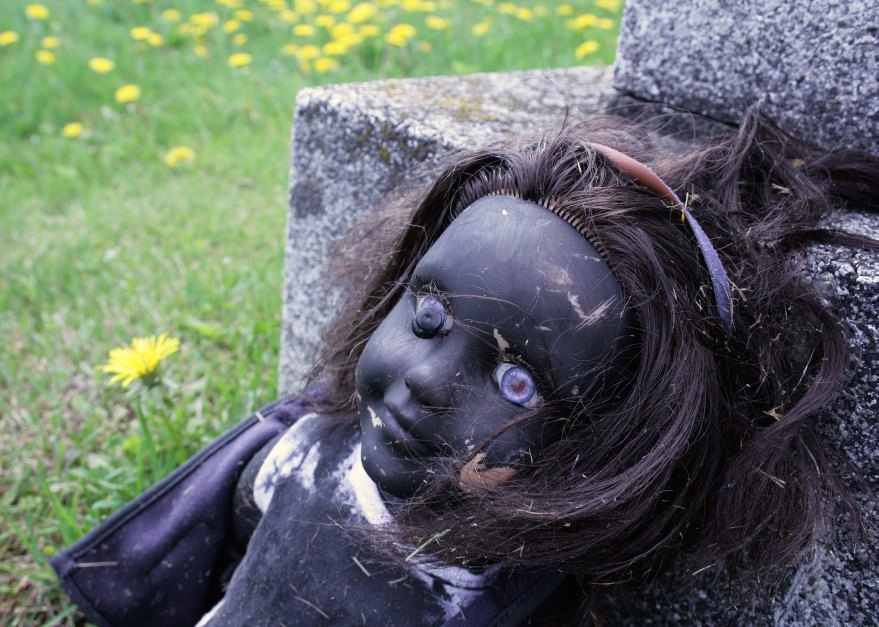
A creepy plastic doll, the kind where the eyes close when you tilt it backward. Except this one has a push pin pushed into its plastic eyeball. It was also painted black. I found it leaning up against the backside of a granite gravestone.

How it ended up there, I can’t even speculate. Was it bored teenagers? Or was it left behind with more sinister intentions? I took many photos but left the doll where I found it.

A Ouija Board

I think this is one of my favorite spooky finds! Technically my mom found it. We had gone off on our own, in separate directions, meandering among the gravestones. She called me over when she spotted this unique grave good.

Laying above a small flat stone marker was this hand-made ouija board. It was painted by hand onto a small canvas. I wasn’t able to locate what had been used as a planchette. My guess is they used a glass or cup of some sort, and made sure to return it to where it came from. 

From the looks of it, this hand-made board had been sitting outside for some time. Being an avid Ouija board collector myself, I enjoyed finding this one. But of course, I left it where it was found.

I have written in the past about the cemetery etiquette I follow when visiting cemeteries. I do sometimes clear away debris to get a clearer picture or stand-up fallen grave goods that have been knocked over. But, I would never remove anything from a gravestone, or cemetery for that matter. 

Did you enjoy my round-up of the top three spookiest grave goods I have found in a cemetery? It’s one of my favorite things about cemeteries, you never know what you might find!

Have you ever found anything strange left behind in a cemetery? I would love to read about it in the comments.

Thanks for reading!

Stone Stories: The U.F.O. Gravestone

In early July, my friends and I went on a cemetery road trip, up through Hailybury and New Liskeard to Kirkland Lake. We made quite a few stops along the way, not only at cemeteries. We stopped at a couple of roadside attractions to stretch our legs and take in the sights. 

We did have a few points of interest that we were determined to visit that day. One was the grave of Charles Bélanger, son of famous Canadian sculptor Rose-Aimée Bélanger. You may remember that story, as I wrote about our visit in a blog post called Stone Stories: Art in a Cemetery

The other point of interest, high on our list to see was a gravestone with an epitaph about U.F.O.s.

One of my favorite things about visiting cemeteries is finding unique gravestones. I love gravestones that stand out, that showcase a sense of humor, or something specific about their life story. I love stones that give you a glimpse of who the person was. Sometimes these peculiar gravestones also present a mystery! 

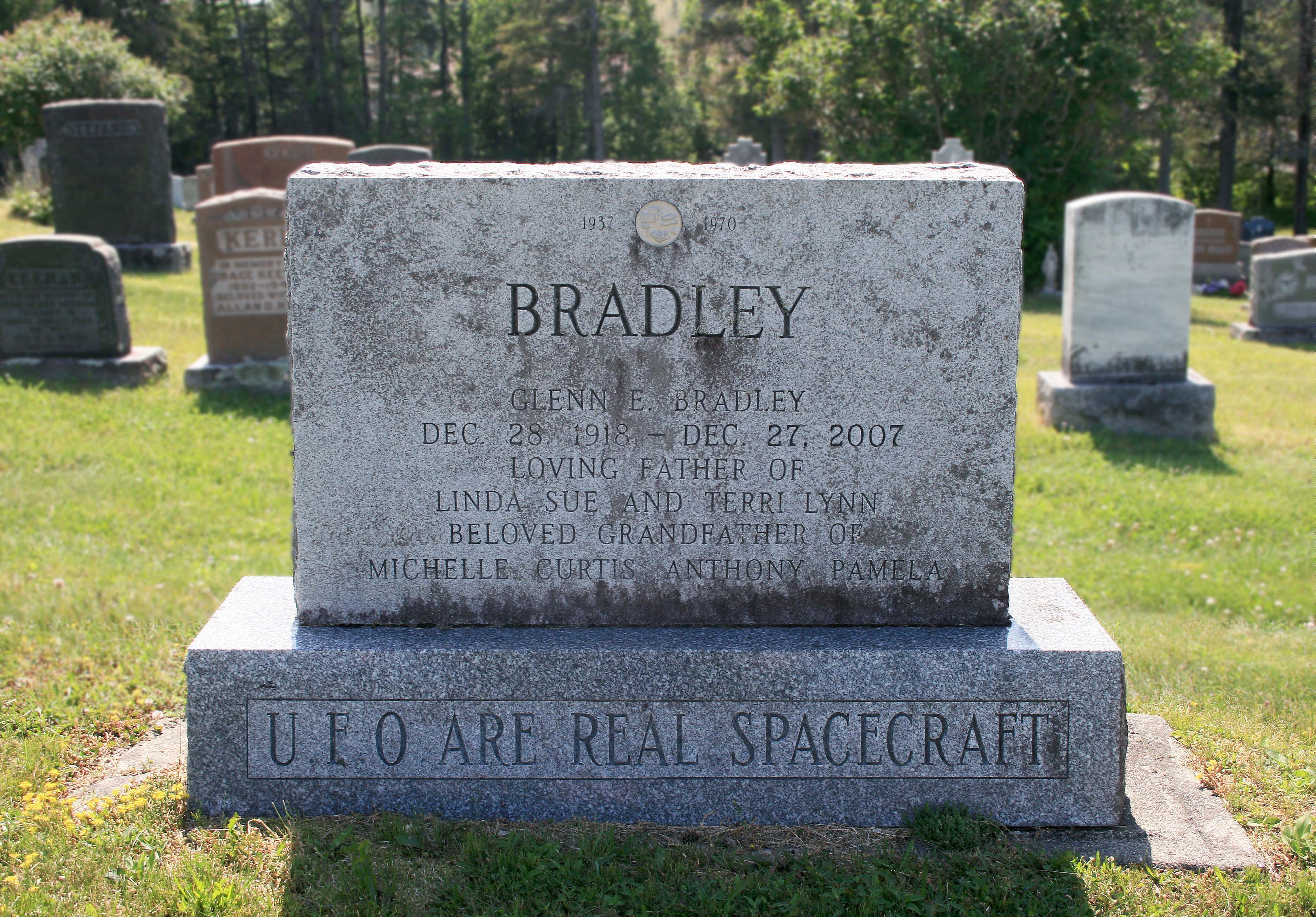
Like this gravestone in Kirkland Lake Cemetery that reads “U.F.O. Are Real Spacecraft.”

This is the gravestone of Glenn Bradley, who passed away on December 27, 2007. A day before what would have been his 89th birthday. From far away, his gravestone doesn’t seem to stand out. It’s a classic style headstone, in grey granite. But upon closer inspection, the epitaph jumps out at you.

It reads: “Bradley / Glenn E. Bradley / Dec. 28, 1918 — Dec. 27, 2007 / Loving Father of / Linda Sue and Terri Lynn / Beloved Grandfather of / Michelle, Curtis, Anthony, Pamela / U.F.O. Are Real Spacecraft.”

The epitaph continues on the backside of the stone: “Spinning Objects Vanquish Gravity / Spinning Objects Levitate / Spin to Exceed the Earths / Relative Feet Per Second / Honorable 60th C.B. Service / 1942 U.S. Navy 1945”

What does it mean? 

I am not the only one fascinated with this gravestone. Bill Steer, also known as Back Roads Bill, wrote an interesting article about this peculiar stone. In it, he shares an interesting tidbit found in Bradley’s obituary. It reads: “He will be remembered for his scientific work such as antigravity and his belief in UFOs.”1

Bradley’s gravestone tells us that he was a veteran of World War II with the U.S. Navy, having served from 1942 to 1945. Is that where he worked on antigravity? Had he seen a U.F.O.?

Recently, NASA revealed a report on UFO sightings, confirming that they are actively monitoring and collecting evidence. In the report, they state that unidentified anomalous phenomena (UAP) are not definitively connected to alien life, but what they are remains uncertain.2 You can read the 33-page report here.

It was on a particularly hot day, that we chose to visit the cemetery. It was the final cemetery on our list, having stopped at many cemeteries along the way. This meant that we were fairly tired when we arrived at the Kirkland Lake Cemetery, also known as Swastika Cemetery. 

Kirkland Lake Cemetery is actually located in Swastika, Ontario, a former mining and railroad town. It sits within the Kirkland Lake municipal boundaries.3 Swastika was originally a railway station along the Temiskaming and Northern Ontario Railway in the early 1900s. The town grew into a small mining community in 1907. It became known for its abundance of gold, which led the company, and officially the town itself, to name themselves after the Sanskrit symbol for “good luck” in 1908.4 

I don’t think we were prepared for how large this cemetery is! I was a little disheartened when we arrived, thinking we may not be able to find the fabled UFO stone. Find a Grave lists 7,871 memorials for this cemetery, and it’s marked as only 83% photographed. It’s quite large! 

After a brief distraction of falling into my regular photographer’s routine of stopping at gravestones that caught my eye, I remembered our objective. I regrouped with my companions and checked out Google one more time to point us in the right direction. In the end, we used some online photos to help us triangulate the stone’s location by matching up unique stones and markers in the background of the photos.

BINGO!

As mentioned previously, the stone from a distance is fairly nondescript. At the top of the gravestone, there is a coin embedded into it, with the dates 1937 — 1970. The coin reads: “E.W. Bliss Company / Bliss since 1857 / From Ingot to Finished Product”. According to the Military Wiki page, E.W. Bliss was an American company based in Brooklyn, New York. Among other things, they produced a line of special sheet metal work presses, power stamping machines, car parts, torpedoes, shrapnel, and armor-piercing projectiles.5

We spent time circling Bradley’s gravestone, pondering his curious epitaph. Without more background information, and as a layperson it did make me scratch my head in curiosity.

Maybe one day, answers will come forth as to what Bradley was talking about with his cryptically scientific epitaph. For now, it makes for a curious extraterrestrial mystery!

Have you ever seen a U.F.O. mentioned on a gravestone before? What do you think? Do you want to believe?

Thanks for reading!


References:

  1. A most unusual epitaph | Bay Today
  2. NASA reveals results of highly anticipated report into UFO sightings | CTV News
  3. Kirkland Lake Cemetery | Find a Grave
  4. Swastika, Ontario | Town of Swastika
  5. E. W. Bliss Company | Military Wiki

Cemetery Book Review: The Dead Die Twice

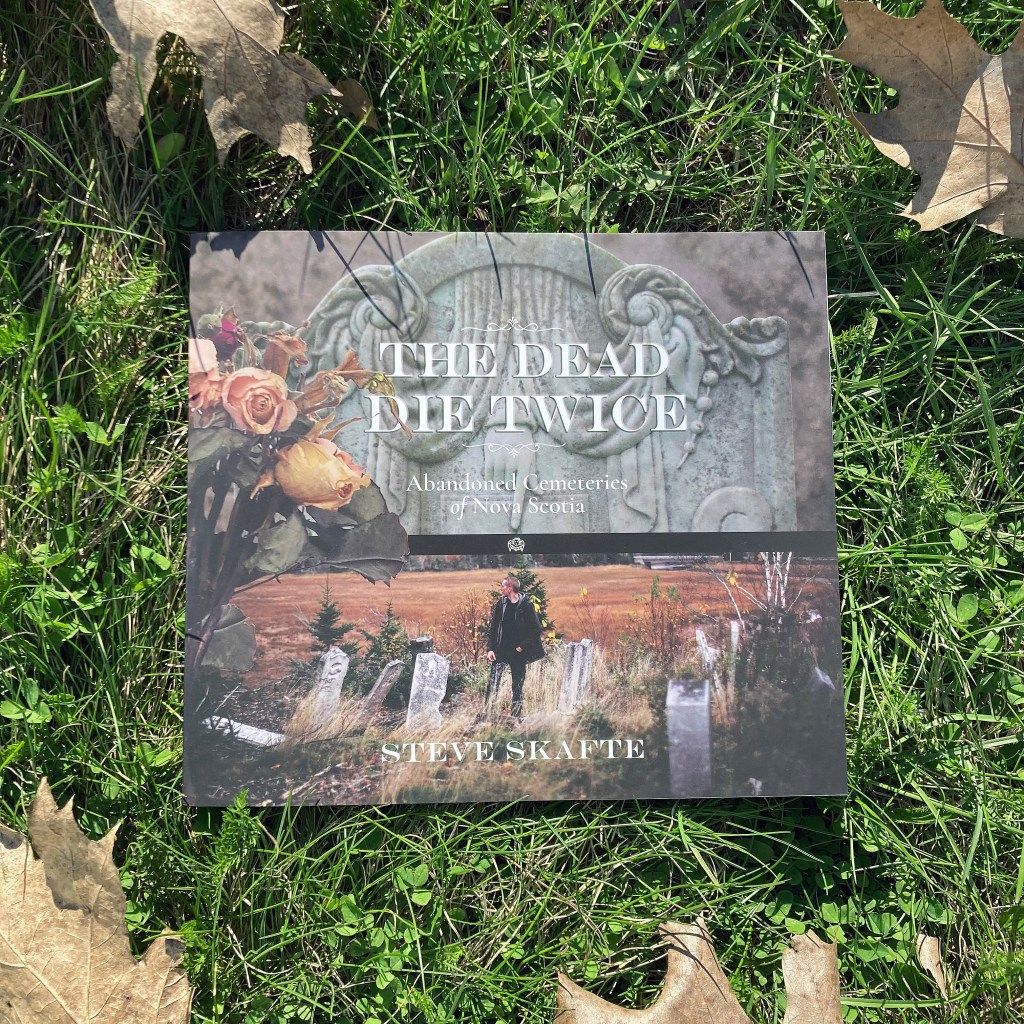
Back in March of this year, I was scanning some news sites when I came across an interesting article titled This N.S. photographer is saving the province’s abandoned cemeteries. It spoke about an upcoming new book that I knew I just had to read! I find books on Canadian cemeteries are somewhat rare, so I made my way to Steve’s Etsy shop and bought myself a signed copy. I was thrilled when it came in the mail a week or so ago. So, for this month’s book review I wanted to talk about The Dead Die Twice: Abandoned Cemeteries of Nova Scotia by Steve Skafte.

The Dead Die Twice is a beautiful little book. It’s filled with gorgeous full-color photography and beautiful prose. The author, Steve Skafte, is a fellow Canadian taphophile, who has been exploring, photographing, and cleaning up old abandoned cemeteries in Nova Scotia. The book is broken up into 3 seasons; Autumn, Winter, and Summer. Each section showcases several abandoned cemeteries and burial grounds, each with an assortment of stunning and moody photography, paired with eloquent musings.

Here is a snippet of the synopsis from Goodreads: “Steve Skafte has lived his entire life in Annapolis County—or what he calls “The Dead Centre”—a place with more forgotten history than anywhere else in the country. In search of those forgotten stories, Skafte stumbled over a couple of overgrown cemeteries and began his quest for what was hiding in the hundreds of cemeteries and burial grounds that lie abandoned in the woods all over Nova Scotia. En route, he discovered twisting trails of indifference, forgetfulness, and desecration. Featuring 80 haunting color images and more than 20 deeply poetic tales of discovery, The Dead Die Twice: Abandoned Cemeteries of Nova Scotia chronicles Skafte’s year of exploring abandoned cemeteries, pushing through walls of scratching brush, cutting a path to the past, and unearthing buried stones and half-forgotten stories.”

Reading this book is a rich experience, starting from the soft satin finish of the cover, the saturated moody photographs, to the beautiful and sometimes whimsical writing. Steve is a very talented photographer, and it’s easy to get lost in the photographs. The accompanying stories also paint a picture, revealing heartbreak and sometimes intrigue. 

While I read The Dead Die Twice, I found myself trying to slow down and take my time with each location. I didn’t want to rush it, even though I easily could have read the whole thing in one sitting. I wanted to explore each place as I would if I were there in person. The accompanying text added to that. I love that the coordinates to each cemetery have also been included in the book, with helpful tips on how to find them. If you’re like me, you’ll want to pin these spots on a map for future cemetery travels, or maybe just use Google Maps to take a closer look at the area.

I think any Canadian taphophile would be excited about this book. As I’ve mentioned before, Canadian cemetery books are a little harder to find. I believe this is also the first book I have read specifically about abandoned cemeteries, which some might find particularly interesting. This gorgeous book would be an excellent addition to any art and photography library as well. 

For those interested in purchasing a copy, you can find it pretty much anywhere books are sold. But, if you would like the bonus of a signed copy, I would order it directly from the source, the author’s Etsy shop.  

Thanks for reading! 


I am always on the hunt for cemetery-related book recommendations. Please feel free to share yours in the comments. If you are an author and have a cemetery-related book you would like me to review, please reach out at hello@chantallarochelle.ca. I would love to hear from you.


References:

  1. This N.S. photographer is saving the province’s abandoned cemeteries | CTV News Atlantic
  2. The Dead Die Twice: Abandoned Cemeteries of Nova Scotia | Goodreads

Our Story in Black and White: Photography Exhibit

Recently, I was very excited to learn that my work had been selected for a group photography show. If you follow me on Facebook or Instagram, you may have seen a few posts about it. Gallery 6500 had put out a request for submissions from local photographers, looking for contemporary black and white photographs. 

They asked photographers to submit works that commented on social, political, economic, and environmental issues within our community. COVID-19 was a focal point of many submissions, including mine. There was a very nice Sudbury.com article written about the show, that highlights the theme as well as some of the other amazing photographers in the exhibit. 

The 5 photographers exhibiting are: Caio Higa, Debbie Anzinger Mckay, Debb Trahan-Pero, Rita Vanderhooft, and myself. 

I was thrilled when I got an email saying my cemetery photographs had been chosen. This is my first time exhibiting in a gallery, and I was a little uncertain as to how my photography would be received. I have been in one other group photography show, that was more of a market or craft show style. It’s been a great experience working with the Gallery and organizers to bring this show to life. 

Last Sunday, April 30th, was the opening of the exhibit. It was a great event! There was a great turnout of friends and family of each featured photographer. It was so nice to see so many people come through to enjoy the photographs. Personally, seeing so many of my friends and family come out to support me made my heart full. I sometimes feel like my work goes unnoticed and I am creating content just for myself, so seeing so many people come out to support me and overhearing conversations surrounding my work was such a thrill!

Our Story in Black and White: Photography Exhibit, at Gallery 6500

I am very excited and honored to be exhibiting alongside such great photographers. There are a variety of subjects presented, each in the photographer’s own unique style. I am sure there is something there for everyone to connect with. There is some very powerful work on display. 

If you were not able to attend the opening, there is still time to visit this great exhibit. Gallery 6500, at 66 Brady Street, in the Steel Workers Hall is open for viewing on weekdays from 8:30 a.m. to 4:30 p.m. Our Story in Black and White is running until June 30th, and is dedicated to the memory of Don Kuyek. Don’t forget to sign the guest book and share your thoughts.

Thanks for reading!