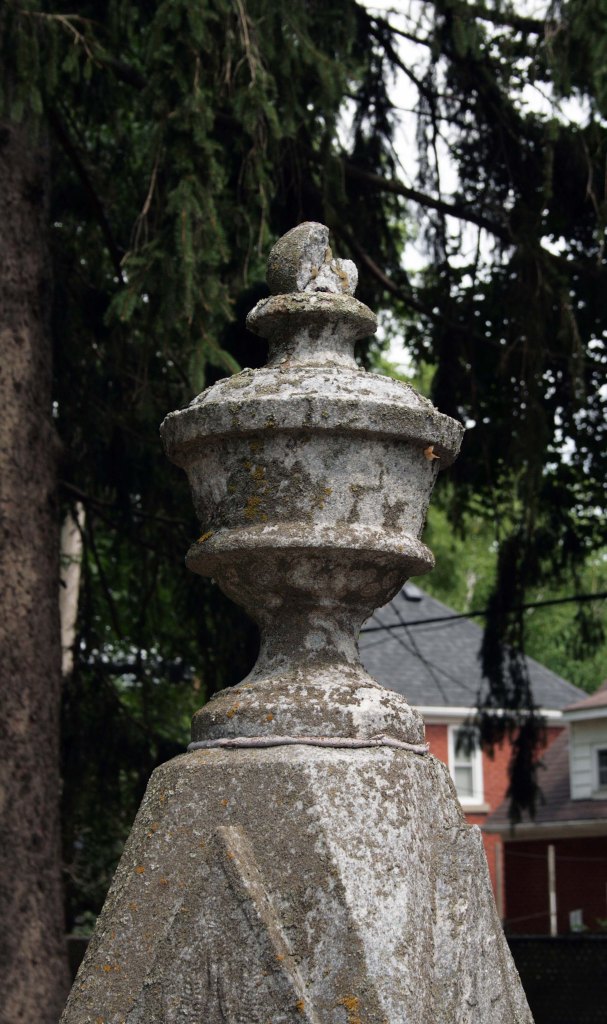
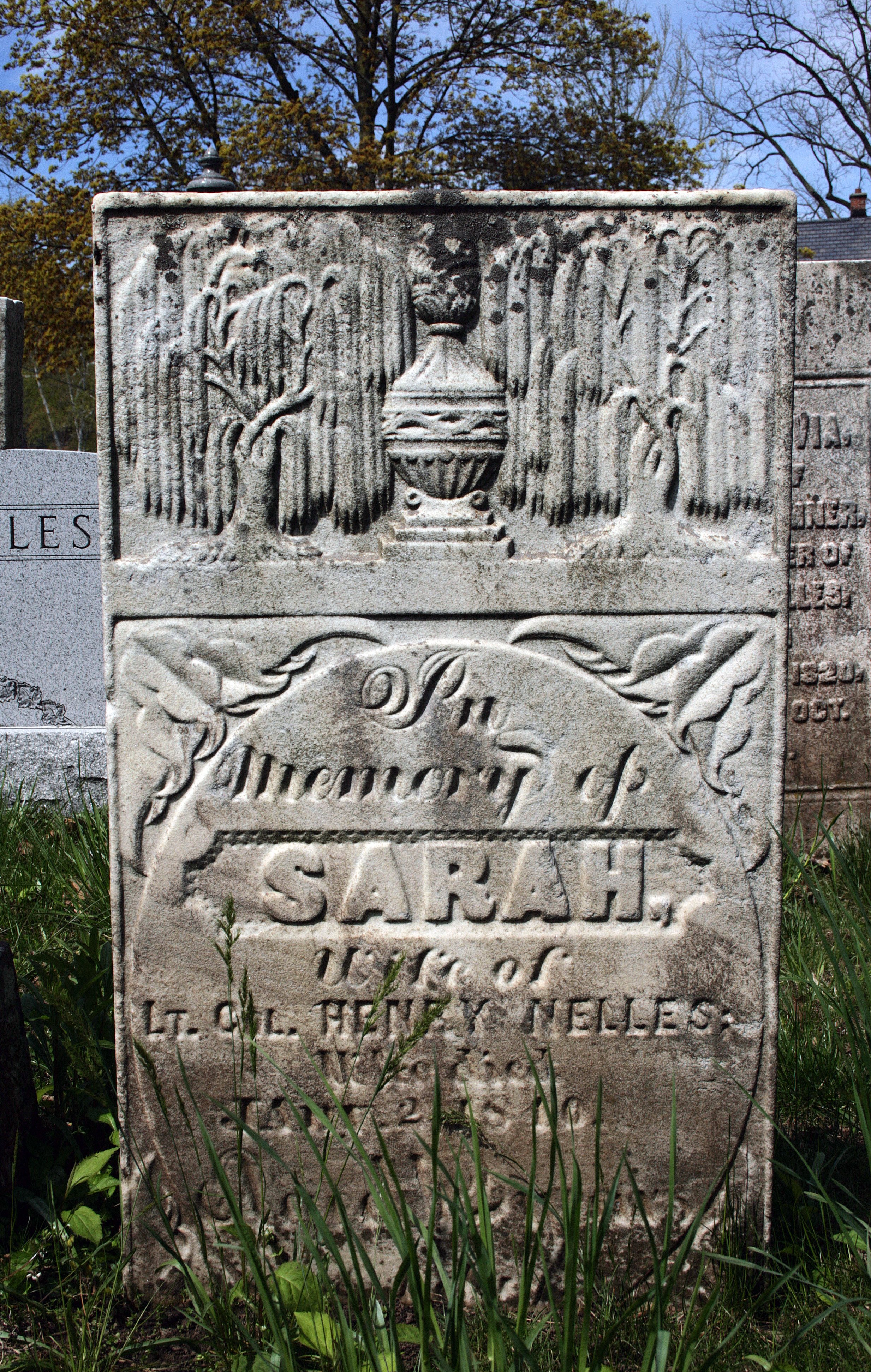
If you spend a lot of time in cemeteries you will often start to notice the repetition of certain cemetery symbols and motifs. In Ontario, more so in southern Ontario, urns tend to be a common gravestone symbol.
Although cremation was rarely practiced in North America at the time, the urn became a popular symbol in the Victorian era. Urns as a funerary symbol were adapted from Ancient Greece. Cremation was commonly practiced by the Ancient Greeks, who used ceremonial urns. As a gravestone symbol, the urn represents the body reduced to its most basic elements and the ascension of the spirit to heaven. Today cremation is a common practice, having started its climb to popularity in the 1980s.
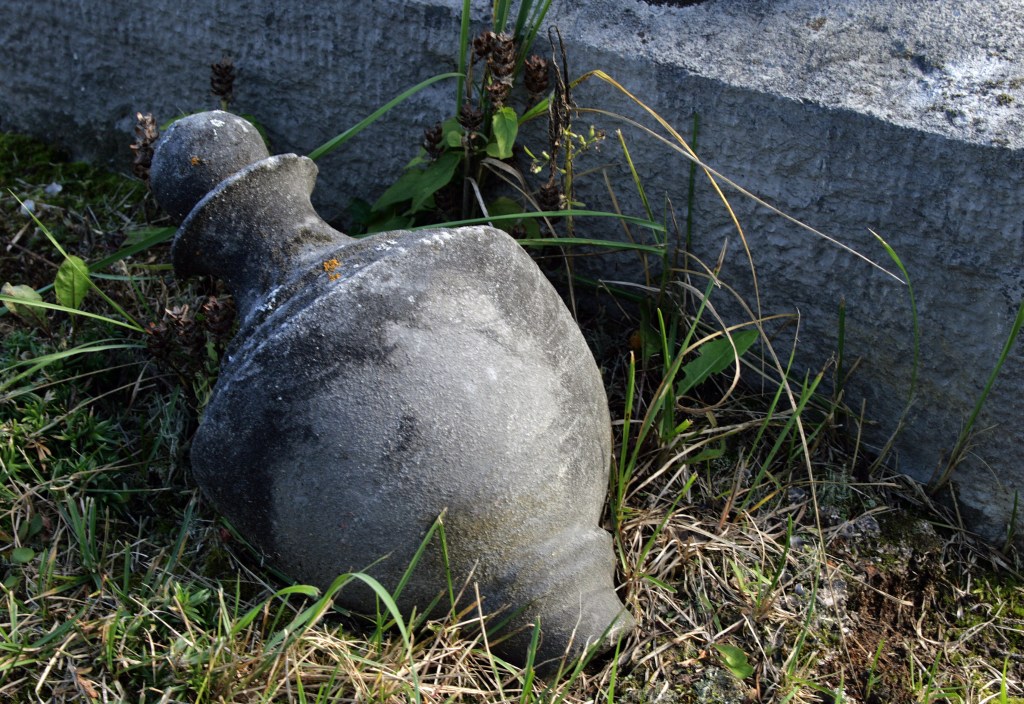
I have found and photographed many urns during my cemetery walks, so today I wanted to share some of them with you.
Like many graveyard symbols, the urn can be found depicted in a variety of ways. Each version of the symbol has a slightly different meaning. This is one of the reasons I find cemetery symbolism so interesting. It is a language unto itself.
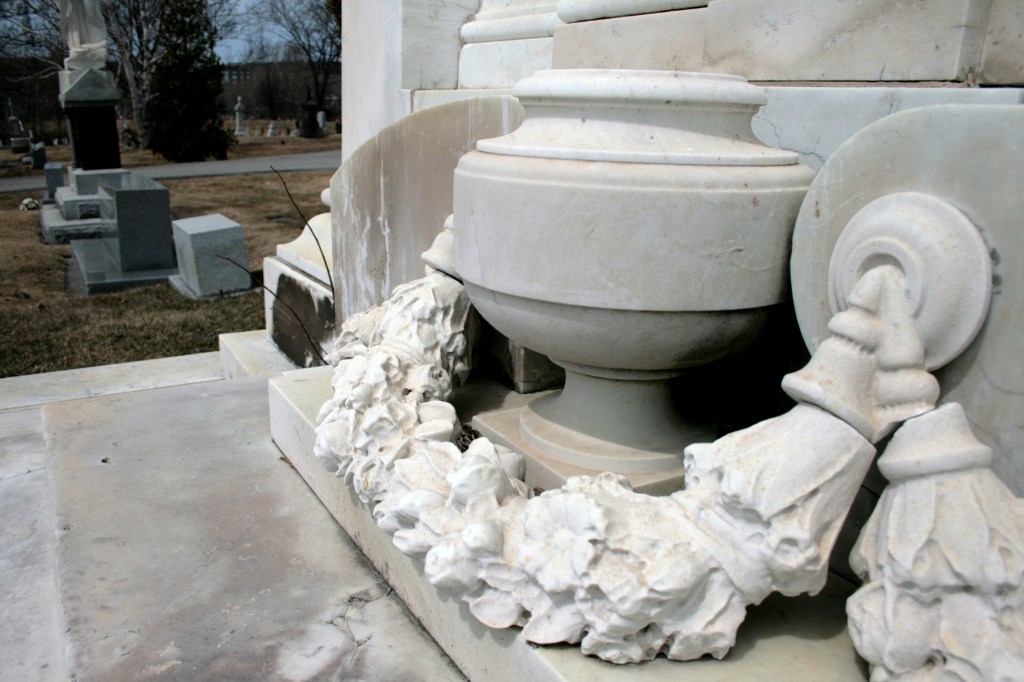
The Victorians were very fond of drapery, and you might come across what looks to be a fabric made of stone draped over an urn. Fabric draped over a gravestone is often thought to symbolize the veil between life and death. The fabric might also represent the shedding of earthly clothes as the deceased moves from this life to the afterlife.
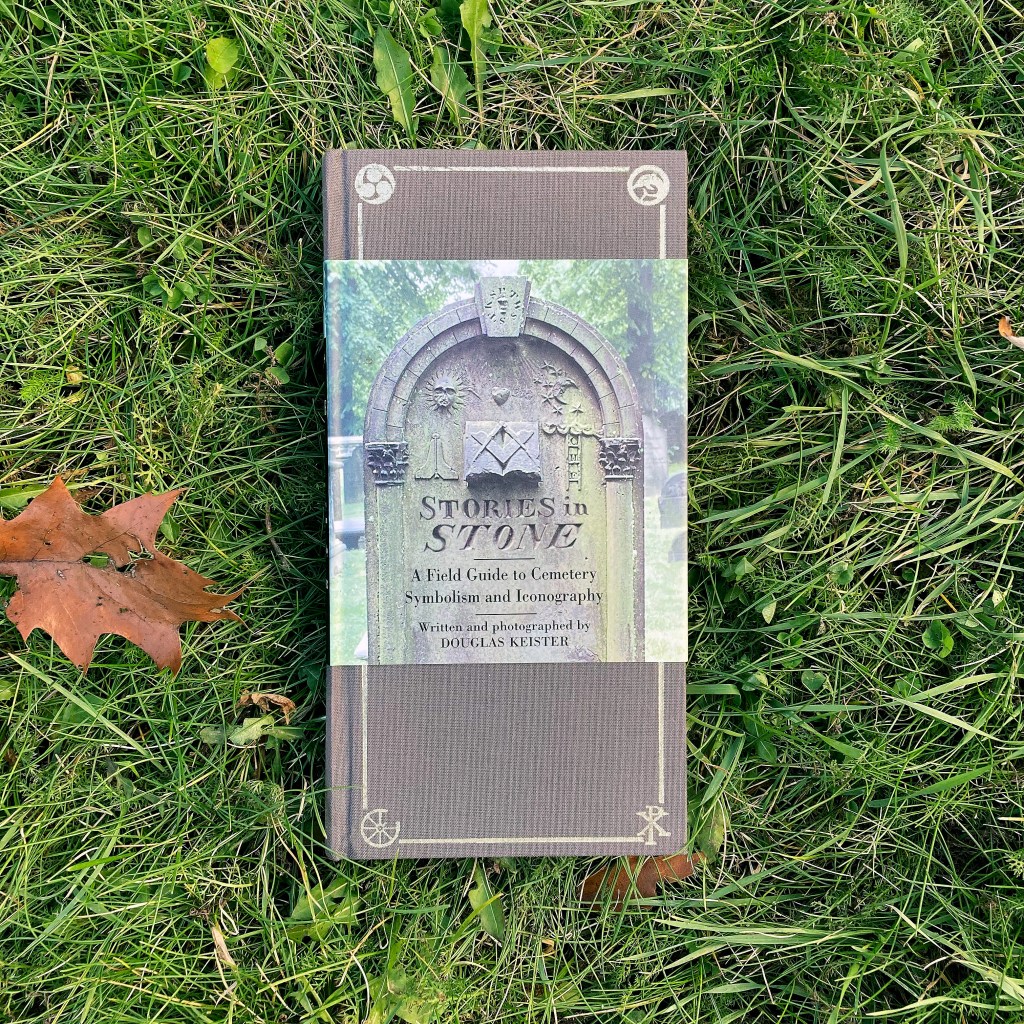
For this month’s cemetery book review, I wanted to talk about Stories in Stone: A Field Guide to Cemetery Symbolism and Iconography by Douglas Keister. I have been meaning to share this one for a while now. This is one of my favorite cemetery books, and one of my go-to reference books when it comes to looking up symbolism. I see it pop up now and then on the cemetery side of Instagram and Facebook and thought I should finally share my thoughts on it.
This book has been on my bookshelf for a very long time and it is something I go back to over and over again. It is a great resource for explaining the meaning and history behind most of the symbolism and iconography you will come across in a cemetery. Every symbol has a meaning, and the descriptions can range from simple to quite in-depth. The book itself is compact, so it’s easy to slip it into your hiking or camera bag if you want to take it with you on your cemetery travels. It’s filled with full-color photos as well to help identify all the variety of symbols you might come across.
Here is a snippet of the book synopsis from Goodreads.com: “Stories in Stone provides history along with images of a wide variety of common and not-so-common cemetery symbols and offers an in-depth examination of stone relics and the personal and intimate details they display; flora and fauna, religious icons, society symbols, and final impressions of how the deceased wished to be remembered. Douglas Keister has created a practical field guide that is compact and portable, perfect for those interested in family histories and genealogical research.”
I don’t recall where I picked up my copy, but it is a reference I use often. I never bring mine with me on my cemetery travels, but my cloth-bound hardcover copy has a special place at my desk for easy access when I need to look something up. This book covers iconography from A to Z, as well as the different art styles and architecture that can be found in cemeteries. It covers everything from religious and military symbols to fraternal organizations and secret societies. Douglas Keister is also an amazing photographer and his beautiful color photos of detailed gravestone symbols add depth to the descriptions. It also has a very thorough index at the back, which is very handy for moving back and forth throughout the book.
The name Douglas Keister may sound familiar to you. This is not the first book of his that I have reviewed. Back in July 2022, I reviewed his book Going out in Style: The Architecture of Eternity. You can read that review here. Douglas is no stranger to cemeteries and has written quite a few books about them. He is a photographer, author, and co-author of forty-five critically acclaimed books, twenty-five of which are on architecture.2
I highly recommend this book to any budding taphophiles and those interested in learning more about cemetery symbolism and history. This book would be a handy tool for genealogists as well, as many interesting and thoughtful things can be learned about the deceased based on what is on their gravestone.
This book has been an invaluable resource for me. I have always loved learning more about the stories that gravestones can tell us, and finding new symbols to research and learn about is one of my favorite things. It’s a beautiful, high quality book, that I think is an essential addition to any taphophiles library.
Have your read Stories in Stone? I would love to read your thoughts in the comments.
Thanks for reading!
I am always on the hunt for cemetery-related book recommendations. Please feel free to share yours in the comments. If you are an author and have a cemetery-related book you would like me to review, please reach out at hello@chantallarochelle.ca. I would love to hear from you.
Today on the blog I wanted to share a little bit about my first cemetery road trip of the year! A couple of weekends ago, two of my best friends and I went on a fun-filled day of adventures to celebrate a birthday. We traveled over 900 km to visit Grimsby Ontario, in the Niagara Region—and it did not disappoint!
A month or so ago, my friend had asked to visit a graveyard for her birthday, as she had never visited one before. There are closer graveyards we could have visited, but since this was a special occasion I took some time to try and find the perfect spot. Weirdly enough, the internet provided the solution. Randomly, or not so randomly if you believe that technology listens to us, a video popped up in my Youtube feed by Canadian Cemetery History. I took the bait and watched the video. It showed a visit to Saint Andrew’s Anglican graveyard. This beautiful graveyard was just what we were looking for!
Not only does Saint Andrew’s Anglican Churchyard boast the 4th oldest church in the province, but it also has a lychgate and table stones. Both of which we have never seen before in person. So I began looking into what else we could visit in Grimsby; other cemeteries, museums, attractions, haunted locations, and of course interesting places to eat. I pitched the idea to the group, and they were as excited as I was to explore this beautiful little town.
I continued to research things for us to do and managed to book us a private tour of the Nelles Manor Museum. We would be visiting the resting place of the Nelles family at Saint Andrew’s, so it made sense to visit their historic home and learn more about this prominent family.
The day of the trip started bright and early. After picking up our first Starbucks of the day, we left Sudbury a little after 6 a.m. The plan was to drive straight to the graveyard, with a Starbucks stop along the way, to make the best time. Then we would take our time exploring, and visit the Nelles Manor at 3 p.m. for our private tour.
We arrived at Saint Andrew’s Anglican graveyard at about 11 a.m. and got out to stretch our legs and explore. The graveyard was absolutely beautiful. As was the weather, we had a beautiful day for exploring. Right away we noticed the prominence of the Nelles family as they had their own family plot, as well as family members scattered throughout the graveyard. We would learn more about the Nelles family when we toured the Museum later in the day.
Saint Andrews Anglican Church and graveyard is located a stone’s throw away from the Nelles Manor. The current church building dates back to 1825. The graveyard is well-maintained and has a large number of historically important grave markings. The land for the church was originally donated by Colonel Robert Nelles.1 The Nelles family plot is closest to the church on the left side of the churchyard, enclosed by a chain with small cast iron tassels hanging from it.
This graveyard also acts as an arboretum of sorts, with beautiful examples of different varieties of trees. Many were in full bloom when we visited. There is a lovely variety of gravestones to be found there as well, many of which I had not seen in person before, like the willow and urn motif, broken column symbolism, and closed books covered in cloth. It was curious to see the difference in popular cemetery symbols that we found. In the Sudbury area, lambs, doves, and hands are very common. There also stand the tallest tablet stones I have ever seen. They are taller than I am! The gravestones I was most looking forward to seeing in this graveyard were the table stones. I have not had the chance to see one in person yet, and I find them so unique and fascinating.
Table stones have an elevated ledger top, that provide space for a longer inscription, and is supported by four to six columns. This type of gravestone was popular during the first part of the 19th century.2These types of stones were used for prominent people and were sometimes installed many years after the person’s death. In that instance, these stones would sometimes cover the original gravestone. These tabletop stones are often more worn, like the ones we saw, due to larger surface erosion, making the stones barely legible.3
After we wandered the entire graveyard, we took a break for lunch and then made our way back toward the Nelles Manor. We were a little bit early for our tour, but luckily there were a few points of interest in and around the Nelles Manor for us to explore while we waited. We visited the Trinity United graveyard, and the Grimsby Museum and grounds where we discovered more interesting Grimsby history. When it was time, we made our way a couple of houses over to visit the historic Nelles Manor Museum for our private tour.
The Nelles Manor was built from 1788 to 1798, well before the American invasions in the War of 1812. The house was fully built and lived in by the Nelles family by the time the Americans declared war on the British. The Niagara Peninsula became a gateway for American fighting forces to work their way from the American frontier on the East side of the Niagara River as they reached for Burlington, York, and Kingston. Nelles Manor was occupied by British and local militia during the War of 1812, but on at least two occasions was also occupied by American forces that had moved up from Niagara.1
We received a very warm welcome when we arrived at the Nelles Manor. Our tour guide Kate, and two other guides, were finely dressed in period clothing, which added to the authenticity of the experience. We started our tour outside, taking in the magnificent architecture of the building, as well as the warm weather. Our guide talked about the land where the Nelles Manor sits, and its connections to its surroundings. Our group found it very helpful that we had visited Saint Andrew’s, as well as the Grimsby Museum grounds before our tour.
After moving inside, we were treated to a walking tour of the house; starting at the front door, touring through the sitting room parlor, and making our way upstairs. Every room is beautifully decorated for the time period, with great attention to detail. Along with period-specific furnishings, the house is decorated with some original pieces that belonged to the Nelles family, as well as original art from the period. It felt like we were stepping back in time.
The guides are incredibly versed in the history of the house, the Grimsby area, and the Nelles family. They had no trouble answering our many questions. We had explained that we were in the area to visit the cemeteries and graveyards, and they kindly pointed out artifacts and related tidbits as they took us along the tour. At the end of our tour, they asked if we would also be interested to hear some of the haunted history of the house. We of course said yes!
They shared stories of experiencing odd smells when there shouldn’t have been any, such as smelling a delicious roast or floral perfume, which was a favorite of Mrs. Nelles. They also shared some stories from paranormal investigations that have taken place in the manor. Paranormal teams have reported their fresh equipment batteries dying quickly and suddenly. They have also captured some eerie electronic voice phenomena (EVP). The staff now use some of these EVPs during their Halloween events, wherein they tell the haunted stories of the house. I would love to attend one someday. As we were discussing the spooky happenings, my friend happened to check her Apple Watch and noticed the battery was dead. Were the Nelles spirits letting us know they were with us?
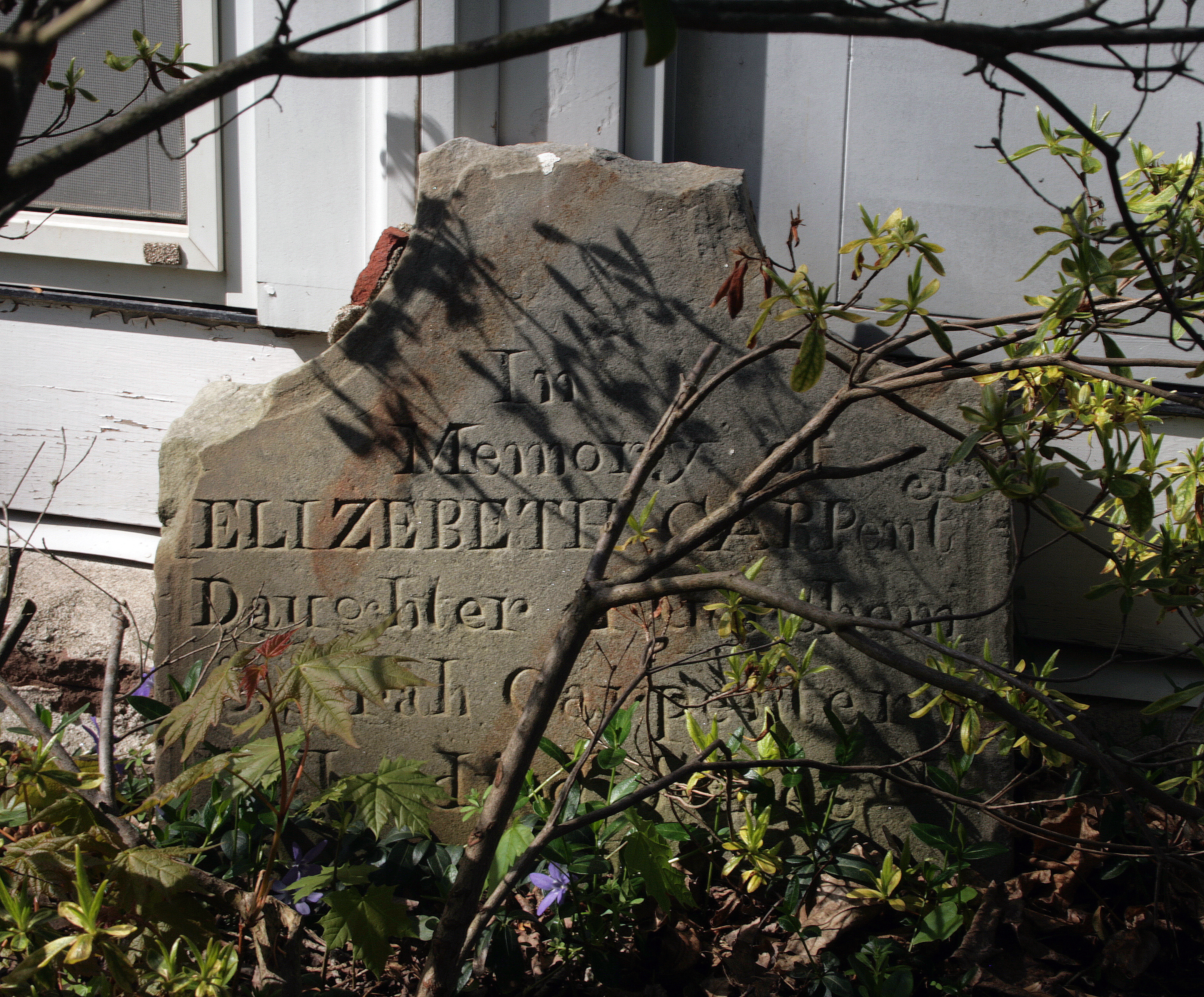
We thanked our tour guides for an amazing tour and made our way outside. They had one last interesting piece of history to point out as we were leaving. In the garden, leaning up against the house are two small gravestones, that are still very legible. Kate explained that these stones were originally at a graveyard close to the water’s edge, which has since eroded away. A cenotaph was erected at Saint Andrew’s Churchyard in memory of the souls that were washed away, and the original gravestones were moved; some ended up at the manor and used as flagstones for the walking paths. These two were preserved and now sit in the garden. You never know where you might find a gravestone.
There was so much we explored and experienced that day. As well as exploring the Nelles Manor Museum, we visited two graveyards, one cemetery, and one burial ground. We also stopped in at the Grimsby Museum and quickly visited the Grimsby Gingerbread houses. I’m sure I will write some more in the future about those visits. It was a very long day, but it was worth it.
If you ever get the chance to visit Grimsby, I highly recommend the Nelles Manor Museum. It’s a beautiful place to learn more about the history of the Niagara region and the War of 1812, and you might also have a paranormal experience. Don’t forget to also pay your respects to the Nelles family at Saint Andrews’s Churchyard.
Did you know that May is Cemetery Appreciation Month?
I first learned about it in 2021, and I have been celebrating every year since. Cemeteries are often seen as taboo and they are not often the first place someone would think to visit, but I believe that cemeteries are for the living. They are filled with history, art, and architecture, and are wonderful places to go for a stroll, or bird watching, among other things. Yes, they are resting places for our loved ones and should be respected, but that doesn’t mean we can’t enjoy their beauty as well. Cemeteries were the blueprints for today’s public parks, after all.
So how do you celebrate? In 2021, I created a mini bucket list of things to do during the month to foster an appreciation for cemeteries. It was a nice excuse to spend more time outside. I had a lot of fun completing everything on my list. Some activities on my list included visiting a cemetery I had not visited before, and re-visiting a favorite local cemetery.
This year I wanted to do something a little different. I’m a graphic designer by trade and wanted to create something that would bring my two loves together—design and cemeteries. I was also inspired by a cemetery scavenger hunt I took part in last October. I thought it would be really fun to do something similar with my group of friends.
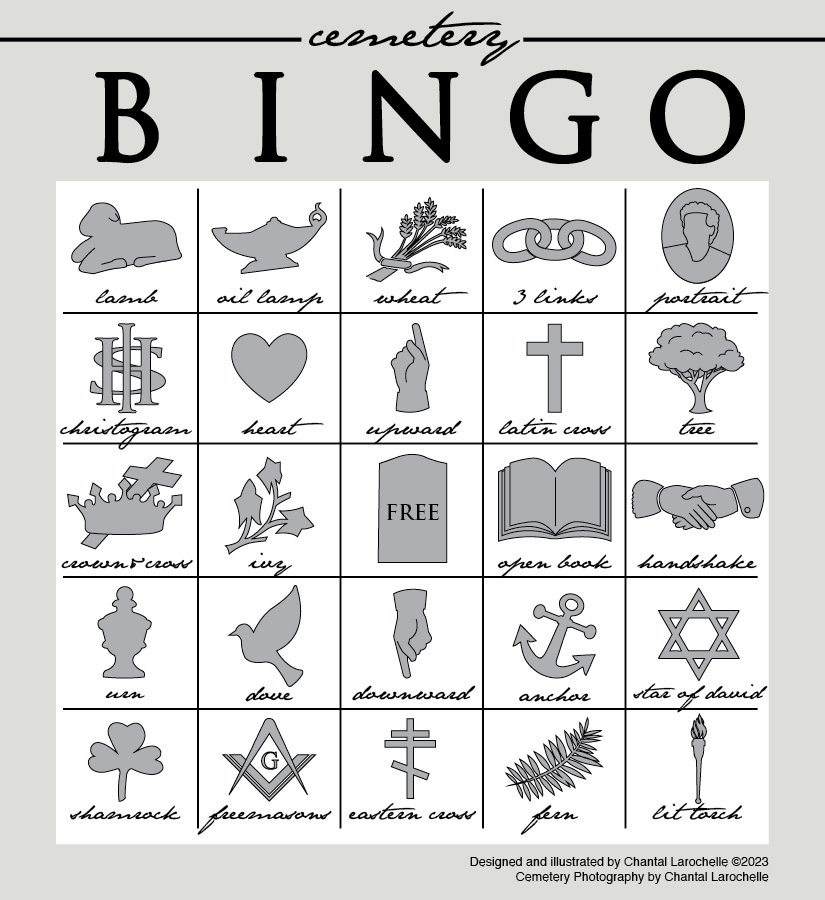
So I thought why not design a Cemetery Bingo card?
It’s a great activity to do in a group or solo and lets you explore the world of cemetery symbols. I created my cards using my cemetery photographs as a reference. I illustrated 40 symbols that are commonly found on gravestones. I included the name beneath the symbol as well, to help identify common motifs you might find while walking in a cemetery.
To play, all you need to do is print out a copy, bring something to mark your cards, and go for a walk in your local cemetery. Match the symbols on the card to what you find on the gravestones. The first one to get a full line wins! You can make that two lines, or even a full card to make it a bit more challenging. I can see this being a fun tool to introduce your friends and family to cemeteries and help explore gravestone symbolism. It could also be a fun activity for kids.
Please remember to be respectful when visiting your local cemeteries. For a guide on cemetery etiquette, you can read a previous blog post I wrote about the rules I follow when visiting a cemetery here.
My friends and I will be going on a cemetery road trip very soon, and I think it will be a great opportunity to try out the bingo cards. We have a lot planned already, but I think we can fit in a round of Cemetery bingo. I’ll be sharing how our cemetery bingo plays out in my stories on Instagram on May 6th.
For best results, send this print-ready file to a local print shop, or you can print them at home on your home printer. Just be careful when you are trimming the pages. Then all you need are some markers, stickers, or bingo dabbers to mark off your finds and have fun! Make sure to tag me in your photos or stories on Instagram and Facebook.
I find it fascinating and love trying to decipher the symbols and iconography I find. Symbolism can be found adorning tombstones and mausoleums. These symbols can range from simple designs to very elaborate ones. The meaning of symbols is a language in itself, and you can tell a lot about a person by what is on their tombstone. Religion, hobbies, clubs, and organizations can all be found represented, among other things, by symbols and icons within a cemetery.
Whenever I spot a symbol I have not seen before, I always turn to my handy reference books. If I can’t find what I am looking for there, the internet is the next best place to look. My go-to reference book is Stories in Stone: A field guide to cemetery symbolism and iconography by Douglas Keister. I have had this book forever, and always go back to it when I see something new. It’s a very in-depth look at what can be found in a cemetery. It covers architecture, sculpture, symbols, as well as acronyms and initials. I highly recommend it!
I recently added another reference book to my library, Understanding Cemetery Symbols: A field guide for historic graveyards by Tui Snider. I have just started getting into this one and I can tell right away it will be a great resource. It has some really in-depth sections on hand symbolism as will as crosses and even statuary.
So what kind of symbols and iconography can you find in your local cemeteries? For the most part religious symbolism is very common. Below are some examples of some common and not-so-common symbols you can find in Canadian cemeteries:
I love finding hands on a tombstone. Hands are shown in many different forms; pointing downward, pointing up, shaking hands, etc. the list goes on! And all of these different positions have different meanings. One of my favorite examples of hands was found in Terrace Lawn Cemetery in North Bay. These stones have weathered beautifully. This hand is pointed downward, with a finger extended which can symbolize God reaching down to collect a soul. The extended finger can mean a sudden or unexpected death. This hand below, is also holding a chain. A broken link in the chain can represent a family or marriage broken by death.
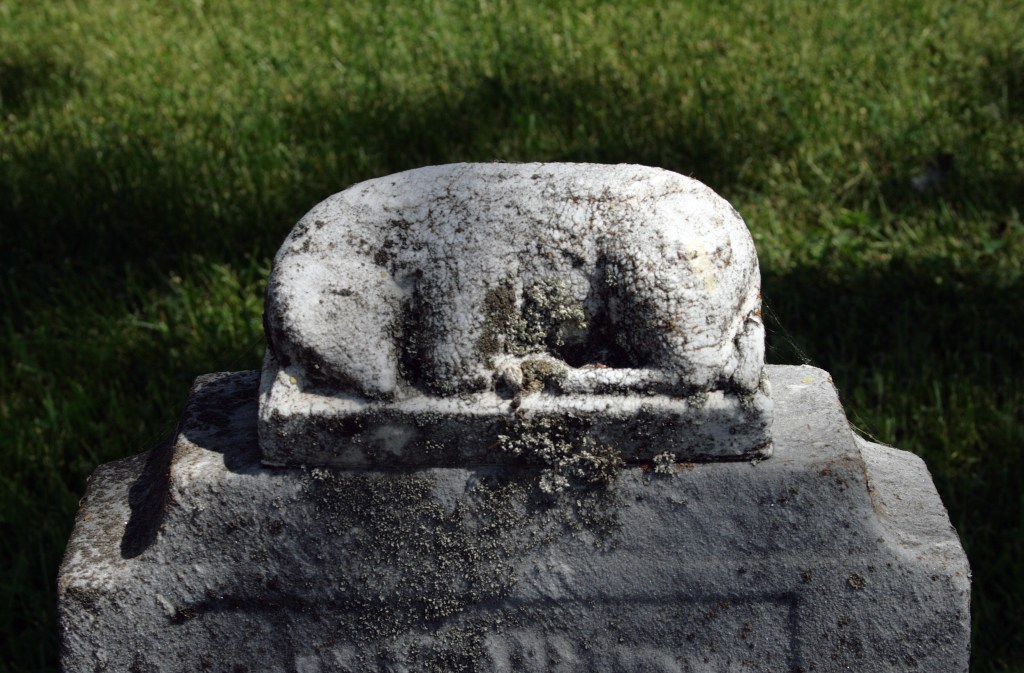
Lambs are a very common sight in cemeteries. These are sometimes accompanied by a tree stump, implying a life cut short. The Lamb itself represents “the lamb of God” and innocence. Sadly, lambs are most often found at the grave of a young child or infant.
Skulls are very rare to come by in my local Canadian cemeteries. I have only found two in all of my local travels, but I am always on the look out for them. They are more commonly found in other places of the world, like the United States and Europe. Most obviously a skull represents death. A skull found at the base of a cross is thought to be symbolic of the skull of Adam.
I have many great examples of symbols and iconography in my photography. If you are interested in seeing more and learning about their meanings, I share them every Friday on Instagram and Facebook.
I would also love to hear about the symbols you have found on your cemetery travels. Do you have a favorite? I would love to read about them in the comments.
Thanks for reading!
References:
Understanding Cemetery Symbols: A field guide to historic cemeteries by Tui Snider
Storie in Stone: A field guide to cemetery symbolism and iconography by Douglas Keister











 Cemetery Photography by Chantal Larochelle