When I was a child, my family often made trips to Quebec to visit extended family. My father loved to use the shortcut through Field, as it cut about 30 miles off our five-hour drive to Val d’Or. We always stopped for a meal at the McDonald’s beside Ms. Claybelt, the 12-foot-tall Holstein cow.
On the way back from our family visits we would add another stop to our route, which also became a road trip tradition. That was stopping at a small unassuming Book Shop that sits beside Highway 11.
I have many fond memories of this little highway book shop, that today sits abandoned. Just like the many books that have sat on the now neglected shelves, the Book Shop has its own interesting story to tell.
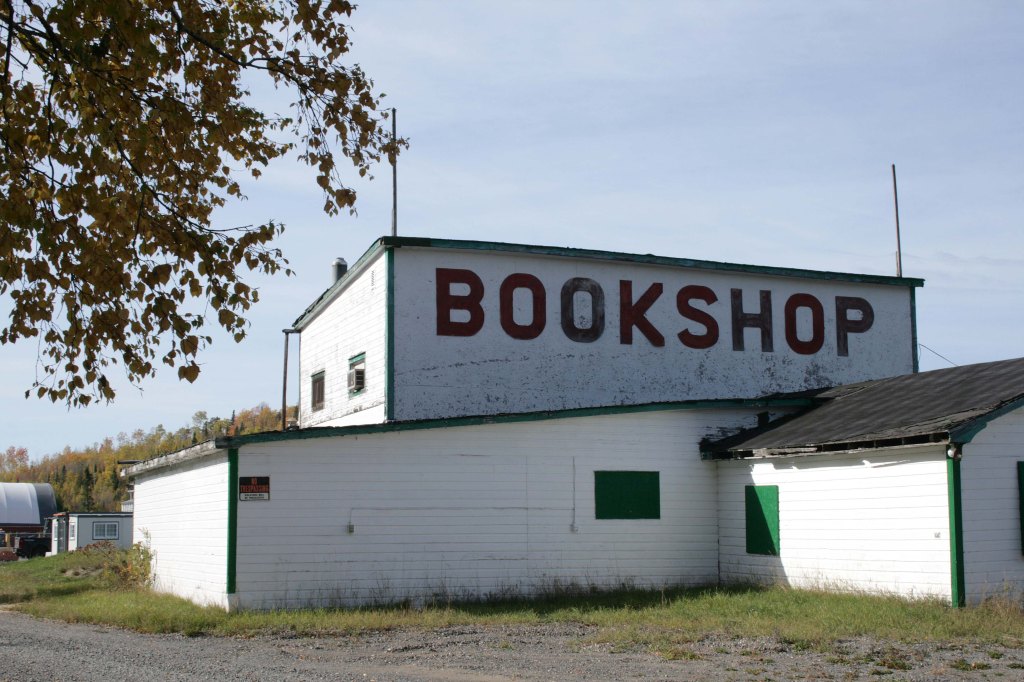
The abandoned Highway Book Shop. ©2022
The Highway Book shop
When Douglas Pollard opened his small print shop, called Pollard Press in 1957, I don’t think he ever imagined how big it would become. What started as a small commercial print shop in his garage, printing general office stationary eventually turned into a Northern cultural landmark.1
The story goes that one of Pollard’s customers asked to barter used books instead of cash to pay his bills. From then on the demand for books became greater and the shop expanded many times over the years to accommodate the growing collection of books.1
Being originally a print shop, it was a natural move for Pollard to start printing and publishing books in the 1970s2. 467 original titles were published through the Highway Book Shop, focusing on local history and Canadian literature.1
What started as a 20’ x 25’ wooden building eventually expanded into a 10,000 square footprint, consisting of building add-ons and even three highway trailers that were used to store nothing but books.2 No wonder so many people made it a mandatory stop in their travels, sometimes just to experience the sheer size of its collection.
I remember as a young girl getting lost among the stacks of books. It was so mind-blowing to me that the staff could find anything in that sea of books. However, the inventory was well maintained and kept very up-to-date. The Book Shop even maintained a list for those looking for specific titles. You could add your name to the list with your desired title and eventually, you might get a call that your book was found. Naturally, this could take some time, even years!2
Pollard, and his first wife Jean Ririe Hope, spent a lot of time at book fairs and conventions, always on the hunt for good books to add to their shop. Pollard even purchased lots of discarded Library books, that were sometimes hit-or-miss for quality.
After Pollard’s first wife passed away, he eventually remarried and brought his second wife into the fold of the Highway Book Shop. Mary Lois Williams was a Librarian with a Master of Library Science from the University of Toronto. She left the Librarian life trading it to work in the Book Shop when she married Pollard in 1986.3
After Pollard died in 2009, Lois worked to keep the Book Shop running. It was a valiant effort, but she ultimately decided to close the shop in 2011. At 87 years old, her heart was just not in the same way anymore.1
Visiting Cobalt
I visited Cobalt in October of 2022 with my mother. We wanted to take advantage of the fall colors and visit some local historical sites. We also wanted to visit Douglas and Lois Pollard in the cemetery, to pay our respects.
We spent most of our time in Cobalt visiting the Heritage Silver Trail, a self-guided trail system that takes you to 14 locations throughout the small town, that highlights the history of the silver mining rush. Unfortunately, when we visited, a lot of places were closed. This was also the case of the bookstore we had hoped to visit, White Mountain Publications.
White Mountain Publications was high on our list to visit as it houses some books that were rescued from the Highway Book Shop after it closed. I was hoping to speak to someone about how many books were rescued and if there were plans to rescue more. White Mountain also published a book that I was hoping to purchase on this trip, called Highway Book Shop: Northern Ontario’s Unexpected Treasure written by Lois Pollard. I ended up purchasing the book through White Mountain’s website instead.
Of course, there were many cemetery stops planned for this trip, but the one we wanted to visit most was the Cobalt Veterans Cemetery. This cemetery is located in Haileybury, a small town adjacent to Cobalt. The cemetery sits beside two other cemeteries; directly beside Mount Pleasant Cemetery, and across the road from the Haileybury Catholic Cemetery.

Cobalt Veterans Cemetery, Haileybury ON ©2022
The Cobalt Veterans Cemetery is the smallest of the three, although Find a Grave lists 332 memorials. I would not have thought there were that many laid to rest there based on the cemetery’s small size. It did make finding the Pollards less of a challenge.
Douglas Pollard passed away on November 25, 2009, at the age of 84. His obituary states that he passed away suddenly at Temiskaming Hospital4, but in her book Highway Book Shop, Lois briefly touches on that fateful night. Like any other normal day, after closing time Pollard went upstairs to retire for the night, as they lived in a small apartment above the book shop. When she followed him upstairs, only ten minutes later, she found that he had “quietly passed away”. Doctors confirmed that he had died of cardiac arrest.2
Douglas is laid to rest beside his second wife, Lois Pollard who passed away on January 3, 2020, at the age of 98. Their gravestone reads: “Pollard / Douglas C. Pollard. C.M. / March 18, 1925 — Nov. 25, 2009 / Beloved Husband of / Mary Lois Williams / July 21, 1922 — Jan. 3, 2020”
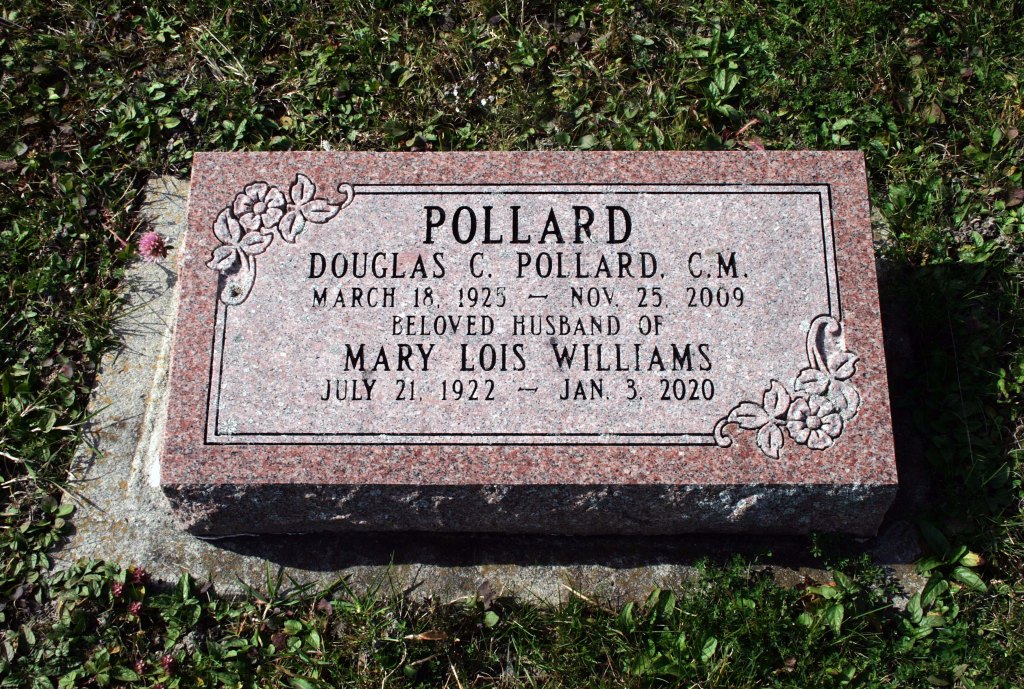
Gravestone of Douglas and Lois Pollard. Cobalt Veterans Cemetery, Haileybury ON ©2022
Douglas’s first wife, Jean Pollard is laid to rest in Valleyview Cemetery in New Liskeard. Jean passed away in October of 1979, unexpectedly on the operating table during a planned second open-heart surgery.2
The Book Shop Today
The Book Shop closed its doors forever on May 29, 2011. In 2012 it was purchased by new owners, but the Book Shop never re-opened.5 Rumour has it that the inventory of approximately one million books1 was left behind on the shelves. As noted above, White Mountain Publishers did rescue some of the books, but is it true that the large majority were left behind?
When we visited the Highway Book Shop on our way back home from visiting Cobalt, we took some time to walk around the building outside. The large sign that stands by the road that once welcomed visitors is slowly deteriorating. The building facade has peeled and faded over the years, and the grass is now growing wild.
We were hoping to catch a glimpse of the stacks of books inside, instead, we got a whiff of the strong musty smell of old books. Depending on where you stand outside the front of the building, you can catch that unmistakable smell. I can just imagine what it must smell like inside the building.
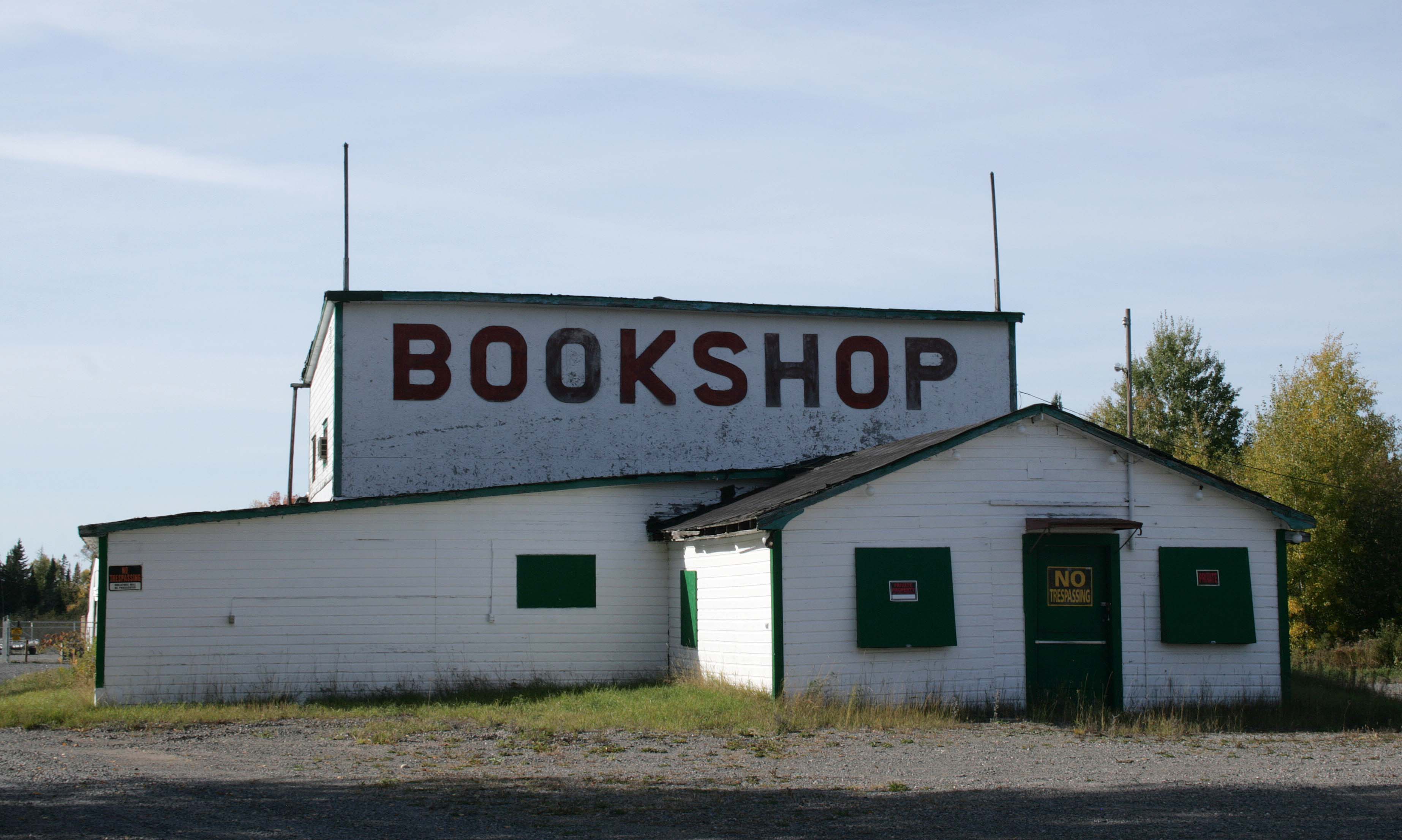


The abandoned Highway Book Shop. ©2022
While touring the grounds we chatted about our memories of visiting the Book Shop. My mother remembers speaking with Lois on our many visits over the years. We also talked about the books—about all the books that were left behind, and wondering about what types of books we could find given the chance. Both of us are not brave enough to cross into urban exploration territory, but luckily we are not the only curious ones.
The good people over at Freaktography have ventured inside to document what the Book Shop looks like today and prove once and for all that the rumor is true, they did leave the books behind. You can watch their video Exploring a HUGE Abandoned Book Store over on their YouTube channel.
Their video and photos show a time capsule, and books in rows upon rows of bookshelves for as far as the eye can see. It looks just like I remember. I am not the only one who has tried to imagine what an abandoned building full of molding and rotting books might smell like. The folks at Freaktography have been asked the question before:
“I have been asked by people, “What did it smell like in there?”, it smells exactly like you would think it does – like old books. It has warm, thick air and the rows upon rows of books give a muffled sensation when talking, there is no echo and it is eerily silent.”6
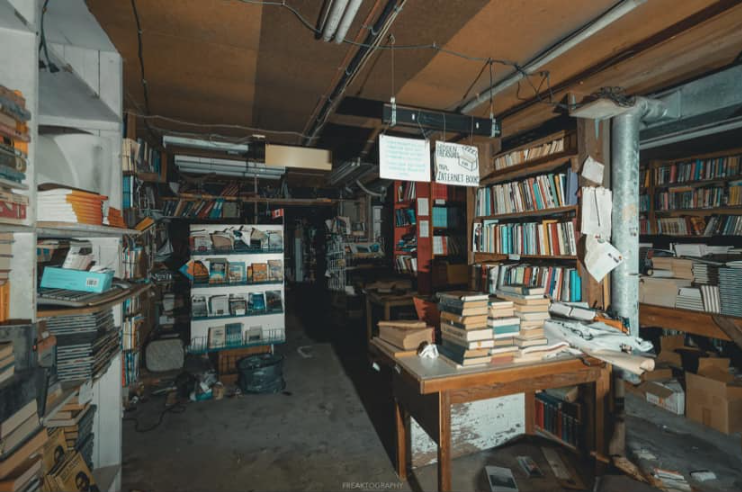
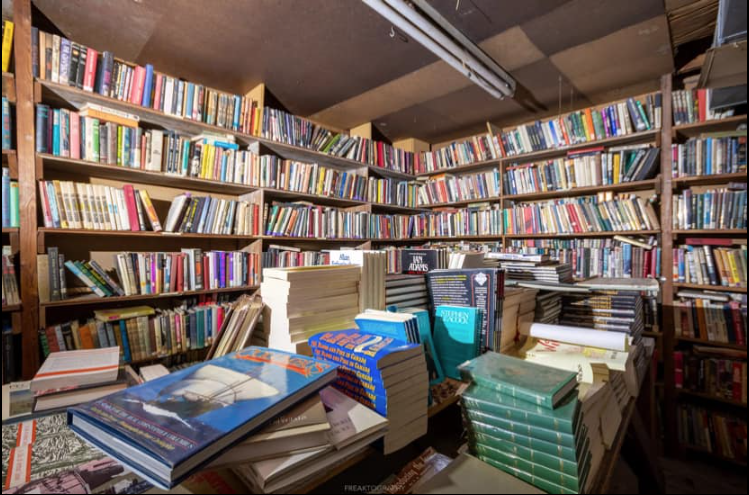

Inside the abandoned Highway Book Shop. Photos by: Freaktography ©2021 Used with permission.
I can only imagine how surreal it would be to walk through those stacks again. Watching the walk-through video does make me a bit sad though. So many books left behind. I wonder what unique and rare finds there might be, what treasure could be found. I mean a lot of those books might be dated and useless now, such as the maps and tech manuals. But just imagine what old and out-of-print finds there might be buried in there as well.
Maybe one day someone will be given the go-ahead to slowly pour through those lost tomes, and bring some of them back into the light. I know I would love to, given the chance.
It was really interesting looking into the backstory of this abandoned landmark, and a piece of my childhood. Learning about the lives and passions of the people who brought the Book Shop to life highlights the fact that there are so many interesting stories out there.
Thanks for reading!
References:
- A Short History | Highway Books
- Highway Book Shop: Northern Ontario’s Unexpected Treasure by Lois Pollard | Book
- Mary Lois Williams Pollard | Find a Grave
- Dr. Douglas Charles Neil Pollard | Find a Grave
- Home | Highway Books
- Exploring a HUGE Abandoned Book Store | Freaktography Youtube Channel



 Cemetery Photography by Chantal Larochelle