Cemetery Road Trip: The Walkerton Water Tragedy

I rarely stop to think about where our drinking water comes from, let alone whether it’s safe.

In May 2000, the small town of Walkerton, Ontario, faced one of Canada’s worst public health disasters. Contaminated water led to the deaths of seven people and made more than 2,300 people sick.1

Walkerton is about a four-hour drive from where I live, and this year marks the 25th anniversary of that tragedy. In June, my mother and I took a road trip there to visit some of the sites connected to the outbreak and to pay our respects to the lives that were lost.
What Happened in Walkerton

You might remember hearing about this on the news. Walkerton’s drinking water became contaminated with E.coli.1 The source of the contamination was traced back to Well #5, where runoff from a nearby farm had entered the groundwater. Heavy rainfall in early May 2000 carried manure into the well, and the danger was made worse by human error and poor safety practices at the time.1

For days, residents kept drinking the water, completely unaware of the risk. Once it was realized what was happening, it was too late. Within weeks, seven people had died and more than 2,300 others became seriously ill.1 Many survivors continue to live with lasting health problems even today.

The Walkerton Inquiry, led by the Honourable Dennis R. O’Connor, later showed that this wasn’t just one bad well—but a series of failures. Training was inadequate, oversight was weak, and protocols weren’t followed the way they should have been. Out of this tragedy came stricter water safety regulations for Ontario, which eventually shaped how drinking water is managed across Canada.2

Visiting Walkerton

When we arrived in Walkerton, our first stop was the Walkerton Clean Water Centre. It first opened in 2004, and since then has trained over 23,000 water system operators.3 The new state-of-the-art building, which we visited, was opened in 2010. It features a demonstration water distribution system for hands-on training, more room to host seminars, and space to conduct research.3

In May of this year, they offered tours of the facility, close to the anniversary of the tragedy. The timing didn’t work out for us to take a tour, but I still wanted to take a look at the building.

It’s a modern building, with a lovely koi pond just outside its main doors. The large windows have a nice view of the pond, and let in a lot of natural light. There is also a small pond across from the entrance, overgrown with tall grass and cattails, that is surrounded by a little trail loop. I imagine the staff take advantage of that little walking trail on their lunch breaks. I think the water features, while also being pretty, act as little reminders of how important water is to our ecosystem and us.

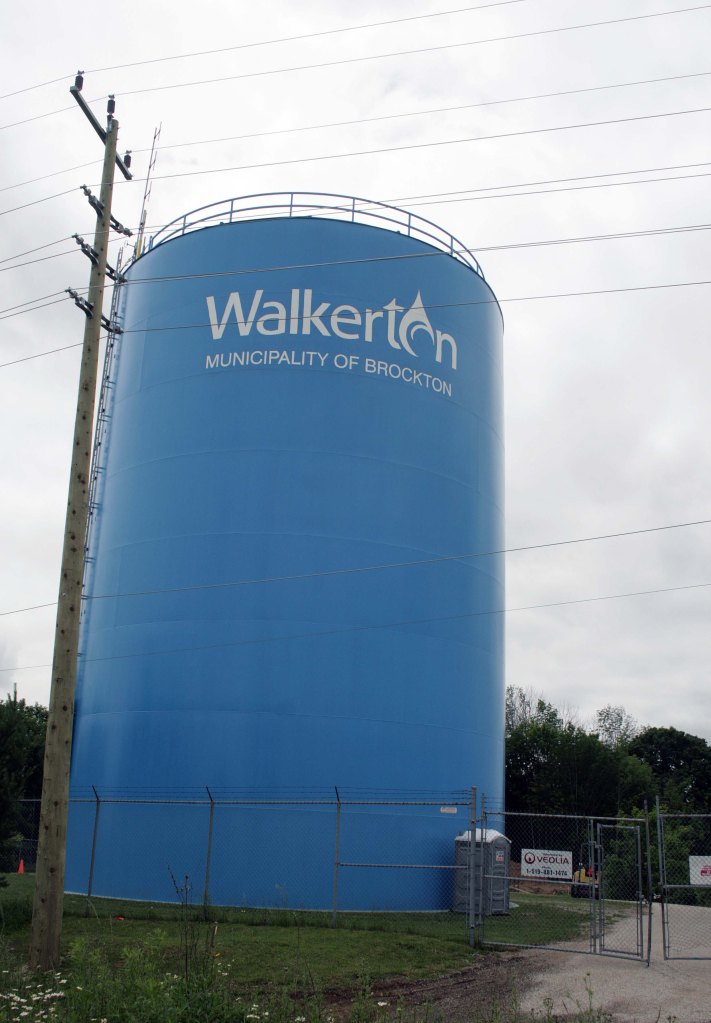
Our next stop brought us to a small cemetery that wasn’t connected to the tragedy. I am not one to pass up a cemetery visit though, so we made our way to visit. It just so happened to be very close to the Walkerton water tower. After that, we decided to visit a few more cemeteries, the last one of the day being Calvary Cemetery.

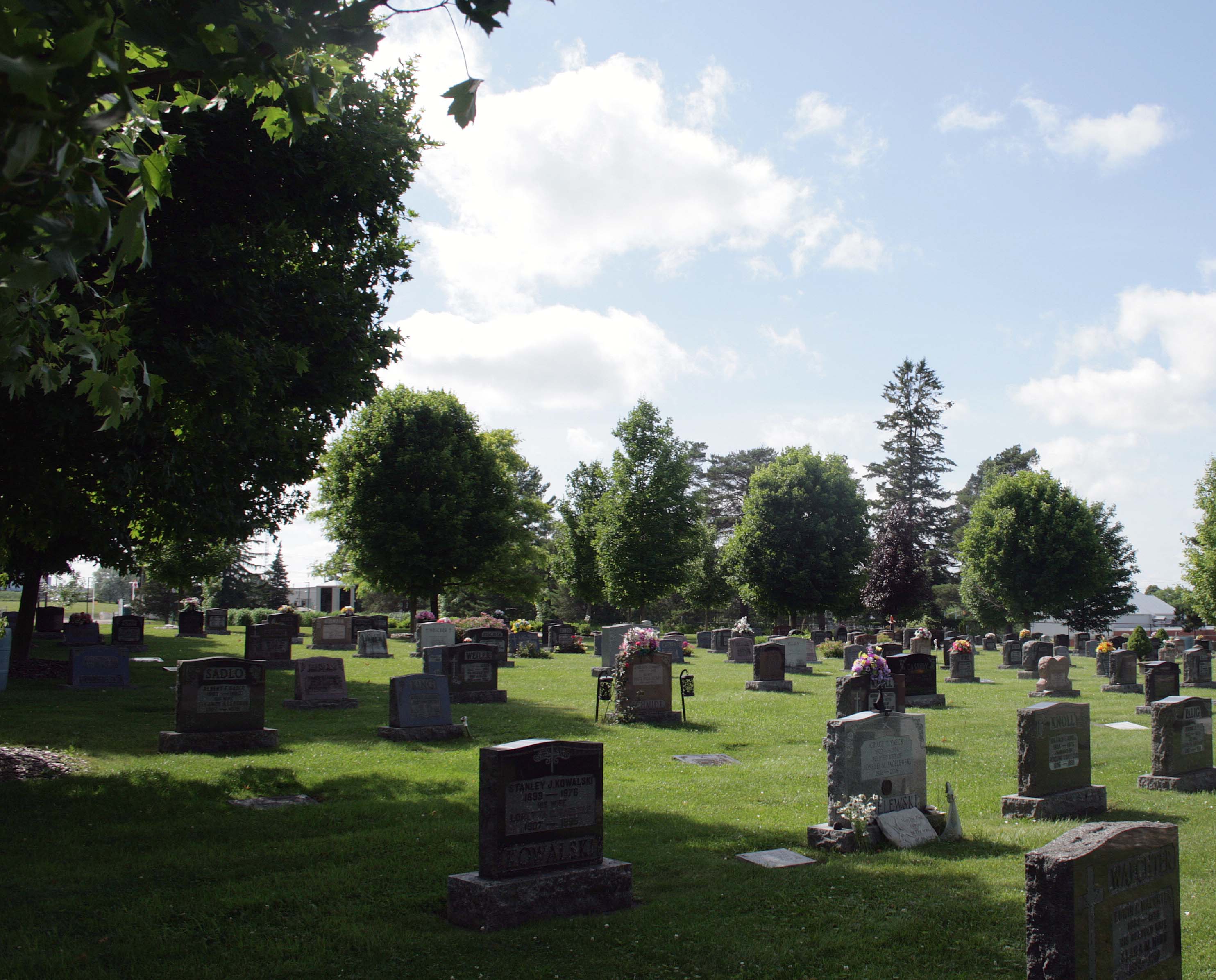
Calvary Cemetery is on the outskirts, just south of the town. This cemetery visit was important for our journey, as it is the final resting place of two people who died in the water tragedy.

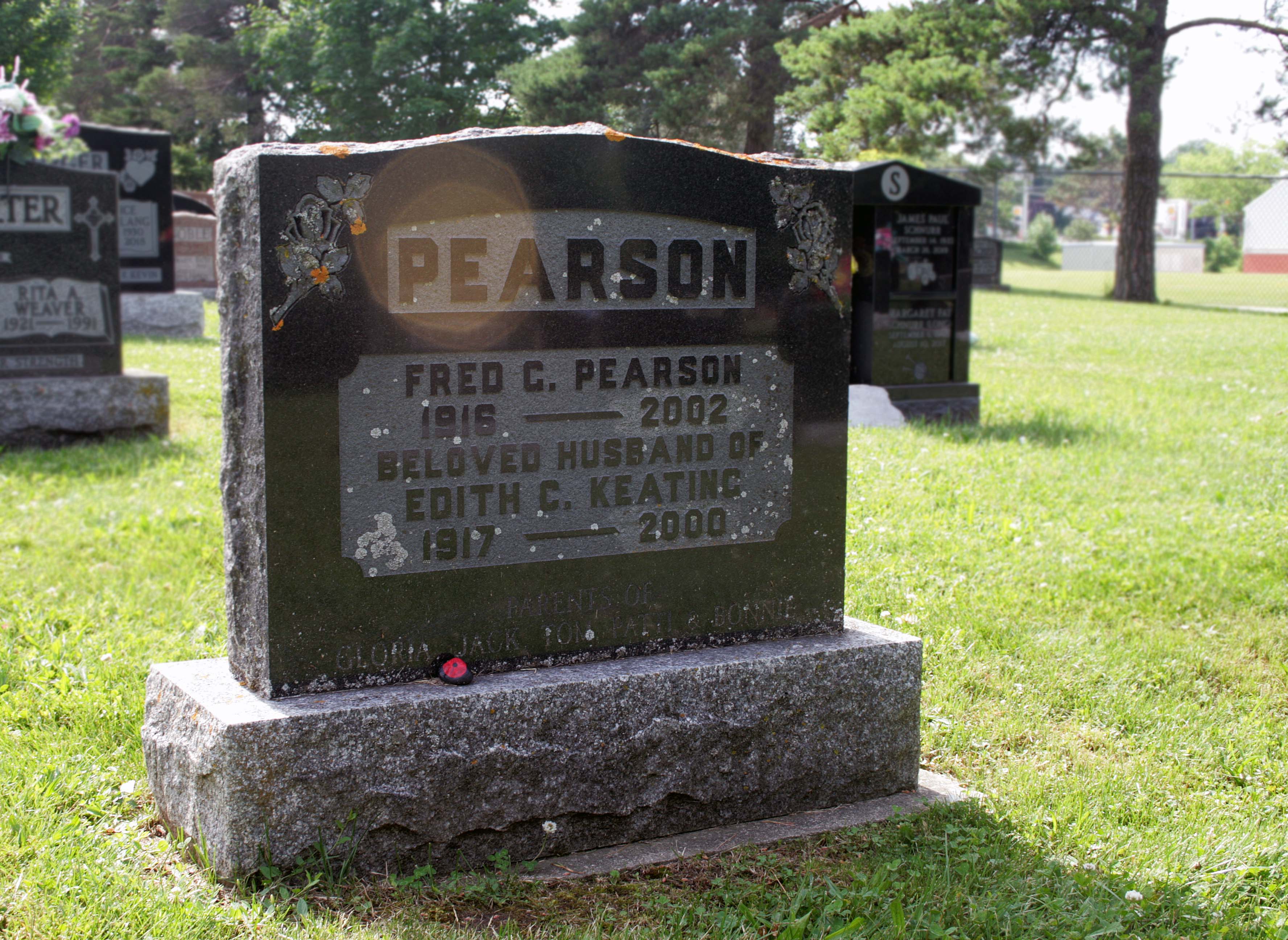
Edith Pearson, a mother of five and a grandmother of 13, passed away at the age of 82.4 Not far from her rests Lenore Al, a retired part-time librarian, who passed away at the London Health Sciences Centre at the age of 66.4 Their memorial services were held both during the same week.5

It was a very reflective visit, as my mother and I walked the rows searching for these specific graves. It was a scary thought to think what could happen by just drinking a glass of water. Standing in front of their graves also made their story real, bringing it off the page and into reality.
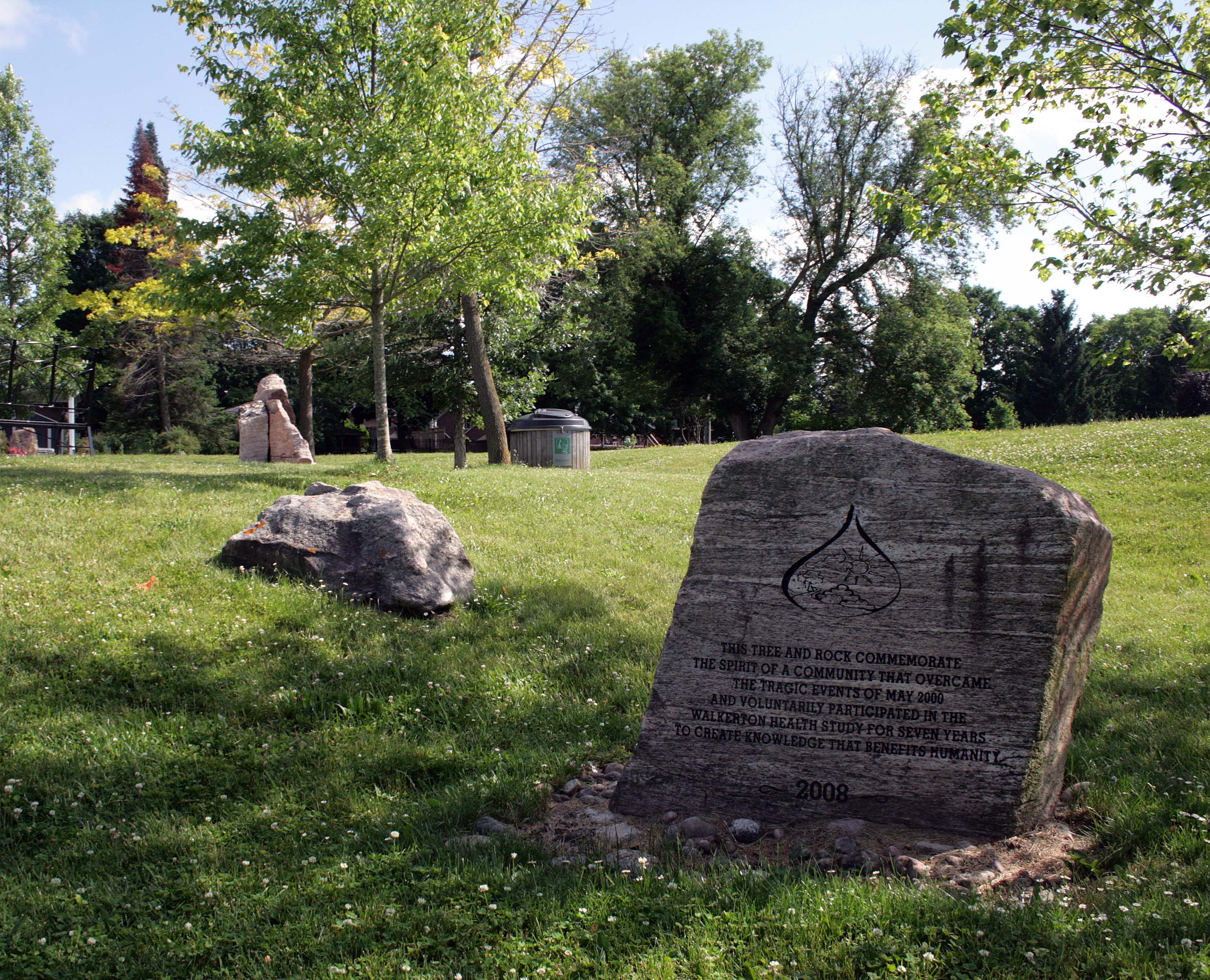
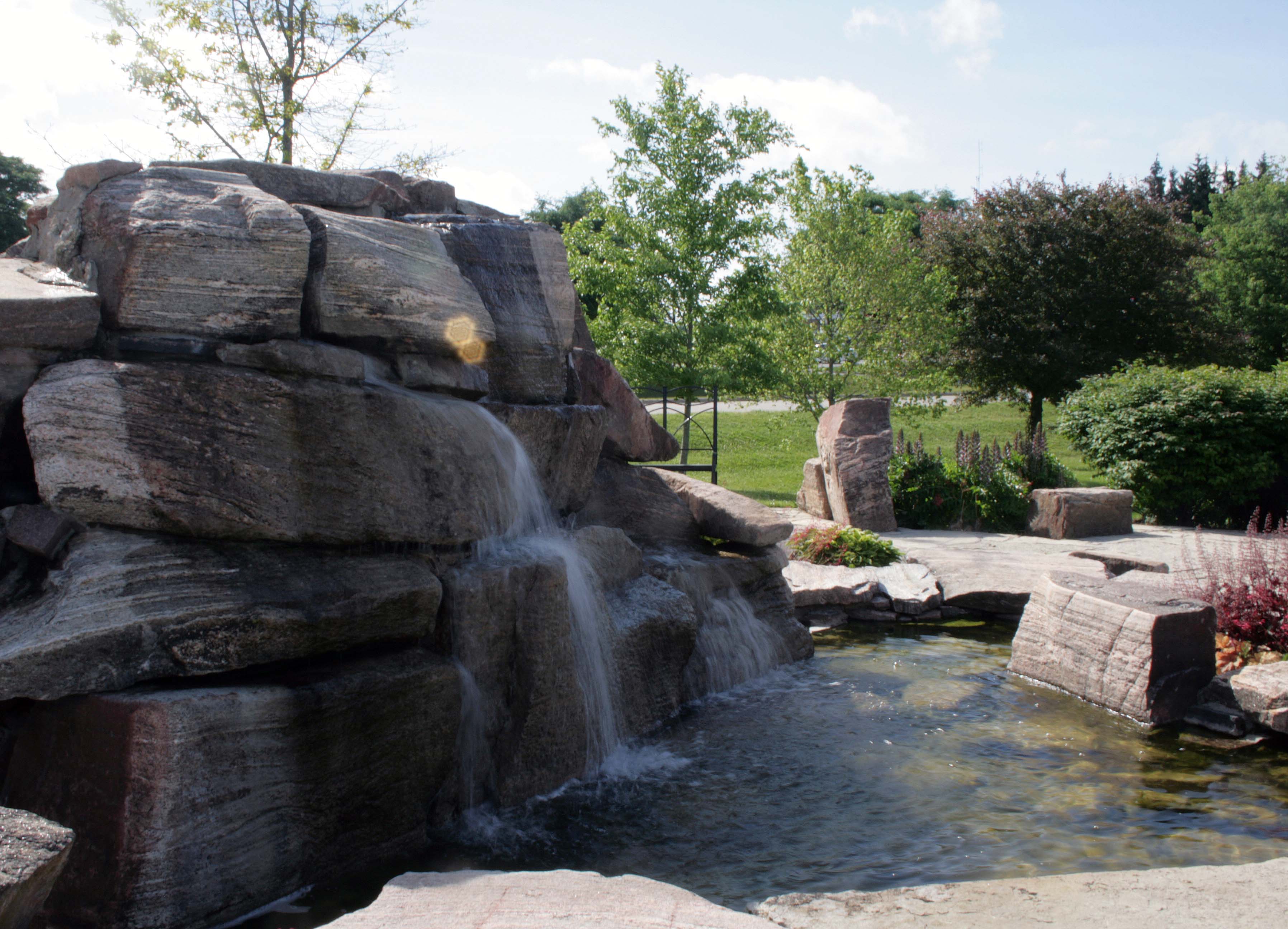
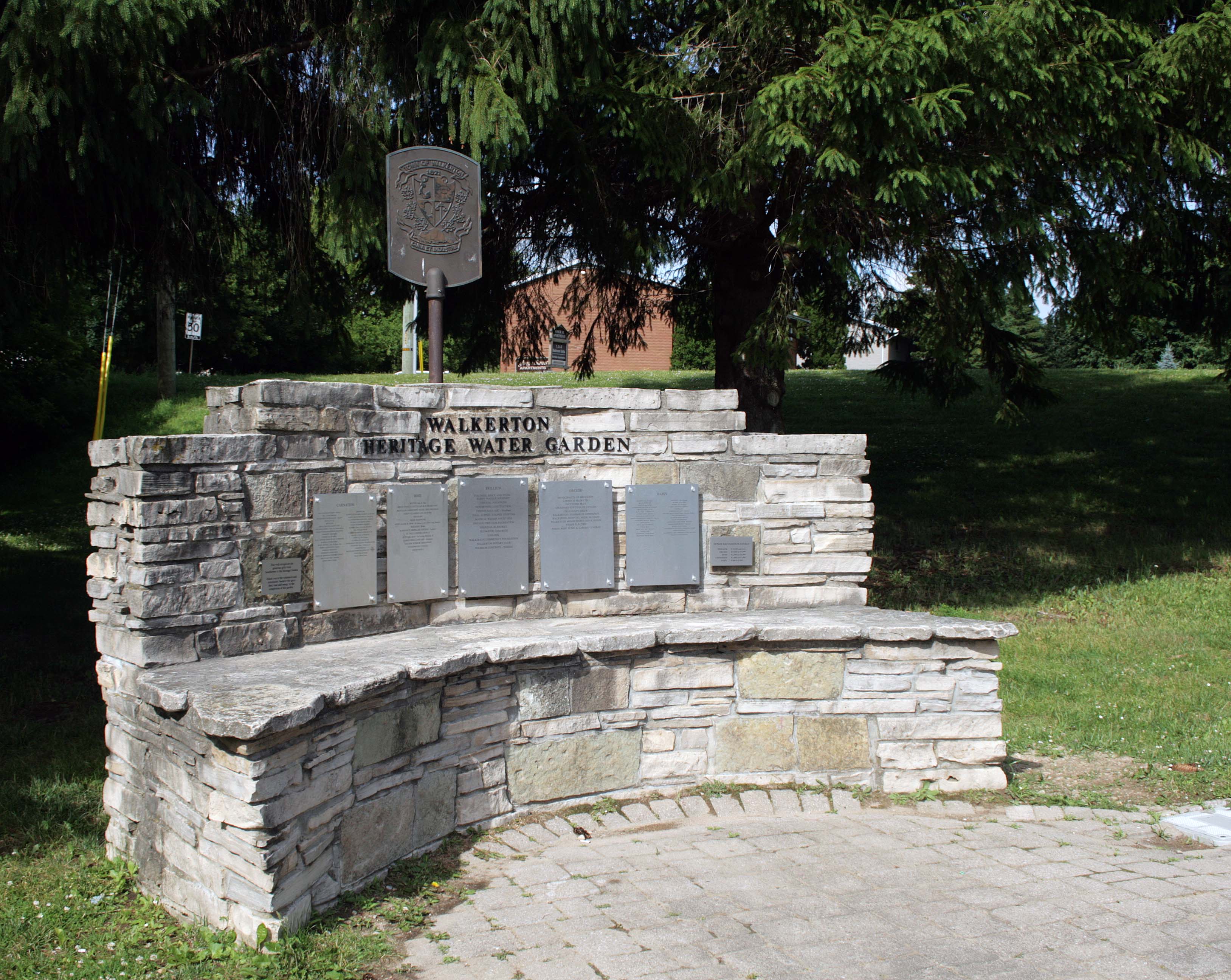
After that somber visit, I thought it might be a good idea to visit something a little more hopeful. The Walkerton Heritage Water Garden features a waterfall that gushes out from a crack in a large rock formation. It’s inspired by the biblical story of Moses, who struck a rock in the desert to bring water to the Israelites.6 It represents water as a positive symbol of life, healing and renewal. The waterfall pours into a small pond that is surrounded by a larger walking trail. There are benches and small clusters of flowers and tall grass that dot the path that leads you back to the memorial fountain.

It was a hot day when we visited, so the occasional cool spray from the waterfall was very welcome. It was a nice little spot for a small walk, but the constant running water made it hard to forget why it was there.

Our first day in Walkerton was a long one. Shortly after our walk, we found something to eat and then settled in to our motel for the night. We had one more site we had to visit.

The next morning, after a good breakfast, I wanted to find Well #5.

Sometimes while planning and researching, it can be tricky to find exact locations, even in this digital age. But I thought we have to give it a try. So with only a street name in my GPS we headed out.

Slowly driving down the dirt road, we kept our eyes peeled for signs of the well. I was getting worried as we reached the end of the road, but I caught the glimmer of what looked like a silver plaque.

We found the well, which has since been capped off, tucked in behind a small building on the edge of a farmer’s field. Today, it’s just a large cement pad with a small silver plaque. If you didn’t know what you were looking at, you may think nothing of it, but the plaque tells the whole story.

“Well 5 Memorial / This plaque marks the location of Walkerton’s former Well 5 / which supplied a portion of the town’s drinking water from / 1978 into the spring of 2000. In mid May of the year 2000, / extremely heavy rains washed a toxic blend of biological / pathogens through the soils and into the vulnerable shaft of / Well 5 and ultimately into Walkerton’s Municipal drinking / water system. The resulting contamination of the town’s / drinking water system lead to the deaths of seven people and / caused thousands of others to fall ill. It is hoped that all those / who visit this location will reflect upon the multiple causes of / this tragedy and will be filled with a renewed reverence for the / comprehensive stewardship of the waters that sustain us all.”

Finding the well was a moving moment, and as the plaque suggested, my mother and I took some time to reflect as we looked into the farmer’s field and at the old well.

Lasting Impact

The story of Walkerton didn’t end in 2000. For many survivors, the contamination left behind long-term health complications that they will carry for the rest of their lives. One of those people was Robbie Schnurr, who became seriously ill during the outbreak.7 The illness damaged his kidneys and digestive system, leaving him to cope with constant pain and health struggles for nearly two decades.7

In May of 2018, Robbie made the heartbreaking decision to end his life through Medical Assistance in Dying (MAID).7 He was just 51 years old. The illness caused by Walkerton’s poisoned water was just too heavy a toll.7 Robbie’s story is a reminder that the impact of what happened in Walkerton wasn’t confined to the weeks of the outbreak. It rippled out for years, forever altering lives and families.

Moving Forward

One of the outcomes of the Walkerton Inquiry was a complete overhaul of Ontario’s drinking water regulations. New laws were brought in to ensure public accountability, proper testing, and better training for those operating municipal water systems—all with the goal of making sure something like this never happens again.2

And yet, even in 2025, not every community in Canada can count on that promise. Some First Nation reserves continue to struggle with unsafe drinking water, some living under boil-water advisories that have lasted for years.8

It’s a frustrating and heartbreaking reality. Safe drinking water should be a basic human right, not a privilege.

Visiting Walkerton was an educational and somber experience. Standing at the memorial fountain, walking through the cemetery, and pausing at Well #5 all carried more weight than just stops on a road trip. It was a chance to reflect on a tragedy that forever shaped this small town, and to see how its lessons continue to make Ontario’s communities safer today.

Twenty-five years later, the Walkerton water tragedy remains a powerful reminder of what’s at stake when safety is ignored. It also reminds us of the resilience of a community that continues to honour those lost, while moving forward with a commitment to never forget.

Thanks for reading!


References:

  1. Inside Walkerton: Canada’s worst-ever E. coli contamination | CBC
  2. Commemorating Walkerton – 20 Years Later | Drinking Water Source Protection Quinte Region
  3. New Walkerton Clean Water Centre Opens | Ontario.ca
  4. The Walkerton Tragedy | Globe and Mail
  5. Second funeral held in town with tainted water | CBC
  6. Walkerton Heritage Water Garden | Bruce Grey Simcoe
  7. In 2000, Walkerton’s poisoned water ruined his life. He decided it was time to end it | Toronto Star
  8. 30 years under longest boil-water advisory in Canada, Neskantaga First Nation pushes for new treatment plant | CBC
Cemetery Road Trip: Guess Where Trips

Who doesn’t love a road trip; especially one that is pre-planned for you? All you need is your sense of adventure, a full tank of gas, and someone to share it with!

I mentioned last week that I would share more details about the Guess Where Trips adventure that my mom and I did during our summer vacation. So, today on the blog, I wanted to introduce you to this fun company, if you haven’t already heard of them, and share a little bit more about how our adventure played out.

Marilu, the Travel Support Specialist at Guess Where Trips, gave me a Historic Haunts tour to try out for free, in return for an honest review. The Historic Haunts tour includes a couple of cemetery stops, so it was a perfect fit! This trip is a round-up of spooky and unusual attractions, leading you on a route full of haunted history and ghostly stories. My favorite kind of road trip!

Guess Where Trips

Guess Where Trips offers beautifully packaged, one-day surprise road trips that will take you to all manner of hidden gems in Canada and the United States. Inspired after creating a scavenger hunt-style road trip as a gift to her parents, Jess Off founded Guess Where Trips in January of 2020.1 These curated road trips encourage you to explore the road less traveled, while also supporting small businesses and communities along the way.1

Lots of meticulous planning and research goes into all 135 available trips. And they are working on creating new adventures all the time. On June 20th of this year, they released 13 new trips that feature Michigan, Ohio, and Indiana.

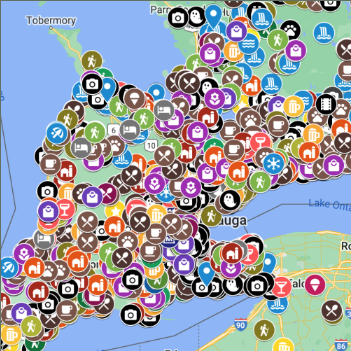
In a recent email, the Guess Where Trips team shared all the intricate work and planning that goes into designing their trips. A big part of their planning revolves around what they call their “magic map”, an evolving map filled with pinned locations that serve as a foundation for outlining their growing list of surprise road trips. 

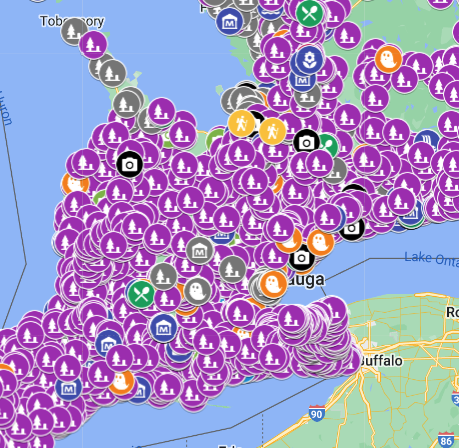
I thought their magic map looked pretty similar to my master map of Ontario cemeteries. Although mine focuses on cemetery locations, there are a few hiking trails, and museums pinned on there. I use my map a bit differently, using it to track visited sites (the grey pins) and as a starting point for creating location-specific maps for my cemetery road trips.  

The Historic Haunts tour was the first ghostly trip created by Jess Off and her team and was initially most popular around the Halloween season. Today, all their haunted trips have become popular regardless of the season. Some of the other spooky trips they offer in Ontario are Weird and Wonderful ThingsSpooky Sights & Ghostly TalesBeautifully Haunted, and Hidden Gems of Huronia.

They offer an adventure for everyone! If haunted hidden gems are not your thing, you might enjoy one of their other themed trips. They have trips that feature wineries, and breweries, romantic getaways, scenic drives, and outdoorsy adventures.

My Guess Where Adventure

The Historic Haunts tour begins in Cambridge, Ontario which is about a 4-and-a-half-hour drive from me. So, my mother and I packed up the car and took advantage of the nice summer weather to make an overnight trip. We drove up to the tri-city on Thursday, with plans to follow the surprise road trip all day on Friday. Then we would drive home on the Saturday. This gave us some extra time to explore the area, so I found some other things for us to do as well.

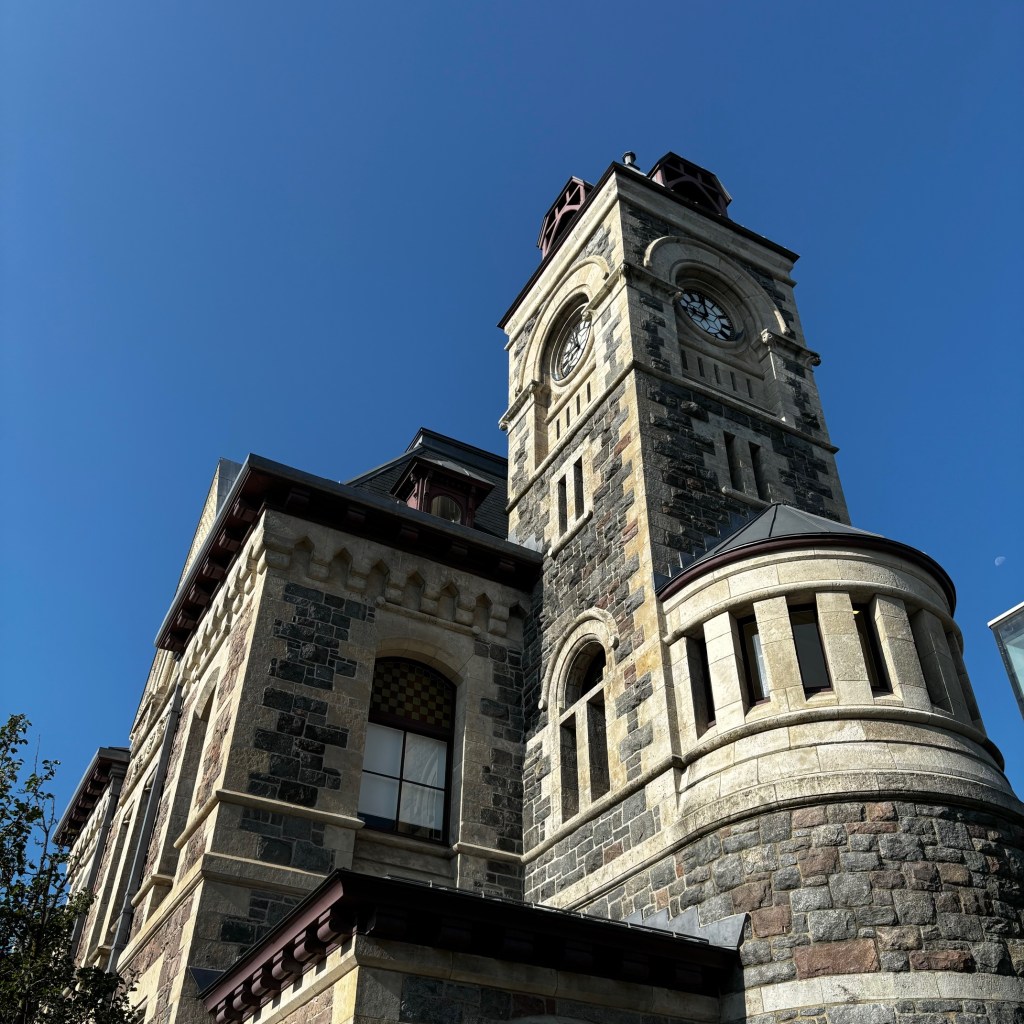
Friday morning, after a nice breakfast, we opened our first envelope to see where our first stop would take us. It brought us to downtown Cambridge to explore the architecture and haunted history of some of its older buildings. With coffee in hand, we sat outside the beautiful stone building that was once a Post Office, and read the tragic tale of a torrid love affair that ended in suicide. Even though it was a bright sunny morning, it was still a bit spooky to be looking up at so much dark history.

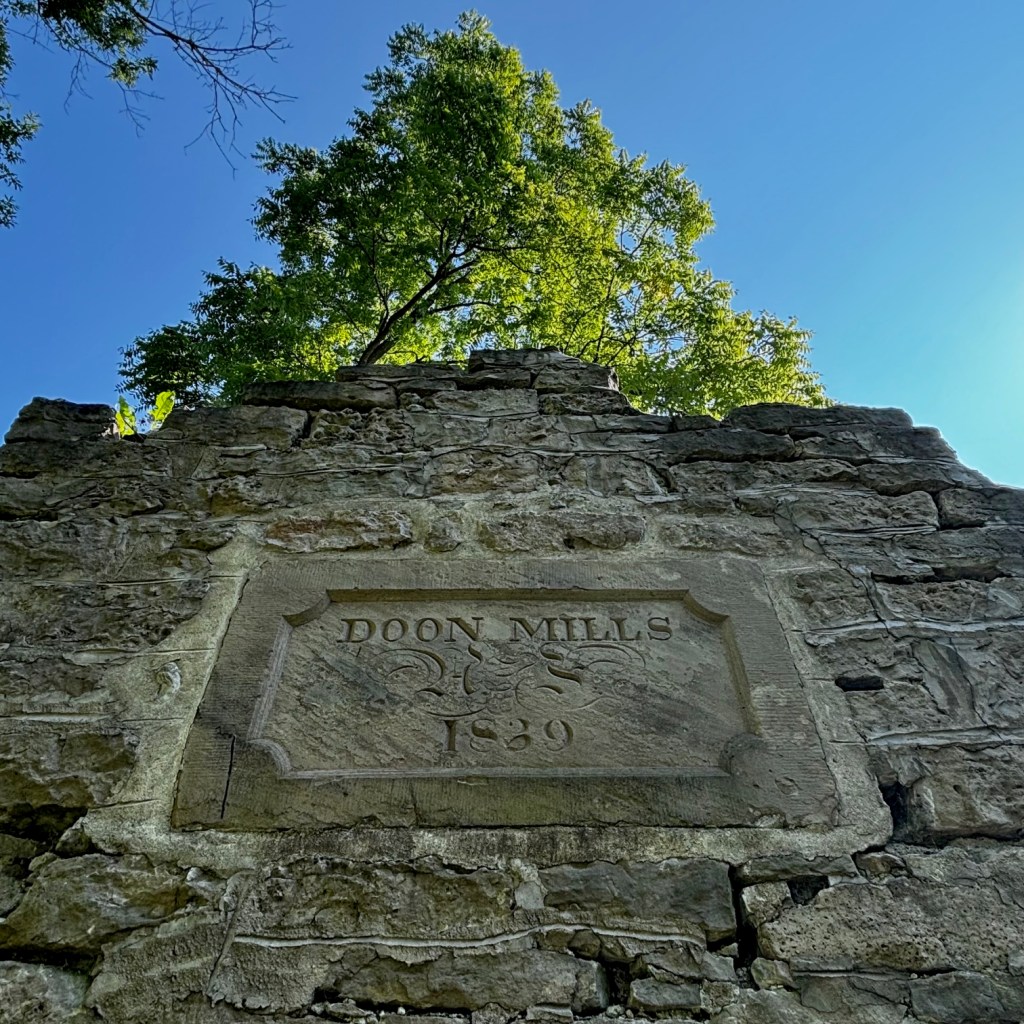
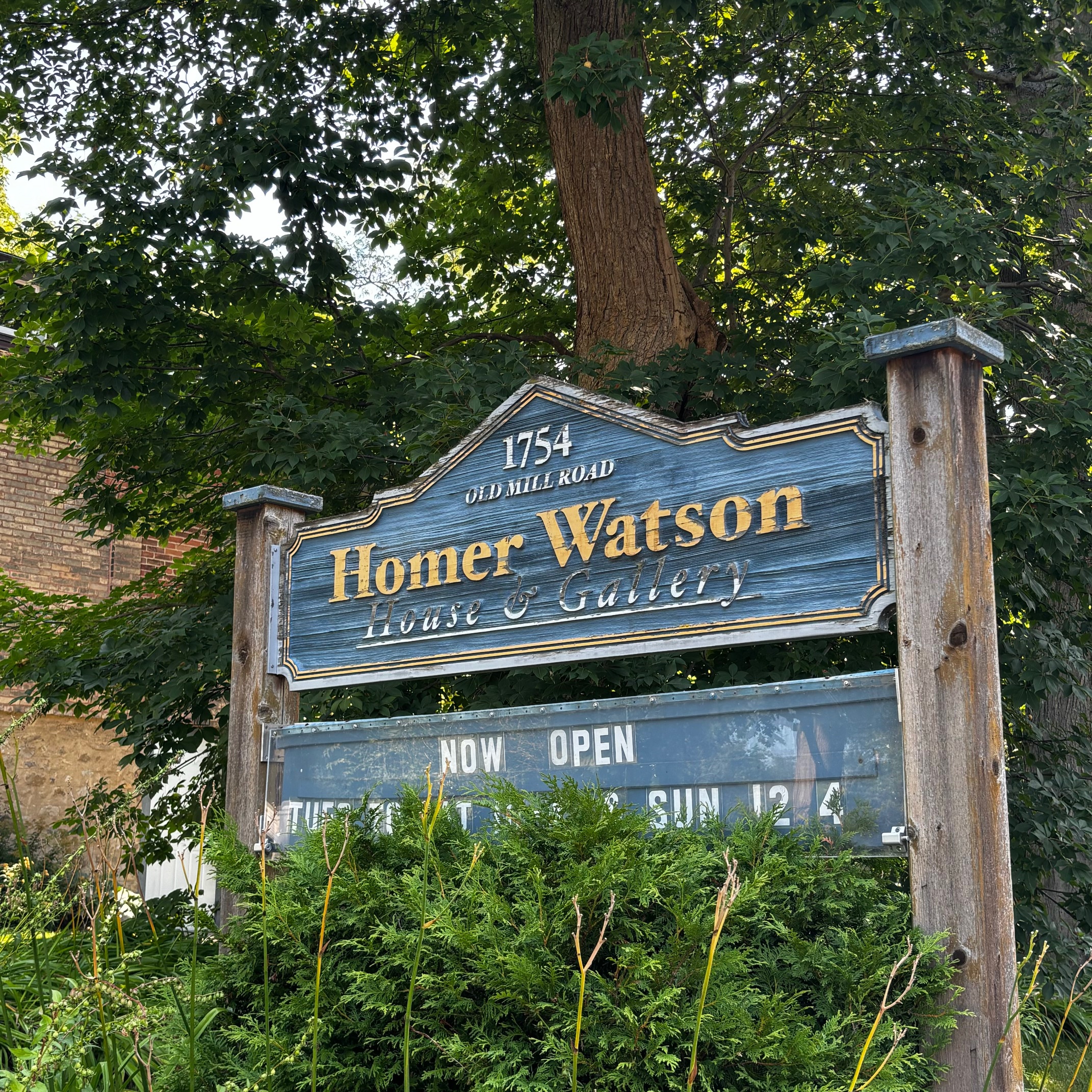
Our second stop brought us to a beautiful historic house and art gallery. We were a little early, arriving before they opened for the day, so we decided to explore the optional spooky abandoned spot that was just around the corner—The Doon Mills Ruins. 

Things got a little interesting at this point. The Doon Mills, originally built in 1834 have seen many tragedies, having burned in a fire not once, but twice! Today, many people report ghostly occurrences at this small section of ruins that sit at the trailhead. People claim to have heard ghostly footsteps or even heard their name called. Almost as soon as we arrived at the ruins, my mother complained of a burning wood smell. I didn’t smell anything though. My mom got a little creeped out when I reminded her that smelling burning wood was something many people experienced when visiting the ruins. 

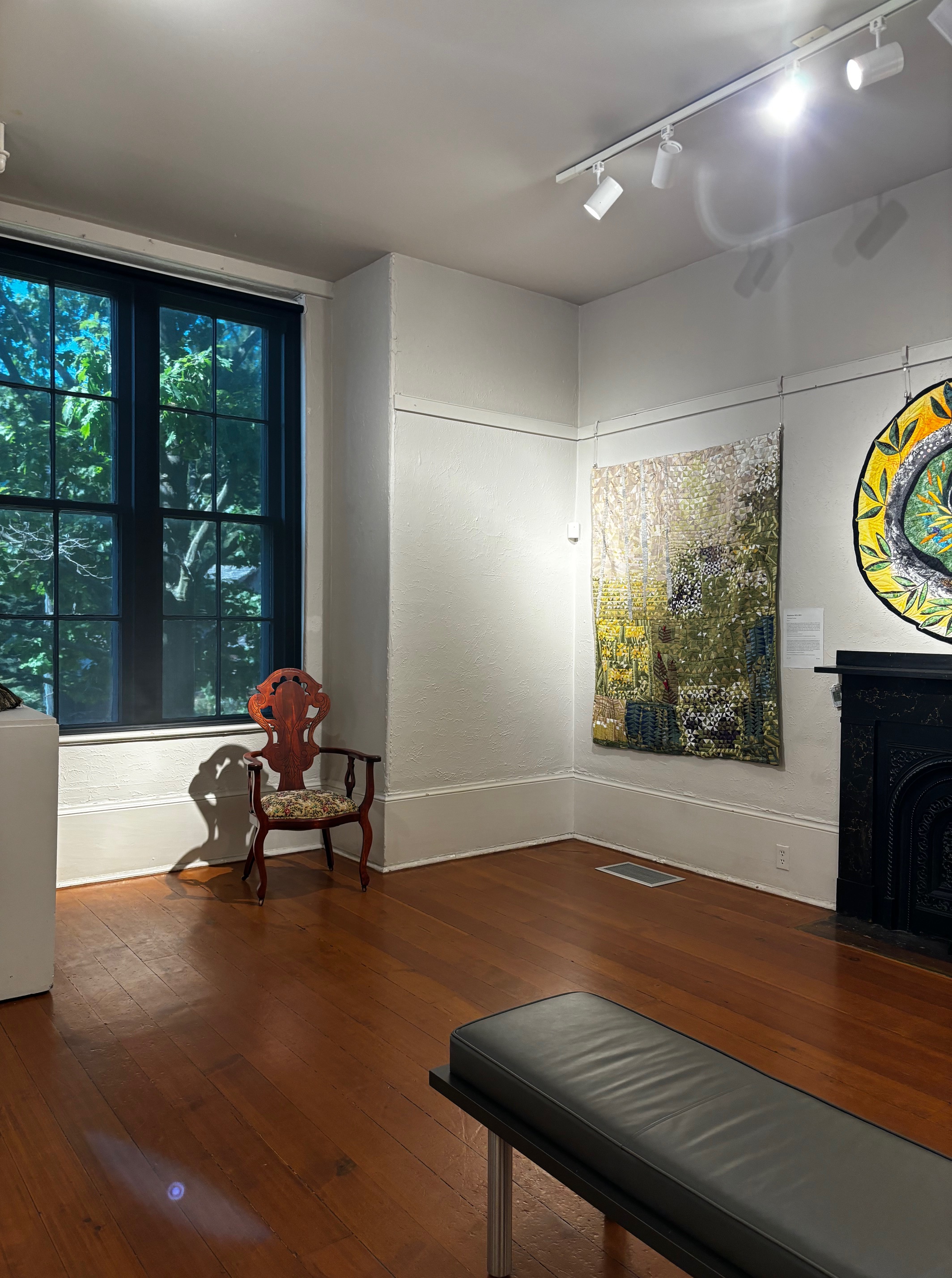
We made our way back to the Homer Watson House & Gallery once it had opened for the day, and was given a lovely tour by the staff. They made sure to tell us the haunted history of the place when we told them we were on the Haunted History tour. It is a beautiful house with a very interesting history. After exploring the house, I just had to ask where Homer Watson might be buried. It just so happens that he is laid to rest in the cemetery just down the road from the historic house, so my mother and I made an extra stop to visit his grave and pay our respects.

Remember how I mentioned I had found some other things for us to visit while we were in Cambridge for the tour? Well, that ended up mucking up our surprise road trip a little bit. The third stop on our road trip directed us to a haunted tower and an ancient cemetery. Well, it just so happens that my mother and I had visited this location the day before. It was a perfect evening activity as it checked a lot of boxes for us; a historic site, a cemetery, and a walking trail. At the time of our visit though, we had no idea the tower was haunted.

By this time it was also the lunch hour, so instead of visiting that location again, we decided to try one of the recommended restaurant stops. We visited the Borealis Grille & Bar to have some lunch and read through some of the haunted history of the tower we visited the evening before. After that nice rest, we opened our next envelope.

Our fourth envelope presented a choose-your-own-adventure opportunity. So it worked out that we had already visited the previous stop. This gave us more time to visit multiple locations on this leg of our road trip adventure.

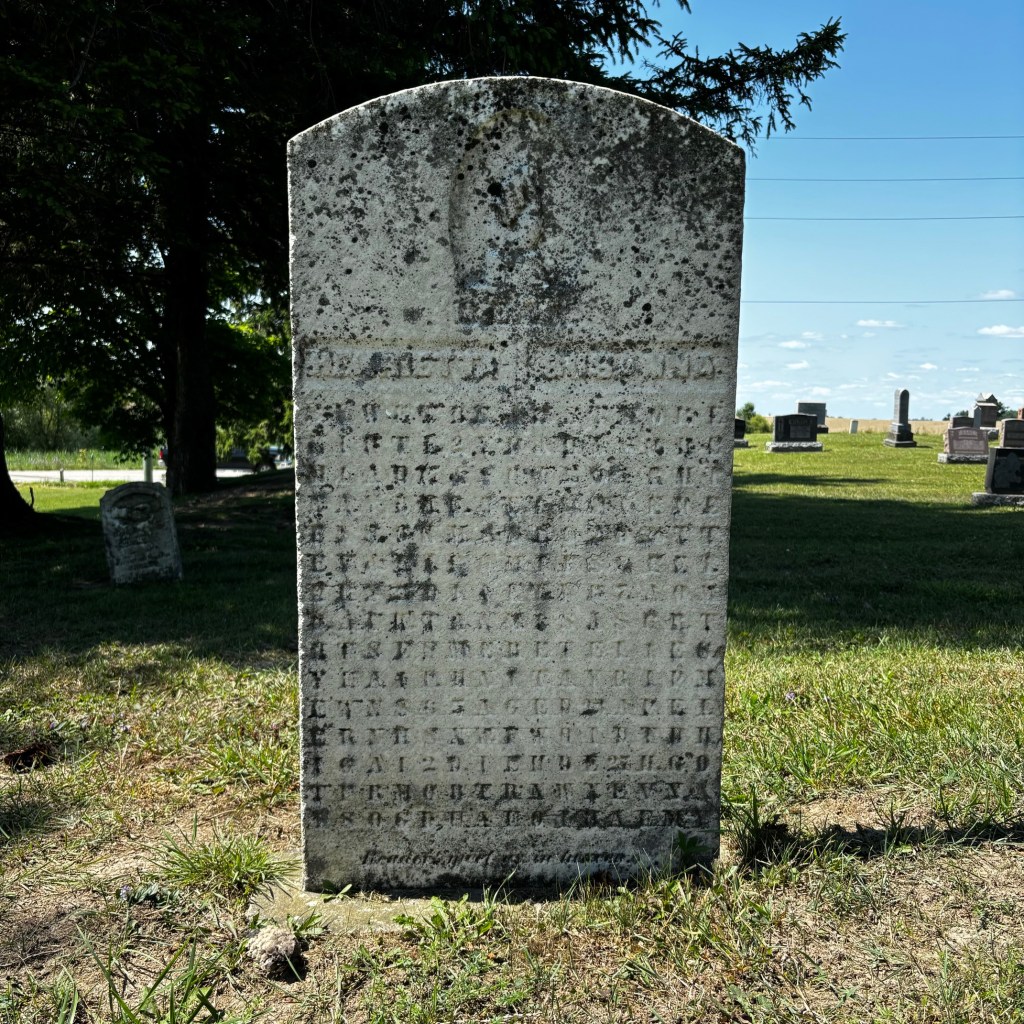
We chose to visit Rushes Cemetery in Wellesley first. I was pretty excited to see this listed as the first optional stop. There is a very interesting gravestone in this cemetery, and it has been on my cemetery bucket list for a while. This cemetery is the final resting place of Henrietta and Susanna, the first and second wives of Dr. Samuel Bean. What makes this stone so unique is the fact that this tombstone is written in a crossword code, and it took over 100 years to decode it. 

After I took some time to photograph the cemetery we made our way to Fergus to visit the Wellington Museum & Archives. By the time we got there, we would have just enough time for a quick tour before they closed for the day. 

Once known as the Wellington County House of Industry and Refuge, built in 1877, this beautiful building now houses a permanent display of the Institution’s history, as well as a few changing exhibits. The permanent exhibit “If These Walls Could Speak” explores the lives of the people who lived, worked, and died within the walls of the Poor House. It’s not surprising this National Historic site is also home to a few ghosts. 

After we toured the building, taking in all the interesting exhibits and history we made our way down the road to visit the Poorhouse Cemetery. This cemetery sits at the edge of the property and was established for those who had no family to claim them. After we paid our respects at the cemetery, we headed back to Cambridge to have some supper and rest at the hotel. 

Our Historic Haunts tour was a great success. My mother and I had a lot of fun exploring and learning about the community and local history. It was a great mix of haunted history, museums, and cemeteries. Although we did add a couple of cemetery stops to our trip, it made sense to stop in and pay our respects after learning so much about their history. 

I also loved the surprise element and the choose-your-own-adventure style. Opening each envelope was a fun addition that created a sense of anticipation. The multiple options also gave you the freedom to choose how your route was going to unfold. The restaurant and cafe options were also great additions, taking into account that you may get hungry or need a coffee break during all the exploring. It is so well thought out!   

I asked my mom what she thought of the trip and she loved that all the planning is done for you and that it was really easy to follow. She also loved all the history that is provided for each stop, her favorite being the tragic tale of love and loss at the Old Post Office. She loved the beautiful architecture but noted that we would have never known about its tragic history, just by looking at the building. She said it was a great adventure!

We had a great time, and we both would recommend these trips to anyone looking for a unique adventure. So if you are looking for road trip ideas, definitely check out Guess Where Trips and let them lead you to some fun and fascinating destinations! 

Thanks for reading!


References:

  1. About Us | Guess Where Trips

Cemetery Road Trip: The Muskokas

It’s graving season again in Northern Ontario!

Two weeks ago, I went on my first cemetery road trip of 2024. I was inspired by a book I read at the end of March, called Muskoka’s Most Haunted 2 by Andrew Hind. I have read a few of Hind’s books that have inspired some cemetery road trips, but this one was a bit serendipitous. I was already planning a trip to the Muskokas this summer and had a few cemeteries mapped out, one of which just so happened to be featured in the book. I took that, and the warmer weather, as a sign it was time to get back in the field. 

The Muskoka District is located north of Lake Simcoe and extends from the southeast shore of Georgian Bay to Algonquin Provincial Park.1 Sometimes referred to as cottage country, the Muskoka area is well known for its beautiful landscapes and rugged shorelines.

The Muskokas are also home to many charming small towns. They dot the landscape among picturesque parks. It is so well known, that many celebrities spend their summer vacations here. In 2023, Shaquille O’Neal, Mark Wahlberg, and Victoria & David Beckham were all spotted in the Muskokas enjoying everything the summer has to offer.2

Small towns are usually accompanied by cemeteries. For this trip, I planned a route that would take us up and around Lake Muskoka. There are many cemeteries in the area, so I was uncertain how many we would actually be able to visit. 

We left bright and early on the morning of Easter Monday, stopping for our obligatory road trip coffee before officially getting on the road. We planned to visit as many cemeteries as we could, while also visiting any attractions that may be open, and of course, stopping for a meal. That second item on the list was a little uncertain as the holiday meant that some places would be closed.

Our first cemetery stop, after enjoying the winding views in Bala, was Torrance Union Cemetery. Since it was so early in the morning, it was a bit chilly out but we still took our time exploring. We spent quite a bit of time at this cemetery, but I don’t want to go into too much detail just yet about our visit. This cemetery has some very interesting stories attached to it that I want to explore a little more in October.

Our next stop was the larger town of Gravenhurst. We made another stop for coffee and then stopped in at the three cemeteries within the city limits. We will have to go back to Gravenhurst sometime in the summer to take in the views of the waterfront and visit some attractions. That’s always the downfall of visits on a statutory holiday—everything is closed.

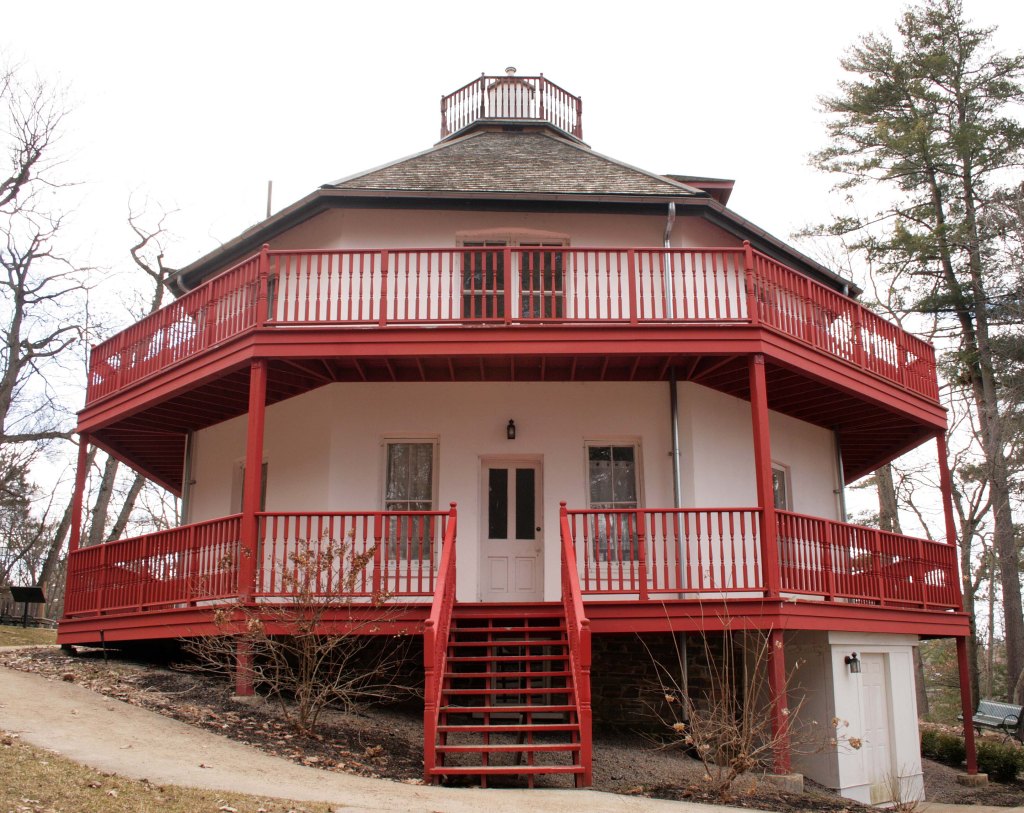
After a leisurely lunch at Chuck’s Roadhouse in Bracebridge, we decided to change things up a bit. Our next stop was the Woodchester. This beautiful octagonal home is a historic site, that is also an event space. It too was closed when we visited, but many walking trails surround it. Some of the trails have historical plaques that tell the story of the house and its previous owners. We were able to walk the circumference of the house and look at building maps that show what the layout of the inside looked like, when it was lived in. 

The Bracebridge walking trails meander alongside the Muskoka River and waterfalls. The waterfalls were strong and thundering when we visited. Unfortunately, part of the trail was closed off, most likely due to possible flooding, so we didn’t get to enjoy the full trail. The views were still lovely though and it was a nice way to break up our day. 

After that little pit stop, we visited three more cemeteries. The Annie Williams Memorial Cemetery was the smallest cemetery we visited that day. Only three people rest in that cemetery, which sits in the middle of a park and playground. This tiny gated cemetery sits under some large trees, only a few feet away from an active playground that often hears the boisterous sounds of children playing. It also sits a foot or two away from a popular little library, that was bursting at the seams with books.

As the day waned, it was time to start making our way back home. But we couldn’t help but stop at one more cemetery. Our last cemetery stop of the day was Port Carling Cemetery. That marked the end of our loop around Lake Muskoka.

This trip was a lot of fun! We ended up visiting a total of eight cemeteries, not bad for a first-time out after the cold of winter. We had beautiful weather that warmed up as the day went on which made our visits comfortable. Which means the weather can only get better from here. I look forward to my next outing and seeing where cemeteries take me. 

Thanks for reading!


References: 

  1. Muskoka | Destination Ontario
  2. This Canadian Town Is A Magnet For A-Listers On Vacation— Here Are 8 Celebs That Were Spotted There This Summer | Buzzfeed

Cemeteries:

  1. Torrance Union Cemetery also known as Whitting Family and Church Cemetery, Torrance
  2. St. James Anglican Cemetery, Gravenhurst
  3. Lakeview Cemetery, Gravenhurst
  4. Mickle Memorial Cemetery, Gravenhurst
  5. Bracebridge United Cemetery, Bracebridge
  6. Annie Williams Memorial Cemetery, Bracebridge
  7. Saint Thomas Cemetery, Bracebridge
  8. Port Carling Cemetery, Port Carling

Stone Stories: The U.F.O. Gravestone

In early July, my friends and I went on a cemetery road trip, up through Hailybury and New Liskeard to Kirkland Lake. We made quite a few stops along the way, not only at cemeteries. We stopped at a couple of roadside attractions to stretch our legs and take in the sights. 

We did have a few points of interest that we were determined to visit that day. One was the grave of Charles Bélanger, son of famous Canadian sculptor Rose-Aimée Bélanger. You may remember that story, as I wrote about our visit in a blog post called Stone Stories: Art in a Cemetery

The other point of interest, high on our list to see was a gravestone with an epitaph about U.F.O.s.

One of my favorite things about visiting cemeteries is finding unique gravestones. I love gravestones that stand out, that showcase a sense of humor, or something specific about their life story. I love stones that give you a glimpse of who the person was. Sometimes these peculiar gravestones also present a mystery! 

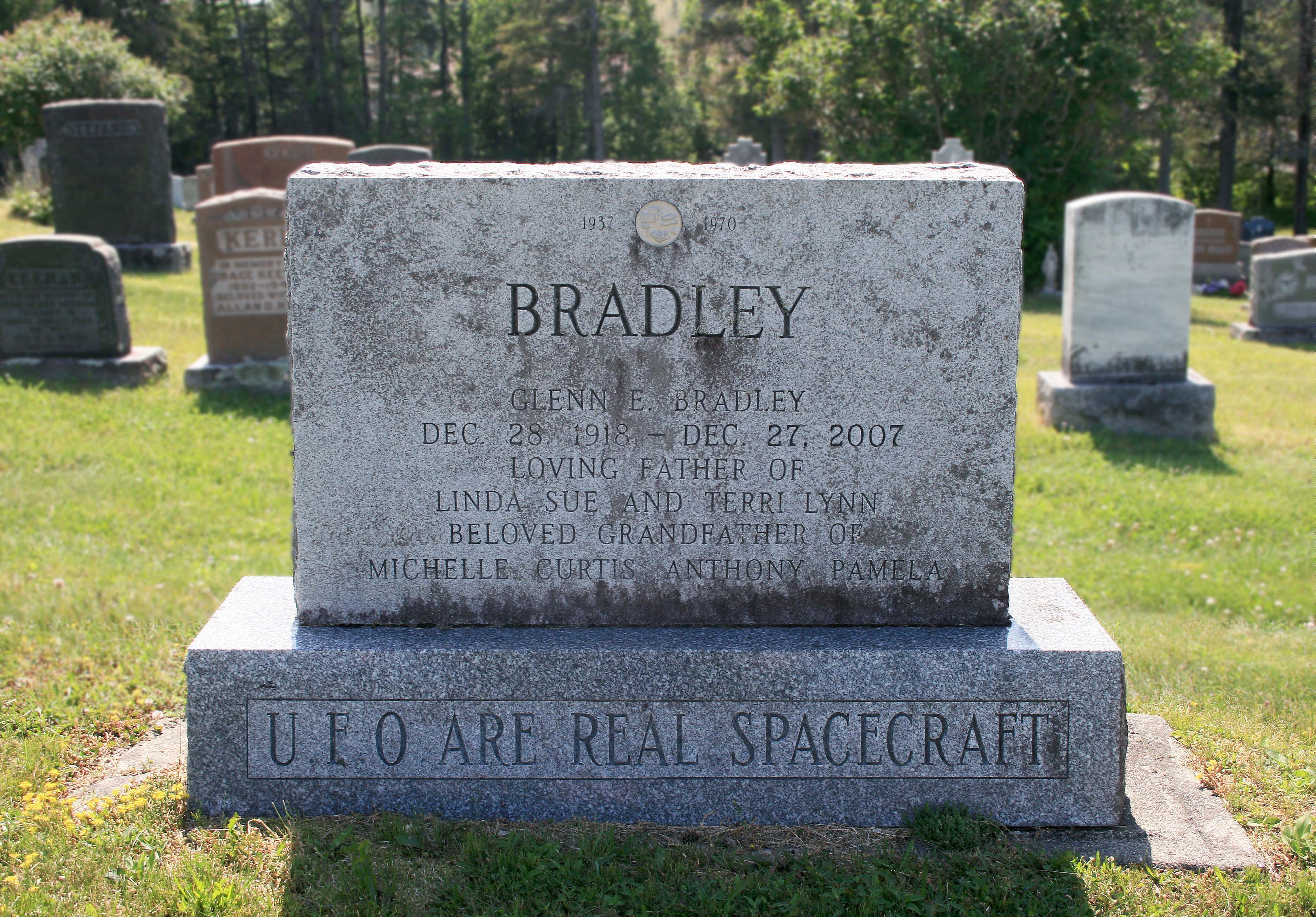
Like this gravestone in Kirkland Lake Cemetery that reads “U.F.O. Are Real Spacecraft.”

This is the gravestone of Glenn Bradley, who passed away on December 27, 2007. A day before what would have been his 89th birthday. From far away, his gravestone doesn’t seem to stand out. It’s a classic style headstone, in grey granite. But upon closer inspection, the epitaph jumps out at you.

It reads: “Bradley / Glenn E. Bradley / Dec. 28, 1918 — Dec. 27, 2007 / Loving Father of / Linda Sue and Terri Lynn / Beloved Grandfather of / Michelle, Curtis, Anthony, Pamela / U.F.O. Are Real Spacecraft.”

The epitaph continues on the backside of the stone: “Spinning Objects Vanquish Gravity / Spinning Objects Levitate / Spin to Exceed the Earths / Relative Feet Per Second / Honorable 60th C.B. Service / 1942 U.S. Navy 1945”

What does it mean? 

I am not the only one fascinated with this gravestone. Bill Steer, also known as Back Roads Bill, wrote an interesting article about this peculiar stone. In it, he shares an interesting tidbit found in Bradley’s obituary. It reads: “He will be remembered for his scientific work such as antigravity and his belief in UFOs.”1

Bradley’s gravestone tells us that he was a veteran of World War II with the U.S. Navy, having served from 1942 to 1945. Is that where he worked on antigravity? Had he seen a U.F.O.?

Recently, NASA revealed a report on UFO sightings, confirming that they are actively monitoring and collecting evidence. In the report, they state that unidentified anomalous phenomena (UAP) are not definitively connected to alien life, but what they are remains uncertain.2 You can read the 33-page report here.

It was on a particularly hot day, that we chose to visit the cemetery. It was the final cemetery on our list, having stopped at many cemeteries along the way. This meant that we were fairly tired when we arrived at the Kirkland Lake Cemetery, also known as Swastika Cemetery. 

Kirkland Lake Cemetery is actually located in Swastika, Ontario, a former mining and railroad town. It sits within the Kirkland Lake municipal boundaries.3 Swastika was originally a railway station along the Temiskaming and Northern Ontario Railway in the early 1900s. The town grew into a small mining community in 1907. It became known for its abundance of gold, which led the company, and officially the town itself, to name themselves after the Sanskrit symbol for “good luck” in 1908.4 

I don’t think we were prepared for how large this cemetery is! I was a little disheartened when we arrived, thinking we may not be able to find the fabled UFO stone. Find a Grave lists 7,871 memorials for this cemetery, and it’s marked as only 83% photographed. It’s quite large! 

After a brief distraction of falling into my regular photographer’s routine of stopping at gravestones that caught my eye, I remembered our objective. I regrouped with my companions and checked out Google one more time to point us in the right direction. In the end, we used some online photos to help us triangulate the stone’s location by matching up unique stones and markers in the background of the photos.

BINGO!

As mentioned previously, the stone from a distance is fairly nondescript. At the top of the gravestone, there is a coin embedded into it, with the dates 1937 — 1970. The coin reads: “E.W. Bliss Company / Bliss since 1857 / From Ingot to Finished Product”. According to the Military Wiki page, E.W. Bliss was an American company based in Brooklyn, New York. Among other things, they produced a line of special sheet metal work presses, power stamping machines, car parts, torpedoes, shrapnel, and armor-piercing projectiles.5

We spent time circling Bradley’s gravestone, pondering his curious epitaph. Without more background information, and as a layperson it did make me scratch my head in curiosity.

Maybe one day, answers will come forth as to what Bradley was talking about with his cryptically scientific epitaph. For now, it makes for a curious extraterrestrial mystery!

Have you ever seen a U.F.O. mentioned on a gravestone before? What do you think? Do you want to believe?

Thanks for reading!


References:

  1. A most unusual epitaph | Bay Today
  2. NASA reveals results of highly anticipated report into UFO sightings | CTV News
  3. Kirkland Lake Cemetery | Find a Grave
  4. Swastika, Ontario | Town of Swastika
  5. E. W. Bliss Company | Military Wiki

Time for a Vacation

It’s that time of year again! 

For the next two weeks I will be taking some time to step away from my computer and work life to enjoy the waning summer weather. I am hoping to disconnect, step out of routine, and explore with friends and family. 

I plan on visiting quite few cemeteries while I am away, like Canadas largest cemetery in Montreal. I also plan to pay my respects at the second resting place of Tom Thomson. So keep an eye out for some upcoming blog posts about those adventures. 

That being said, I will not be monitoring my social media channels while I am away, and I will reply to all questions and comments on my return. Regularly scheduled social posts will continue to go up as normal, except for my weekly blog posts. 

I hope everyone takes some time for themselves this summer to relax and recharge!

Thanks for reading! 

Stone Stories: The Screaming Heads

Writing these weekly blog posts, I often feel like a travel writer. Cemetery tourism is one of my favorite things! For this week’s blog post I wanted to share another cemetery road trip destination—The Screaming Heads.

At the beginning of June, I went on another Birthday weekend road trip. This trip was a mix of cemetery visits, museums, and attractions. We visited 15 cemeteries, played a game of Cemetery Bingo, and visited the Wiseman’s Corner Schoolhouse Heritage Centre, which happened to have a gravestone on its grounds. 

The main attraction of this trip, and the whole reason we visited Burk’s Falls, was to finally visit and experience The Screaming Heads, in Midlothian. We had talked about visiting for about the last 2 years but never managed to make our way there. So this year we made a special birthday trip to visit this unique resting place. You never know where you might find a cemetery.

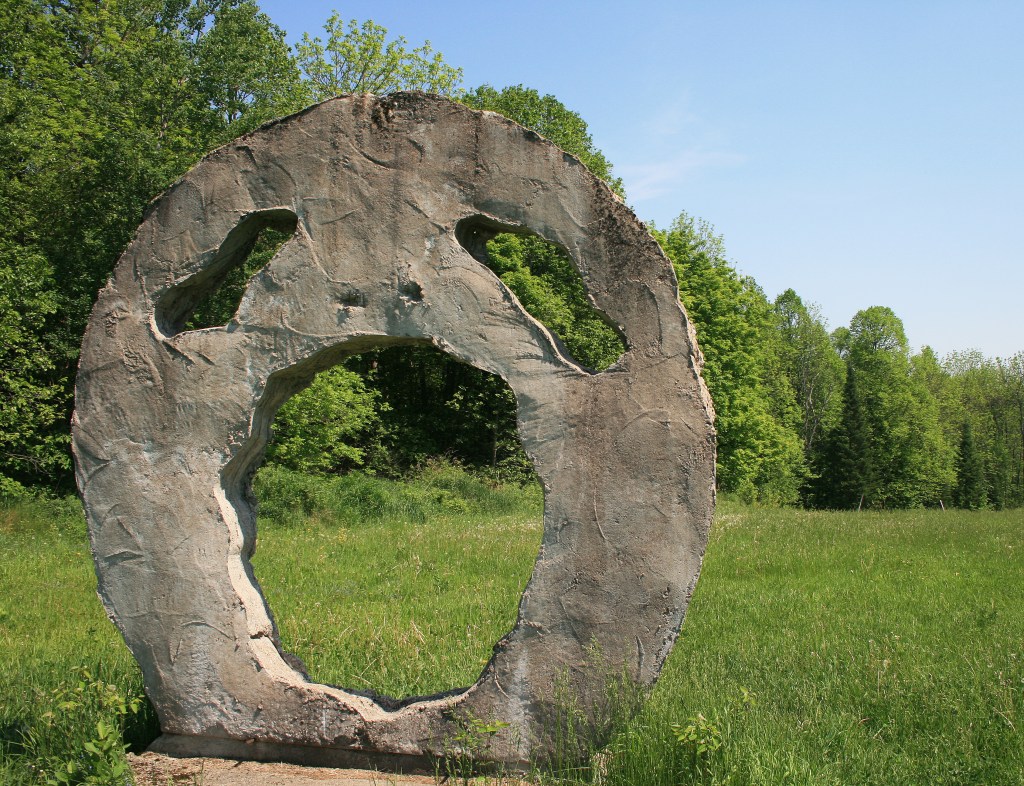
The Screaming Heads is an ever-growing art installation created by Peter Camani, a Canadian artist, sculptor, and retired art teacher. This public open-air art gallery dots the landscape of his 310-acre property.Living among his artwork, Peter lives in the Midlothian Castle, which was built upon a 19th-century derelict farmhouse. 

There is a giant spider web gate made of stone and rebar that surrounds the castle. If the gate is open, you may get a chance to look inside and visit the artist’s studio and living space. Everywhere you look there are interesting details to admire, from the metallic dragon that breathes smoke when the fireplace is lit, to a giant head that houses a studio space within it, to the rows of smaller screaming heads that line the top wall of the gate. 

Located on Midlothian Road, near the small town of Burks’s Falls, The Screaming Heads is an off-the-beaten-path roadside attraction. You know you are getting close if you start spotting smaller screaming heads; like at the Burk’s Falls visitor center and the Wiseman’s Corner Schoolhouse Heritage Centre. Peter opens his property to tourists year-round, from dawn till dusk. You’ll find much more at this attraction than just amazing artwork. The property is also home to about 300 species of birds, including peacocks. Their eerie calls can be heard all around you as you hike through the open fields and bush. There is a small gift shop that has some neat Screaming Heads merch, and on weekends you might also find a small farmers market.

The main attraction is of course The Screaming Heads. The artist has described these 20-foot-tall concrete sculptures as a warning against environmental degradation, “the earth rebelling against what we’re doing to the land.”2 Peter has transformed this once barren farmland, by planting many of the trees on his property and propagating spring-fed ponds. His large concrete structures are arranged in such a way that they form the shape of a dragon when viewed from the air, although today the trees are so large they obscure some of the statues.2

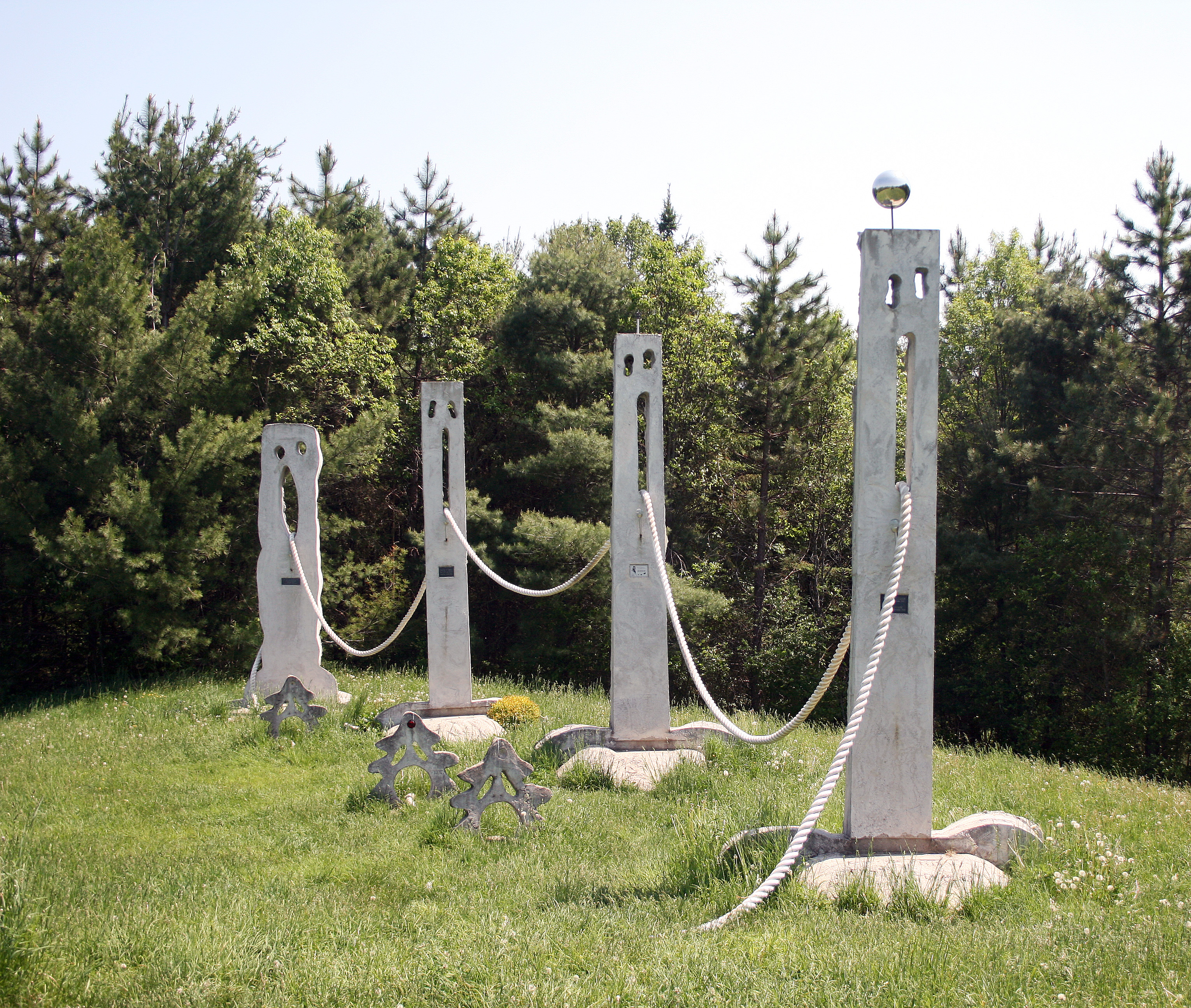
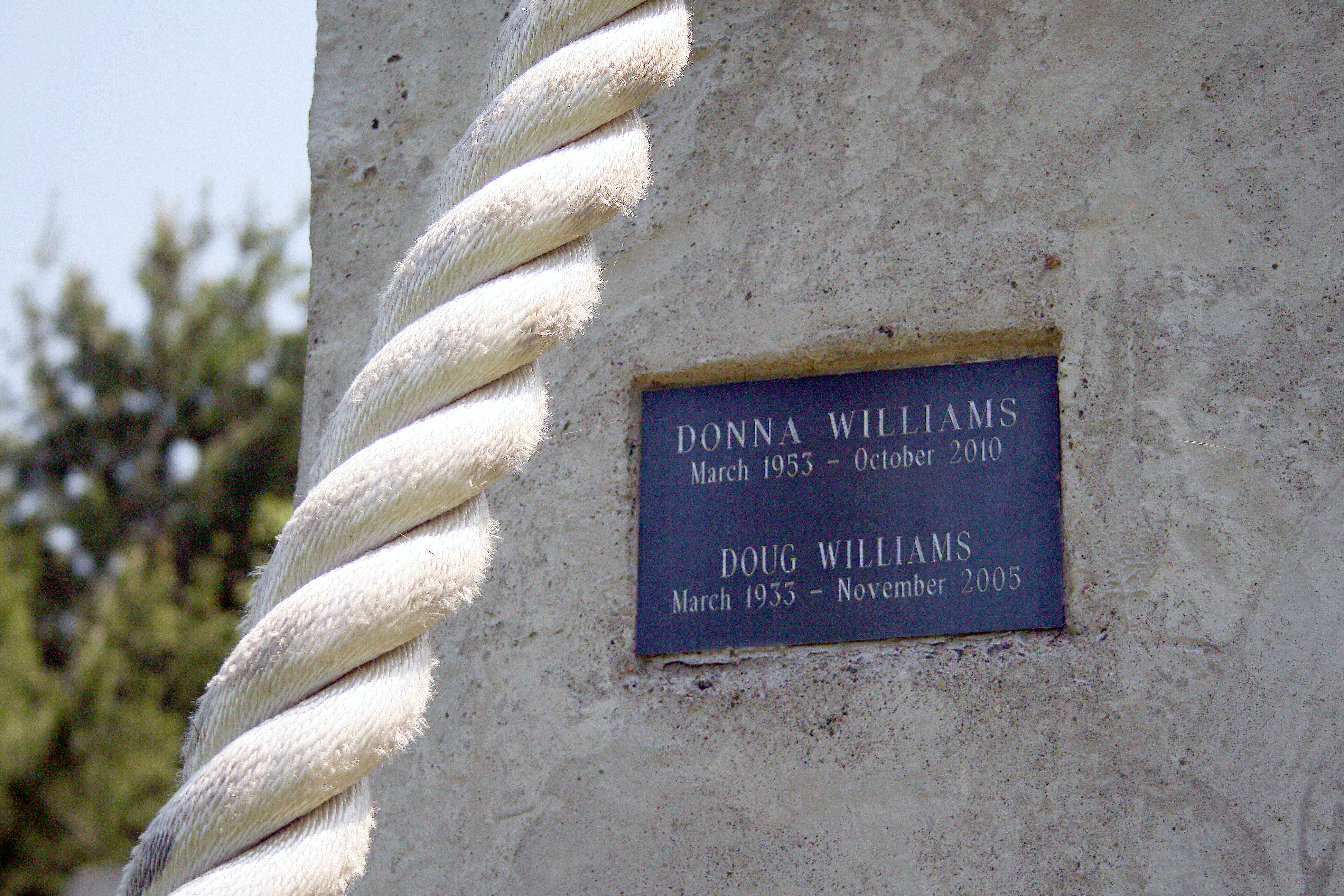
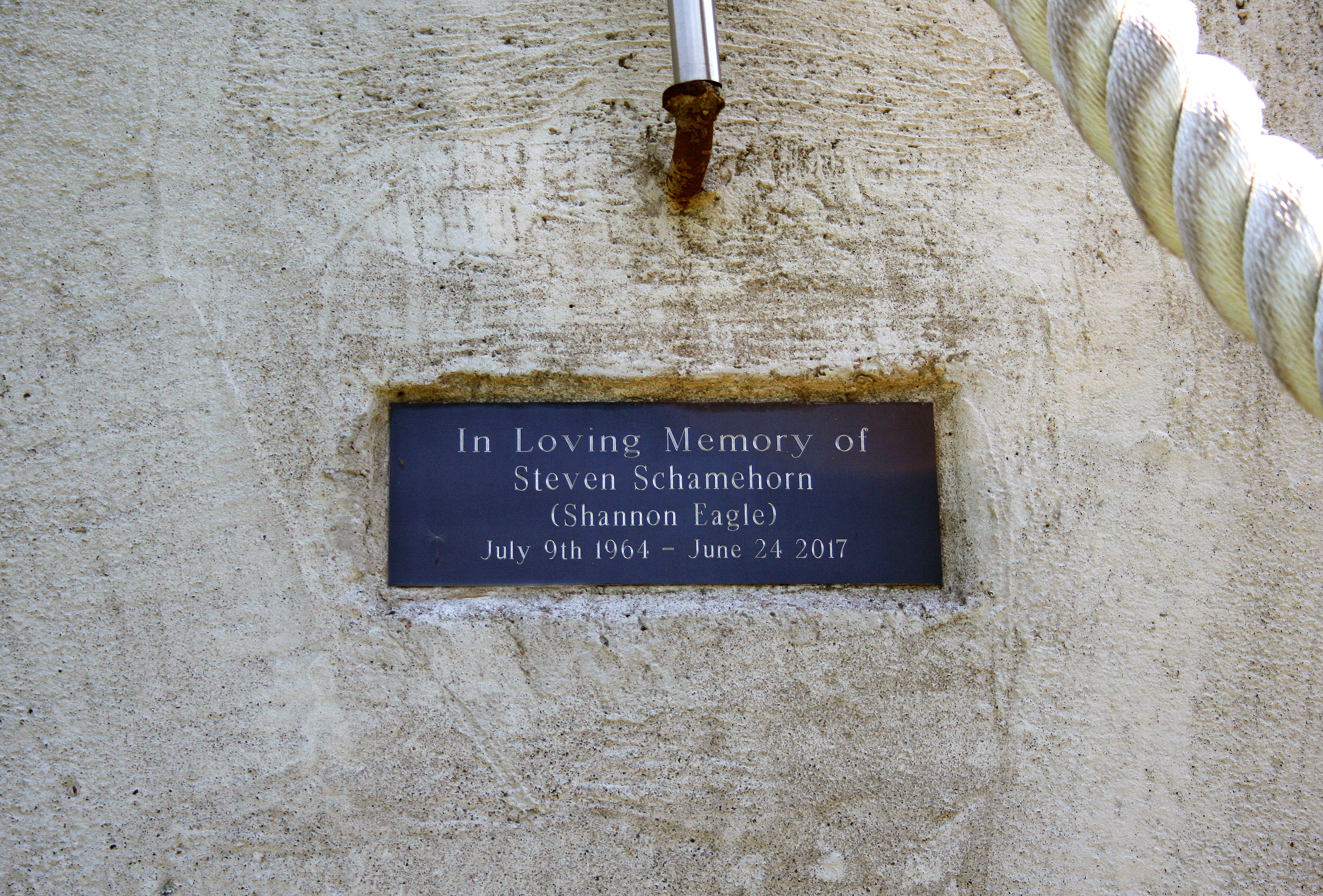
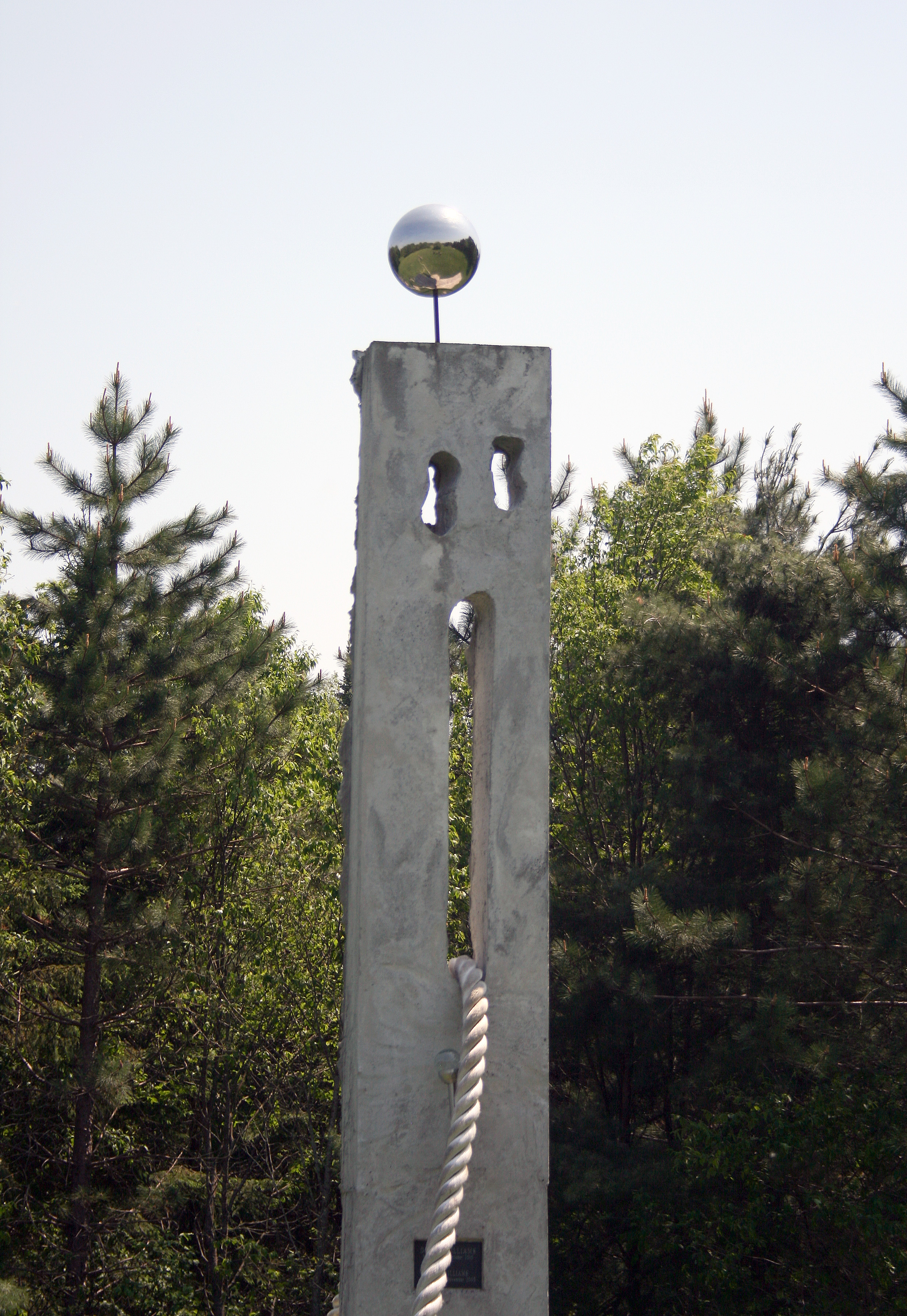
Along with being a unique roadside attraction, The Screaming Heads can also be considered a cemetery. A small grouping of Screaming Heads stand out among the other round Edvard Munch-like sculptures. These tall narrow creations have cremated remains mixed into the concrete. On his website, which now seems to be defunct, the artist had a creative suggestion for where your final resting place could be when you pass away; “Why settle for a small underground plot in the suburbs, when you have the option of joining a vibrant creation that fills the landscape?”3 At one time, If you wanted to be memorialized in this open-air art gallery, you would need $10,000 to reserve your spot.3 Since the website is now gone, I am uncertain if this option still exists.

At the time of our visit, there were 4 human ash sculptures, with memorial plaques for 5 people.

“Gone but not forgotten” Memorial sculptures created with cremated remains. Artist: Peter Camani. Midlothian ON ©2023

Everyone’s experience with the Screaming Heads will be different, as there is no set way to explore the grounds. There is no trail map, and there are a few trailheads to choose from. When we visited, on an exceptionally warm day, we managed to come upon the memorial sculptures first. The photos don’t do them justice, as they are larger than life! We asked ourselves many times as we wandered the grounds, about the process of making these immense sculptures and what that might look like. 

There is something magical about this place. As you walk among these enormous, whimsical sculptures, it’s easy to feel like you are in a magical forest, where strange creatures may reveal themselves at any moment. I was filled with a sense of wonder as we walked through the woods and fields, discovering hidden sculptures as we got closer to them. The eerie sound of the peacocks also added to the experience. Their cries always seemed to surround us, and just when we thought we were close enough to see one, we would hear their scream from another direction. 

I can understand why someone would want their final resting place to be in such a magical place. The idea of becoming art, becoming part of something larger than yourself, to instill a sense of awe in others; that guarantees you will always be remembered.

Do you want to plan your own trip to visit The Screaming Heads? They are located in Midlothian, Ontario, close to the small town of Burk’s Falls. The grounds are open year-round, from dawn till dusk, and admission is by donation. Make sure to bring your camera, your water bottle, and LOTS of bug spray. Have you already visited? I would love to hear about your experience in the comments.

Thanks for reading! 


References:

  1. The Screaming Heads North of Muskoka | The Great Canadian Wilderness
  2. Peter Camani | Wikipedia
  3. How to Be Posthumously Transformed Into an 18-Foot Screaming Head | Slate

Additional Links:

Cemetery Road Trip: Graveyards in Grimsby

Today on the blog I wanted to share a little bit about my first cemetery road trip of the year! A couple of weekends ago, two of my best friends and I went on a fun-filled day of adventures to celebrate a birthday. We traveled over 900 km to visit Grimsby Ontario, in the Niagara Region—and it did not disappoint!

A month or so ago, my friend had asked to visit a graveyard for her birthday, as she had never visited one before. There are closer graveyards we could have visited, but since this was a special occasion I took some time to try and find the perfect spot. Weirdly enough, the internet provided the solution. Randomly, or not so randomly if you believe that technology listens to us, a video popped up in my Youtube feed by Canadian Cemetery History. I took the bait and watched the video. It showed a visit to Saint Andrew’s Anglican graveyard. This beautiful graveyard was just what we were looking for!

Not only does Saint Andrew’s Anglican Churchyard boast the 4th oldest church in the province, but it also has a lychgate and table stones. Both of which we have never seen before in person. So I began looking into what else we could visit in Grimsby; other cemeteries, museums, attractions, haunted locations, and of course interesting places to eat. I pitched the idea to the group, and they were as excited as I was to explore this beautiful little town. 

I continued to research things for us to do and managed to book us a private tour of the Nelles Manor Museum. We would be visiting the resting place of the Nelles family at Saint Andrew’s, so it made sense to visit their historic home and learn more about this prominent family. 

The day of the trip started bright and early. After picking up our first Starbucks of the day, we left Sudbury a little after 6 a.m. The plan was to drive straight to the graveyard, with a Starbucks stop along the way, to make the best time. Then we would take our time exploring, and visit the Nelles Manor at 3 p.m. for our private tour. 

We arrived at Saint Andrew’s Anglican graveyard at about 11 a.m. and got out to stretch our legs and explore. The graveyard was absolutely beautiful. As was the weather, we had a beautiful day for exploring. Right away we noticed the prominence of the Nelles family as they had their own family plot, as well as family members scattered throughout the graveyard. We would learn more about the Nelles family when we toured the Museum later in the day. 

Saint Andrew’s Anglican Churchyard, Grimsby ON ©2023

Saint Andrews Anglican Church and graveyard is located a stone’s throw away from the Nelles Manor. The current church building dates back to 1825. The graveyard is well-maintained and has a large number of historically important grave markings. The land for the church was originally donated by Colonel Robert Nelles.1 The Nelles family plot is closest to the church on the left side of the churchyard, enclosed by a chain with small cast iron tassels hanging from it.

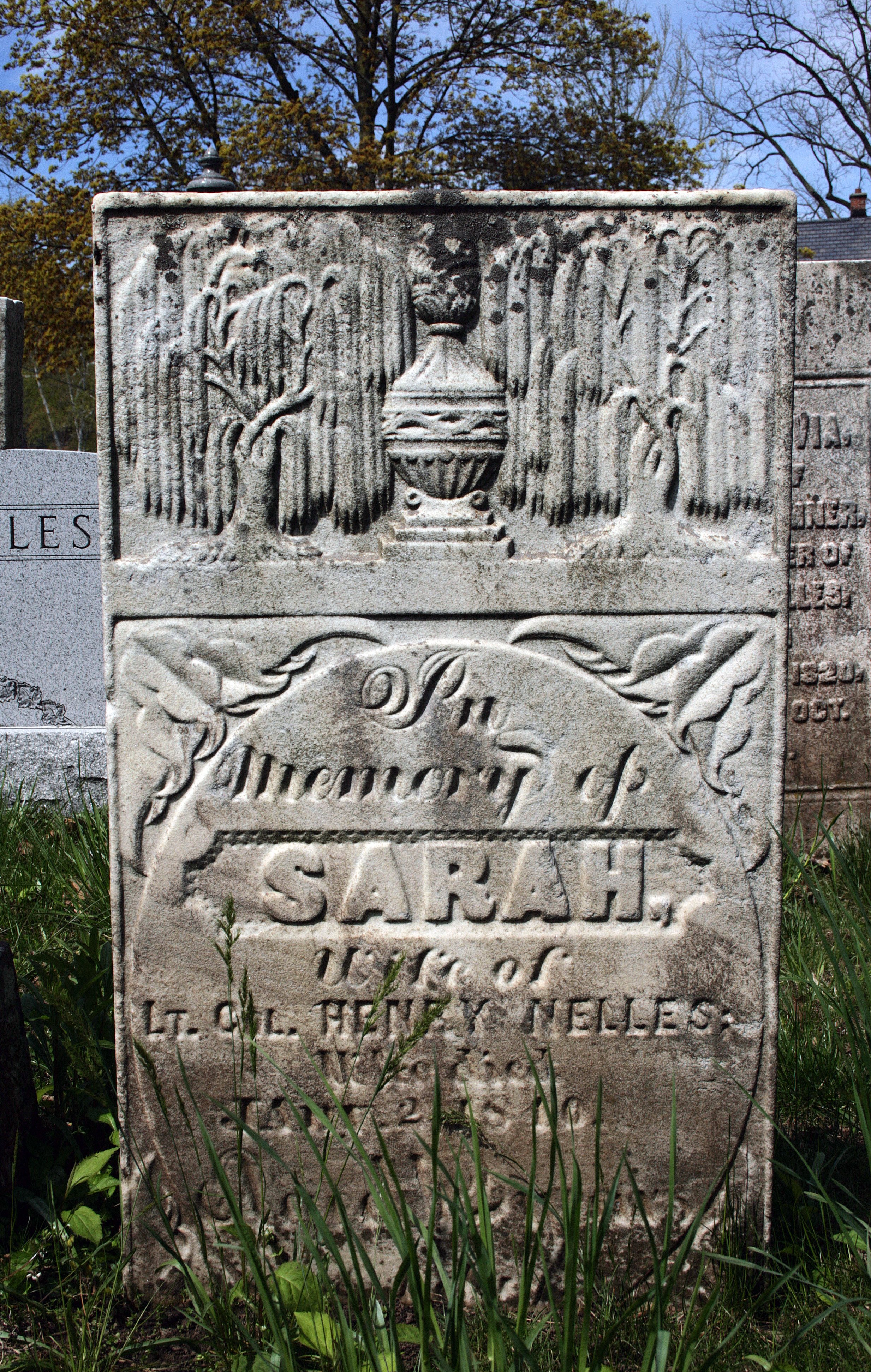
This graveyard also acts as an arboretum of sorts, with beautiful examples of different varieties of trees. Many were in full bloom when we visited. There is a lovely variety of gravestones to be found there as well, many of which I had not seen in person before, like the willow and urn motif, broken column symbolism, and closed books covered in cloth. It was curious to see the difference in popular cemetery symbols that we found. In the Sudbury area, lambs, doves, and hands are very common. There also stand the tallest tablet stones I have ever seen. They are taller than I am! The gravestones I was most looking forward to seeing in this graveyard were the table stones. I have not had the chance to see one in person yet, and I find them so unique and fascinating.

Table stones have an elevated ledger top, that provide space for a longer inscription, and is supported by four to six columns. This type of gravestone was popular during the first part of the 19th century.2 These types of stones were used for prominent people and were sometimes installed many years after the person’s death. In that instance, these stones would sometimes cover the original gravestone. These tabletop stones are often more worn, like the ones we saw, due to larger surface erosion, making the stones barely legible.3

After we wandered the entire graveyard, we took a break for lunch and then made our way back toward the Nelles Manor. We were a little bit early for our tour, but luckily there were a few points of interest in and around the Nelles Manor for us to explore while we waited. We visited the Trinity United graveyard, and the Grimsby Museum and grounds where we discovered more interesting Grimsby history. When it was time, we made our way a couple of houses over to visit the historic Nelles Manor Museum for our private tour. 

The Nelles Manor was built from 1788 to 1798, well before the American invasions in the War of 1812. The house was fully built and lived in by the Nelles family by the time the Americans declared war on the British. The Niagara Peninsula became a gateway for American fighting forces to work their way from the American frontier on the East side of the Niagara River as they reached for Burlington, York, and Kingston. Nelles Manor was occupied by British and local militia during the War of 1812, but on at least two occasions was also occupied by American forces that had moved up from Niagara.1

Nelles Manor Museum, Grimsby ON ©2023

We received a very warm welcome when we arrived at the Nelles Manor. Our tour guide Kate, and two other guides, were finely dressed in period clothing, which added to the authenticity of the experience. We started our tour outside, taking in the magnificent architecture of the building, as well as the warm weather. Our guide talked about the land where the Nelles Manor sits, and its connections to its surroundings. Our group found it very helpful that we had visited Saint Andrew’s, as well as the Grimsby Museum grounds before our tour. 

After moving inside, we were treated to a walking tour of the house; starting at the front door, touring through the sitting room parlor, and making our way upstairs. Every room is beautifully decorated for the time period, with great attention to detail. Along with period-specific furnishings, the house is decorated with some original pieces that belonged to the Nelles family, as well as original art from the period. It felt like we were stepping back in time. 

The guides are incredibly versed in the history of the house, the Grimsby area, and the Nelles family. They had no trouble answering our many questions. We had explained that we were in the area to visit the cemeteries and graveyards, and they kindly pointed out artifacts and related tidbits as they took us along the tour. At the end of our tour, they asked if we would also be interested to hear some of the haunted history of the house. We of course said yes! 

They shared stories of experiencing odd smells when there shouldn’t have been any, such as smelling a delicious roast or floral perfume, which was a favorite of Mrs. Nelles. They also shared some stories from paranormal investigations that have taken place in the manor. Paranormal teams have reported their fresh equipment batteries dying quickly and suddenly. They have also captured some eerie electronic voice phenomena (EVP). The staff now use some of these EVPs during their Halloween events, wherein they tell the haunted stories of the house. I would love to attend one someday. As we were discussing the spooky happenings, my friend happened to check her Apple Watch and noticed the battery was dead. Were the Nelles spirits letting us know they were with us?

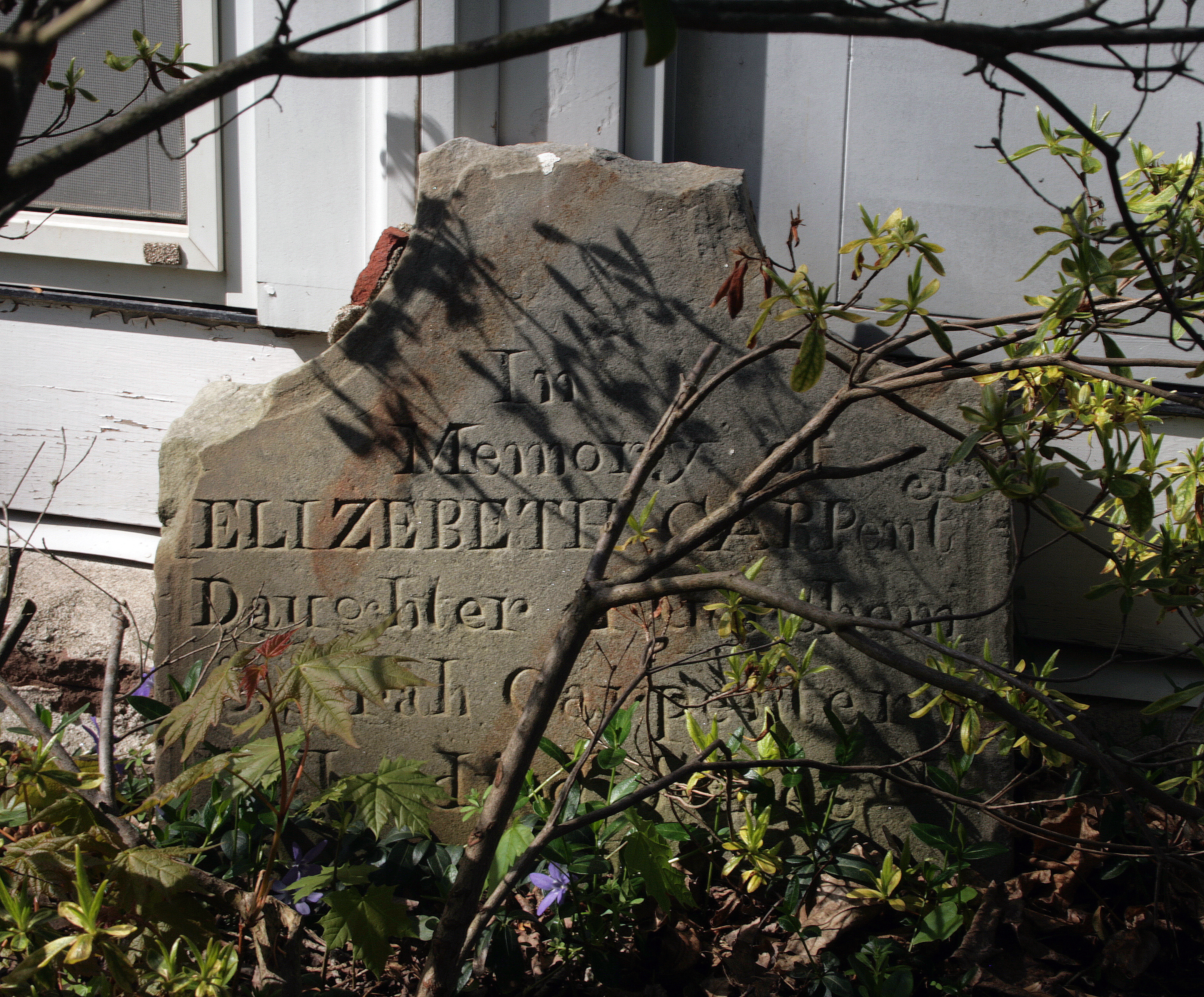
We thanked our tour guides for an amazing tour and made our way outside. They had one last interesting piece of history to point out as we were leaving. In the garden, leaning up against the house are two small gravestones, that are still very legible. Kate explained that these stones were originally at a graveyard close to the water’s edge, which has since eroded away. A cenotaph was erected at Saint Andrew’s Churchyard in memory of the souls that were washed away, and the original gravestones were moved; some ended up at the manor and used as flagstones for the walking paths. These two were preserved and now sit in the garden. You never know where you might find a gravestone.

Gravestones in the garden of the Nelles Manor Museum, Grimsby ON ©2023

There was so much we explored and experienced that day. As well as exploring the Nelles Manor Museum, we visited two graveyards, one cemetery, and one burial ground. We also stopped in at the Grimsby Museum and quickly visited the Grimsby Gingerbread houses. I’m sure I will write some more in the future about those visits. It was a very long day, but it was worth it.

If you ever get the chance to visit Grimsby, I highly recommend the Nelles Manor Museum. It’s a beautiful place to learn more about the history of the Niagara region and the War of 1812, and you might also have a paranormal experience. Don’t forget to also pay your respects to the Nelles family at Saint Andrews’s Churchyard.

Thanks for reading!


References: 

  1. History | Nelles Manor Museum
  2. Ledger, Box and Table-type Grave Markers | A Grave Interest
  3. Table Stone Gravestones | Cape Cod Gravestones

Cemetery Road Trip: Visiting Historic Fort St. Joseph Cemetery

I feel like a broken record lately, always talking about the snow. But it’s finally melting! We have been having some consistent warm weather so the snow has been disappearing quickly. I have been getting ready for the warmer weather by planning and mapping some upcoming cemetery walks. It’s exciting that the weather is finally warming up. I have some great future road trips planned and am looking forward to some fun cemetery adventures. All this planning has got me thinking about some of last year’s trips. 

My mother and I did some exploring of St. Jospeh’s Island last year, home to Fort St. Joseph National Historic Site and bird sanctuary. We spent the night at a quaint little motel on the island and explored everything the island had to offer. I wrote a little about our adventure and finding a pet cemetery, but there are many more stories to tell from that trip.

So today, I wanted to share another experience from that cemetery road trip and talk about our visit to Fort St. Joseph, and the Historic Fort St. Joseph Cemetery.

I first learned about Fort St. Joseph when I stumbled onto a trail map while going down an internet rabbit hole. The cemetery trail piqued my interest and I redirected my Google search to learn more. Fort St. Joseph is a National Historic Site of Canada that features the ruins of an archaeological site and is filled with history about the War of 1812. “History that saw a powerful alliance struck between the British and the First Nations People of the western Great Lakes region.”1 

The historic site has an interactive visitor center with a walk-through exhibit as well as an educational short film that tells you more about the history and discovery of the site. There is also a trail system that takes you through and around the ruins and includes the Cemetery Trail, Rains Point Trail, and the Lapointe Point Trail. Visiting cemeteries and hiking are two of my favorite things and often go hand in hand. I thought they would be a perfect destination for a summer road trip. My mother was on board right away when I asked her if she wanted to come. She is an avid bird watcher and was excited to visit the bird sanctuary. More than 200 species have been spotted in the area.1 

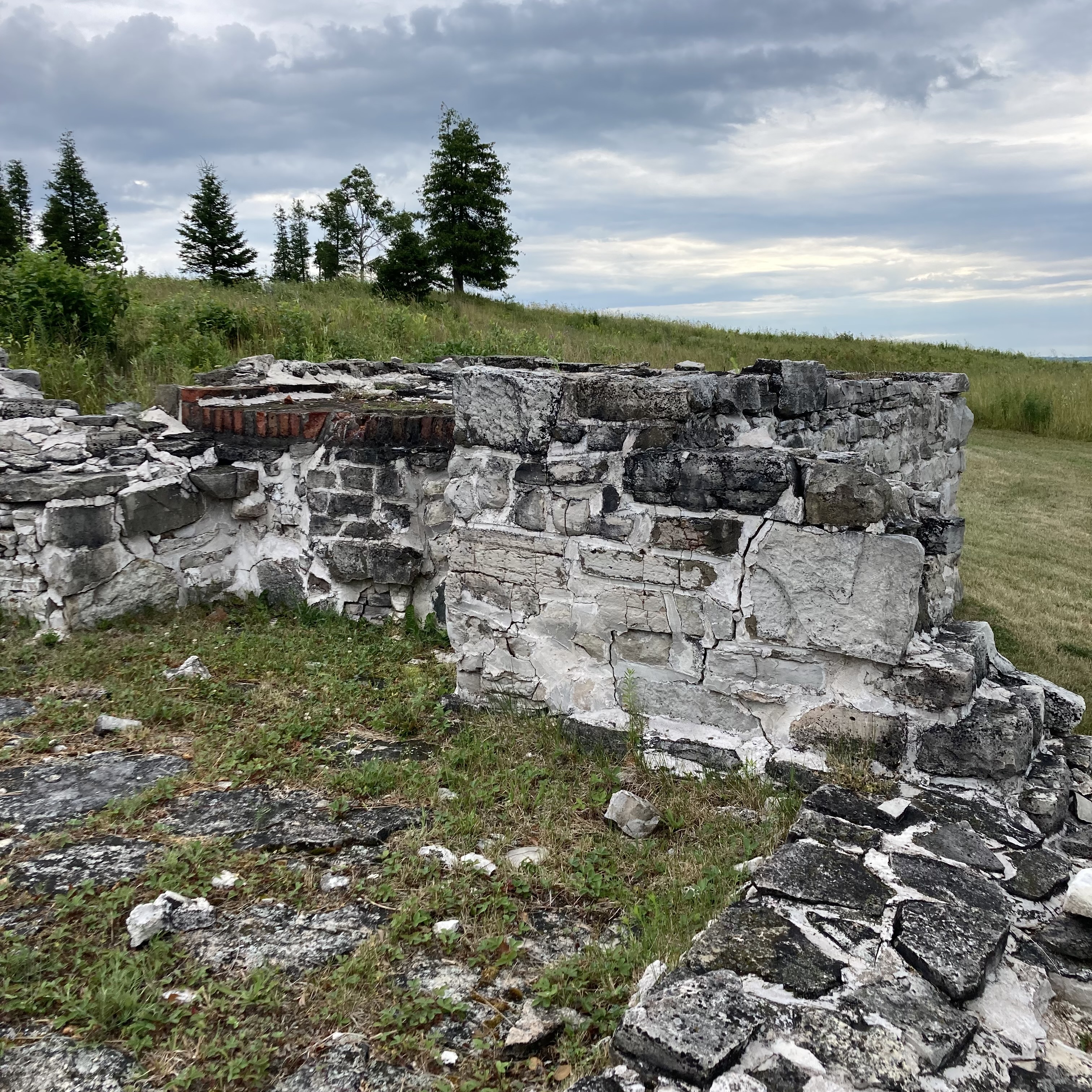
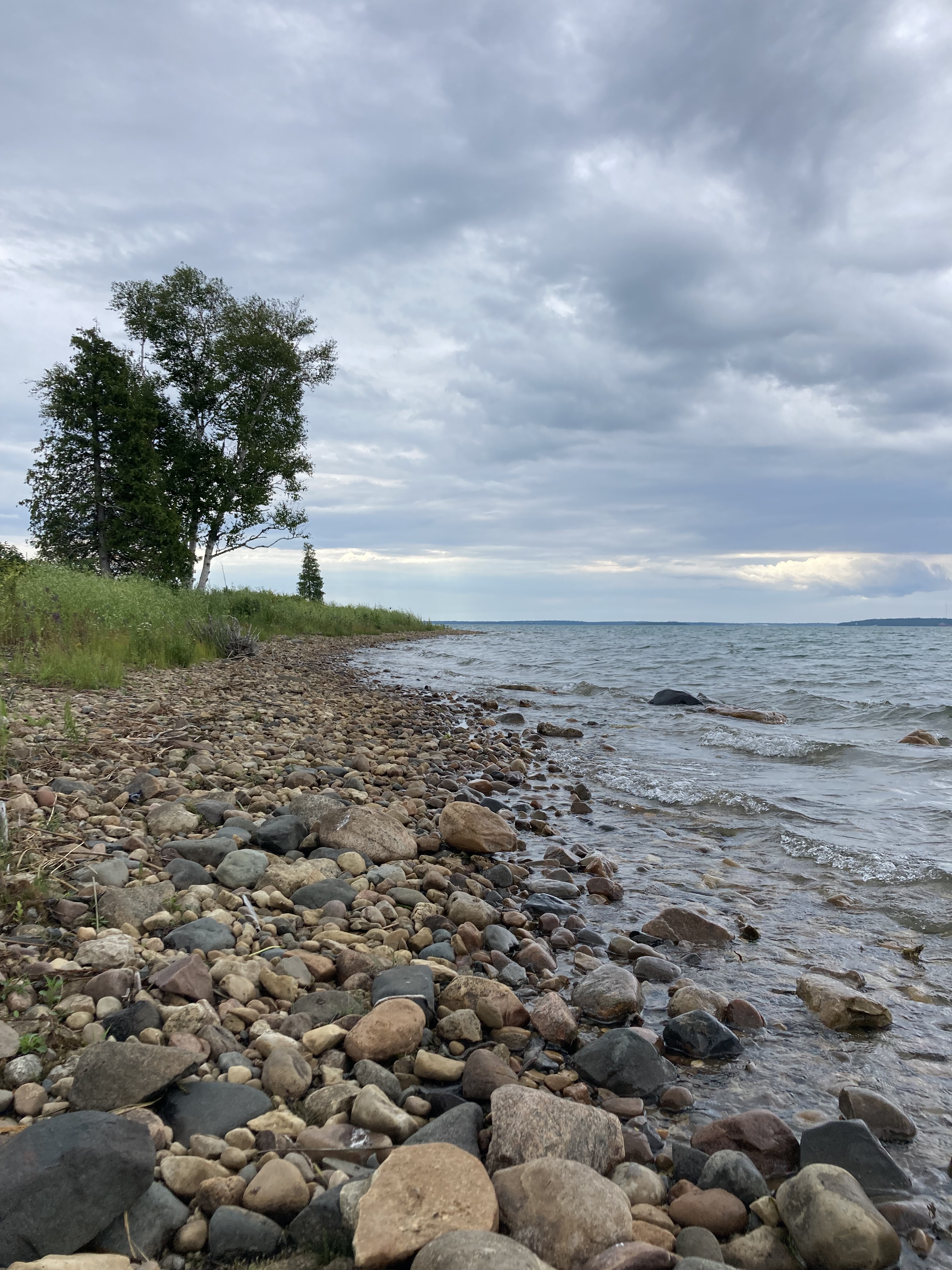
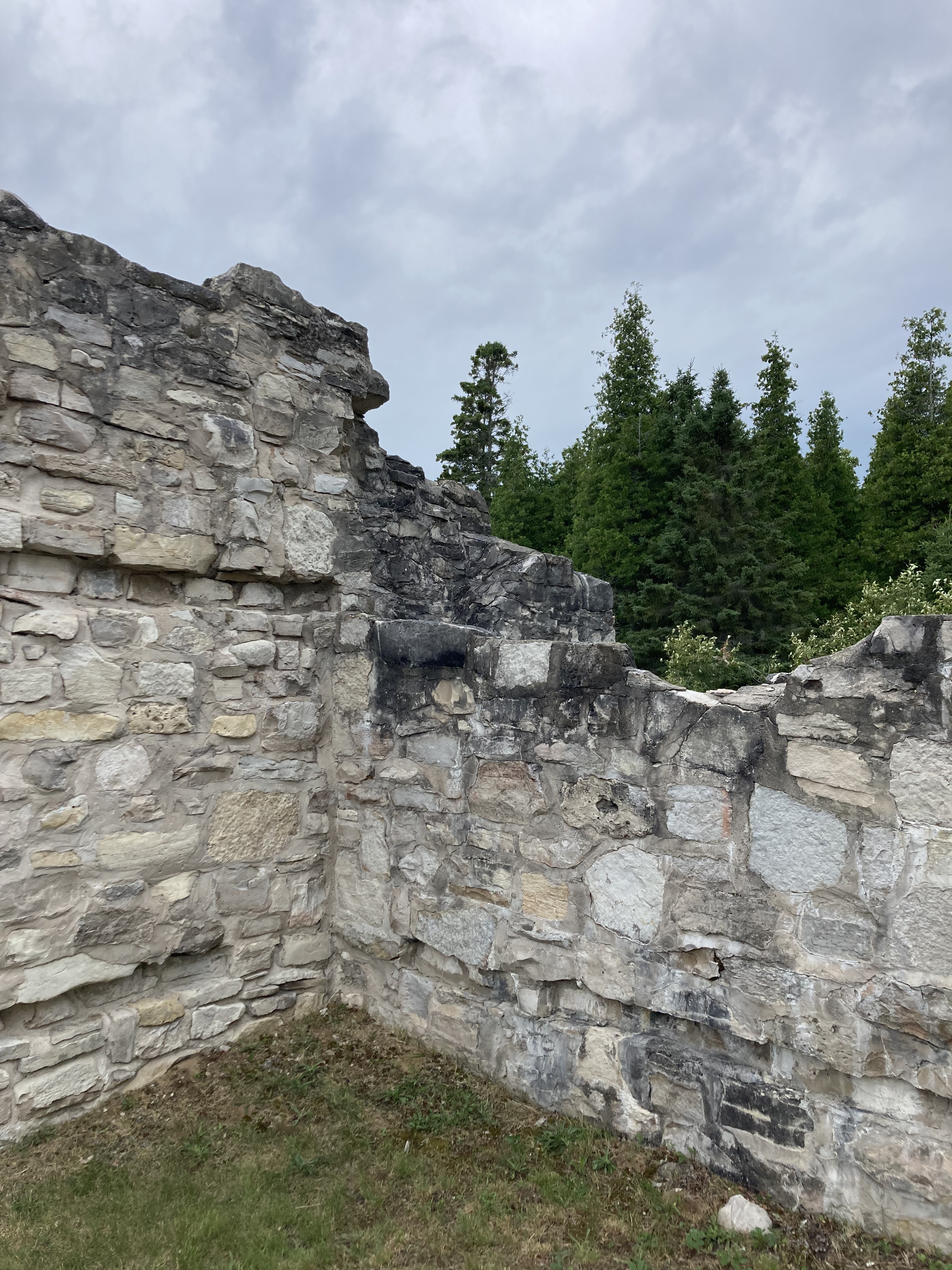
After taking our time exploring the interactive exhibits and watching the film my mother and I headed outside to explore the ruins. Fort St. Joseph was once the most westerly fort in Upper Canada.1 All that is left today are the foundations, ruins, and surviving artifacts. It was very windy the day we went to explore the ruins, and rain was on the way. We took a chance and tried to beat the rain by going as soon as the site opened. We toured the ruins, reading the plaques and taking in the history laid out before us. I found it a little hard to imagine these small foundations housing a community, but the helpful diagrams and maps of the area helped visualize what the layout of the fort would have looked like in its time. Because we got there so early we had the place to ourselves and took our time exploring. Even with the strong winds, we spent some time at the shoreline, examining the horizon. Unfortunately, we didn’t see any birds or wildlife while we were there. I think we can blame the stormy weather on that. 

Fort St. Joseph National Historic Site, St. Joseph Island ON ©2022

As we were finishing up at the ruins, the rain started to come down and visitors started to trickle in. When the rain started to pour down harder we took shelter in the visitor center and gift shop and tried to wait out the storm. They have a cozy little gift shop filled with most of the typical things you would expect from a historic site; postcards, magnets, pins, sweatshirts. One of the more interesting items they had was chocolate, more specifically heritage chocolate. Using a recipe and ingredients authentic to the colonial era, you can try a chocolatey treat that was commonly consumed at the time. They had chocolate sticks and hot chocolate mix at the time of our visit, and I regret not picking up the hot chocolate mix along with the couple of chocolate sticks I did purchase.

After the rain finally eased up, we made our way to the car. There was one more stop to make. The Cemetery Trail turns off the main road to and from the historic site. A small green sign with a hiking symbol and the word “Cemetery” mark the turnoff. My mother was a bit tired at that point and didn’t want to walk the trail. I didn’t have any idea where the cemetery was on this trail loop so I wasn’t sure how far I would need to walk to find it. She decided to stay in the car and wait.

At the trailhead, there is a trail map, along with a description of the cemetery. It reads “The cemetery at Fort St. Joseph contains graves established between 1796 and 1812. While there were only 10 recorded deaths during the occupancy of the fort, such as those of Jessie Crawford’s twins who died in 1807 shortly after birth, there are probably others who rest here eternally, their identities unknown. Those that died at Fort St. Joseph usually suffered from illness or their deaths were as a result of tragic events or accidents like that of Private Antoine Gazzinel who was killed May 9, 1803 when a loaded musket went off as he was placing it into a bateau. A cairn was erected in 1954 to recognize the final resting place of these individuals and stands today as a reminder of the community that once existed at Fort St. Joseph.”

The Cemetery is located right at the beginning of the trail, with a clearing opening up on the right side of the trail. The rain held out for me as I examined the large cairn and took photographs. The cairn reads, in English and French, ”This cairn marks the site of Fort St. Joseph cemetery in which are the graves of soldiers and fur traders who died here between the years 1796 and 1812.” There are about a dozen white crosses here, with no names. One grave looks to also be marked with stones surrounding it. It’s a peaceful spot, surrounded by the lush green forest, but it is also a place of sorrow. I was very sad to see the blank white crosses, marking lives that are now unknown, and who knows how many more lie there unmarked.

Fort St. Joseph Cemetery, St. Joseph Island ON ©2022

My mother and I really enjoyed our time visiting Fort. St. Joseph, even though the weather wasn’t ideal. Exploring the historic ruins and cemetery was an interesting look at the past, even when at times it was a somber one. It was my first time exploring a ruin site, and I look forward to the chance to visit more.

Have you visited Fort St. Joseph? Will you be adding it to your travel plans? I would love to read your thoughts in the comments. 

Thanks for reading!


References:

  1. Fort St. Joseph National Historic Site | Parks Canada

Blog updates & more…

I realize I owe you all a blog post after missing last Sunday, but I don’t have anything that is quite ready to share with you yet. I have a few posts that I have been working on, but more research is needed. So instead, this will be an update, to share what I have been working on and what you can look forward to on the blog in the coming months. 

Most recently, I have been working on a piece inspired by Death’s Garden Revisited, edited by Loren Rhoads. My piece is about my own personal connection to cemeteries. After speaking with my Mother about the subject, it created more questions than answers. As we chatted we uncovered our own little family cemetery mystery, which sent me down yet another research rabbit hole. I’m sure you all will find that story very interesting. 

I have also been saving a cemetery story, especially for this month, as February is the anniversary of this local tragedy. I need a little more time to work through the research and sort through my photos from last summer’s road trip. That will be another post to look forward too.

Along with writing and creating content for the blog, I have also been taking an online course to sharpen my writing skills. The course is through Atlas Obscura and is called Historical Nonfiction: Research-based writing with Hadley Meares. This 4-week course promises to help you write historical essays using a research-based lens. I am on week 3 of the course and it has already solidified the good writing habits I already had while introducing new habits, methods, and resources to my writer’s toolbox. I look forward to sharing the article that comes from completing the course. 

Amidst all this writing I have also been updating the portfolio section of my website. I have posted many additions to my existing web portfolios and have added some new ones entirely. Sorting through, editing, and posting my archive of cemetery photos has been a great way to look back at all the cemetery adventures I have had over the years.

I have also been working on researching some new areas and cemeteries to visit. I have some great cemetery road trips already planned for this summer and can’t wait to get back on the road and photographing. I plan on visiting Owen Sound, for part two of Chasing Tom Thomson, while also stopping in at some fun interesting spots along the way. I also have another trip planned for early spring which will include my first visit to a loyalist cemetery, and seeing table stones in person. I’m pretty excited about that trip.

I have also been busy getting some submissions ready for a local photography contest, and a gallery showing. I am not quite sure how my cemetery work will be received, but I think they could be great opportunities to get my work out there, regardless of the outcome.

Hopefully, some of these upcoming posts sound interesting and will have you coming back to read more. As always, if you have any book or cemetery recommendations, or cemetery stories of your own to share, please leave me a comment or send me an email at hello@chantallarochelle.ca

Thanks for reading! 

Stone Stories: Chasing Tom Thomson

Summertime is meant for road trips! In July, I went on a two-week vacation full of adventures. One of the trips I was looking forward to most on my vacation was visiting Algonquin Provincial Park. Algonquin is Canada’s first Provincial Park, having been founded in 1893.1 It’s a large and beautiful piece of wilderness, that also holds a mystery.

My 80-year-old mother joined me on this camping trip. It had been about 40 years since she last went camping, so I made sure we did all the fun camping things; sleeping in a tent, cooking on a fire, and making s’mores. There were a couple of other things on our to-do lists: visit Canoe Lake, search for Mowat Cemetery, and find the grave of Tom Thomson.

The story of Tom Thomson is an interesting one. Today, he is often referred to as the Canadian Van Gogh.2 And rightly so, his use of color and thick strokes vividly bring the northern landscapes to life. Thomson spent a lot of time painting and fishing in beautiful Algonquin Park. His love of the area must have been contagious as he soon had other painters joining him on his painting excursions. They even had a name for themselves, the “Algonquin Park School of painters”.3 You might recognize them more now as the Group of Seven. Unfortunately, Tom wouldn’t live long enough to see that recognition as he died mysteriously, two years prior. I would consider him a founding member, of the now famous group of painters.

There have been many things written about what happened to Tom Thomson on that fateful day in July. But to this day, no one knows for sure what happened. With so many varying accounts over the years, speculating what may have happened, the details of the events don’t seem to add up. We do know that Tom’s canoe was found on July 8th, but he was not. His body was found in Canoe lake, 8 days later on July 16th.4 He was found with bad bruising on his face and head, with a fishing line wrapped around his left or right ankle, depending on which account you read. In most accounts, the fishing line is seen as an indication of foul play. I don’t agree. I have been doing a lot of reading about this mystery and one thing that always stands out to me is the fishing line.

Tom’s body was found floating in the lake. Many people speculate that something heavy was tied to the fishing line to weigh the body down, that he was purposely drowned. BUT all the accounts mention that the body was tethered to the shore, and not removed immediately from the water. I think it would make sense that they would have used a fishing line to tether the body to the shore, which would account for the fishing line. One blog post I found corroborates this thought, but for some reason has not been looked at more closely. The blog post comes from a professional journalist, Robert Reid. In his blog post, Epistles from the Grave, Robert talks about letters that were written in the 1970s by Jack Wilkinson. He would have been six years old at the time of Tom’s death. These letters were written to correct some inaccuracies in the accounts that were circulating, most notably the fishing line. In the letters, Wilkinson confirmed that the fishing line was merely used to tether the body to the shore, so it would not float away until the coroner could be alerted and come collect the body.5 This would mean the fishing line had nothing to do with Tom’s death. Still, the questions persist—was it murder? Or was his death an accident? These details we may never know.

Tom was hastily buried at Mowat cemetery, sometimes referred to as Canoe Lake cemetery. This is not what his family wanted. They wanted him brought home. So his remains were exhumed the next day and transported to Leith, Ontario, near Owen Sound. There his remains were buried once again, and a proper headstone was erected.1 Here lies another facet of the mystery—many people claim his body was never moved.

Is that why people also claim to see a ghost in the early morning fog on Canoe lake? Over the years, many people have reported seeing a man slowly paddling a distinctive grey canoe through the still waters of the early morning.6 What’s interesting about these sightings is that in life Tom Thomson had painted his canoe a unique dove-grey color, that he had mixed himself from his paints. This dove-grey canoe stood out among the identically colored canoes of the local lodges.1 Unfortunately, I was not able to find anyone in the park who had experienced any sightings firsthand. 

Our search for his grave began on the morning of July 17th, which just so happened to be the 105th anniversary of Tom’s burial at Mowat Cemetery. We drove into Algonquin Park that morning, and after stopping in to check on our campsite at Tea lake, we decided to try and find the cemetery. I had been planning this trip since the early spring of this year and had been researching how to find the hidden cemetery. In early June, Back Road’s Bill, a local adventure/nature writer, published an article about the two graves of Tom Thomson, so I reached out to him about directions for reaching the cemetery. He was very helpful. With the coordinates locked into my Google Maps, I felt pretty confident that we could reach the cemetery. 

That confidence wavered a little though when we visited the Canoe Lake Access Point Permit Office. We stopped in, after taking in the view of the infamous Canoe Lake, to buy some firewood and talk to the staff. The clerk was a young man, who had just started working at the permit office. He didn’t have any personal stories to share about the haunting of canoe lake but did have some interesting ideas about where Thomson may actually rest. He shared an interesting theory that the gravedigger that was hired to move the body had sent a coffin filled with dirt and rocks to the family, to approximate the weight of a body. He also told me that the cemetery can only be accessed by canoe and that the back roads I had pointed out are actually the train line, not a road. I was a little dismayed, but I had faith in Back Roads Bill and his map, so we continued on.

And good thing we did! The rail line the Permit office staff talked about was now a camp road. We followed it as far as we could, safely by car. At one turn-off the road became quite rough so we decided to park the car on the side of the road and continue on foot. This would turn out to be our hike for the day. It was a very nice walk in the lush woods of Algonquin Park. After walking for a time, we came upon some cottages on the lakefront. One cottage had a large family gathering outside, so we stopped and asked them for directions to make sure we were on the right path. They assured us we were and gave us some landmarks to go by, as there is no sign marking the cemetery. We continued on our way, trying to align ourselves with Canoe lake, and picture what it would look like to travel the route by canoe. We couldn’t easily see the lake. Unfortunately, the landmarks the cottagers gave were not the most helpful and we got a little turned around.

For an area that seems incredibly remote, there are a fair number of family cottages out there. We happened upon another cottage where it looked like they were packing up to go home. We asked again for directions. The gentleman we had asked was kind enough to walk with us to the entrance of the cemetery trail. We had gone a bit too far, having stayed to the left when we should have taken a right at the fork in the trail. His german shorthaired pointer puppy joined us, zooming back and forth past us as we walked. He told us how that day was the anniversary of Tom’s burial and how his family sometimes walked up to the cemetery to pay their respects. He didn’t have any ghost stories to share though. He brought us to the start of the cemetery trail, a small almost hidden trail that veers again to the right off of the bigger trail. We thanked him and continued on our way. This part of the trail was more rugged, with felled trees and a faint trail that was sometimes hard to distinguish in the wild forest. My mother said she was starting to have doubts at this point in our adventure, but those doubts faded when we came to a hill. 

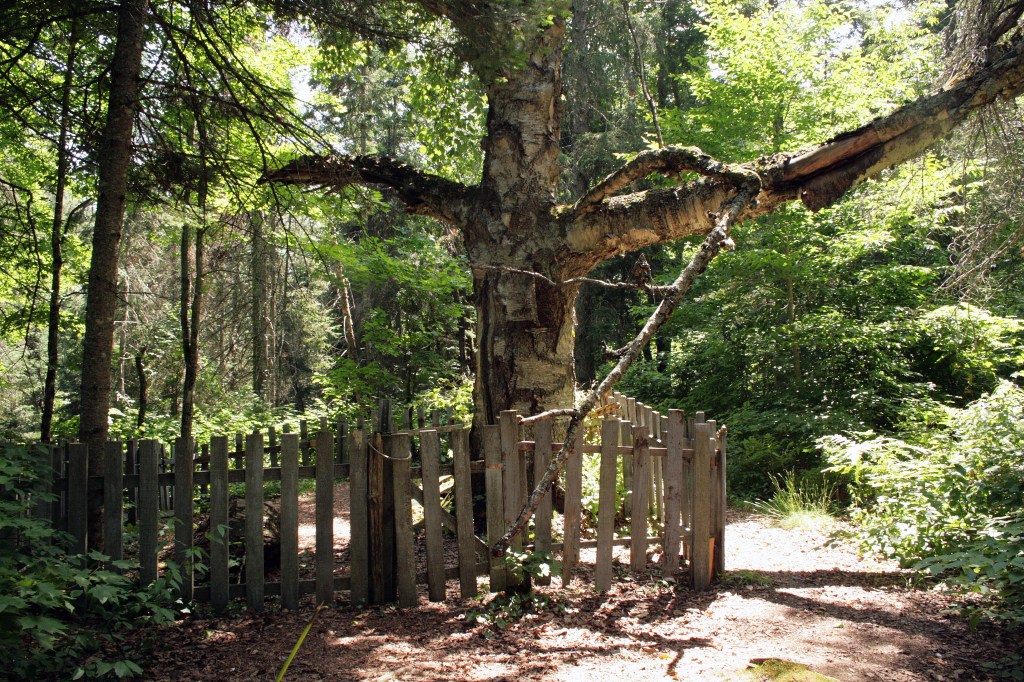
Sitting at the top of the hill we could see an old weathered fence and the supposedly 500 year old birch tree. It’s the largest birch tree I have ever seen! We happily climbed to the top and walked into Mowat cemetery. This small pioneer cemetery is a small remnant of the town of Mowat. This mill town was the largest in Algonquin Park and had about 500 residents in its heyday. The town included a hospital and school, as well as recreational lodges. Tom Thomson often frequented Mowat Lodge. The town began to dwindle, after the lumber recession.7 Today, all that remains of Mowat is the cemetery and a few cement foundations. 

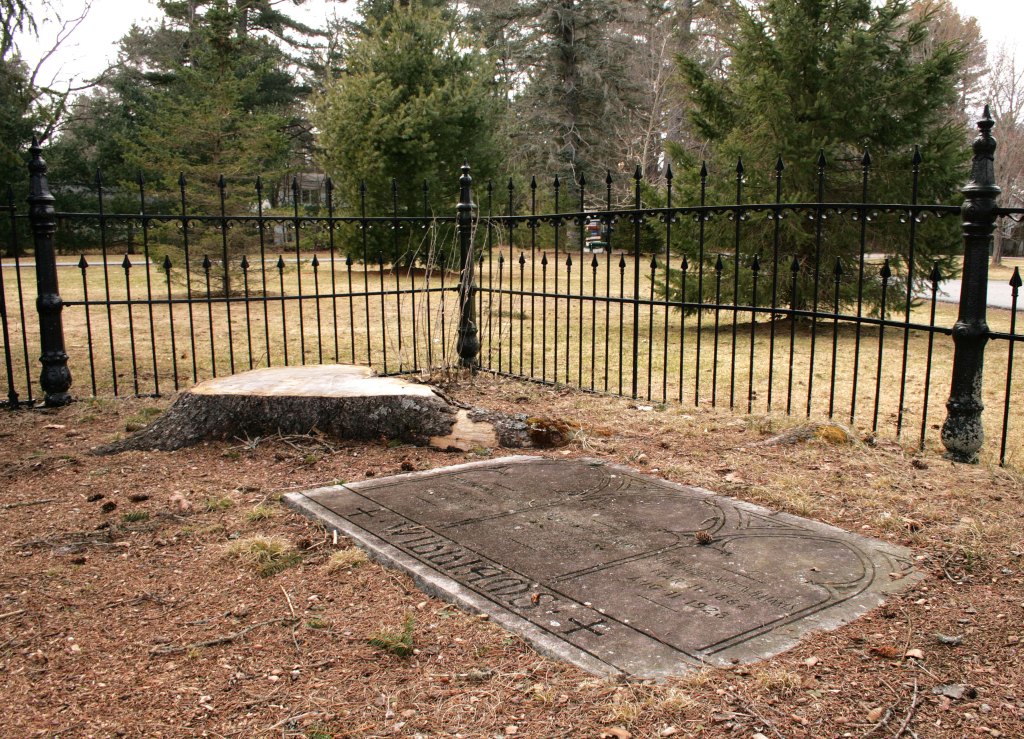
The cemetery is very small, with only a handful of grave markers. There is one field stone, and two engraved headstones within the picket fence. There is also a white wooden Latin cross, that marks the grave of Tom Thomson. It is thought that the cross was placed by the CBC in the 1960s for a documentary. There also seems to be a depression in the ground at his grave. There were a few grave goods left for Tom; a small electric tea light, some paint brushes and a fishing lure. There was no one at the cemetery when we visited, but I think Tom still receives his fair share of visitors. 

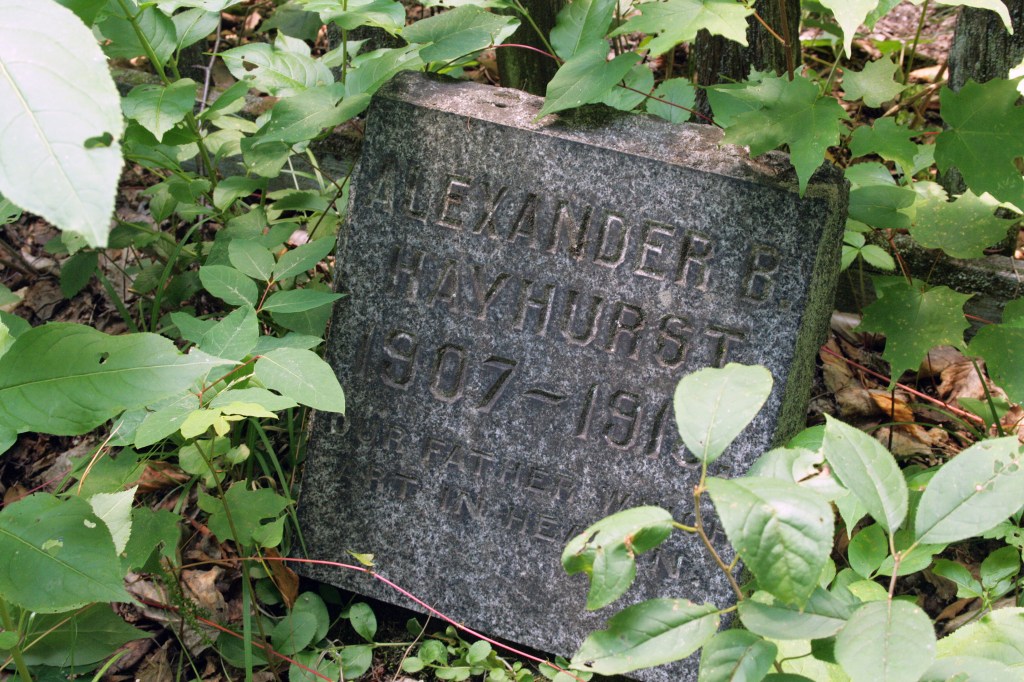
Within the cemetery fence, there is a small grave marker for Alexander B Hayhurst, a child who died of diphtheria in 1915. 

There is also a large flat gravestone for Ja’s Watson who is thought to be the first person buried at Mowat Cemetery. His stone is hardly legible now, but records say that the epitaph reads:

“In Memory of Ja’s Watson / The First White Person Buried / at / Canoe Lake / Died May 25 1897 being one of / about 500 employed at this Camp by / the Gilmour Lumbering Co. Aged 21 yrs / Remember Comrades (when passing by) / As you are now so once was I / As I am now so you shall be / Prepare thyself to follow me.”8

We spent a lot of time in the cemetery, trying to decipher the stones and admiring the enormous birch tree, and paying our respects to Tom Thomson. We tried to imagine what the cemetery would have looked like in 1917 when he was laid to rest. After a time we decided to head back down the hill and retrace our steps back to the car. It was a bit of a long journey, but it was incredibly rewarding. Back at our campsite we had a nice campfire supper of burgers and corn on the cob and talked about our visit to Mowat cemetery. We speculated on what might have happened to Tom and whether or not he was still laid to rest on that hill. My mother was very adamant that he was still there. After supper, we made some s’mores for dessert and enjoyed the campfire as it lit up the darkness of the night.

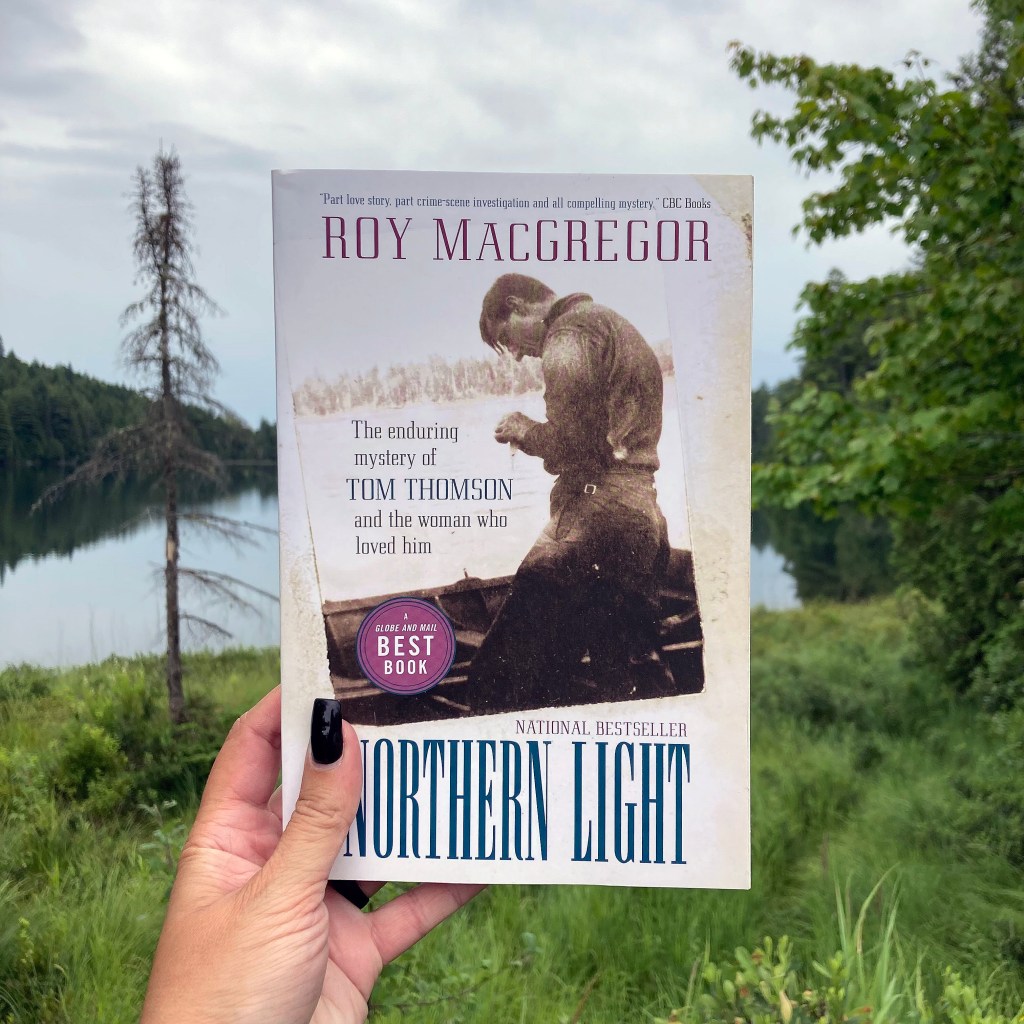
The next morning we decided to explore the park a little more before heading home. We stopped in at the Algonquin Art Centre to look around. This world-class art gallery showcases some of Canada’s foremost wilderness and wildlife artists.9 Outside, on the Centre grounds, we took a look at a set of plaques celebrating Tom Thomson. They told the story of Thomson as a painter, his attraction to Algonquin Park, his body of work, and his legacy as an artist. We also viewed an outdoor exhibit of painted canoes, called Tom Thomson’s Canoe Murals. We spent some time inside the gallery as well, taking some time to admire the gorgeous art gallery and browsing the gift shop. This is where I purchased my copy of Northern Light by Roy MacGregor.

Northern light: The enduring mystery of Tom Thomson and the woman who loved him by Roy MacGregor is a very good read. It presents some really interesting theories as to what may have happened to Thomson, and also suggests that his body never left Mowat Cemetery. In the 1950s, a small group of men took it upon themselves to prove whether Tom was still buried in the cemetery on Canoe lake. They took some shovels, went up to the cemetery, and started digging. I think to even their surprise, they did find human remains. They took a few bone samples, including the skull, and sent them for analysis. The results were not what they expected and seemed to raise more questions.1 More recently, a facial reconstruction was attempted using photographs of the unearthed skull. The face that emerged was pretty uncanny, but does that mean the mystery is solved?10

I don’t think the mystery will ever truly be solved. I believe the truth of what happened to Tom Thomson went to the grave a long time ago. But that doesn’t mean people will stop trying to solve it. Stories will continue to be told about his tragic life, cut short. As much as Algonquin Park was a part of Tom’s life, his artwork is now a part of it as well. You can find his artwork at the Art Centre. You can see the inspiration for his art in the beauty of the wilderness. You can learn more about his life in the Visitor Centre, alongside the history of the land and the evolution of the communities within the park. Tom Thomson, whether it be his artwork, his story, or his ghost will continue to be a big part of Algonquin Park. 

I really enjoyed my time exploring the park and searching for the grave of Tom Thomson. It was a rewarding trip, that let me explore nature while also learning more about art and Canadian history. It was one of the more challenging cemeteries to find, but it was a beautiful place to visit and photograph. My mother enjoyed this trip immensely. She was a bit leery at first, but the history drew her in. She talks about our trip often. Coincidentally, I started writing this blog post on what would have been Tom’s 145th birthday, August 5th, 2022. My mother shares his birthday. 

Have you ever been to Algonquin Park? Have you seen the ghost of Tom Thomson? I would love to read your stories in the comments. If you are interested in reading more about the mysterious death of Tom Thomson, check out the links below. 

Thanks for reading! 


References:

  1. MacGregor, R. (2010). Northern light: The enduring mystery of Tom Thomson and the woman who loved him. Vintage Canada. 
  2. A break in the mysterious case of Tom Thomson, Canada’s Van Gogh | The Globe and Mail
  3. Algonquin Art Centre 
  4. Tom Thomson | The Canadian Encyclopedia
  5. Epistles from the Grave | Reid between the lines
  6. Is Tom Thomson Haunting Algonquin Park? | Haunted Walk
  7. Mowat (Tom Thomson murder) | OAP Urban Database
  8. Ja’s Watson headstone, Mowat cemetery | Canadian Mysteries.ca
  9. About | The Algonquin Art Centre
  10. Skull recreation attempts to solve ‘perfect mystery’ behind untimely death of artist Tom Thomson | National Post

More interesting links:

  1. 100 years of haunting by Tom Thomson’s ghost | Toronto Star
  2. Death on a painted lake: The Tom Thomson tragedy | Canadian Mysteries.ca
  3. What REALLY Happened to Tom Thomson? | The Country Connection Magazine
  4. Why the 100-year-old mystery of Tom Thomson’s death lives on | CBC
  5. Tom Thomson’s mysterious death just won’t die | The Globe and Mail