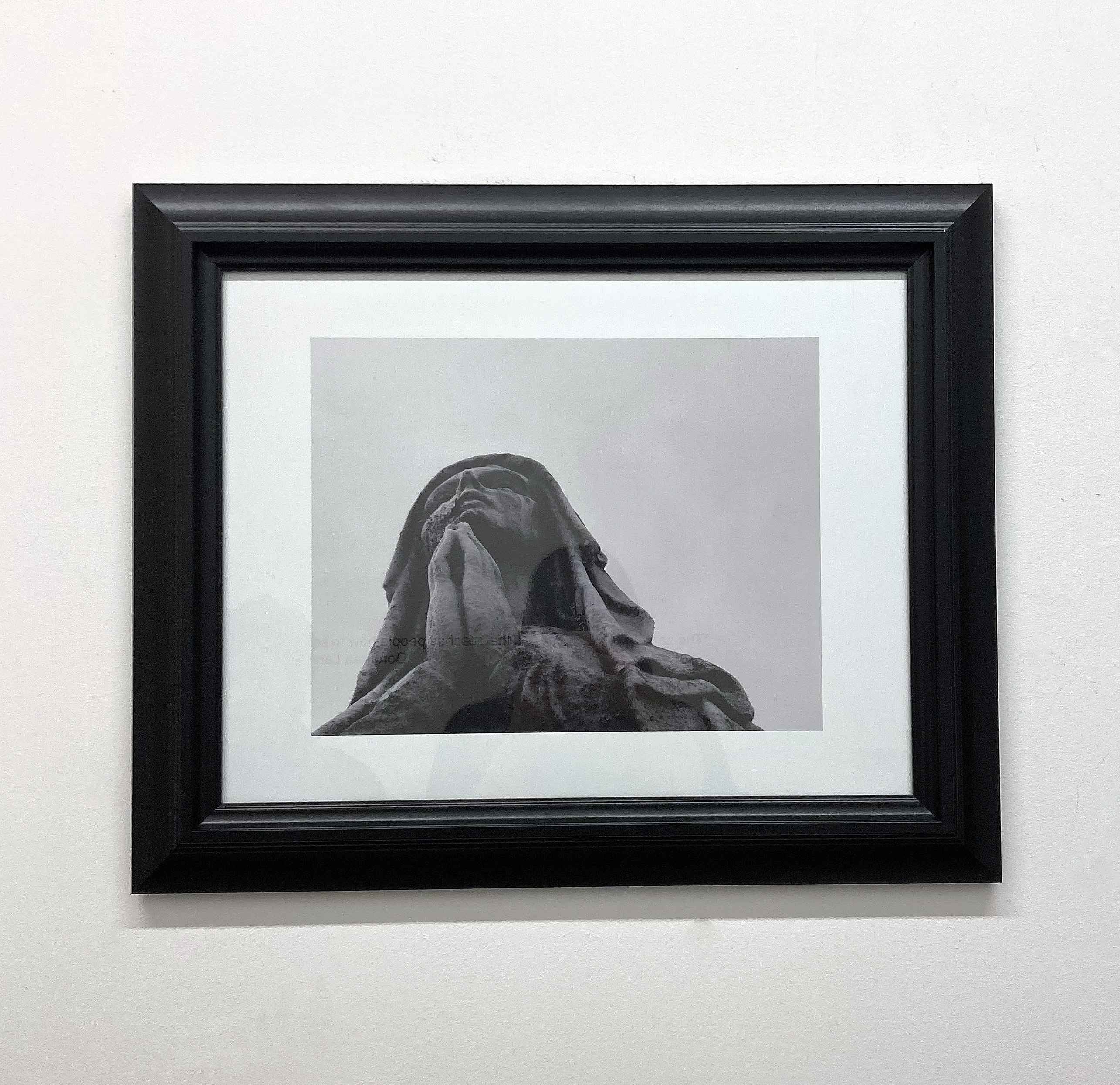
Recently, I was very excited to learn that my work had been selected for a group photography show. If you follow me on Facebook or Instagram, you may have seen a few posts about it. Gallery 6500 had put out a request for submissions from local photographers, looking for contemporary black and white photographs.
They asked photographers to submit works that commented on social, political, economic, and environmental issues within our community. COVID-19 was a focal point of many submissions, including mine. There was a very nice Sudbury.com article written about the show, that highlights the theme as well as some of the other amazing photographers in the exhibit.
The 5 photographers exhibiting are: Caio Higa, Debbie Anzinger Mckay, Debb Trahan-Pero, Rita Vanderhooft, and myself.
I was thrilled when I got an email saying my cemetery photographs had been chosen. This is my first time exhibiting in a gallery, and I was a little uncertain as to how my photography would be received. I have been in one other group photography show, that was more of a market or craft show style. It’s been a great experience working with the Gallery and organizers to bring this show to life.
Last Sunday, April 30th, was the opening of the exhibit. It was a great event! There was a great turnout of friends and family of each featured photographer. It was so nice to see so many people come through to enjoy the photographs. Personally, seeing so many of my friends and family come out to support me made my heart full. I sometimes feel like my work goes unnoticed and I am creating content just for myself, so seeing so many people come out to support me and overhearing conversations surrounding my work was such a thrill!
Our Story in Black and White: Photography Exhibit, at Gallery 6500
I am very excited and honored to be exhibiting alongside such great photographers. There are a variety of subjects presented, each in the photographer’s own unique style. I am sure there is something there for everyone to connect with. There is some very powerful work on display.
If you were not able to attend the opening, there is still time to visit this great exhibit. Gallery 6500, at 66 Brady Street, in the Steel Workers Hall is open for viewing on weekdays from 8:30 a.m. to 4:30 p.m. Our Story in Black and White is running until June 30th, and is dedicated to the memory of Don Kuyek. Don’t forget to sign the guest book and share your thoughts.
Did you know that May is Cemetery Appreciation Month?
I first learned about it in 2021, and I have been celebrating every year since. Cemeteries are often seen as taboo and they are not often the first place someone would think to visit, but I believe that cemeteries are for the living. They are filled with history, art, and architecture, and are wonderful places to go for a stroll, or bird watching, among other things. Yes, they are resting places for our loved ones and should be respected, but that doesn’t mean we can’t enjoy their beauty as well. Cemeteries were the blueprints for today’s public parks, after all.
So how do you celebrate? In 2021, I created a mini bucket list of things to do during the month to foster an appreciation for cemeteries. It was a nice excuse to spend more time outside. I had a lot of fun completing everything on my list. Some activities on my list included visiting a cemetery I had not visited before, and re-visiting a favorite local cemetery.
This year I wanted to do something a little different. I’m a graphic designer by trade and wanted to create something that would bring my two loves together—design and cemeteries. I was also inspired by a cemetery scavenger hunt I took part in last October. I thought it would be really fun to do something similar with my group of friends.
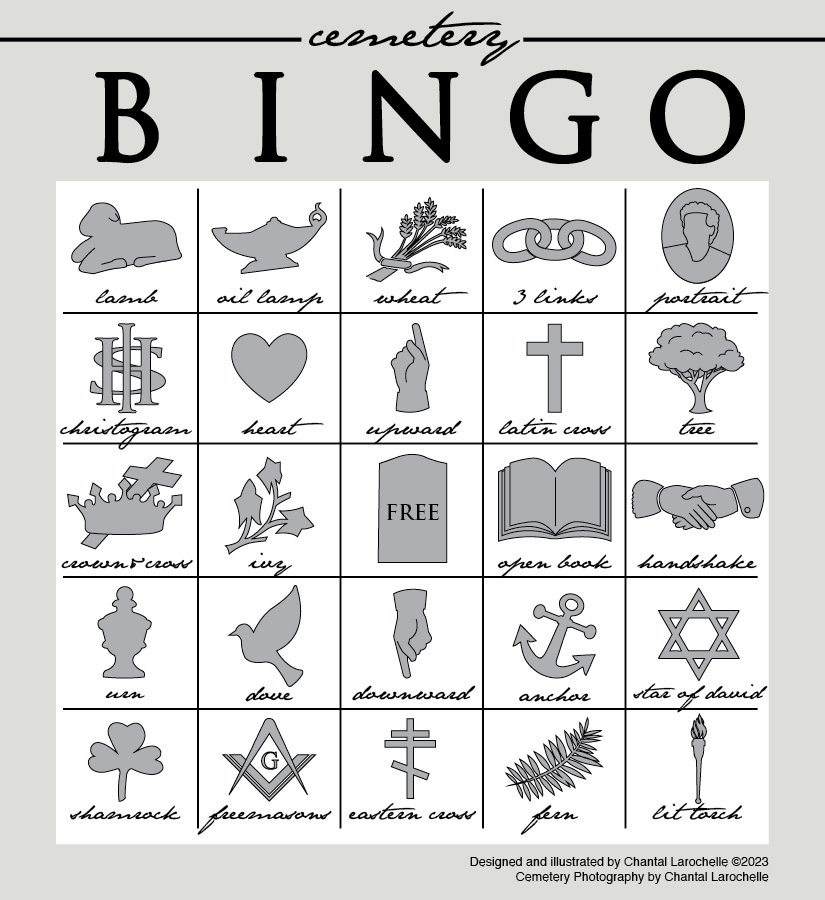
So I thought why not design a Cemetery Bingo card?
It’s a great activity to do in a group or solo and lets you explore the world of cemetery symbols. I created my cards using my cemetery photographs as a reference. I illustrated 40 symbols that are commonly found on gravestones. I included the name beneath the symbol as well, to help identify common motifs you might find while walking in a cemetery.
To play, all you need to do is print out a copy, bring something to mark your cards, and go for a walk in your local cemetery. Match the symbols on the card to what you find on the gravestones. The first one to get a full line wins! You can make that two lines, or even a full card to make it a bit more challenging. I can see this being a fun tool to introduce your friends and family to cemeteries and help explore gravestone symbolism. It could also be a fun activity for kids.
Please remember to be respectful when visiting your local cemeteries. For a guide on cemetery etiquette, you can read a previous blog post I wrote about the rules I follow when visiting a cemetery here.
My friends and I will be going on a cemetery road trip very soon, and I think it will be a great opportunity to try out the bingo cards. We have a lot planned already, but I think we can fit in a round of Cemetery bingo. I’ll be sharing how our cemetery bingo plays out in my stories on Instagram on May 6th.
For best results, send this print-ready file to a local print shop, or you can print them at home on your home printer. Just be careful when you are trimming the pages. Then all you need are some markers, stickers, or bingo dabbers to mark off your finds and have fun! Make sure to tag me in your photos or stories on Instagram and Facebook.
While working on an upcoming project, I was going through my photo archive and found myself frequently stopping on the images of weeping willows. I have captured an interesting variety in the last few years. I love weeping willows, they have a very unique look. They are not common in my area, in the forests, or on graves.
So for today’s collection, I wanted to take a closer look at this cemetery symbol and share some of the different versions I have found and photographed during my cemetery walks.
As the name implies, weeping willows commonly symbolize grief and mourning. They are a very common Victorian-era cemetery symbol. Adopted from the Ancient Greeks, the weeping willow can represent immortality and life after death. Weeping willows are sometimes associated with the Underworld because, in Greek mythology, Orpheus brought with him a willow branch on his travels to the Underworld to save Eurydice from Hades.1 The symbolism of immortality stems from the fact that willow trees are very hardy, and can survive heavy damage.
A variety of the weeping willow motif you might find is a weeping willow standing beside a gravestone. I love the idea of a gravestone on a gravestone.
Another variation you might come across is of a weeping willow and urn. The urn represents death itself, and the willow again symbolizes grief.2 This motif was a popular gravestone symbol of the late eighteenth and early nineteenth century. You might also see weeping willows paired with a lamb or a cross.3 I have yet to come across these variations.
I noticed that the majority of the ones I found were in Southern Ontario. As I explore more Ontario cemeteries this summer, I hope I will come across a few more to photograph. I would love to find some more variations on the symbol. If you have any suggestions for where I might look, I would love to hear about them in the comments.
Thanks for reading!
References:
Understanding Cemetery Symbols: A Field Guide for Historic Graveyards by Tui Snider
I feel like a broken record lately, always talking about the snow. But it’s finally melting! We have been having some consistent warm weather so the snow has been disappearing quickly. I have been getting ready for the warmer weather by planning and mapping some upcoming cemetery walks. It’s exciting that the weather is finally warming up. I have some great future road trips planned and am looking forward to some fun cemetery adventures. All this planning has got me thinking about some of last year’s trips.
My mother and I did some exploring of St. Jospeh’s Island last year, home to Fort St. Joseph National Historic Site and bird sanctuary. We spent the night at a quaint little motel on the island and explored everything the island had to offer. I wrote a little about our adventure and finding a pet cemetery, but there are many more stories to tell from that trip.
So today, I wanted to share another experience from that cemetery road trip and talk about our visit to Fort St. Joseph, and the Historic Fort St. Joseph Cemetery.
I first learned about Fort St. Joseph when I stumbled onto a trail map while going down an internet rabbit hole. The cemetery trail piqued my interest and I redirected my Google search to learn more. Fort St. Joseph is a National Historic Site of Canada that features the ruins of an archaeological site and is filled with history about the War of 1812. “History that saw a powerful alliance struck between the British and the First Nations People of the western Great Lakes region.”1
The historic site has an interactive visitor center with a walk-through exhibit as well as an educational short film that tells you more about the history and discovery of the site. There is also a trail system that takes you through and around the ruins and includes the Cemetery Trail, Rains Point Trail, and the Lapointe Point Trail. Visiting cemeteries and hiking are two of my favorite things and often go hand in hand. I thought they would be a perfect destination for a summer road trip. My mother was on board right away when I asked her if she wanted to come. She is an avid bird watcher and was excited to visit the bird sanctuary. More than 200 species have been spotted in the area.1
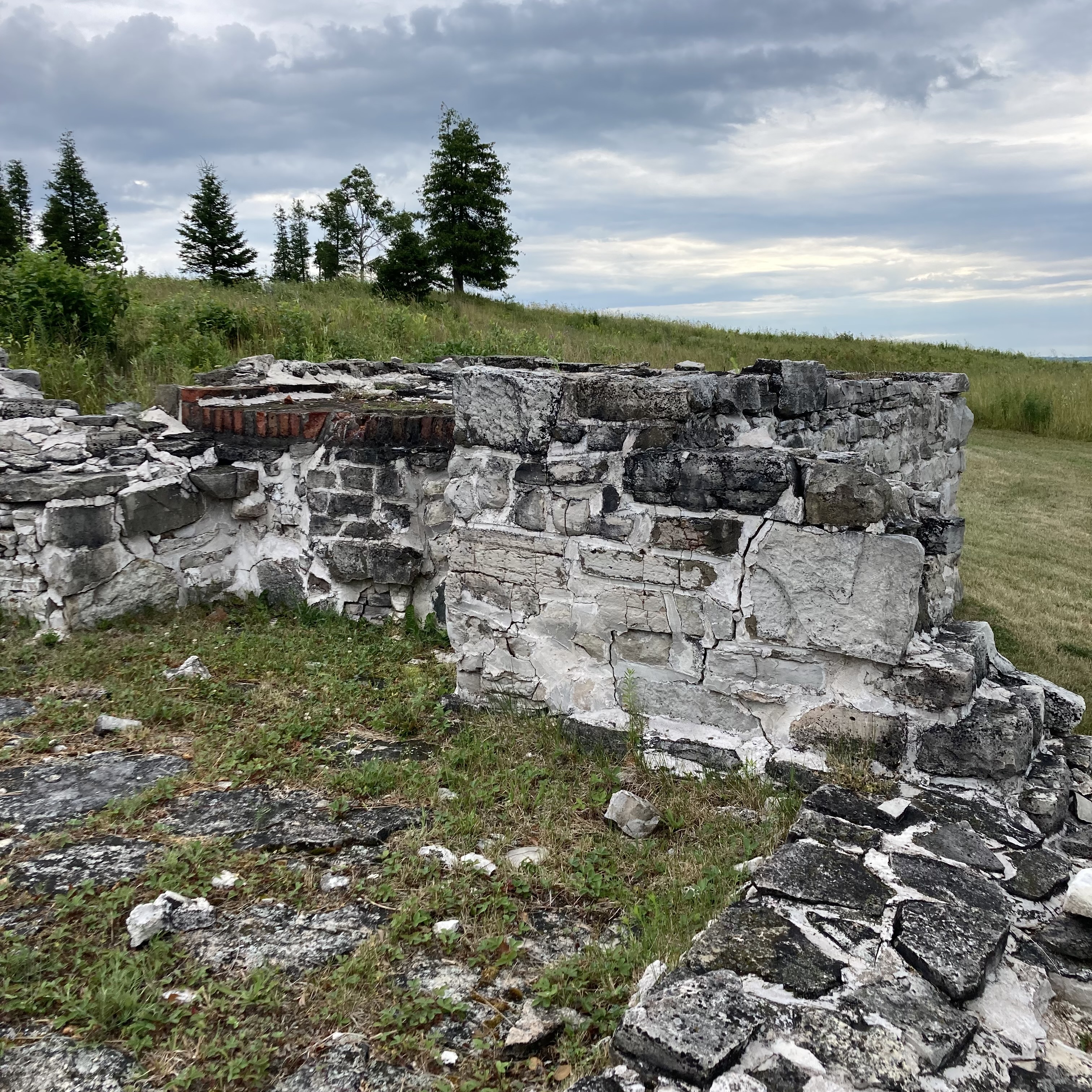
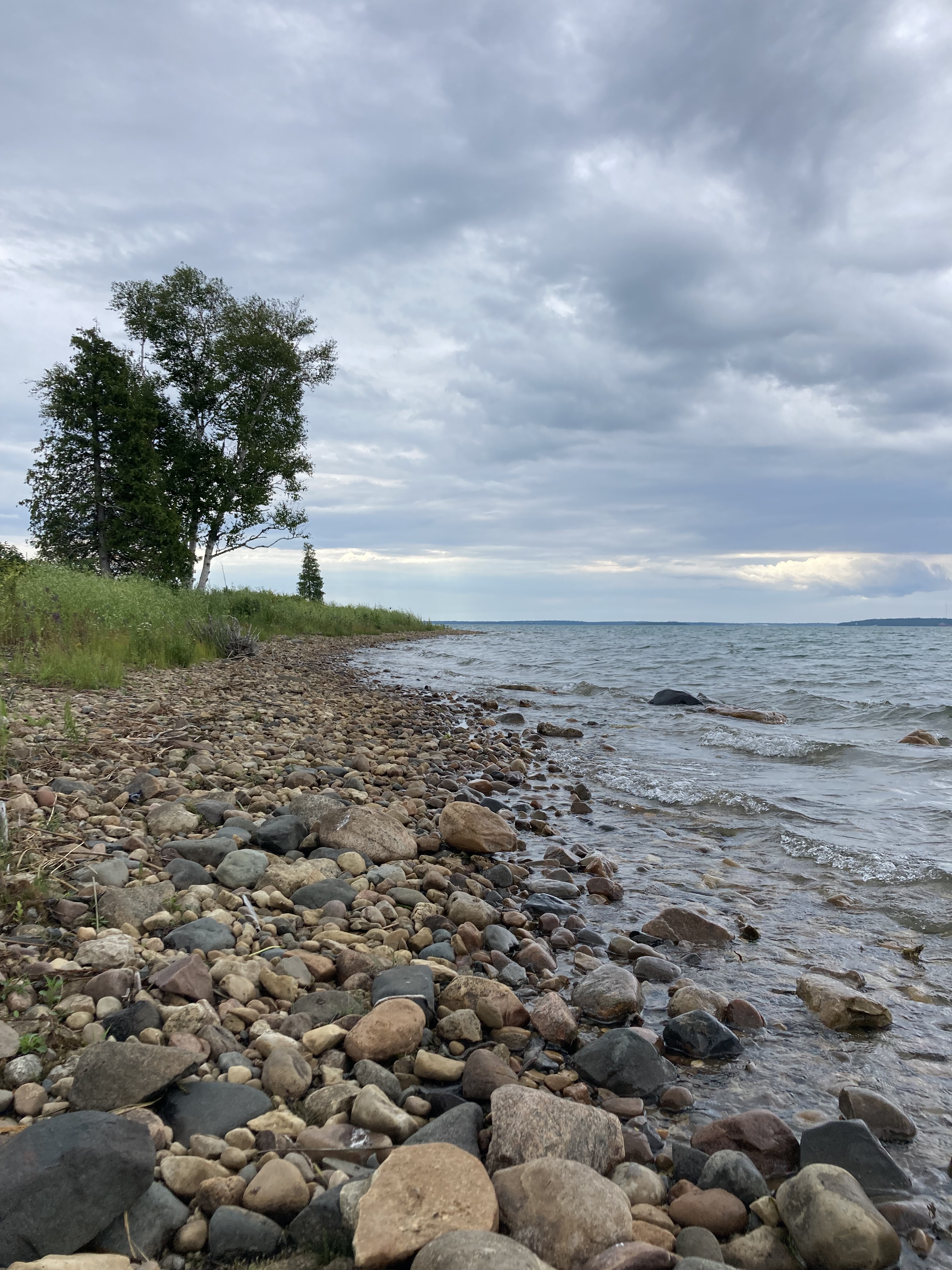
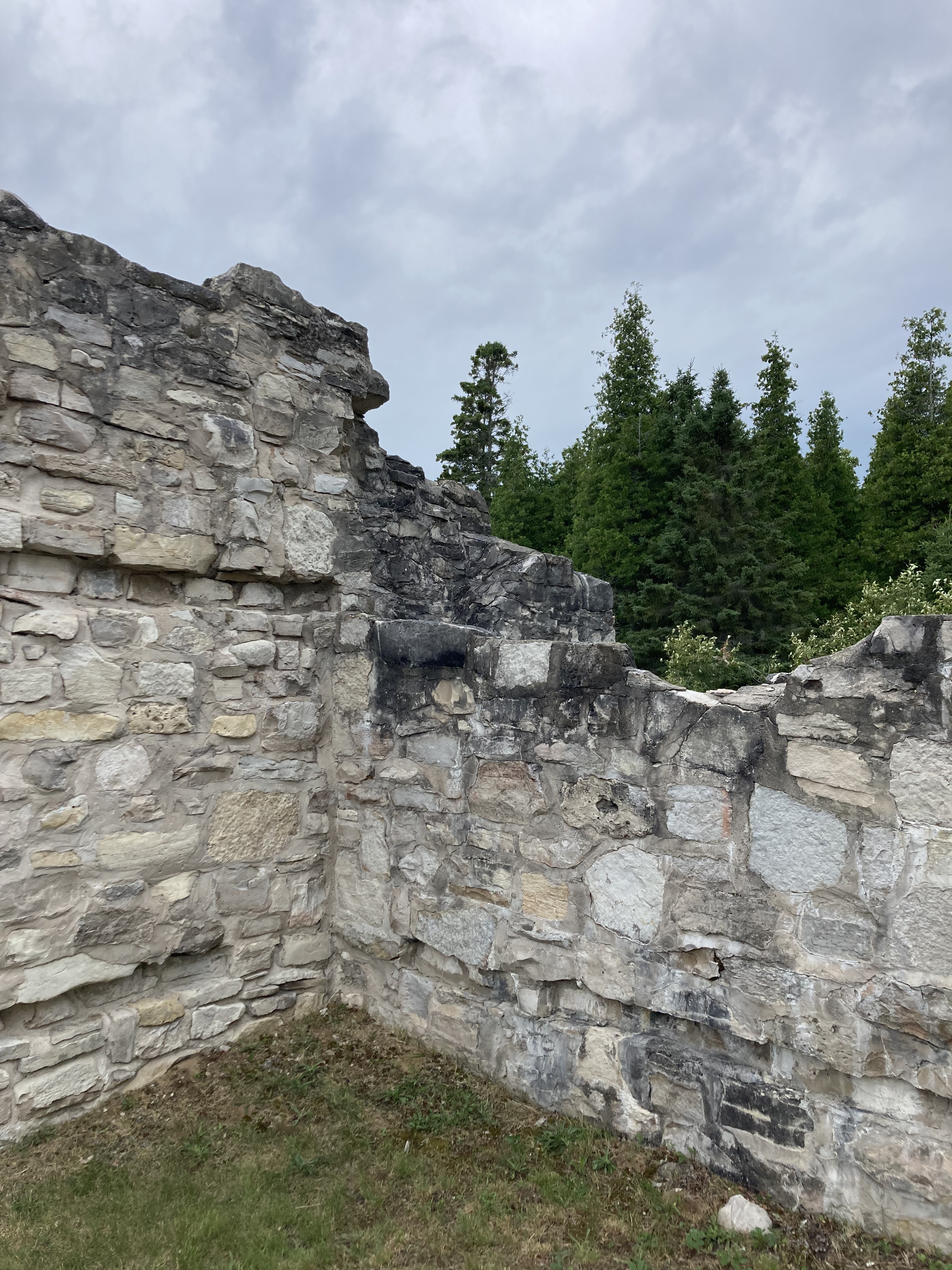
After taking our time exploring the interactive exhibits and watching the film my mother and I headed outside to explore the ruins. Fort St. Joseph was once the most westerly fort in Upper Canada.1 All that is left today are the foundations, ruins, and surviving artifacts. It was very windy the day we went to explore the ruins, and rain was on the way. We took a chance and tried to beat the rain by going as soon as the site opened. We toured the ruins, reading the plaques and taking in the history laid out before us. I found it a little hard to imagine these small foundations housing a community, but the helpful diagrams and maps of the area helped visualize what the layout of the fort would have looked like in its time. Because we got there so early we had the place to ourselves and took our time exploring. Even with the strong winds, we spent some time at the shoreline, examining the horizon. Unfortunately, we didn’t see any birds or wildlife while we were there. I think we can blame the stormy weather on that.
As we were finishing up at the ruins, the rain started to come down and visitors started to trickle in. When the rain started to pour down harder we took shelter in the visitor center and gift shop and tried to wait out the storm. They have a cozy little gift shop filled with most of the typical things you would expect from a historic site; postcards, magnets, pins, sweatshirts. One of the more interesting items they had was chocolate, more specifically heritage chocolate. Using a recipe and ingredients authentic to the colonial era, you can try a chocolatey treat that was commonly consumed at the time. They had chocolate sticks and hot chocolate mix at the time of our visit, and I regret not picking up the hot chocolate mix along with the couple of chocolate sticks I did purchase.
After the rain finally eased up, we made our way to the car. There was one more stop to make. The Cemetery Trail turns off the main road to and from the historic site. A small green sign with a hiking symbol and the word “Cemetery” mark the turnoff. My mother was a bit tired at that point and didn’t want to walk the trail. I didn’t have any idea where the cemetery was on this trail loop so I wasn’t sure how far I would need to walk to find it. She decided to stay in the car and wait.
At the trailhead, there is a trail map, along with a description of the cemetery. It reads “The cemetery at Fort St. Joseph contains graves established between 1796 and 1812. While there were only 10 recorded deaths during the occupancy of the fort, such as those of Jessie Crawford’s twins who died in 1807 shortly after birth, there are probably others who rest here eternally, their identities unknown. Those that died at Fort St. Joseph usually suffered from illness or their deaths were as a result of tragic events or accidents like that of Private Antoine Gazzinel who was killed May 9, 1803 when a loaded musket went off as he was placing it into a bateau. A cairn was erected in 1954 to recognize the final resting place of these individuals and stands today as a reminder of the community that once existed at Fort St. Joseph.”
The Cemetery is located right at the beginning of the trail, with a clearing opening up on the right side of the trail. The rain held out for me as I examined the large cairn and took photographs. The cairn reads, in English and French, ”This cairn marks the site of Fort St. Joseph cemetery in which are the graves of soldiers and fur traders who died here between the years 1796 and 1812.” There are about a dozen white crosses here, with no names. One grave looks to also be marked with stones surrounding it. It’s a peaceful spot, surrounded by the lush green forest, but it is also a place of sorrow. I was very sad to see the blank white crosses, marking lives that are now unknown, and who knows how many more lie there unmarked.
My mother and I really enjoyed our time visiting Fort. St. Joseph, even though the weather wasn’t ideal. Exploring the historic ruins and cemetery was an interesting look at the past, even when at times it was a somber one. It was my first time exploring a ruin site, and I look forward to the chance to visit more.
Have you visited Fort St. Joseph? Will you be adding it to your travel plans? I would love to read your thoughts in the comments.
Today on the blog I wanted to share another cemetery recipe with you. All the recipes I have made so far have been sweet treats, and today’s recipe is no different. It’s the Easter long weekend, so I thought today’s recipe would be a perfect fit – A Good Carrot Cake.
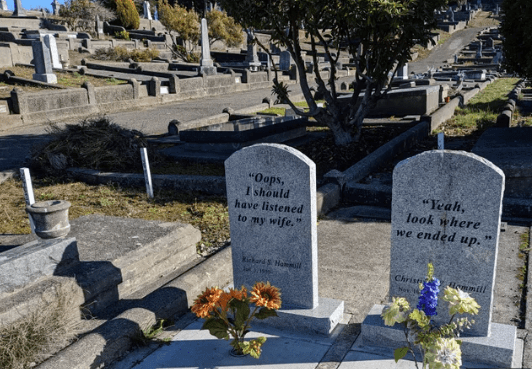
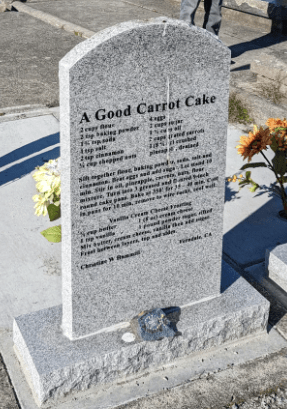
This recipe is a little different than the previous ones I have made. It can be found on a white tablet gravestone for Christine W Hammill in Ferndale, California. Her stone sits beside the stone for her husband Richard. The difference is that Christine and Richard are still living.
They seem like pretty fun folks as well, based on their gravestones! Not only can this delicious recipe be found on the back side of Christine’s gravestone, they both also have some funny epitaphs on their headstones.
Photo of Richard and Christine Hammills gravestone. Photographer unknown. If this is your photo or you know who the photographer is, please contact me for proper photo credit.
The white granite tablet gravestones read:
“Oops, / I should / have listened / to my wife.”
Richards S. Hammill
June 3, 19__ –
“Yeah. / Look where / we ended up.”
Christine W. Hammill
Nov.
Unfortunately, I haven’t been able to find more information about the Hammills and where their future resting place is, but I do know that Christine makes an excellent carrot cake.
Here is the recipe:
A Good Carrot Cake
2 cups flour
4 eggs
2 tsp. baking powder
2 cups sugar
1 1/2 tsp. soda
1 1/2 cups oil
1 tsp. salt
2 cups grated carrots
2 tsp. cinnamon
1 (8 1/2 oz.) crushed pineapple, drained
2/3 cup chopped nuts
Sift together flour, baking powder, soda salt, and cinnamon. Beat eggs and add sugar. Let stand 10 mins. Mix in oil, pineapple, carrots, nuts, flour mixture. Turn into 3 greased and floured 9-inch round cake pans. Bake at 350’ for 35 – 40 min. Cool in pans for 10 min, remove to wire racks, and cool well.
Vanilla Cream Cheese Frosting
1/2 cup butter
1 (8 oz.) cream cheese
1 tsp. vanilla
1 pound powdered sugar, sifted
Mix butter, cream cheese, vanilla then add sugar. First between layers, top and sides.
Photo of the backside of Christine Hammills gravestone. Photographer unknown. If this is your photo or you know who the photographer is, please contact me for proper photo credit.
This is one of the more thorough sets of baking instructions I have come across on a gravestone. It didn’t need any guesswork at all. The recipe is very easy to follow and create. I started with the prep work first; chopping, grating, and measuring out ingredients to make the mixing process a bit smoother.
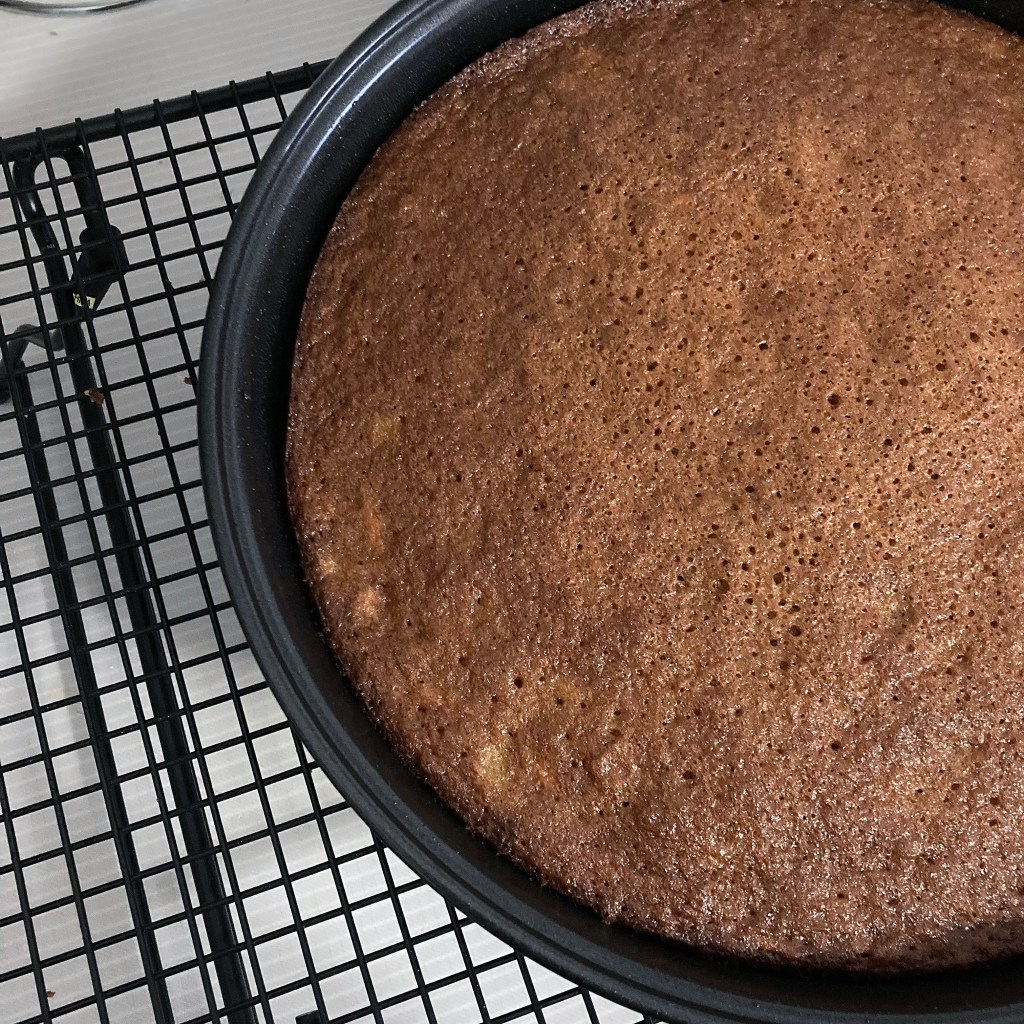
I did start off thinking I would only need two cake pans, but I did need to make a third layer. I only filled the cake pans about halfway with batter because I had a feeling they would rise as they baked. They did rise as I suspected so that left batter for a third layer. I only have 2 cake pans though. I put the first two pans in the oven for 35 minutes and used the toothpick trick to test if they were done.
If you don’t know this trick, you take a toothpick and stab it into the middle of the cake, touching the bottom of the pan. If it comes out clean when you pull it out, it means the cake is done. If there is batter on the toothpick when you pull it out, it means the center is not cooked all the way through and should go back in for a few more minutes.
After the first two layers were done, I let them cool for ten minutes then removed them from the pan and placed them on a wire rack to continue cooling. Then I put the third layer into the oven to bake. This did make the baking process a bit longer, but it wouldn’t be an issue if you have extra cake pans.
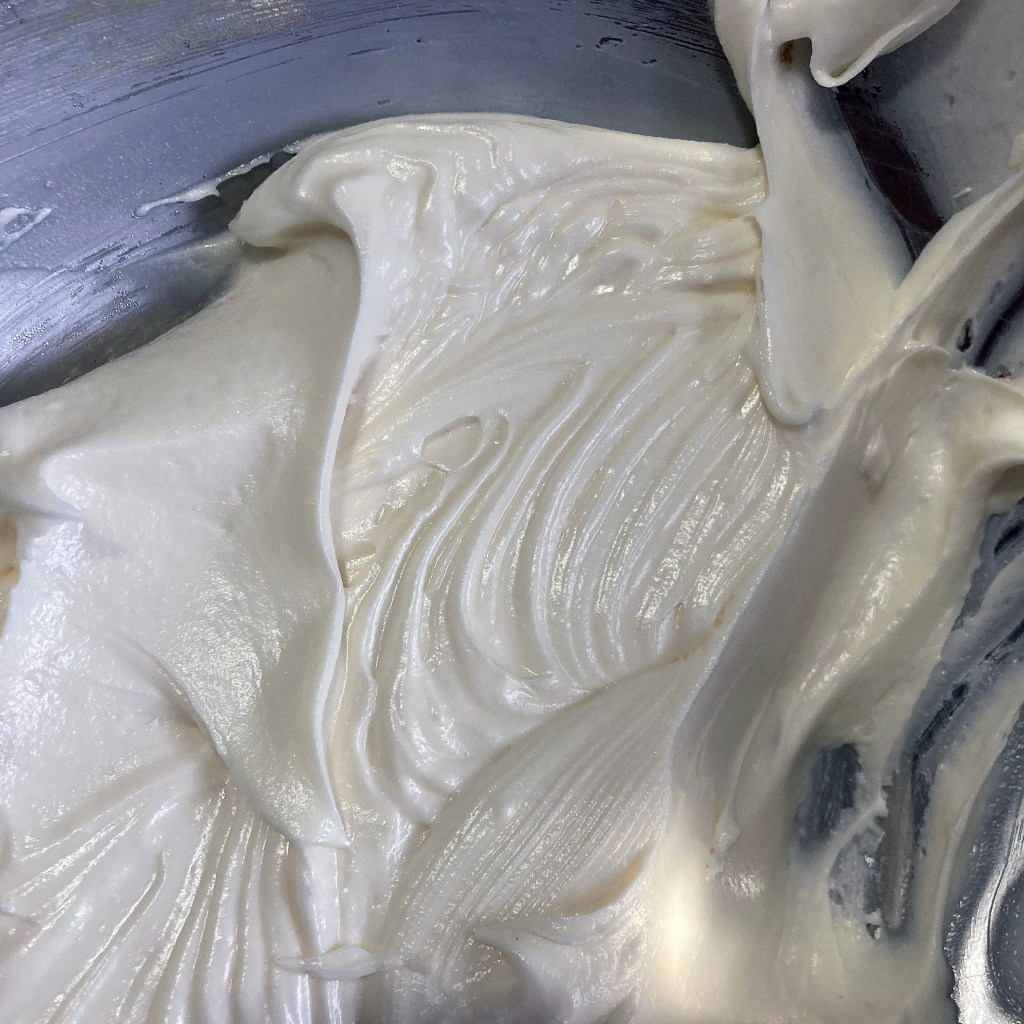
I used the time while the last layer was baking, to make the cream cheese frosting. I have to say, it’s the best frosting I have ever made. Sifting the powdered sugar made all the difference in creating a smooth and creamy frosting. I ended up with some extra frosting as I was unsure how much to frost in between the layers. I was afraid to run out of frosting for the top and the sides. I didn’t have to worry though as I had quite a bit left over. I put the leftover frosting in a container and put it in the fridge to use as a cookie dip. I couldn’t let that deliciousness go to waste.
I had some chopped walnuts left over and decided to sprinkle them on the outer edge of the cake as decoration and to use them up. I think it was a nice added touch, but you can decorate it however you like. The white frosting is a lovely base for frosting accents, sprinkles, or any other type of decoration you may want to add to make your cake more festive.
I love a good carrot cake with a good cream cheese frosting, and this might just be the best one yet. I was curious how the final product would taste with the addition of pineapple. I had never seen that in a carrot cake recipe before. The cake is so moist and sweet, I think because of the pineapple. It’s one of the best cakes I’ve ever made. I shared this cake with my mother and fiancé, and they both agreed, it was delicious. I think this cake would make a lovely finish to an Easter meal, or any meal for that matter. It’s a big cake, so it’s perfect for sharing with loved ones.
I wish I knew more about Christine and this recipe. I am going to assume that it is a Hammill family favorite. At any rate, I want to say thank you to Christine, for sharing this sweet treat with the world!
Have you tried this recipe before? Do you have a favorite carrot cake recipe? I would love to read about it in the comments.
I recently had an author reach out to me, asking if I would be interested in reviewing her book Cemetery Reflections and if it would be a good fit. She described her book as a pairing of photographs with epitaphs, poetry, and prose; giving a slightly different slant to a typical walk through a cemetery. I thought it would be a perfect fit! So for this month’s cemetery book review, I wanted to share my thoughts about Cemetery Reflections by Jane Hopkins.
Cemetery Reflections looks at the beauty and emotion that accompanies cemetery visits and is meant to be read in bits and pieces, as a cemetery walk would be. This new book was published in the fall of 2022, by Headstone Press. This is Jane’s first cemetery photography book, but she is no stranger to photography. Her fine art photography has been exhibited and sold since 2002, at many venues including the Memorial Art Gallery in Rochester, New York, and the Dyer Arts Center at the Rochester Institute of Technology.1
I was already familiar with Jane’s work, having seen her beautiful photographs on various cemetery social media accounts that I follow. I was very excited when she reached out and asked me to review her book. She was also very gracious and provided me with a beautiful paperback copy to read.
Here is the book synopsis from Goodreads: “Stroll through three centuries of American cemeteries through photographic images, historic poetry, and memorable prose. The reader will find stunning photos in both black-and-white and color. Paired with the images are poignant passages drawn from timeless literature and sensitive recollections of family losses. The cemetery emerges as a place of solace, where final and loving farewells may rest safely among the tombstones.
This book offers a compassionate context that deepens awareness of the experience of death. Devotees of art, history, poetry, and philosophy will find Cemetery Reflections a mesmerizing journey. Grief is intense and lonely, dying can be frightening and sometimes painful beyond expectation, and the “great beyond” remains a mystery. The pandemic and recent violence in the US have brought issues of death to the forefront. People are searching for ways to better understand and cope with challenges that once seemed far distant. Cemetery Reflections can provide a valuable assist in this process.”2
Cemetery Reflections by Jane Hopkins.
This is a beautiful, high-quality softcover photography book. It’s filled with full-color and black-and-white photographs alongside beautiful poetry, epitaphs, and musings. It is very different than the books I have been reading lately. I loved that it showcases American cemeteries alongside Canadian ones. I also love the variety of the photography, from detailed shots of grave goods to lovely cemetery landscapes, and everything in between.
Cemetery Reflections feels like a contemplative walk through a cemetery. I found each epitaph, poem, and beautiful photograph encouraged self-reflection and exploration of my own understanding of grief and remembrance. At times it is a very emotional read.
I would highly recommend this book to anyone interested in fine art photography, poetry, and cemetery walks. Because of the self-reflective nature of this book, I would also recommend it to those who may be grieving a loss, as well as those who might find cemeteries and death uncomfortable. They might find its heartfelt and thoughtful messages to be healing.
Have you read Cemetery Reflections? Do you agree with my review? Or will you be adding it to your reading list? I would love to read your thoughts in the comments.
Thanks for reading!
I am always on the hunt for cemetery-related book recommendations. Please feel free to share yours in the comments. If you are an author and have a cemetery-related book you would like me to review, please reach out at hello@chantallarochelle.ca. I would love to hear from you.
The winter weather seems to be dragging on this year. We got a lot of snow this winter in Northern Ontario, which I think is adding to this feeling. It feels like it will never all melt. I am trying to be optimistic, and am hoping to be hiking and visiting cemeteries soon. For the last couple of weeks, I have been focused on planning cemetery road trips, near and far. I am ready to get outside, it’s supposedly Spring after all!
The official first day of Spring was March 20th, so I wanted to share something a bit more colorful to help ring in the Spring season. Flower arrangements are often found on gravestones, in plastic, or made of fresh blooms. You might also find bright and vibrant cemetery flowers planted on graves or cemetery grounds. Each variety of flower holds a special meaning, that also varies by color. So for today’s collection, I wanted to share some cemetery flowers I have photographed over the years and take a look at what they might symbolize.
These delicate light blue hydrangeas symbolize regret, apology, and forgiveness.1 Seeing them at a graveside or planted on a grave intensifies that meaning for me.
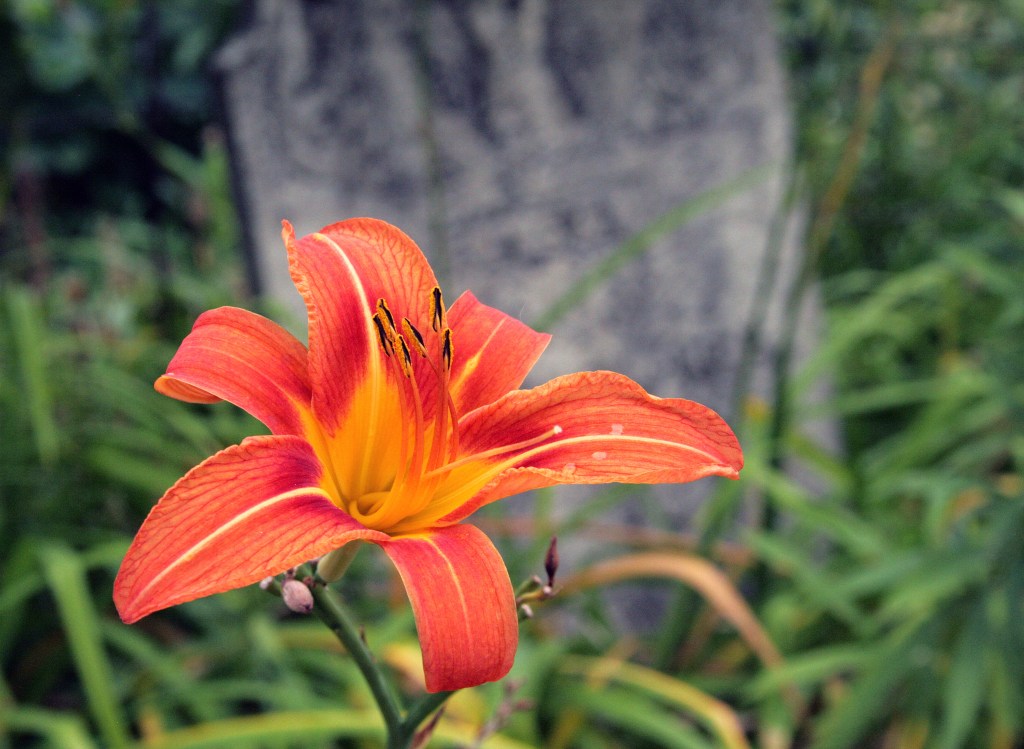
Daylilies bloom during the day and close up at night. Orange or yellow daylilies commonly symbolize love and devotion, as well as joy, beauty, and courage. A dark orange, or redder daylily like the one pictured, may symbolize a deep passion.2
Lilac shrubs are one of the earliest plants to bloom in the Spring, and because of this, are thought to symbolize a fresh start and renewal.3 Pink lilacs commonly symbolize first love.4 I was able to capture this yellow swallowtail visiting this lilac bush. Yellow swallowtail butterflies represent grace and the free nature of the soul.5 Fitting since this photo was taken in a cemetery.
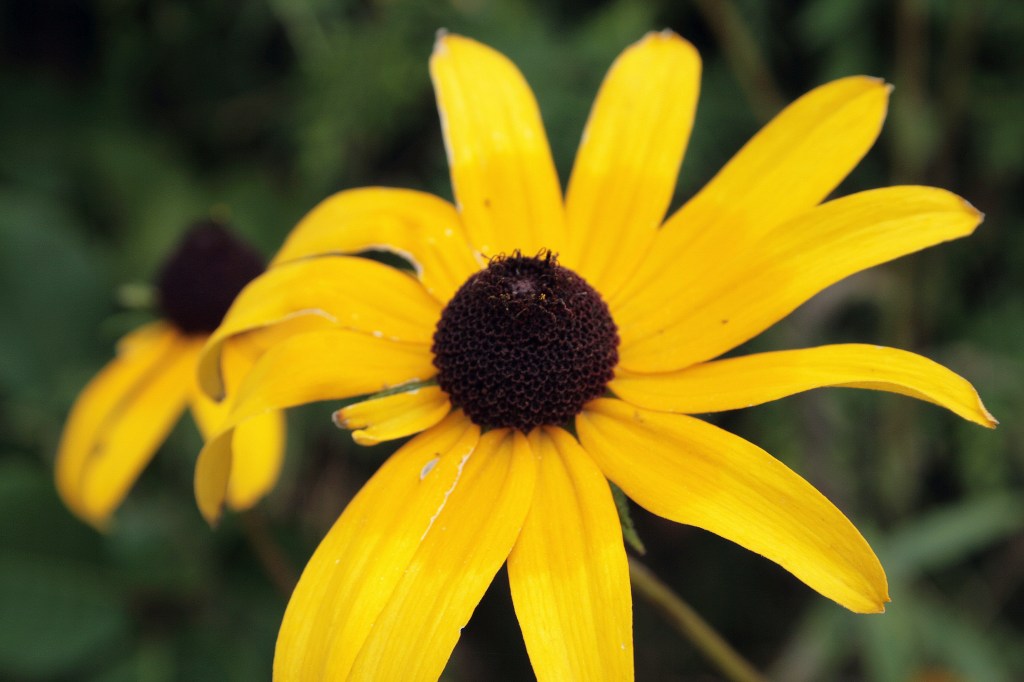
Black-eyed Susans are a common sight here in Northern Ontario. They are also sometimes called brown-eyed Susans because of their dark brown-to-black centers. Black-eyed Susans are thought to symbolize resilience and endurance as well as justice and truth.6
Begonias have a lot of symbolism tied to them, but are commonly seen as a symbol of uniqueness, gratitude, and harmony, but can also be a symbol of caution. Yellow begonias are thought to be a representation of hope, kindness, or friendship.7
I am still working on learning to identify different types of plants, in bloom and on gravestones. I find it fascinating that there is a meaning for practically everything! Looking at all these colorful blooms has got me excited to be visiting cemeteries and enjoying the sunshine soon.
I hope wherever you are, you will be enjoying the sunshine soon as well if you’re not already. Happy Spring!
I have been thinking a lot lately about my connection to cemeteries. I recently read Death’s Garden Revisited, edited by Loren Rhoads. It’s a collection of 40 personal essays by people from all walks of life, regarding their own connections with cemeteries. I saw a lot of myself in those essays, and it has encouraged me to look back on past events in my own life that have attributed to my love of cemeteries.
One of those moments that stand out, is a family story that has been passed down by my mother. I was too young at the time, so I have no memory of it, but my mother has told me the story many times.
When I was a child, I saw an angel in a cemetery.
Now you may be thinking, well yes, there are lots of angels in cemeteries! And yes, this is very true. Angel statues are a very common sight in Catholic cemeteries. Children are also known to have overactive imaginations, and I was no exception. I did have an imaginary friend growing up. But I am curious and wanted to learn more about the circumstances of this cemetery visit.
One of my earliest memories is of attending my uncle’s funeral in Elliot Lake. I was very young, maybe 5 or so, but I vividly remember the funeral parlor. I remember the smell of the parlor, as well as seeing many somber family members, sitting in dark leather armchairs. I don’t remember the cemetery though. Was this the same moment? Were we visiting the cemetery after the funeral service?
In 2021, my mother and I took a drive to Elliott Lake to do some hiking and cemetery wandering. We visited my uncle in the cemetery. I had no recollection of being there, but my mother had vivid memories of the place. She said it looked a lot different; there had not been as many graves in the section where my uncle was laid to rest. Over the years it had become a very popular section. It was so full that the cemetery opened another section at the back, which was now about half full. The cemetery has no standing gravestones, only flat grave markers. No angel statues here. My Mom confirmed this was not the cemetery where I saw an angel.
It turns out there is MUCH more to this story.
In the summer of 1987, My mother, father and I were visiting my uncle in Quebec for a family reunion. I would have been about 3 years old. It was planned to be a big reunion of my father’s side of the family. Unfortunately, only we showed up. My uncle was a bit dismayed but decided to not let that ruin our visit, so there was a change of plans. Since we were close to Quebec City we would visit some old stomping grounds and visit some cemeteries to visit family. There was one family member in particular that my dad and uncle wanted to find—their uncle Joseph Larochelle.
The story goes that my great-uncle, Joseph Larochelle who was blind, went out into a snowstorm with his dog. His Family members told him not to go out, because of the blustery winter weather—but he went anyway. He said he would be fine since he had his dog with him. Unfortunately, he lost his way in the storm and went missing. Tragically, both he and his dog perished in the storm. He had gotten stuck on a fence and was not able to break free. He was not found until the late spring.
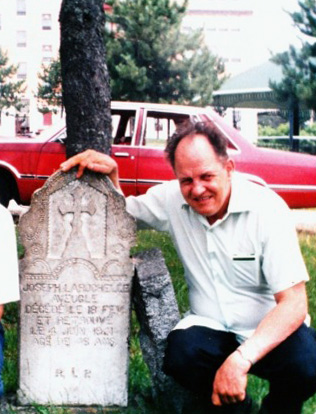
My dad and uncle did manage to find the grave of Joseph. They took a picture with the gravestone that has some details of what happened to him. The gravestone states he was blind, died February 18, and was found June 4. I don’t know the year, as the photo is a little hard to read. It was while visiting this cemetery that I saw an angel.
The gravestone reads: “Joseph Larochelle / Blind / Died February 18 / And Found / June 4, 19_1 / Aged __ Yrs. / R.I.P”
I have reached out to my aunts and uncles to see if they have more information, or know which cemetery he is buried in. I have not been able to find anything much so far. My searches on Find a Grave and Ancestry have not turned up anything yet. I have an idea where to look—Quebec City, but I don’t have much more than that at the moment. I would love to learn more about my great-uncle, as well as the cemetery where he is laid to rest. Is it filled with stone angels?
When I started looking into this story, I didn’t expect to uncover a cemetery mystery. I love a good cemetery mystery, and it’s even more intriguing to have a family connection to one. I will keep researching and maybe will have an update on this story in the future. In the meantime, I will continue to go down cemetery rabbit holes looking for answers. Maybe I’ll also get closer to answering my question about my cemetery angel.
For this month’s cemetery book review, I wanted to talk about Corpses, Coffins, and Crypts: A History of Burial by Penny Colman. This was the October selection of the AGS book club last year. I had never read this author before and was excited to dive into this one.
“Drawing on extensive historical and anthropological research, personal accounts, and interviews with people who work in the funeral industry, Penny Colman examines the compelling subjects of death and burial across cultures and societies. The text, enriched with stories both humorous and poignant, includes details about the decomposition and embalming processes (an adult corpse buried six feet deep without a coffin will usually take five to ten years to turn into a skeleton) and describes the various customs associated with containing remains (the Igala people in Nigeria have a custom of burying people in as many as twenty-seven layers of clothing). Intriguing facts are revealed at every turn; for example, in Madagascar winter was considered the corpse-turning season.
This comprehensive book also includes a list of burial sites of famous people, images in the arts associated with death, fascinating epitaphs and gravestone carvings, a chronology, a glossary, and over a hundred black-and-white photographs, most of which were taken by the author.
Penny Colman writes with compassion and intelligence and humanizes the difficult subjects of death and burial. The result is a powerful look at an inevitable part of life—death.”
Corpses, Coffins and Crypts: A History of Burial by Penny Colman.
This book touches on so many facets of death and burial. I enjoyed the way the author weaved in her own personal stories and experiences with death. It added a very personal touch. This book is also filled with beautiful black-and-white photographs that accentuate the content. I was lucky enough to find a reasonably affordable copy on Thrift Books. My copy is a previously loved hardcover library book, that is beautifully laid out. It has a wonderful flow that makes it a very easy read, and hard to put down.
This would be a great introduction for those who are interested in death and burial but may be bit intimidated by heavy reading. Colman touches on so many different aspects of death and burial, in a way that holds your attention and connects you to the history. I love that a handy chronology and glossary is also included at the back of the book.
I would highly recommend this book for those who are curious about death and burial practices, as well as seasoned taphophiles! It has a little something for everyone.
Have you read this book? Did you enjoy it? I would love to read your thoughts in the comments.
Thanks for reading!
I am always on the hunt for cemetery-related book recommendations. Please feel free to share in the comments. If you are an author and have a cemetery-related book you would like me to review, please reach out at hello@chantallarochelle.ca. I would love to hear from you.
I realize I owe you all a blog post after missing last Sunday, but I don’t have anything that is quite ready to share with you yet. I have a few posts that I have been working on, but more research is needed. So instead, this will be an update, to share what I have been working on and what you can look forward to on the blog in the coming months.
Most recently, I have been working on a piece inspired by Death’s Garden Revisited, edited by Loren Rhoads. My piece is about my own personal connection to cemeteries. After speaking with my Mother about the subject, it created more questions than answers. As we chatted we uncovered our own little family cemetery mystery, which sent me down yet another research rabbit hole. I’m sure you all will find that story very interesting.
I have also been saving a cemetery story, especially for this month, as February is the anniversary of this local tragedy. I need a little more time to work through the research and sort through my photos from last summer’s road trip. That will be another post to look forward too.
Along with writing and creating content for the blog, I have also been taking an online course to sharpen my writing skills. The course is through Atlas Obscura and is called Historical Nonfiction: Research-based writing with Hadley Meares. This 4-week course promises to help you write historical essays using a research-based lens. I am on week 3 of the course and it has already solidified the good writing habits I already had while introducing new habits, methods, and resources to my writer’s toolbox. I look forward to sharing the article that comes from completing the course.
Amidst all this writing I have also been updating the portfolio section of my website. I have posted many additions to my existing web portfolios and have added some new ones entirely. Sorting through, editing, and posting my archive of cemetery photos has been a great way to look back at all the cemetery adventures I have had over the years.
I have also been working on researching some new areas and cemeteries to visit. I have some great cemetery road trips already planned for this summer and can’t wait to get back on the road and photographing. I plan on visiting Owen Sound, for part two of Chasing Tom Thomson, while also stopping in at some fun interesting spots along the way. I also have another trip planned for early spring which will include my first visit to a loyalist cemetery, and seeing table stones in person. I’m pretty excited about that trip.
I have also been busy getting some submissions ready for a local photography contest, and a gallery showing. I am not quite sure how my cemetery work will be received, but I think they could be great opportunities to get my work out there, regardless of the outcome.
Hopefully, some of these upcoming posts sound interesting and will have you coming back to read more. As always, if you have any book or cemetery recommendations, or cemetery stories of your own to share, please leave me a comment or send me an email at hello@chantallarochelle.ca


















 Cemetery Photography by Chantal Larochelle