October Stone Stories: The Father of Zombies

“They’re coming to get you, Barbra”

This is one of my favorite movie quotes, and it comes from the 1968, black-and-white independent horror classic, Night of the Living Dead. I even have a small piece of the Evans City Chapel framed on my wall. The chapel sits in Evans City Cemetery, which is where the opening scene of the film was shot.

This horror classic was written and directed by George Romero, the father of zombie films. This summer, I had the chance to visit the final resting place of this iconic director.

George A. Romero

George Andrew Romero was born in New York City on February 4, 1940, and grew up in the Bronx. His interest in film began at an early age and he would go on to enroll at Carnegie Mellon University, in Pittsburgh.1

After graduating in 1960, Romero began shooting short films and TV commercials, including an early short for the popular children’s show Mister Rogers Neighborhood.1

Romero’s break-out film Night of the Living Dead was revolutionary for the horror genre, and today is a staple of any horror film addict’s collection. This film completely reinvented the image of one of today’s most popular movie monsters.

Romero created the rules for a new kind of zombie. Now portrayed as reanimated corpses who hunger for living flesh. They are slow and shambling, with only one purpose. Silent, aside from their eerie moaning as they get closer to their prey. There is only one way to stop them—a violent strike to the head.

The film’s explicit violence and gore garnered negative reviews at its release, but today the film has amassed a cult following. In 1999, the film was deemed culturally and historically significant by the Library of Congress and has been preserved by the National Film Registry.2 In part for its social commentary during the 1960’s.

Romero would go on to write and direct other films, even directing a romantic comedy, but he always gravitated back toward the undead. He would go on to create a whole series of films set in the Dead universe; Dawn of the Dead, Day of the Dead, Land of the Dead, Diary of the Dead, and Survival of the Dead—his last film.

After falling in love with the city, Romero moved to Toronto, Ontario in 2004. He would shoot a lot of his later films in the city. In 2009, he acquired his Canadian citizenship, becoming a dual Canadian-American citizen.

In 2017, George Romero died in his Toronto home of lung cancer. He was 77.3 Romero is laid to rest in Toronto Necropolis Cemetery and Crematorium.

Toronto Necropolis Cemetery

The Toronto Necropolis Cemetery and Crematorium is one of the city’s oldest and most historic cemeteries, dating back to 1850.4 The fully restored cemetery entrance features high Victorian Gothic architecture which also makes it one of the most scenic cemeteries in the area.4

I was enthralled the minute we stepped out of the Uber. The grand cemetery entrance sets the tone for the beautifully forested cemetery within. It was my first time visiting this enchanting cemetery. Being unfamiliar with its layout, I used Google Maps to lead us. Of course, I was easily distracted by the elaborate and historic gravestones we passed along our route.

As we approached a densely forested section, we heard the screeching of a hawk. It sounded close and didn’t seem to like us encroaching on its territory. Luckily the grave we were searching for was a bit farther back in the cemetery. My fiancé stuck to the meandering paths that snaked around the grounds while I ventured into the rows to read the graves.

Although not quite accurate, Google Maps led me to the general area we were searching for. Surrounded by tablet stones and obelisks, sits the mirror-like black granite stone of George A. Romero.

The epitaph reads, “George A. Romero / 1940 – 2017 / He Loved, / And Was Loved.”

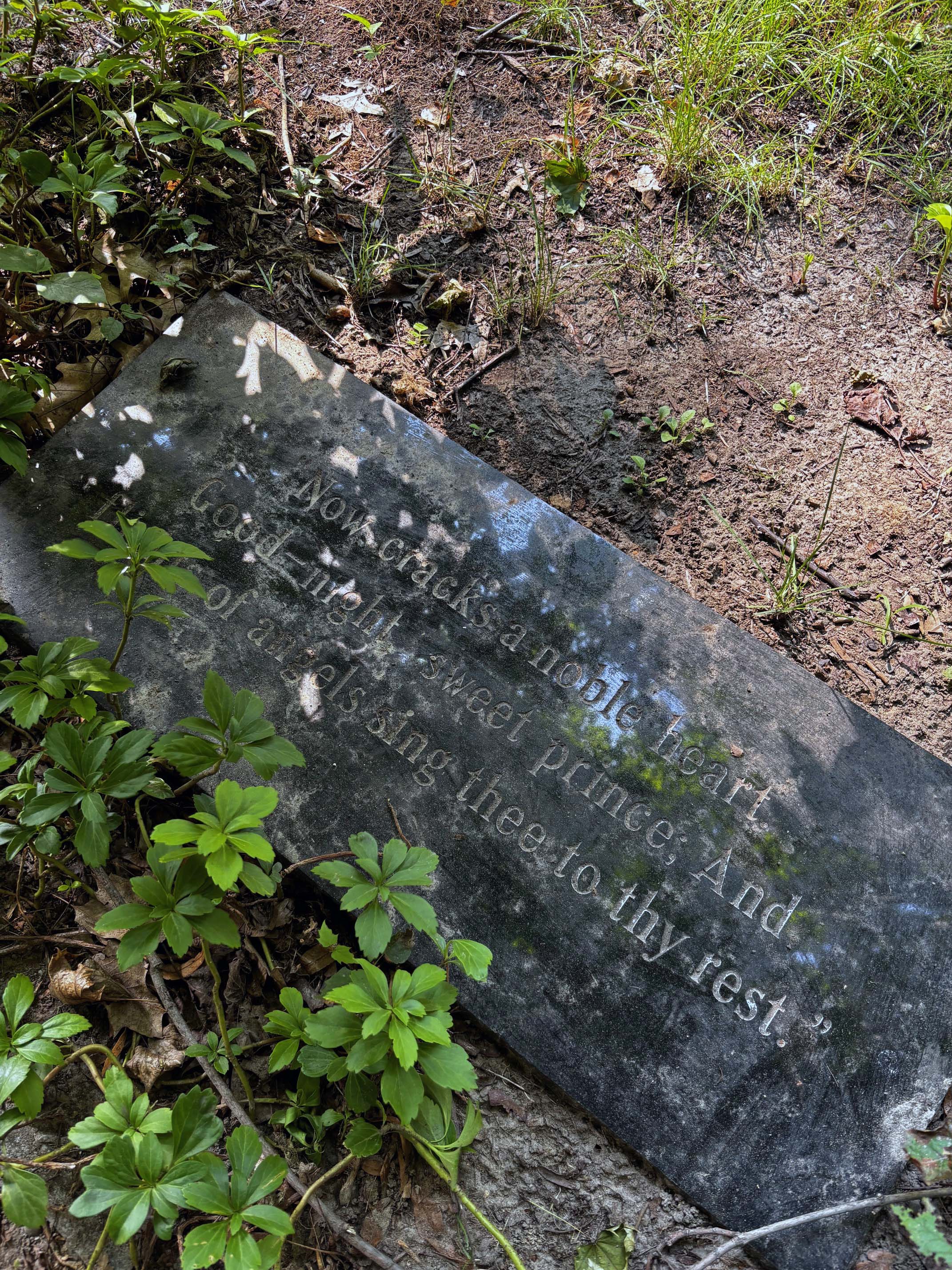
On the footstone is inscribed a quote from Shakespeare’s Hamlet, “Now cracks a noble heart. / Good-night sweet prince; And / flights of angels sing thee to thy rest.”

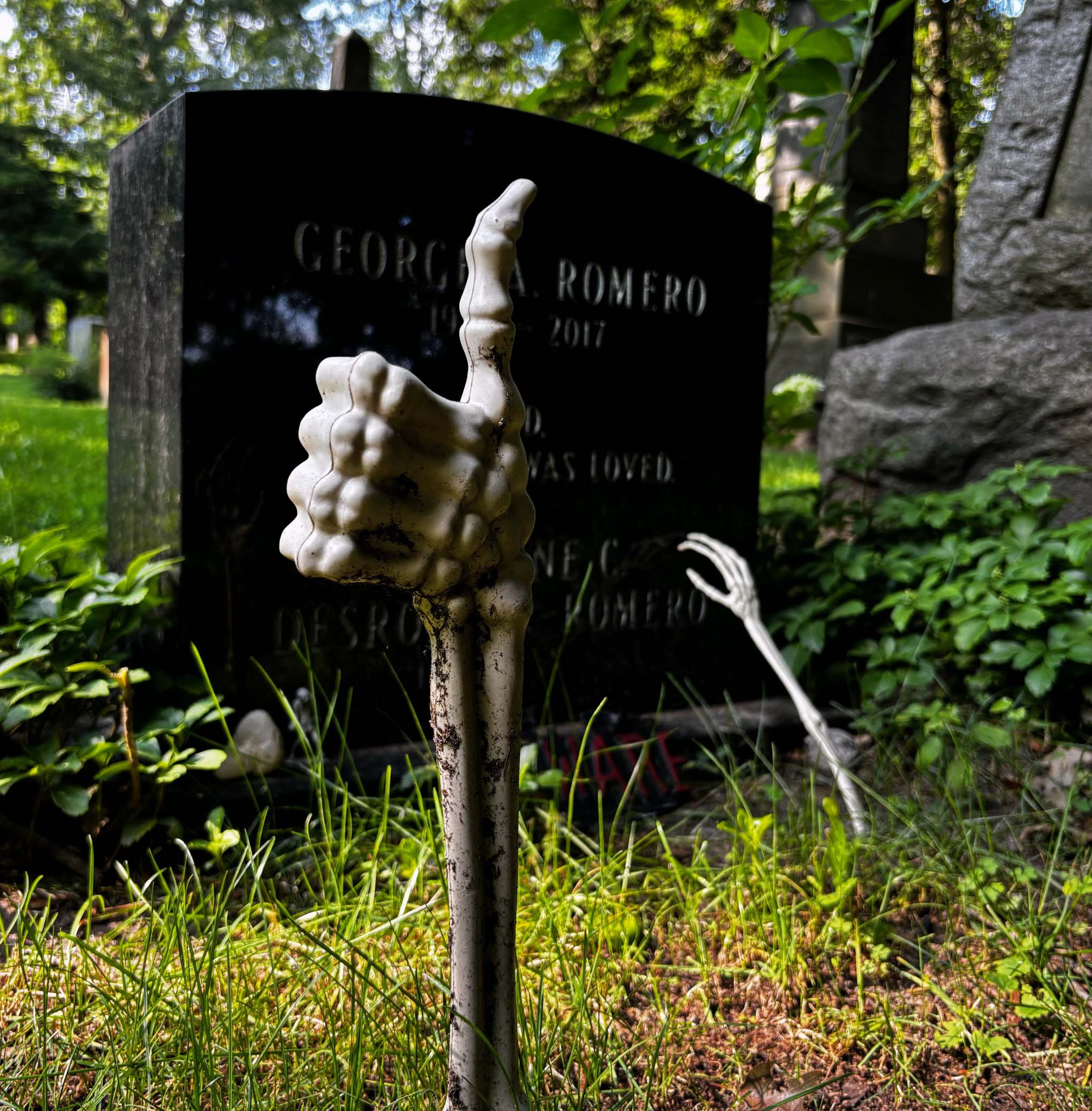
Although the cemetery was quiet that day, we could tell that many had come before us to pay their respects. Someone had planted two skeleton hands at the base of the grave, reaching up towards the inscription. Another skeleton hand, giving a thumbs up was also planted near the gravestone. Someone also left a little miniature zombie figure. The gravesite looked decorated for Halloween, even though we visited at the end of July!

Years ago, while collaborating with a community group dedicated to screening cult classics for charity, I envisioned hosting an event that would bring Romero to my small Northern Ontario town for a screening of one of his legendary films. Unfortunately, that dream never came true.

Although I never had the chance to meet him in person, to thank him for all the scares, visiting his grave and paying my respects was a profound and memorable experience for me.

Thanks for reading!


References:

  1. George A. Romero | Find a Grave
  2. Preserving the Silver Screen | Library of Congress
  3. Fans say final goodbye to ‘Godfather of zombies’ George Romero at visitation | CBC
  4. Toronto Necropolis Cemetery and Crematorium | Find a Grave
October Cemetery Stories: A Haunted Tower and a Pioneer Cemetery

During the summer, I wrote about a surprise road trip I took with my mother in Cambridge. This curated road trip, created by Guess Where Trips took us to exciting and spooky places. I shared a little about our Historic Haunts tour, but I wanted to keep some of the details a surprise at the time, so I could share this ghost story and pioneer cemetery visit with you now, in October.

So today on the blog, I want to share a little bit more about my visit to the haunted Waterloo Pioneer Memorial Tower and Doon Pioneer Cemetery and explore its rich history.

Waterloo Pioneer Memorial Tower

While looking for places to go for a walk, the day before our Historic Haunts tour, I found a hidden gem that had everything we were looking for—a walking trail, a historic site, and a cemetery. Little did we know when we visited that it was also haunted!

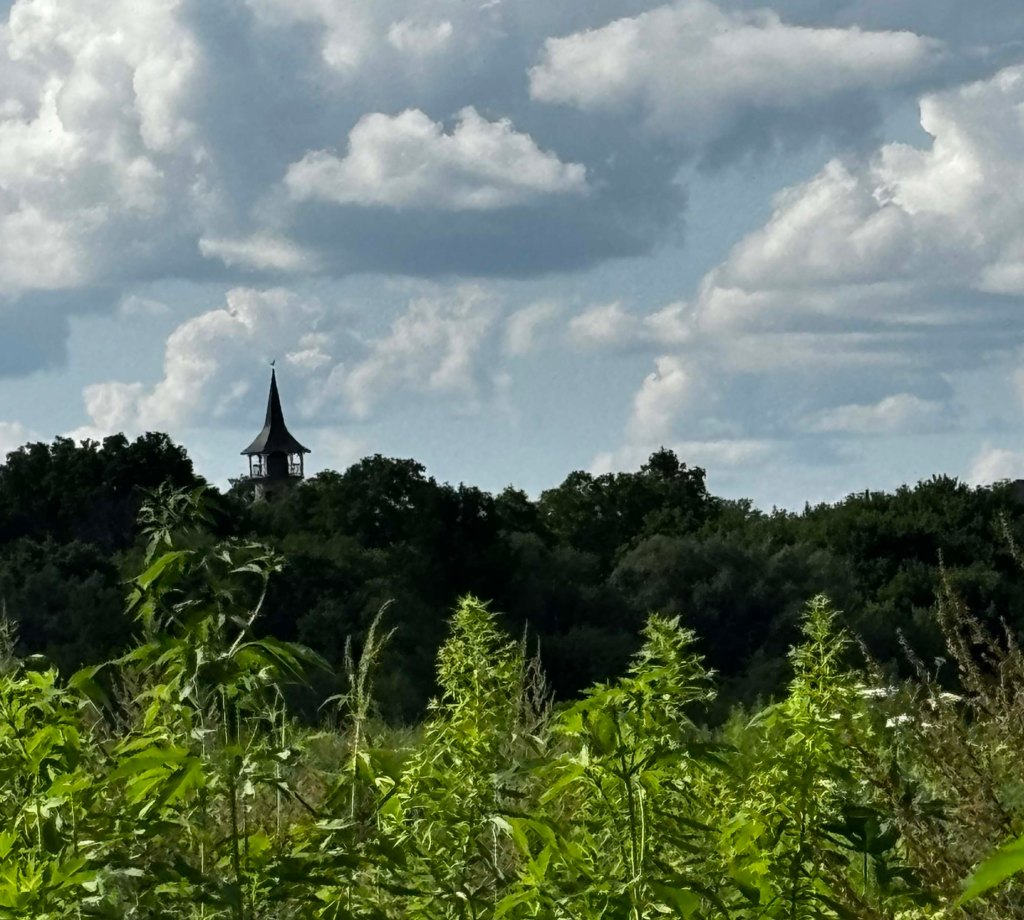
The Waterloo Pioneer Memorial Tower stands 18.9 meters tall, and peaks out above the surrounding trees. We could see its Swiss-style copper roof and the cute Conestoga wagon weather vane that sits atop it, as I parked my car in the nearby parking lot.1

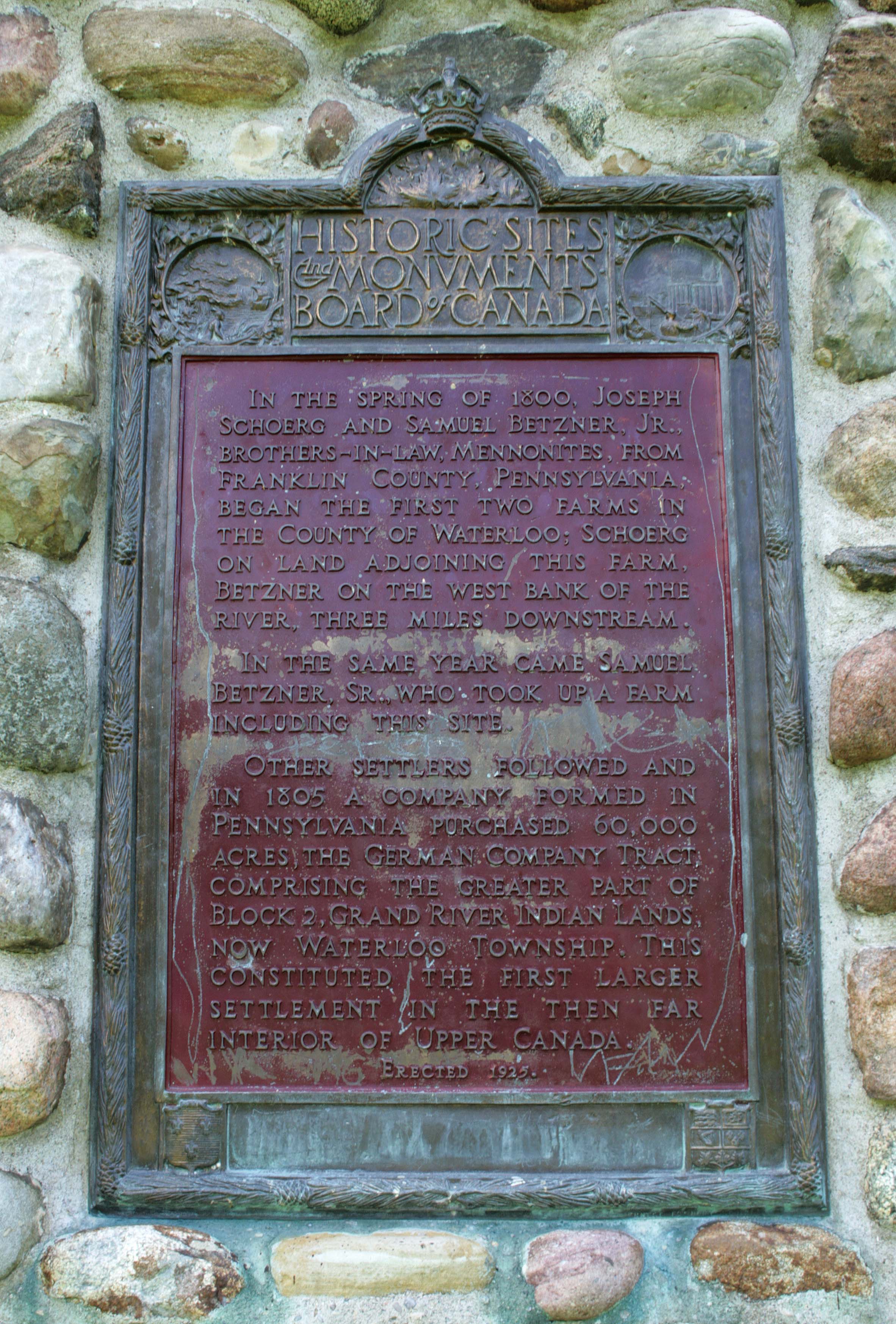
The Tower built in 1926, was created to commemorate the arrival of the Pennsylvania-German pioneers who immigrated to the area between 1800 and 1803.1 Fieldstones that line the outside wall of the tower represent the tireless work they did to plow and clear the land for farms and homesteads.

At one time, it was possible to go inside the tower and climb its spiral staircase to the eight-sided observation deck. The view is amazing, as Bob Oberholtzer noted in a 2015 article for the Waterloo Region Record. Citing it as one of the most “historic views”, it’s possible to overlook the first four Mennonite farms that were settled in the area.2 Oberholtzer also talked about how they used to scare the girls who climbed the tower, not with ghost stories, but with childhood antics like shaking the stairs as the girls climbed up.2

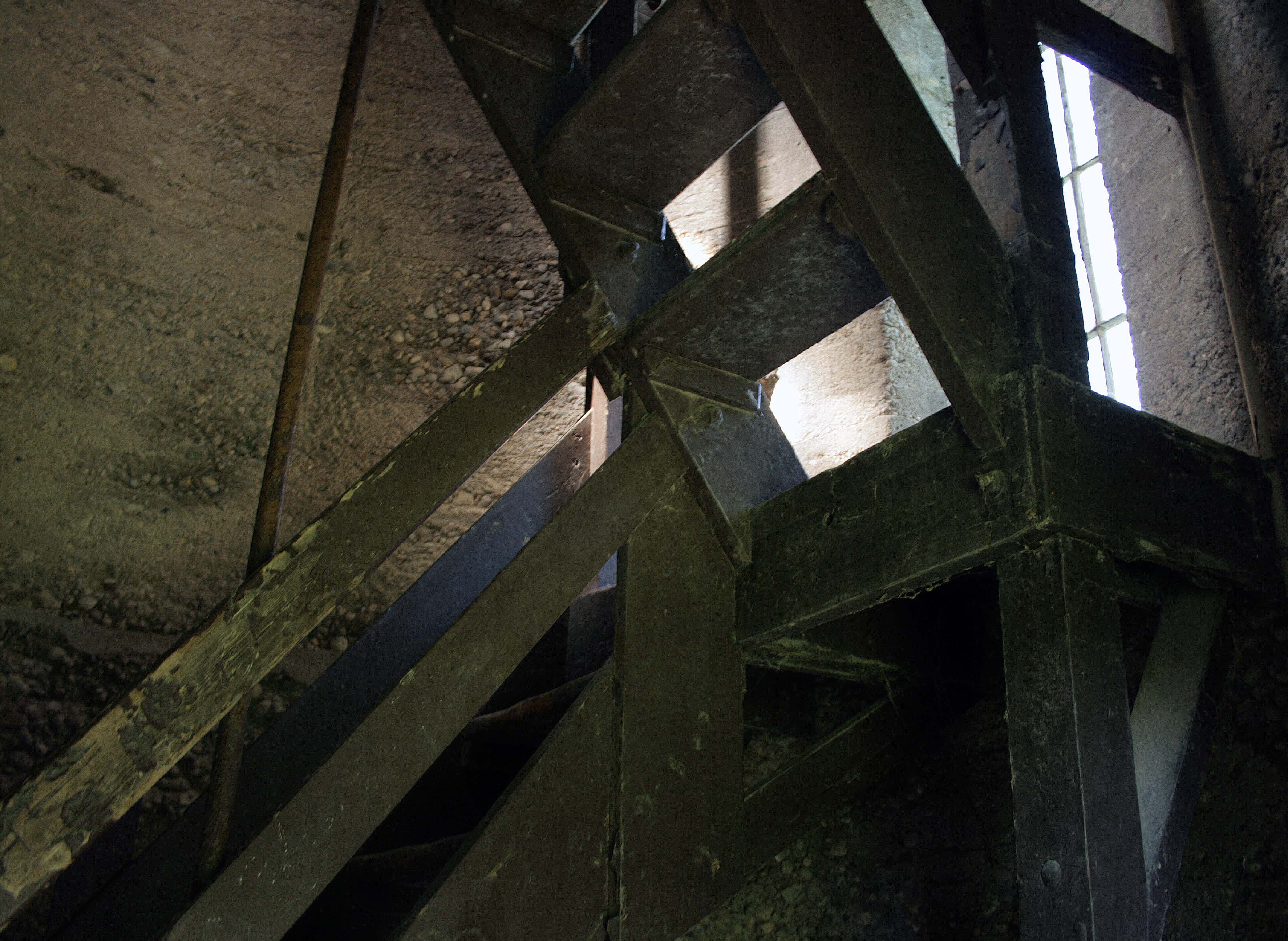
Although the tower has barely needed any repairs to keep it standing over the years, the tower has been closed to the public since 2008.2 BUT, it is possible to tour inside, by special request.2 A sign on site has a phone number that can be called to book a visit to the top of the tower. I wish I would have known this when we visited. We made do by peering through the gated doors to glimpse the cobwebs and spiral staircase inside.

What we also didn’t know at the time of our visit, was the haunted history of the place. The story goes that a woman jumped to her death from the top of the tower. She was distraught and suffering from grief of the loss of her husband, who went off to war—but never returned.3

They say her restless spirit can sometimes be seen at the top of the tower, waiting for her lost love to return.3

Doon Pioneer Cemetery

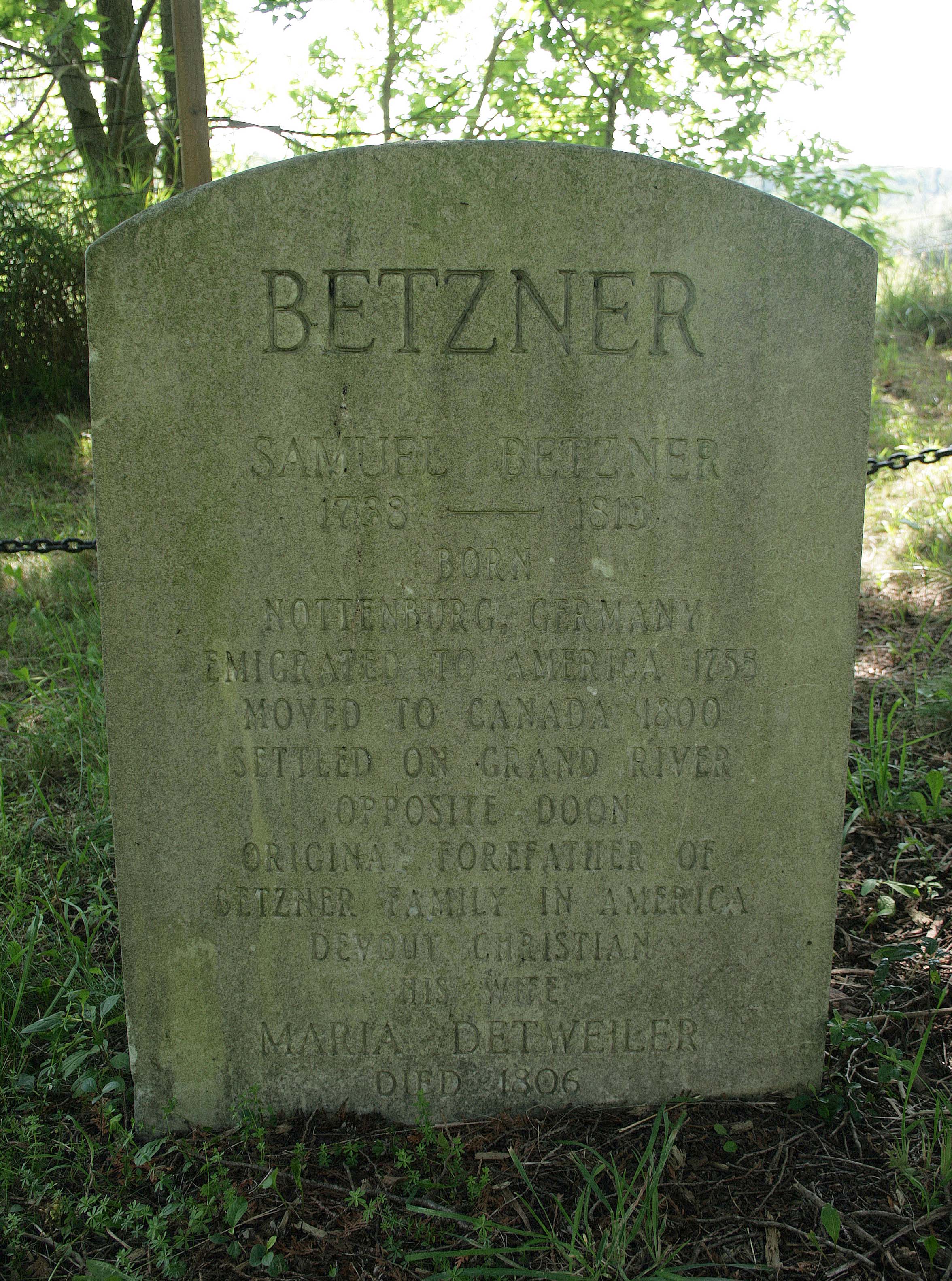
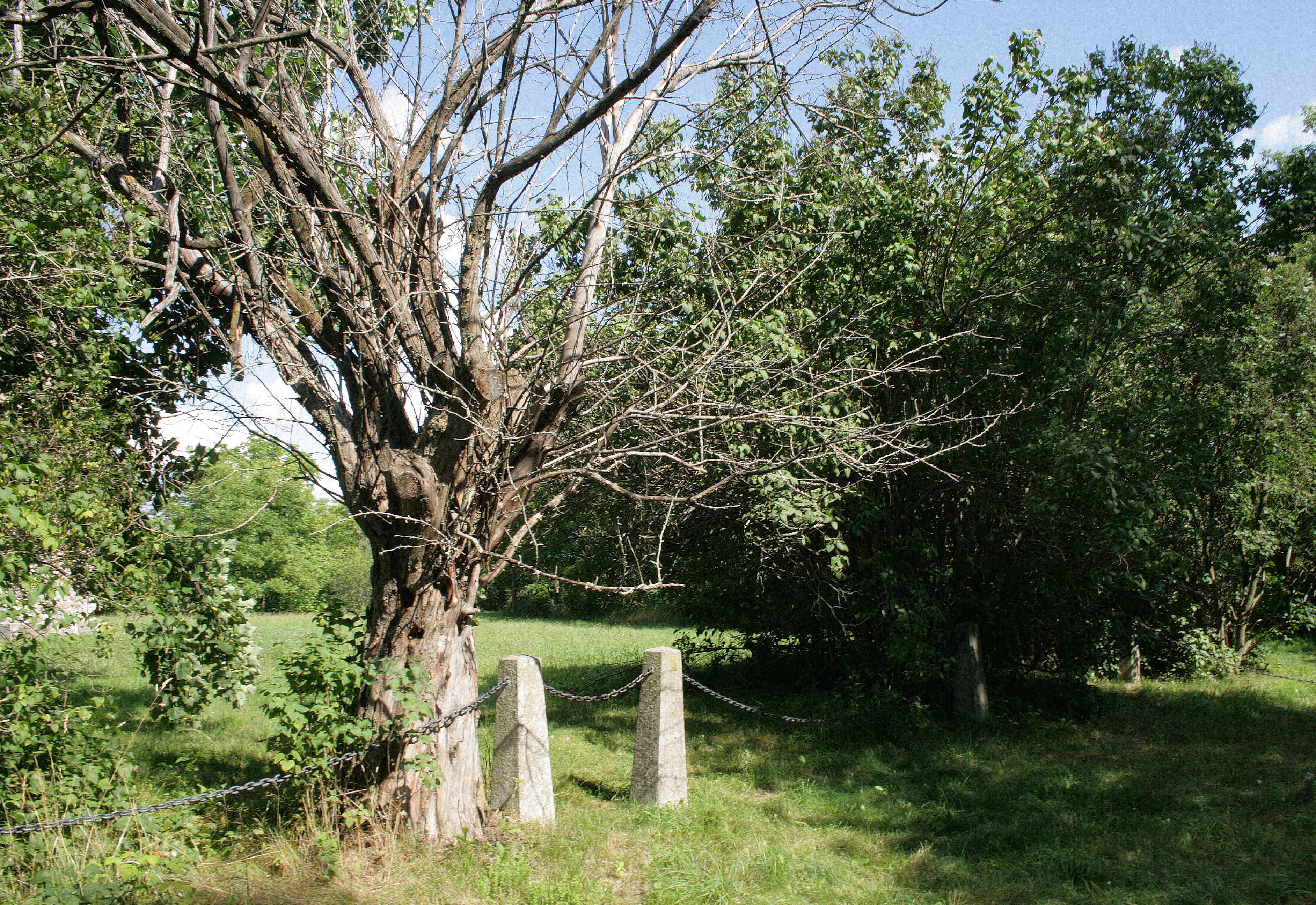
The 98-year-old Pioneer tower sits within a small grassy field, right beside the Doon Pioneer Cemetery. This is the final resting place of the Schoerg and Betzner families and overlooks the Grand River.

Also known as the Schoerg/Betzner cemetery, this small burial ground is where the first settlers are laid to rest, who arrived in Waterloo Township in the spring of 1800. The small cemetery is filled with old gravestones and field stones, marking their final resting place.

Some of the gravestones are very worn, so I took the opportunity to try out a trick I saw in one of the cemetery groups I am a part of. By using a mirror to reflect sunlight, or by holding a flashlight at an oblique angle you can create enough contrast to make gravestones legible again.

I had a small flashlight on me, one with a small beam so it worked well on the smaller stones. I asked my mom to hold the flashlight for me, as I lined up my shot by looking through the small viewfinder on my DLSR. The deep shadows help some of the long-forgotten words to be legible again. The flashlight trick didn’t work as well on larger stones, because the beam from the flashlight is too narrow to illuminate enough of the stone. I would need a much larger beam for that. This trick of the light is a great way to reveal gravestone inscriptions while doing no harm.

My mother and I both enjoyed visiting the memorial tower and the small burial ground beside it. We took our time taking in the beautiful craftsmanship and design of the tower and its history. At the time, we had no thoughts of ghostly apparitions in our minds. We didn’t experience anything supernatural. We just admired the Fieldstone Tower and all the toil and hard work it represented for those early pioneers.

After exploring the cemetery and paying our respects to the early settlers of the area, we made our way to the Walter Bean Grand River Trail. The flat gravel path meanders through the Pioneer Tower Natural Area taking you along the Grand River. The trail is dotted with educational panels, and the path eventually brings you to the Pioneer Tower Bridge.

On the opposite side of the bridge lies the Doon Valley Golf Course. On our walk, we didn’t cross but stopped at the bridge to take in the views. We sat for a time at a little garden roundabout, just before the bridge, admiring the flowers and wildlife. We were lucky to see a wild rabbit scurry across the trail.

The Memorial Tower was always in view during our walk, peeking out above the treeline like a sentinel keeping watch. A strong reminder of those who came before us. The whole area is beautiful, even more so now I imagine with the fall colors starting to emerge.

So if you are looking for a nice place to take in nature and enjoy some dark history, I think the Waterloo Pioneer Memorial Tower and adjacent Doon Pioneer cemetery would be a great place for a fall outing. Who knows, you might even see a ghost.

Thanks for reading!


References:

  1. Waterloo Pioneer Memorial Tower | Parks Canada
  2. Descendant of Waterloo pioneers wants memorial tower open again | Waterloo Region Record
  3. Historic Haunts Tour | Guess Where Trips

Cemetery Road Trip: Guess Where Trips

Who doesn’t love a road trip; especially one that is pre-planned for you? All you need is your sense of adventure, a full tank of gas, and someone to share it with!

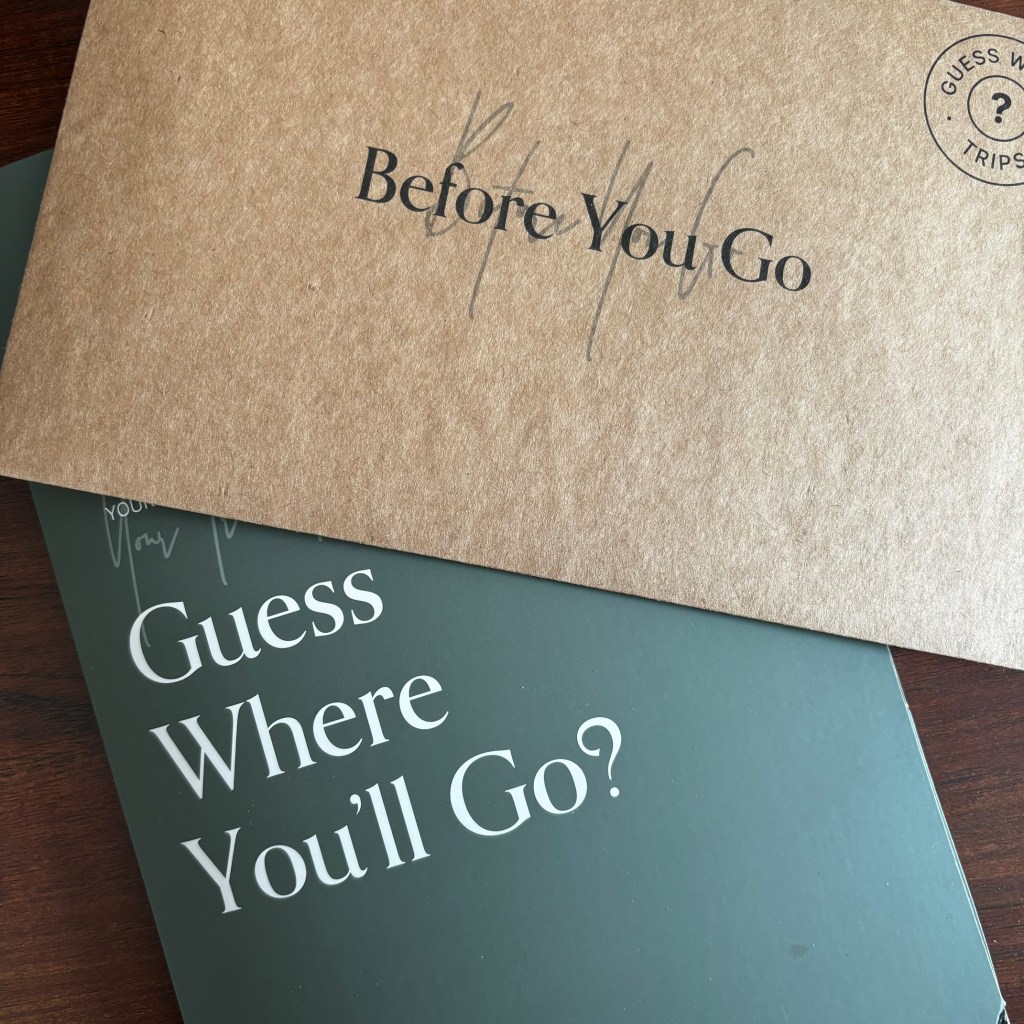
I mentioned last week that I would share more details about the Guess Where Trips adventure that my mom and I did during our summer vacation. So, today on the blog, I wanted to introduce you to this fun company, if you haven’t already heard of them, and share a little bit more about how our adventure played out.

Marilu, the Travel Support Specialist at Guess Where Trips, gave me a Historic Haunts tour to try out for free, in return for an honest review. The Historic Haunts tour includes a couple of cemetery stops, so it was a perfect fit! This trip is a round-up of spooky and unusual attractions, leading you on a route full of haunted history and ghostly stories. My favorite kind of road trip!

Guess Where Trips

Guess Where Trips offers beautifully packaged, one-day surprise road trips that will take you to all manner of hidden gems in Canada and the United States. Inspired after creating a scavenger hunt-style road trip as a gift to her parents, Jess Off founded Guess Where Trips in January of 2020.1 These curated road trips encourage you to explore the road less traveled, while also supporting small businesses and communities along the way.1

Lots of meticulous planning and research goes into all 135 available trips. And they are working on creating new adventures all the time. On June 20th of this year, they released 13 new trips that feature Michigan, Ohio, and Indiana.

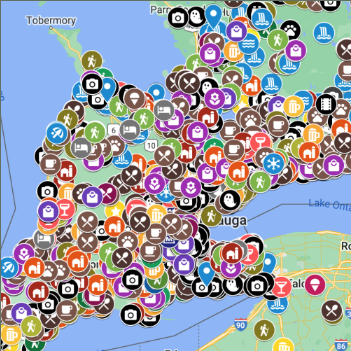
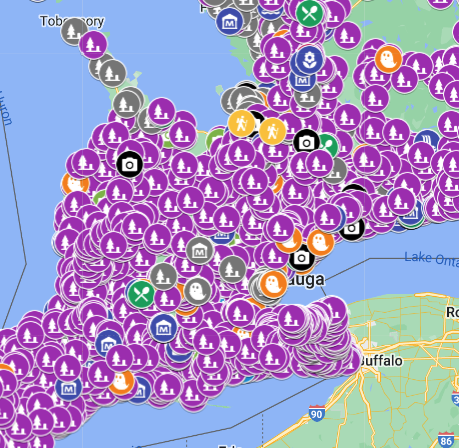
In a recent email, the Guess Where Trips team shared all the intricate work and planning that goes into designing their trips. A big part of their planning revolves around what they call their “magic map”, an evolving map filled with pinned locations that serve as a foundation for outlining their growing list of surprise road trips. 

I thought their magic map looked pretty similar to my master map of Ontario cemeteries. Although mine focuses on cemetery locations, there are a few hiking trails, and museums pinned on there. I use my map a bit differently, using it to track visited sites (the grey pins) and as a starting point for creating location-specific maps for my cemetery road trips.  

The Historic Haunts tour was the first ghostly trip created by Jess Off and her team and was initially most popular around the Halloween season. Today, all their haunted trips have become popular regardless of the season. Some of the other spooky trips they offer in Ontario are Weird and Wonderful ThingsSpooky Sights & Ghostly TalesBeautifully Haunted, and Hidden Gems of Huronia.

They offer an adventure for everyone! If haunted hidden gems are not your thing, you might enjoy one of their other themed trips. They have trips that feature wineries, and breweries, romantic getaways, scenic drives, and outdoorsy adventures.

My Guess Where Adventure

The Historic Haunts tour begins in Cambridge, Ontario which is about a 4-and-a-half-hour drive from me. So, my mother and I packed up the car and took advantage of the nice summer weather to make an overnight trip. We drove up to the tri-city on Thursday, with plans to follow the surprise road trip all day on Friday. Then we would drive home on the Saturday. This gave us some extra time to explore the area, so I found some other things for us to do as well.

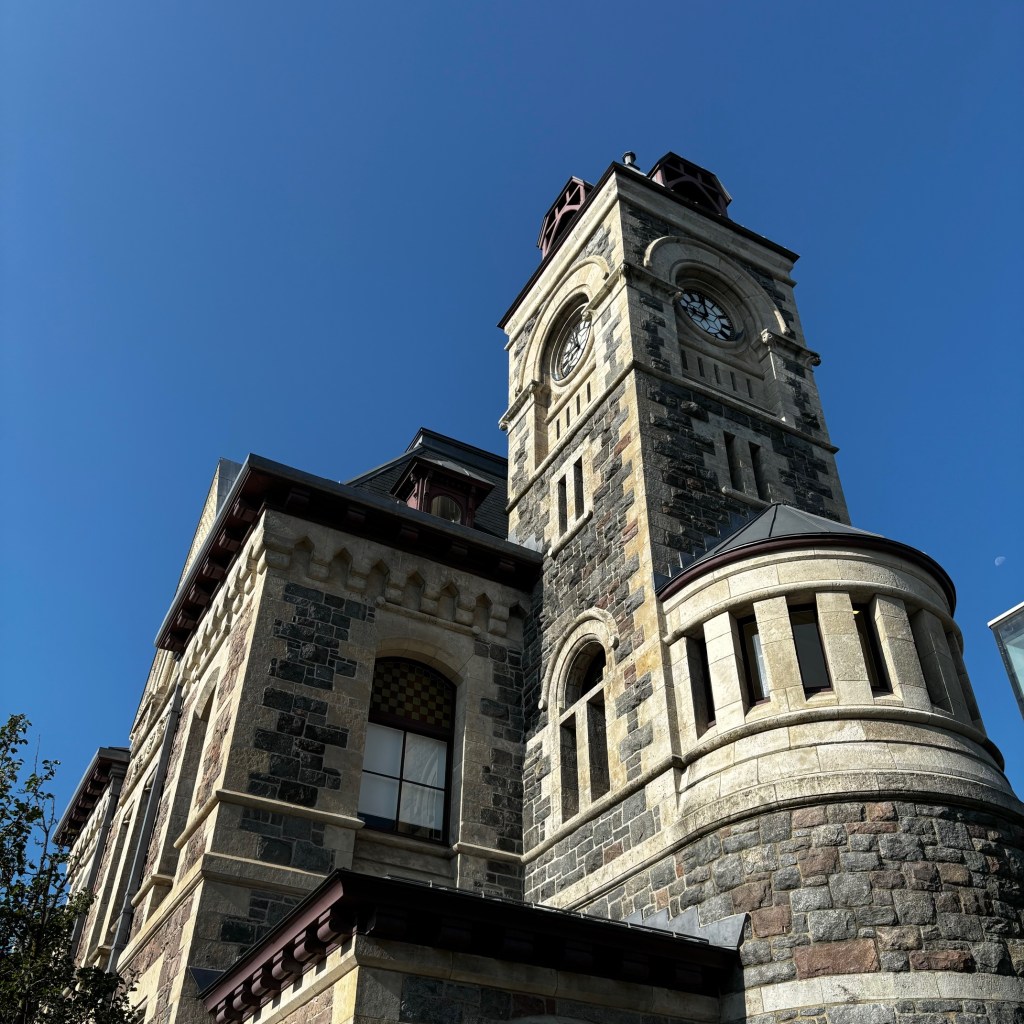
Friday morning, after a nice breakfast, we opened our first envelope to see where our first stop would take us. It brought us to downtown Cambridge to explore the architecture and haunted history of some of its older buildings. With coffee in hand, we sat outside the beautiful stone building that was once a Post Office, and read the tragic tale of a torrid love affair that ended in suicide. Even though it was a bright sunny morning, it was still a bit spooky to be looking up at so much dark history.

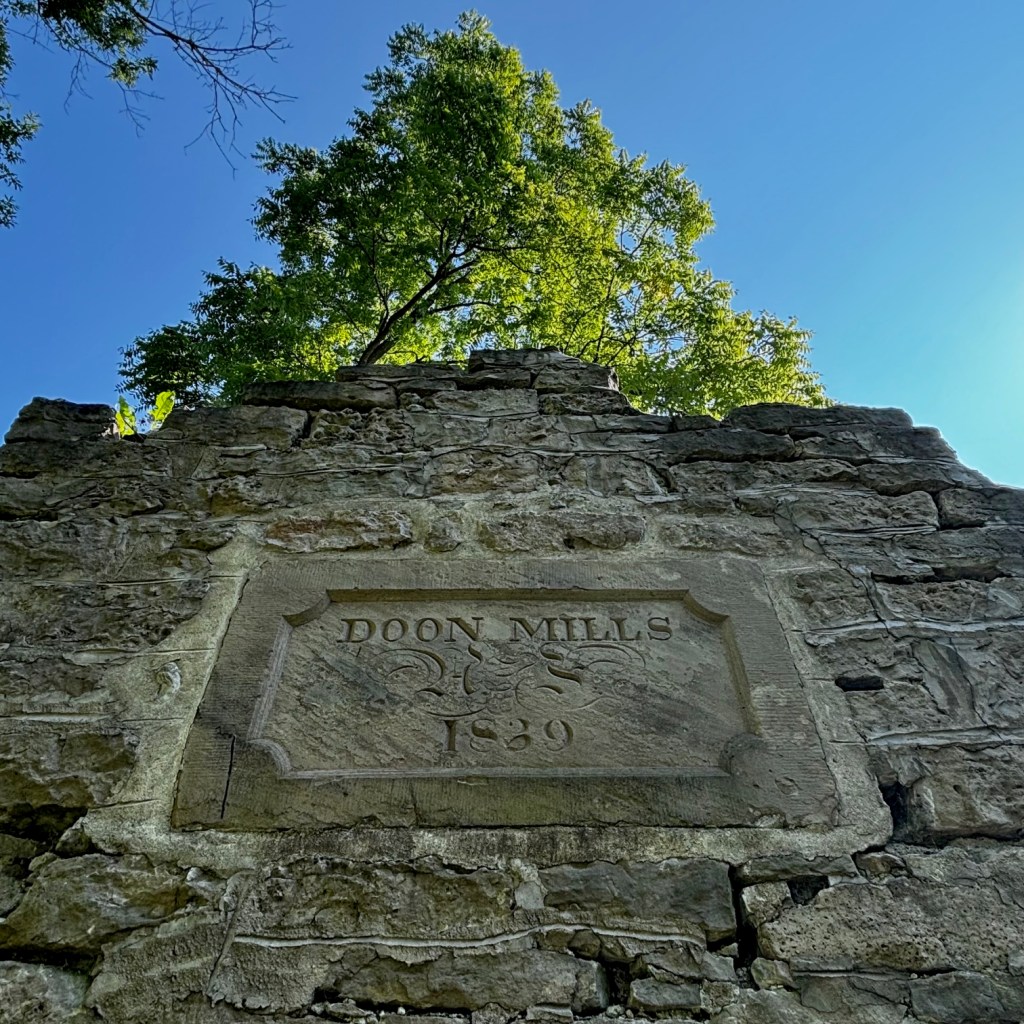
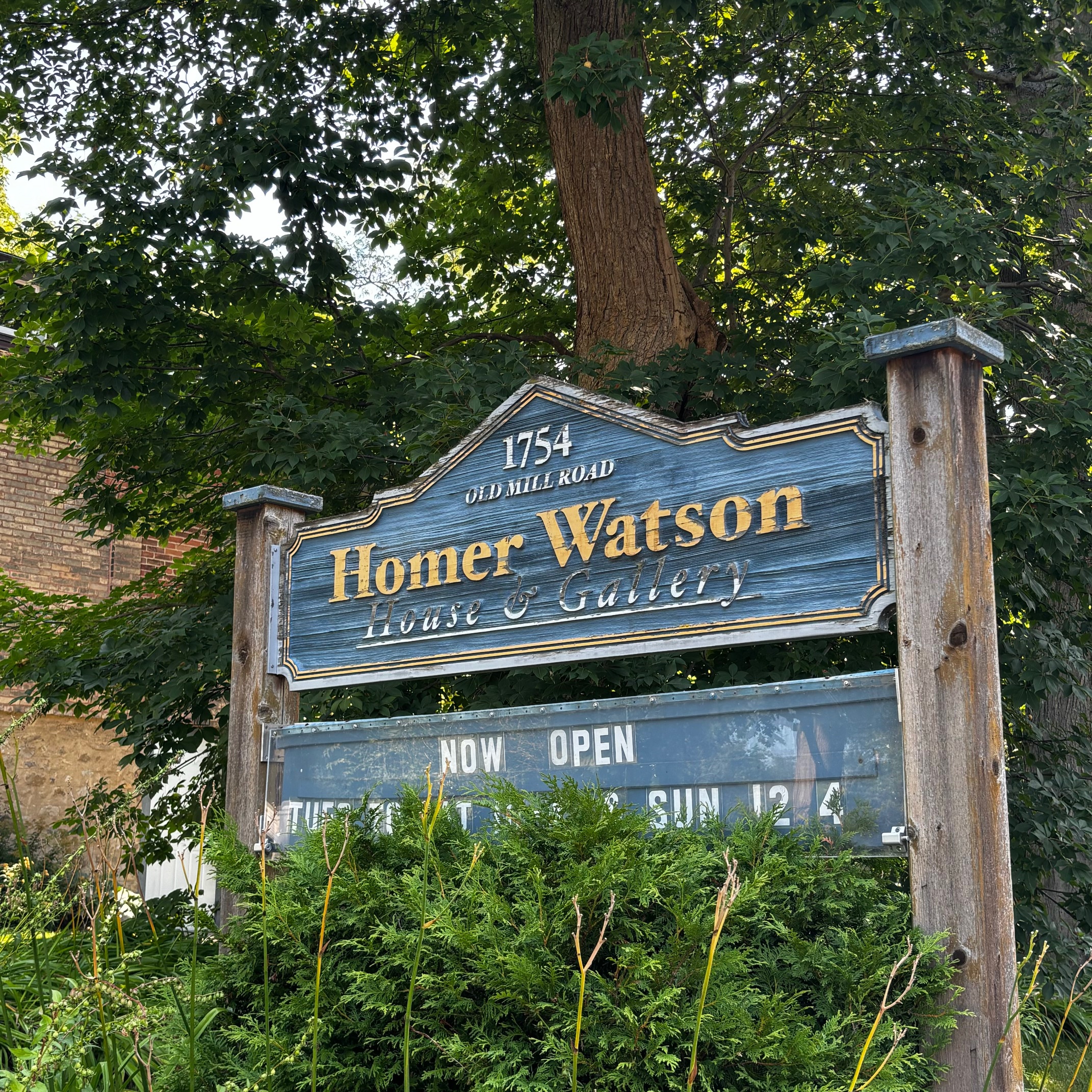
Our second stop brought us to a beautiful historic house and art gallery. We were a little early, arriving before they opened for the day, so we decided to explore the optional spooky abandoned spot that was just around the corner—The Doon Mills Ruins. 

Things got a little interesting at this point. The Doon Mills, originally built in 1834 have seen many tragedies, having burned in a fire not once, but twice! Today, many people report ghostly occurrences at this small section of ruins that sit at the trailhead. People claim to have heard ghostly footsteps or even heard their name called. Almost as soon as we arrived at the ruins, my mother complained of a burning wood smell. I didn’t smell anything though. My mom got a little creeped out when I reminded her that smelling burning wood was something many people experienced when visiting the ruins. 

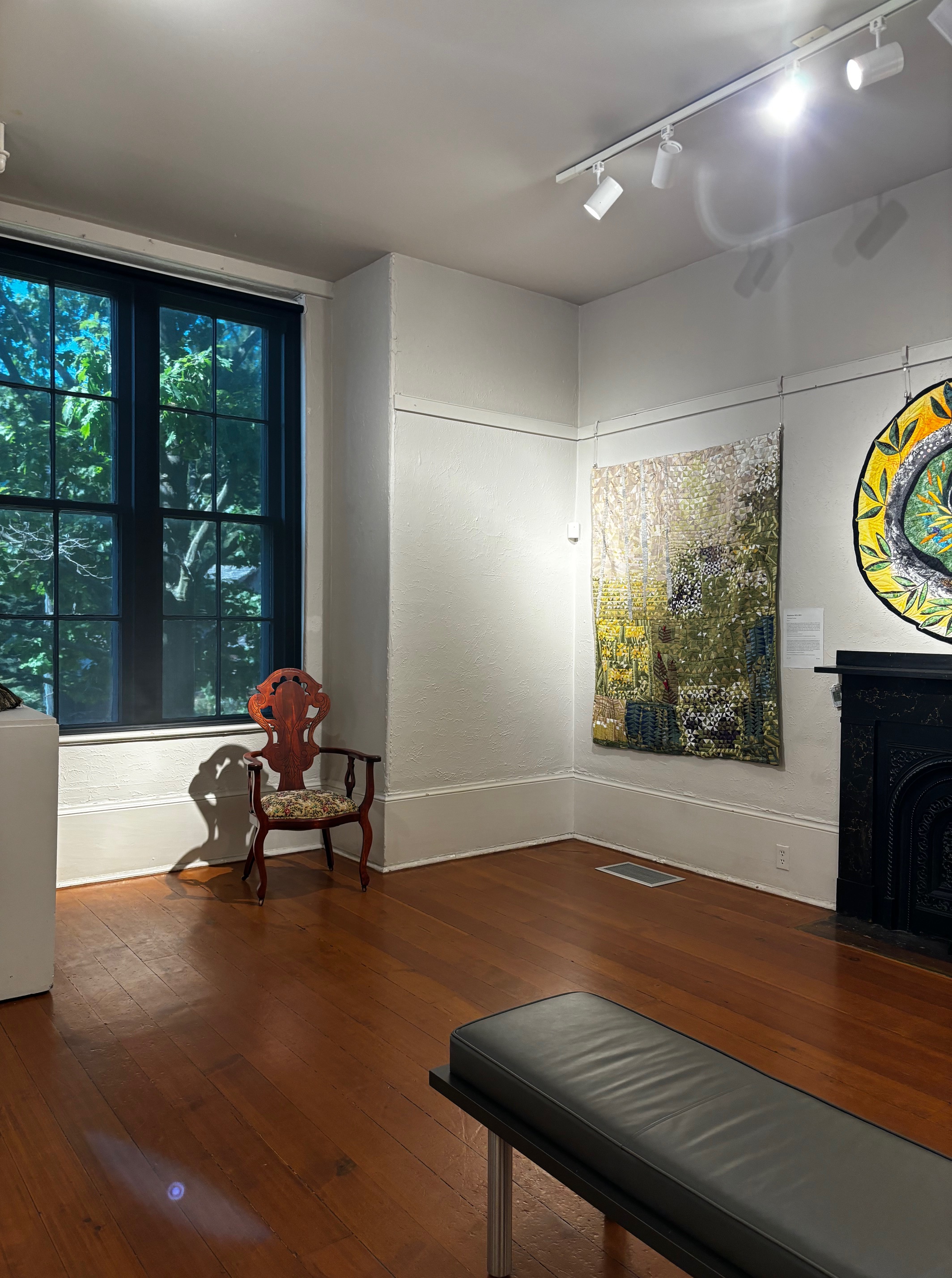
We made our way back to the Homer Watson House & Gallery once it had opened for the day, and was given a lovely tour by the staff. They made sure to tell us the haunted history of the place when we told them we were on the Haunted History tour. It is a beautiful house with a very interesting history. After exploring the house, I just had to ask where Homer Watson might be buried. It just so happens that he is laid to rest in the cemetery just down the road from the historic house, so my mother and I made an extra stop to visit his grave and pay our respects.

Remember how I mentioned I had found some other things for us to visit while we were in Cambridge for the tour? Well, that ended up mucking up our surprise road trip a little bit. The third stop on our road trip directed us to a haunted tower and an ancient cemetery. Well, it just so happens that my mother and I had visited this location the day before. It was a perfect evening activity as it checked a lot of boxes for us; a historic site, a cemetery, and a walking trail. At the time of our visit though, we had no idea the tower was haunted.

By this time it was also the lunch hour, so instead of visiting that location again, we decided to try one of the recommended restaurant stops. We visited the Borealis Grille & Bar to have some lunch and read through some of the haunted history of the tower we visited the evening before. After that nice rest, we opened our next envelope.

Our fourth envelope presented a choose-your-own-adventure opportunity. So it worked out that we had already visited the previous stop. This gave us more time to visit multiple locations on this leg of our road trip adventure.

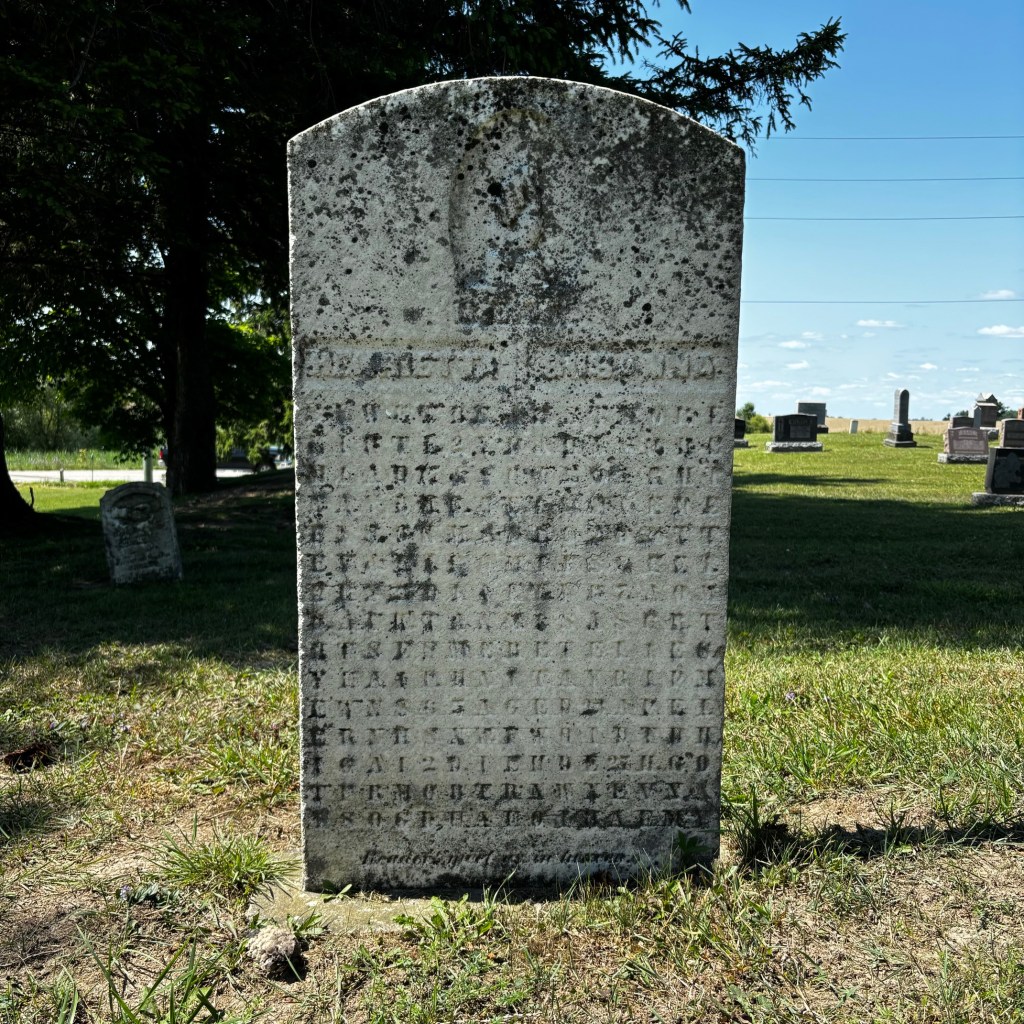
We chose to visit Rushes Cemetery in Wellesley first. I was pretty excited to see this listed as the first optional stop. There is a very interesting gravestone in this cemetery, and it has been on my cemetery bucket list for a while. This cemetery is the final resting place of Henrietta and Susanna, the first and second wives of Dr. Samuel Bean. What makes this stone so unique is the fact that this tombstone is written in a crossword code, and it took over 100 years to decode it. 

After I took some time to photograph the cemetery we made our way to Fergus to visit the Wellington Museum & Archives. By the time we got there, we would have just enough time for a quick tour before they closed for the day. 

Once known as the Wellington County House of Industry and Refuge, built in 1877, this beautiful building now houses a permanent display of the Institution’s history, as well as a few changing exhibits. The permanent exhibit “If These Walls Could Speak” explores the lives of the people who lived, worked, and died within the walls of the Poor House. It’s not surprising this National Historic site is also home to a few ghosts. 

After we toured the building, taking in all the interesting exhibits and history we made our way down the road to visit the Poorhouse Cemetery. This cemetery sits at the edge of the property and was established for those who had no family to claim them. After we paid our respects at the cemetery, we headed back to Cambridge to have some supper and rest at the hotel. 

Our Historic Haunts tour was a great success. My mother and I had a lot of fun exploring and learning about the community and local history. It was a great mix of haunted history, museums, and cemeteries. Although we did add a couple of cemetery stops to our trip, it made sense to stop in and pay our respects after learning so much about their history. 

I also loved the surprise element and the choose-your-own-adventure style. Opening each envelope was a fun addition that created a sense of anticipation. The multiple options also gave you the freedom to choose how your route was going to unfold. The restaurant and cafe options were also great additions, taking into account that you may get hungry or need a coffee break during all the exploring. It is so well thought out!   

I asked my mom what she thought of the trip and she loved that all the planning is done for you and that it was really easy to follow. She also loved all the history that is provided for each stop, her favorite being the tragic tale of love and loss at the Old Post Office. She loved the beautiful architecture but noted that we would have never known about its tragic history, just by looking at the building. She said it was a great adventure!

We had a great time, and we both would recommend these trips to anyone looking for a unique adventure. So if you are looking for road trip ideas, definitely check out Guess Where Trips and let them lead you to some fun and fascinating destinations! 

Thanks for reading!


References:

  1. About Us | Guess Where Trips

Stone Stories: A Tap Dancing Legend

Earlier this month, two friends and I traveled to Oakville, Ontario for another birthday cemetery road trip. It was a bit ambitious, with us hitting the road at the crack of dawn. We planned to beat the traffic, but also to get a head start on the day since it would be a four-hour drive, each way.

Since it would be such a long drive, we wanted to give ourselves as much time as possible to tour the town and sight-see. And yes, of course, visit cemeteries. There was one stop that was very high on our list—the final resting place of American actor and tap-dancing legend, Gregory Hines.

Gregory Hines

Gregory Oliver Hines was born February 14, 1946, in New York, New York. Hines began tap lessons at the age of four and would spend much of his childhood practicing and performing alongside his older brother, Maurice Hines.1 

The Hines Brothers performed their song-and-dance act all over the United States. In 1963, their father joined them, turning the duo into a trio. They continued to make a name for themselves, making countless TV appearances.1 But in 1973, Hines recognized that tap dancings popularity was declining and left the act to pursue a musical career and start a band. This was short-lived though, and Hines soon returned to New York and the stage.1

In the early 80’s, Hines made the transition to Television and film actor. His first feature film credit is his portrayal of Josephus in the comedy/musical Mel Brook’s History of the World Part I (1981). Known for his accomplished choreography and tap dancing, many of Hines’ films showcase his dancing. He starred alongside veteran tap dancer Sammy Davis Jr. in the 1989 film Tap. Credited with 49 acting roles, Hines was a successful and versatile actor. Some of his most successful films are Running Scared (1986), Renaissance Man (1994), and Waiting to Exhale (1995). I would be remiss if I didn’t also list his cameo in the fan favorite, The Muppets Take Manhattan (1984).2

In 2002, Hines was diagnosed with liver cancer. He kept his diagnosis private, sharing his health struggle with only family and close friends. A year later, Hines succumbed to the illness en route to the hospital, from his home in Los Angeles.3 Gregory Hines passed away on August 9, 2003, he was 57.  

Hines is remembered by his two children, a son, and daughter, from two previous marriages. His memorial service took place on August 13, 2003, at Saint Monica’s Catholic Church in California. Based on the photographs I found online, it looks like it was an emotional service, with many Hollywood stars in attendance. Hines is laid to rest in Saint Volodymyr Ukrainian Cemetery in Oakville, Ontario, beside his fiancé Negrita Maria Truszyk Jayde.

Saint Volodymyr Ukrainian Cemetery

Saint Volodymyr Ukrainian Cemetery, also known as West Oak Memorial Gardens, is owned and operated by St. Volodymyr Cathedral. It was founded in 1984, and sits on 100 acres of property that overlooks Sixteen Mile Creek. Today, it’s thought to be the largest Ukrainian cemetery in Canada.4 

It was a beautiful sunny day when we visited Saint Volodymyr. Right away, we noticed how busy the cemetery was. Many people were visiting loved ones, cleaning gravesites, and paying their respects.

I knew before we arrived that the cemetery was a large one, so I had come prepared. I wanted to make sure we had plenty of time to pay our respects and wouldn’t spend all our time searching. With coordinates in hand, we were able to drive directly to the grave of Gregory Hines. 

I’m not sure if it was done on purpose, or if it is just because of the sheer size of the cemetery, but there was a perfect parking space just off the path. Just big enough for one vehicle, across from the famous grave. 

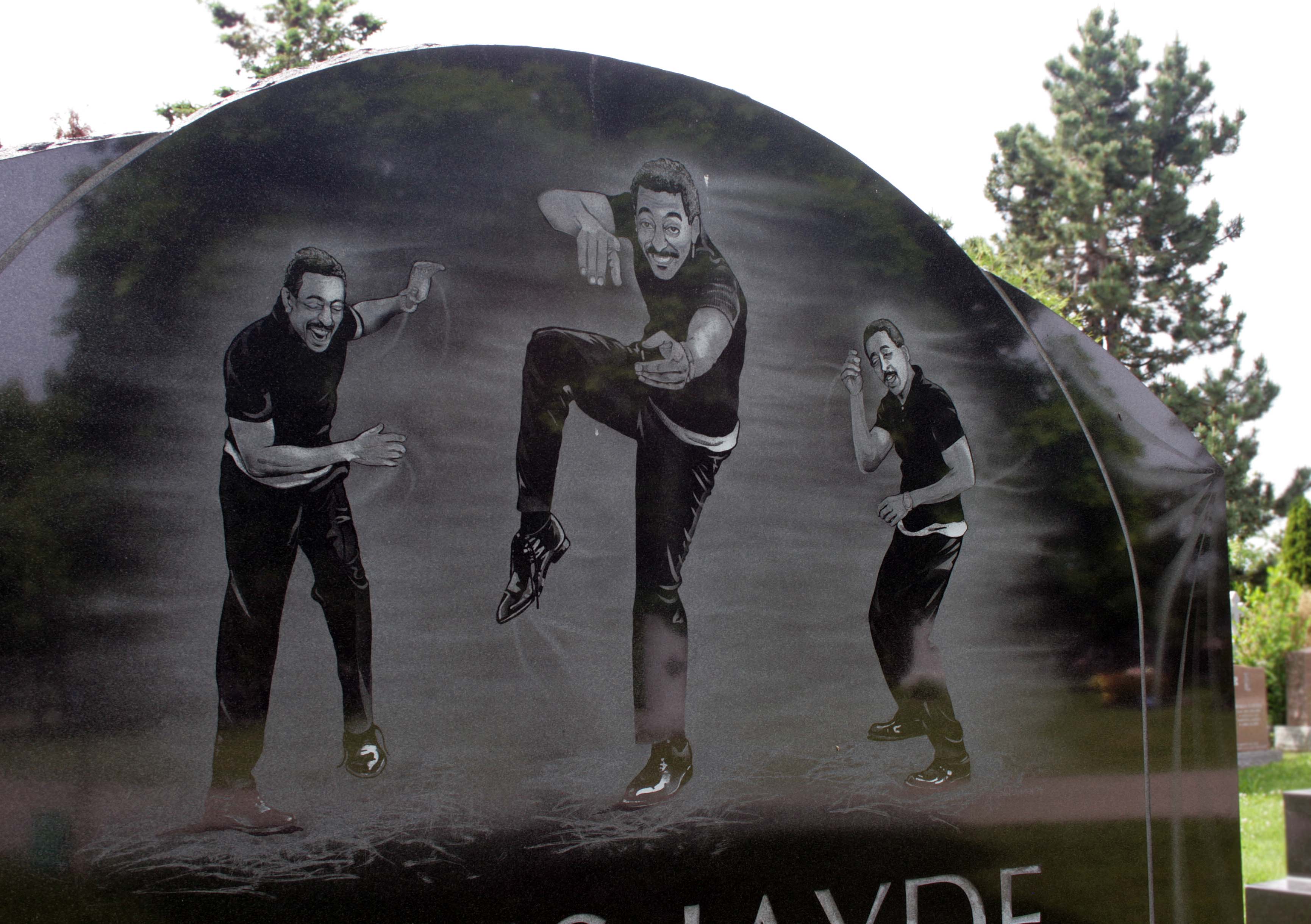
The Hines-Jayde gravestone is a beautiful monument, made from black granite. At the top of the stone is a sandblasted engraving of Hines dancing, framed by what looks like curtains on either side of the stone. He is depicted with a look of joy and happiness on his face. It’s a lovely representation of what he is best known for, and what was such a large part of his life. 

“Hines Jayde / Gregory Oliver / Hines / Feb. 14, 1946 / Aug. 9, 2003 / Together Forever / Negrita Maria / Hines Jayde / July 5, 1958 / Aug. 28, 2009 / So all sing in their festive dance. / “Within you is my true home” Psalms 87:7”

It was easy to tell that we were not the only ones who had made a trip to visit this gravesite. There were many grave goods left behind on the day we visited. These included stones, candles, and oil lamps. There was also a heel and toe plate placed at the base of the gravestone. These plates are mounted to the bottom of a shoe and used to tap dance. 

After paying our respects we wandered the cemetery a little bit, exploring the meandering paths. It’s a beautiful cemetery with its trees creating some beautiful dappled light across the gravestones. I noticed that there were many black granite stones, in some sections that were even the same style. 

I also noticed many oil lamps left at graves. It reminded me of the Jewish practice of leaving pebbles on top of gravestones. Some graves had only one of two oil lamps, while others had handfuls of them surrounding the stones. I can just imagine how beautiful they would look at night with all of the lamps lit up. 

You might be asking yourself how an American-born actor came to be buried in a Canadian cemetery. I had the same question. 

It looks like the reason is because of Hines’ fiancé Negrita Jayde, who is Canadian. A celebrity in her own right, Jayde was an athlete and an author. She was an award-winning professional bodybuilder from Toronto, Ontario, and wrote two books about the subject. She was also an actor, having starred in the action/sci-fi film Safety Zone in 1996.5

Although Hines and Jayde did not get the chance to get legally married before his death, Jayde did take Hines’ last name.6 When Jayde passed away six years, later in 2009 from cancer, she she was laid to rest beside him.

I’m very happy I was able to help one of my best friends pay her respects to one of her favorite actors. I’m also happy that I had the chance to pay my respects as well. Visiting famous graves is always an interesting experience because so often we feel so connected to them, even though we don’t know them on a personal level. TV and film actors, in particular, can feel like our best friends because of how invested we can get into their characters or their careers. So getting the chance to pay our respects at their gravestone can sometimes be a surreal experience.  

Have you ever visited a famous grave? I would love to read about your experience in the comments.

Thanks for reading!


References: 

  1. Gregory Hines | Britannica
  2. Gregory Hines | IMDB
  3. Gregory Hines | Wikipedia
  4. Saint Volodymyr Ukrainian Cemetery | Find a Grave
  5. Negrita Maria Truszyk Jayde | Find a Grave 
  6. Negrita Jayde Trivia | IMDB

A Collection of Wooden Grave Markers

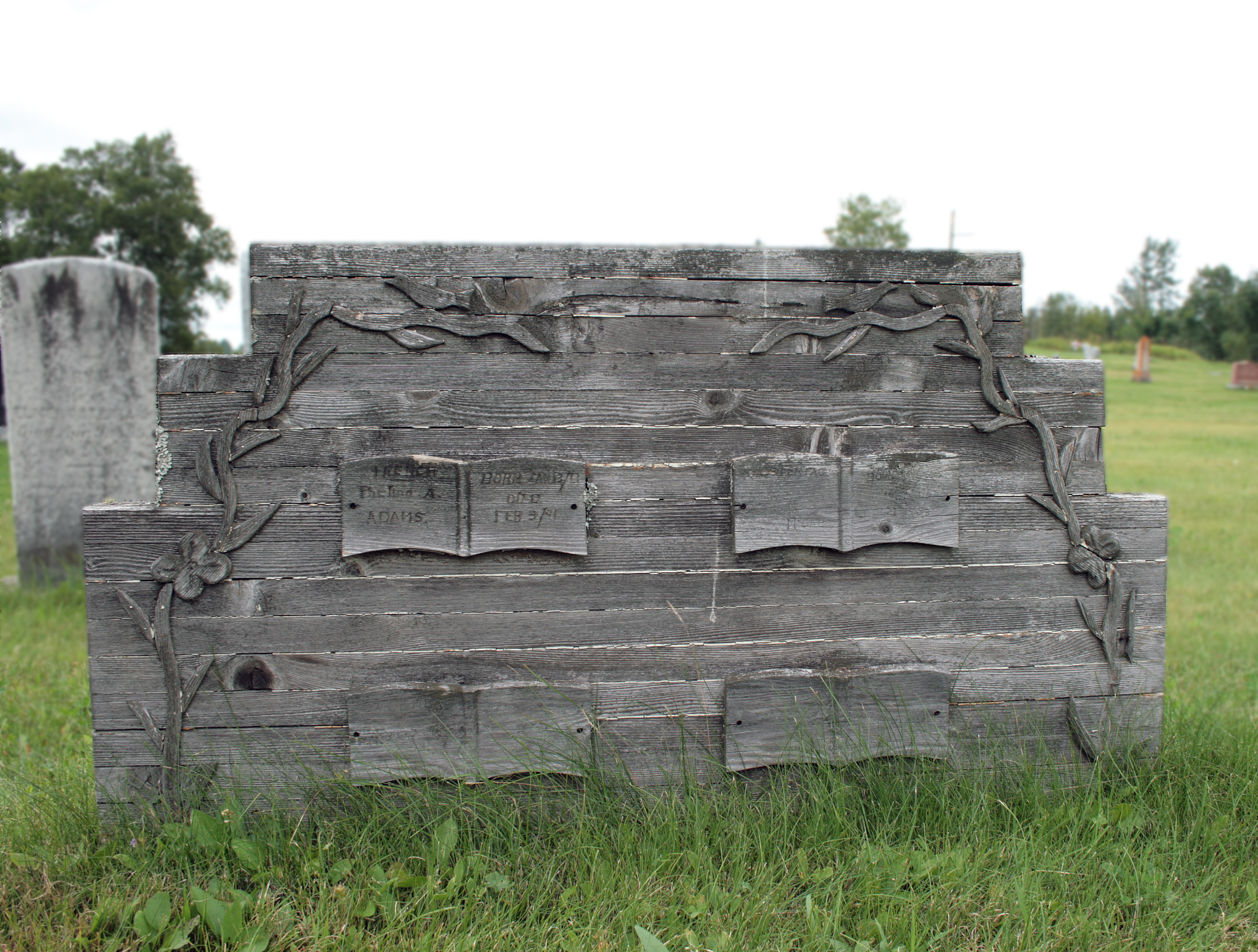
I had the idea for this collection when I was wandering through Maple Ridge Cemetery in Thessalon. I found some very interesting wood markers there, and it reminded me of some other interesting wood markers I have found in the past. So, for today’s blog post, I wanted to share a collection of wooden grave markers.

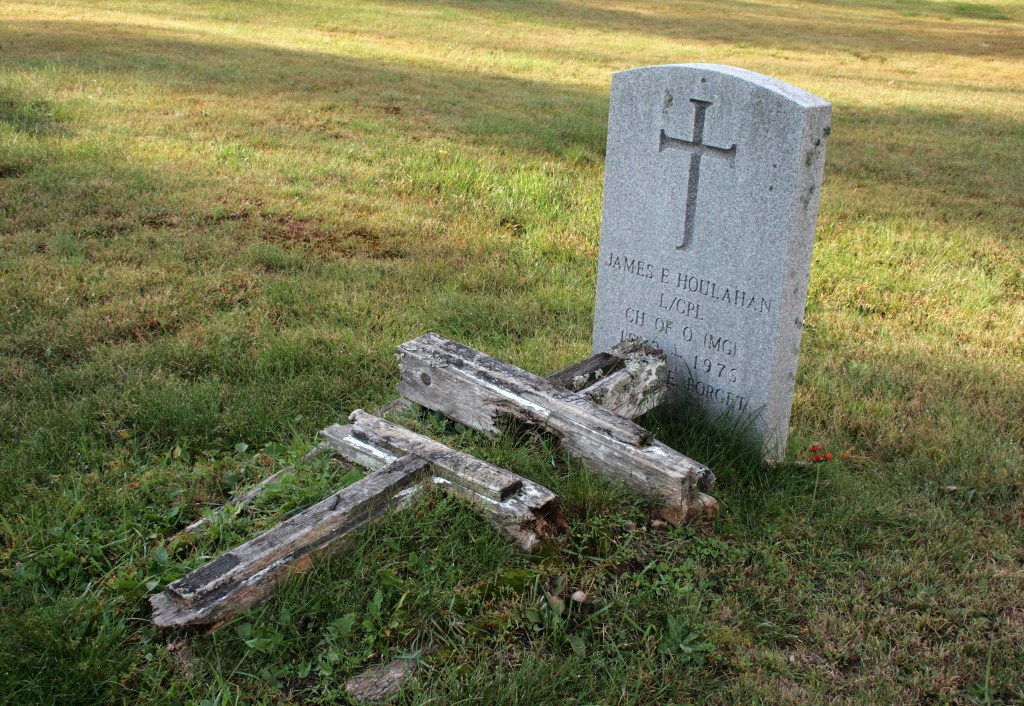
In North America, there was a time when wooden markers were more common. Between 1861 and 1873, wood markers would have been common for graves of Civil War soldiers, but over time marble became more favorable because of its durability.1 Due to the nature of the material, wood is more susceptible to natural decomposition and wood-boring insects. Over a long period of time, the wood just rots away. 
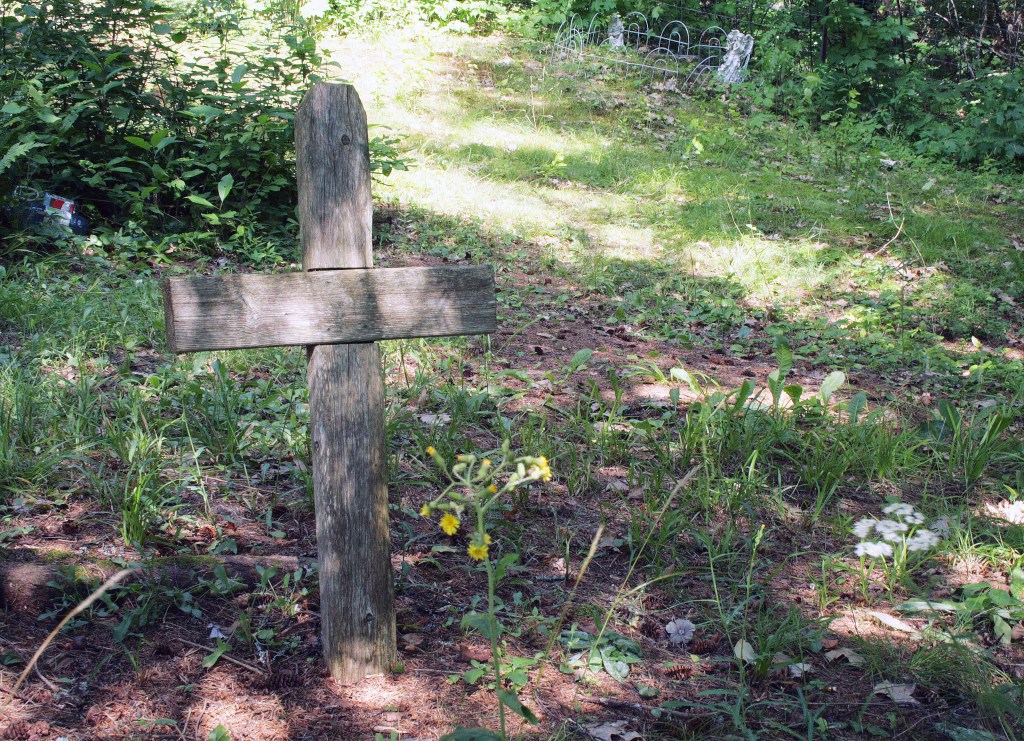
Today, wood markers are not a very common sight in Northern Ontario cemeteries. They often tug at the heartstrings, as wooden markers are usually handmade, and you can see they were made with love. Unfortunately, if they are not used as a temporary marker the wood can become hard to read, and eventually falls apart.

I would argue that this is one of the best reasons why photographing gravestones is important. Over time, these wooden grave markers will be lost to time, so documenting them helps preserve the memory of the deceased. It creates records for those looking to piece together their family history and become great resources. 
Have you found wooden grave markers in your local cemeteries? I would love to read about your finds, in the comments.

Thanks for reading!


References:

  1. The History of Headstones Across Cultures and Religions | Milano Monuments

A Collection of Weeping Willows

While working on an upcoming project, I was going through my photo archive and found myself frequently stopping on the images of weeping willows. I have captured an interesting variety in the last few years. I love weeping willows, they have a very unique look. They are not common in my area, in the forests, or on graves. 

So for today’s collection, I wanted to take a closer look at this cemetery symbol and share some of the different versions I have found and photographed during my cemetery walks.

As the name implies, weeping willows commonly symbolize grief and mourning. They are a very common Victorian-era cemetery symbol. Adopted from the Ancient Greeks, the weeping willow can represent immortality and life after death. Weeping willows are sometimes associated with the Underworld because, in Greek mythology, Orpheus brought with him a willow branch on his travels to the Underworld to save Eurydice from Hades.1 The symbolism of immortality stems from the fact that willow trees are very hardy, and can survive heavy damage.

A variety of the weeping willow motif you might find is a weeping willow standing beside a gravestone. I love the idea of a gravestone on a gravestone. 

Another variation you might come across is of a weeping willow and urn. The urn represents death itself, and the willow again symbolizes grief.2 This motif was a popular gravestone symbol of the late eighteenth and early nineteenth century. You might also see weeping willows paired with a lamb or a cross.3 I have yet to come across these variations. 

I noticed that the majority of the ones I found were in Southern Ontario. As I explore more Ontario cemeteries this summer, I hope I will come across a few more to photograph. I would love to find some more variations on the symbol. If you have any suggestions for where I might look, I would love to hear about them in the comments. 

Thanks for reading!


References:

  1. Understanding Cemetery Symbols: A Field Guide for Historic Graveyards by Tui Snider
  2. Mastering Cemetery Iconography | The Academy at Penguin Hall
  3. Stories in Stone: The Complete Guide to Cemetery Symbolism by Douglas Keister

Cemetery Book Review: In the Land of Long Fingernails: A Gravedigger’s Memoir

For this month’s cemetery book review, I wanted to share an old favourite of mine. I first found out about Charles Wilkins’s book In the Land of Long Fingernails: A Gravedigger’s Memoir, in the book section of Rue Morgue MagazineRue Morgue has always been a great resource for discovering new authors. 

This book, first published in 2008, is a coming-of-age memoir set in a Toronto cemetery in 1969. It’s filled with weird-but-true events, that could only happen while working in a cemetery.

Here is the full book synopsis: “During the hazy summer of 1969, Charles Wilkins, then a student at the University of Toronto, took a job as a gravedigger. The bizarre-but-true events of that time, including a midsummer gravediggers’ strike, the unearthing of a victim of an unsolved murder, and a little illegal bone-shifting, play out amongst a Barnum-esque parade of mavericks and misfits in this macabre and hilarious memoir of mortality, materialism, and the gradual coming-of-age of an impressionable young man.” – Goodreads.com, In the Land of Long Fingernails

I enjoyed this book immensely, I couldn’t put it down! It’s a very easy read with great pacing. I found I devoured it quickly. I think it also helped that I felt a connection to this story because it takes place so close to me, in Toronto, Ontario. The specific Toronto cemetery is never named in the book, but being that I live about 4 hours away, I know I can visit it someday. There are some incredibly funny moments, but also some somber ones, creating a balance between the anecdotal stories. It’s a fascinating memoir but also a great insight into the everyday work life of a gravedigger in the late 60s.

I highly recommend this book if you’re looking for a light read, that could also fall into the feel-good read category. It’s also a quick read, which would make it a perfect choice if you need a break from heavier or academic content.  

I am always on the hunt for cemetery-related book recommendations. Please feel free to share yours in the comments. If you are an author and have a cemetery-related book you would like me to review, please reach out at hello@chantallarochelle.ca. I would love to hear from you.

Thanks for reading!

Cemeteries and Summer Vacation

Summers in Northern Ontario are very short, so you need to make the most of them. Before long we’ll be knee-deep in frozen snow. But let’s not think about that right now!

I just got back from a lovely two-week vacation. My fiancé and I were finally able to visit some family and friends we haven’t seen in 3 years, due to COVID-19. It felt almost like a normal vacation. We traveled a wee bit, and of course, I visited some cemeteries! 

My vacation was split into three different trips. I went camping at Algonquin Provincial Park with my 80-year-old mother. She hadn’t been camping in about 40 years. We only stayed for one night, but we had all the camping experiences; cooking on a fire, making s’mores, sleeping in a tent, and spending some time at the lake. We also took the opportunity to try finding the grave of Tom Thomson, a famous Canadian painter, who died mysteriously on Canoe Lake. You’ll be able to read more about that adventure in an upcoming blog post. 

My fiancé and I, also took some time to visit Southern Ontario and visit family and friends, that we haven’t seen since before the pandemic. We toured the city a little bit, had some great food, and spent some quality time together. We even got a chance to visit some cemeteries. My fiancé is not very interested in visiting cemeteries, but he is very supportive of my love for cemeteries. I think he may have enjoyed hunting for them as we drove back home. We stopped at a few interesting ones that were along our route. 

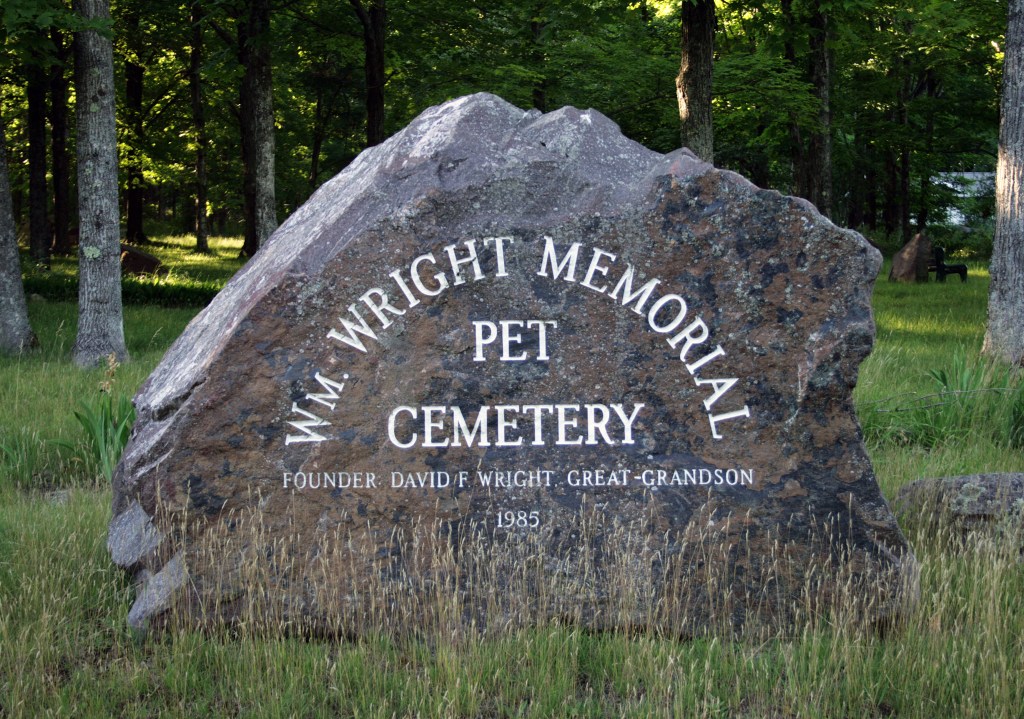
I also took some time to visit St. Joseph Island, the historic fort, and the bird sanctuary. My mother came along with me for that little trip as well. We toured the island and explored. We did some hiking and visited the beautiful Adcock’s Woodland Gardens. We also visited a lot of cemeteries, including a pet cemetery. That was a first for me. You’ll be able to read all about that adventure in an upcoming blog post as well. 

I made sure to plan some buffer days to just relax and recoup between heavy days of driving, where I could spend some time with my fur babies and get ready for the next adventure. I also scheduled some days just to do nothing—but those days filled up fast with spontaneous things. Overall, it was a great vacation! I managed to visit 16 cemeteries, reconnect with friends and family, and recharge my batteries. 

It was a wonderful break from work and my normal routine, but now it’s time to get back to it! I am feeling refreshed and am looking forward to writing about my vacation adventures and editing the hundreds of photos I took. I am also really excited about an upcoming special project and am currently playing around with some new ideas for the blog. I was starting to feel like my creative juices were stalling a little bit, but having a break has helped me reset and look at things with fresh eyes.

I hope you can take some time for yourself this summer if you haven’t already. Even if it’s only a long weekend. It’s so important to take the time to refresh and revitalize. To take your mind off work and just enjoy your family, friends, and nature or whatever else that makes you happy!

Thanks for reading! 

A Collection of Books

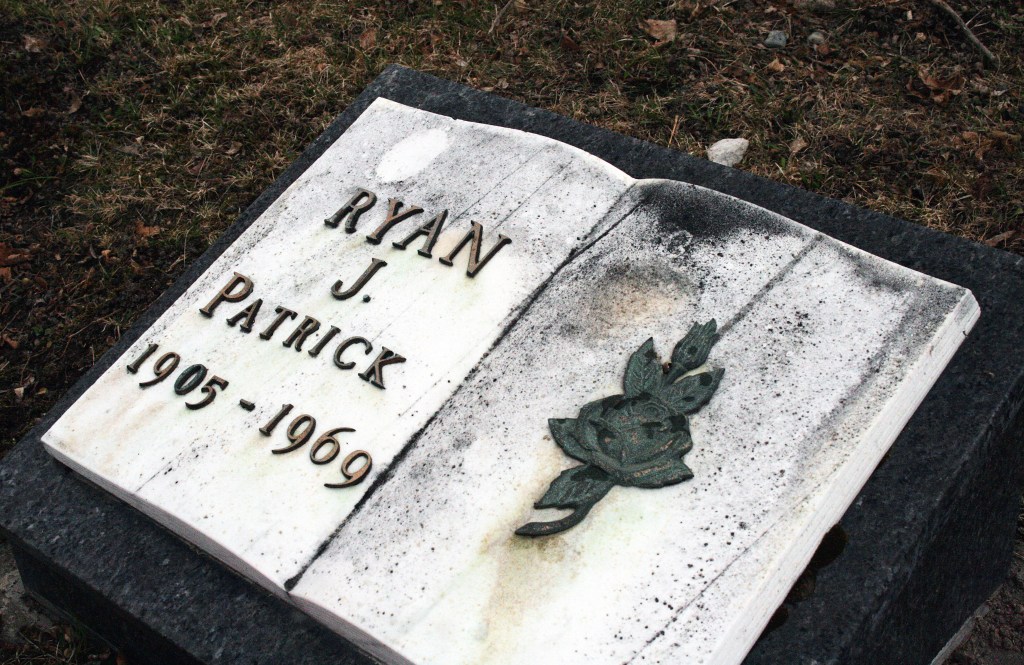
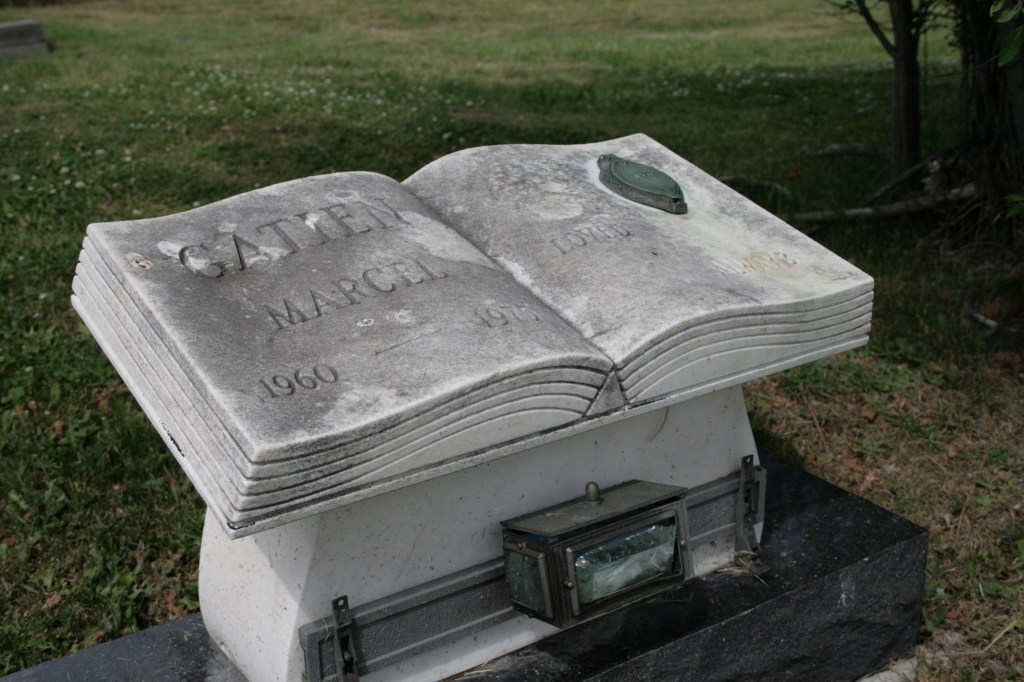
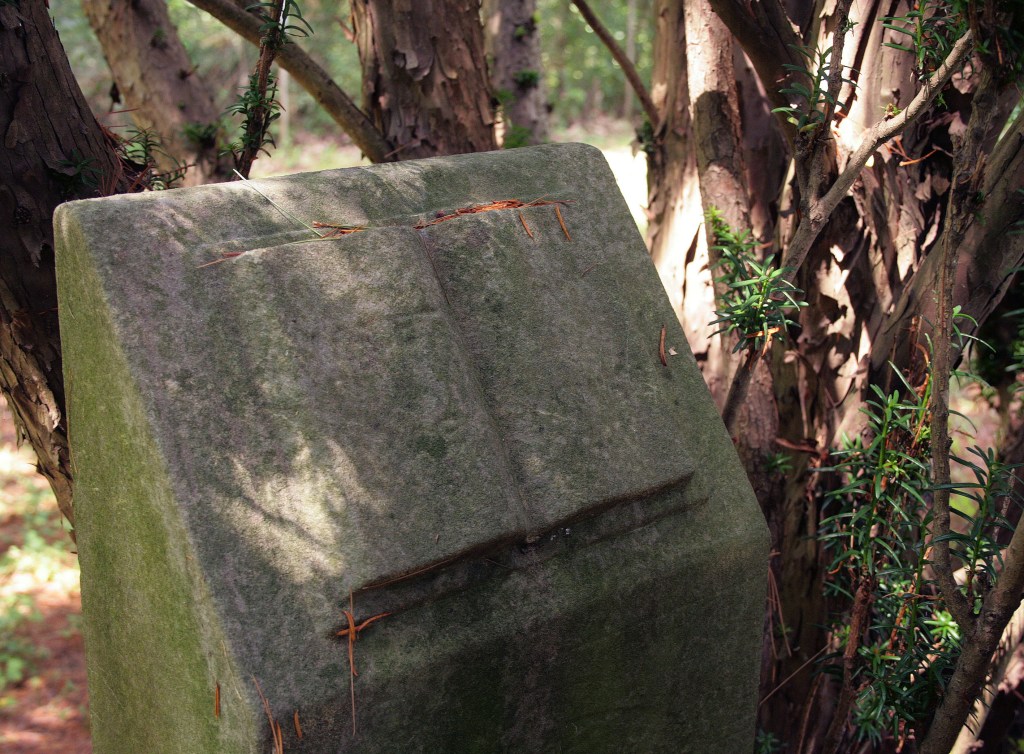
I love books! I am a big reader and have a large book collection at home, but I love finding stone books among the tombstones while wandering a cemetery. I find them very interesting and love trying to interpret what they mean.

Books can be both decorative or a representation of something. You can sometimes find a book being used as a decorative device to display the name of the deceased along with the birth and death dates. An open book can sometimes represent the human heart, as in it’s emotions are open to the world. An open book may also symbolize a life that has been cut short, before getting to the last page. Another variation of this is an open book with a cloth draped across it. This also represents a life cut short, the veil of death having bookmarked the person’s last chapter before the book is finished being written. A closed book might represent a long life, lived to the last chapter.

Any book found in a cemetery may represent the bible. Sometimes you may even find the words “Holy Bible” engraved on the book.

In my experience, books are not as common as some other funerary symbols, like hands and lambs. I love to photograph them when I do find them. I wanted to share some of my favorites with you today.


References:

  1. Understanding Cemetery Symbols: A Field Guide for Historic Graveyards by Tui Snider
  2. Stories in Stone: The Complete Guide to Cemetery Symbolism by Douglas Keister