Let’s be honest, visiting cemeteries can sometimes be a little bit spooky, and for the most part hauntingly beautiful. The weather is cooler, and the leaves have turned from green to red, gold, orange and brown. I love visiting cemeteries in the fall. I always look forward to doing to some leaf peeping! As you may have guessed, fall is my favorite season.
Halloween is only a few days away, so I wanted to talk about a project I worked on that might help you get into the season.
In 2017 I worked with local author, Sarah May, on bringing her book Haunted Sudbury: 101 true accounts of the paranormal to life. This book features 101 stories of local supernatural occurrences, as told to Sarah May. It’s filled with wonderfully spooky true stories of weird experiences and ghost sightings as well as true crime accounts that left their imprint on our small town.
Here is the book synopsis:
“Haunted Sudbury is a collection of true eye-witness accounts of the paranormal. Experience a different side to the city you don’t hear about everyday
‘Lady in White’ haunts a downtown restaurant after a ghastly murder
A ‘Starship’ is spotted in the air above Vale’s tailings dam
Mysterious man walks out of a snow bank and bids a final farewell
Deceased loved one communicates to his girlfriend through a stereo
Local high school teacher saved by a ghostly warning
Wife envisions her late husband catch a limo lift to the next world
Violent death. Lost loves. Haunted places. Haunted Sudbury has it all. Pick up a copy and prepare for a spine-tingling good read.”
Below is the image used on the book cover, with a little ghost manipulation added to it. This image comes from Eyre cemetery, one of the oldest cemeteries in Sudbury.
I loved working on this book, designing the layout and cover, and creating the illustrations. I was extremely excited when Sarah asked me if I wanted to include some of my cemetery photography. Nine of my photos can be found at the back of the book, in black and white. It was really exciting to see my photos in print. And still is!
The book launch for Haunted Sudbury took place at a local restaurant, the site of a murder that is described in the book, and is also reported to be haunted. The night of the launch was also held on the anniversary of the murder. Medium Jay Lane was also in attendance, and gave readings and spoke about the restaurant and what she felt. It was a very interesting experience and a great turnout!
Haunted Sudbury is not available in print at the moment, but Sarah May has another book in the works, that should be coming out soon.
There is a bit of a thrill in discovering a new cemetery.
While doing some photo editing of some photos I took on my vacation, I discovered a cemetery in Sturgeon Falls that I did not know existed. I noticed in my photo files that I had the name of the Sturgeon Falls cemetery entered incorrectly. While looking into the appropriate cemetery name, I discovered there is another hidden cemetery in Sturgeon Falls—Union Cemetery.
This is super exciting to me because I had thought that I had photographed all of the cemeteries close to me. And this gives me an excuse to go on yet another mini road trip!
By using Google Maps and street view, I was able to locate the entrance and get a glimpse of what the cemetery actually looks like. The cemetery grounds look quite large! The entrance also looks like it’s a little bit tucked away, so it will be very interesting to find this location in person and photograph it.
Images from Google Maps
Discovering a new cemetery can be just as exciting as actually visiting it. I can’t wait till the next time I am in Sturgeon Falls!
On my vacation, my Mother and I took a road trip to North Bay, Callander, and Corbeil Ontario to explore and experience the story of Canadian folk figures, the Dionne Quintuplets.
“On May 28, 1934, five identical girls were born to Oliva and Elzire Dionne, a Franco-Ontario family in the tiny community of Corbeil, Ontario. Their births were a miracle of its time during the difficult Depression, the only quintuplets to survive more than a few days. Midwives Douilda (Donalda) Legros and Mary-Jeanne Lebel delivered the first 3 of the quintuplets, and Dr. Allan Roy Dafoe assisted with the final 2 births. The five girls – Yvonne, Annette, Cécile, Émilie, and Marie – became a “good news” story in this challenging time, drawing worldwide attention to the area, and attracting 3 million people to “Quintland” to see and hear the girls at play. Hollywood told their story in 3 movies, while endorsements for commercial products became commonplace.” – Dionne Quints Heritage Board website
The Dionne Quint House Museum
In North Bay, we visited the Quint House Museum. This was the actual family home where the quintuplets were born. It houses a lot of original artifacts; such as the bed where they were born, cribs, children’s beds, children’s clothing, and their baby carriages. It also contains a lot of original photos of when the children were born, while they were growing up at Quintland, and also a lot of the advertising that was created using their image. Everything from baby food to GM motors was advertised using the Dionne Quintuplets. Dr. Dafoe profited from the twin’s fame. At the Quint house museum, we were given a tour of the house and memorabilia by an actual relative of the quintuplets, their nephew. His mother was one of the siblings of the quintuplets, making Elzire Dionne his grandmother. He spoke about the quintuplets and what happened to them as a tragedy and preferred to not mention the doctor, as he sees him as a villain in their story.
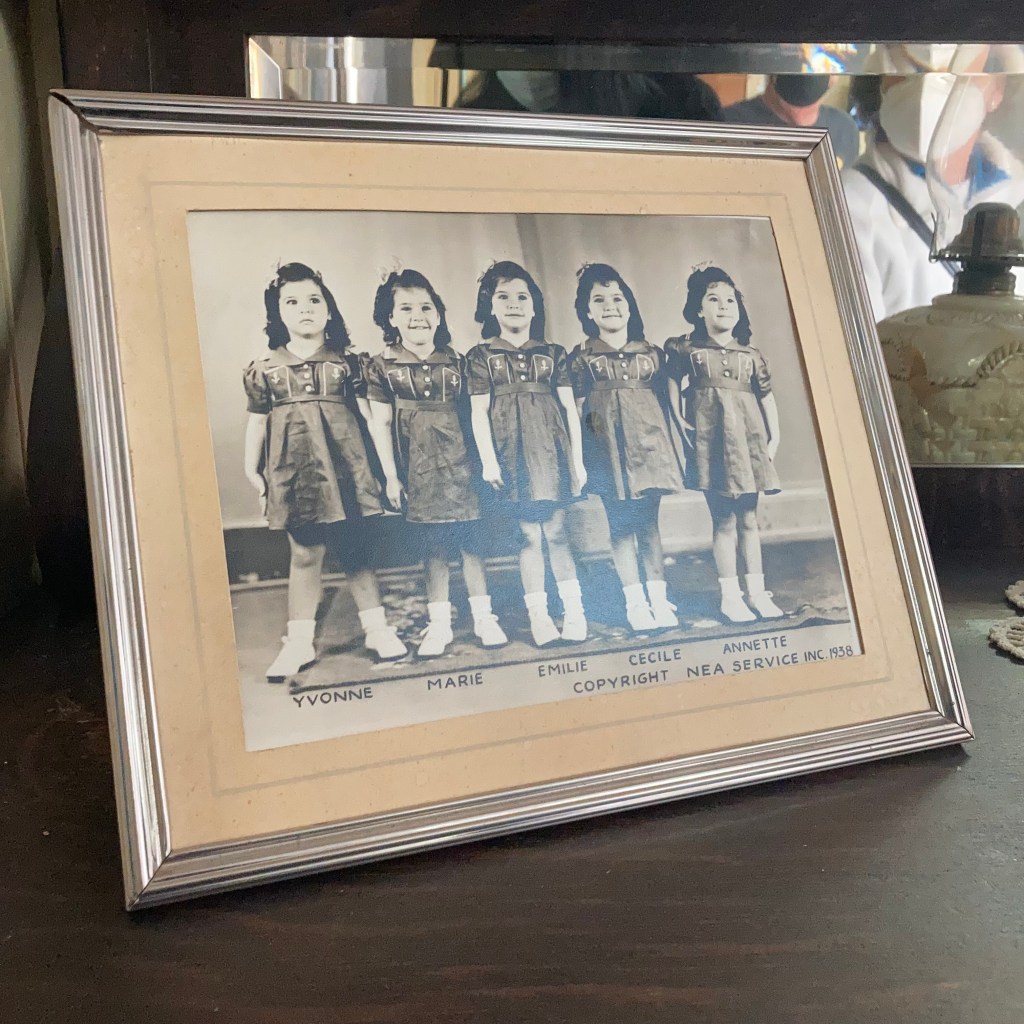
The Dionne Quintuplets: (From left to right) Yvonne, Marie, Emilie, Cécile and Annette.
The Dionne Quintuplets were separated from their family and exploited by the “good” Doctor. As well as extensive advertising using the girl’s image, Quintland was built. A large building complex where people from all over the world came to see the quintuplet girls. The courtyard of Quintland was encircled by two-way mirrors, where visitors could pay a fee to watch the girls as they played. After about 9 years, the girls left Quintland and returned to live with their parents. They had other siblings, as the Dionne’s had had 14 children in total. The quints were essentially strangers to their own family, after having been separated from them for so long. It must have been just as strange for their siblings, hearing about their famous sisters, but not knowing them at all. I can only imagine the strain that would put on the family.
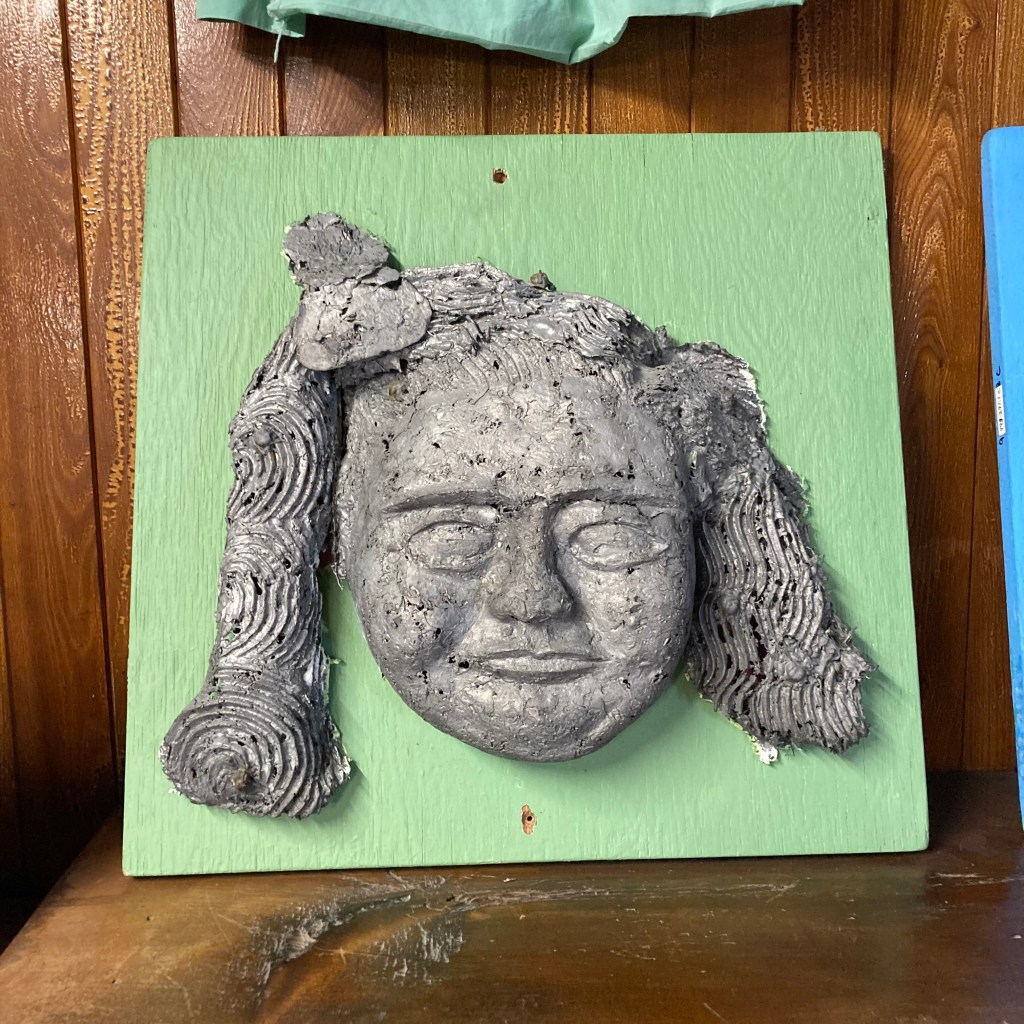
After visiting the Quint House Museum, we traveled a little bit down the road to Callander to visit the Callander Bay Heritage Museum and Alex Dufresne Gallery. This museum is housed in what was once the office of Dr. Alan Roy Dafoe. A turnstile that was used to admit and count attendees to Quintland sits outside. The Quint House Museum also has one of these turnstiles. The house is very rustic and feels like a home office. It would be really interesting if they had a floor plan of what the office looked like when it was in use. This museum also contains a lot of memorabilia of the quintuplets. Some of the more interesting items include lead sculptures of the quintuplet’s faces that were mounted on a clock tower. The sculptures are quite terrifying. There are other exhibits at this museum as well, such as a 1920s barbershop, some military items, as well as logging and mining history.
A lead sculpture of one of the Dionne quintuplets, that was once part of a large clock tower.
Visiting the Quint House Museum first made walking around Dr. Dafoe’s office a little awkward. Knowing the pain and strife he had put the family through, made the experience a tad unpleasant. The Callander Bay Heritage Museum also holds an art gallery. We took a little detour from the quintuplet exploration and looked at the beautiful artwork they had on display. We also visited the gift shop and purchased a few things; in particular a recent book on the history of the quintuplets called The Miracle & Tragedy of the Dionne Quintuplets by Sara Miller.
After grabbing some lunch at a delicious little chip stand in Callander, we made our way to Corbeil to visit the Sacred Heart cemetery. As we traveled down a little dirt road and came to the entrance of what looked like the driveway to a farm, I started to realize something.
I had been to this cemetery before!
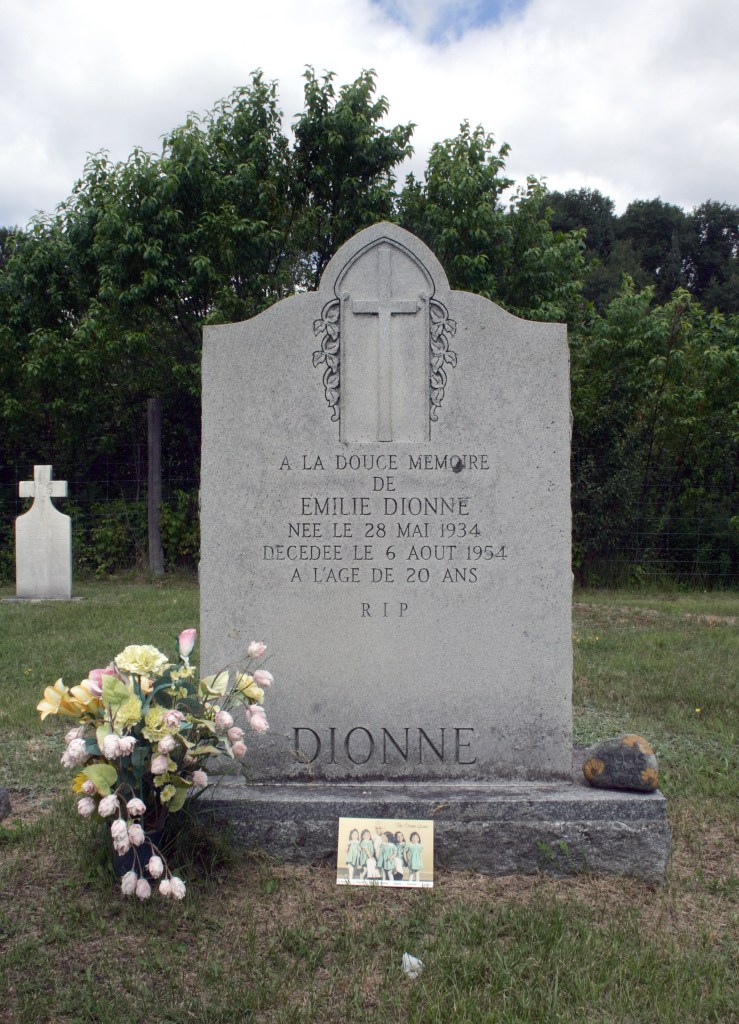
The cemetery is on farm land. Next to the chicken coops and tractors is a fenced-in cemetery with a bright orange diamond sign that says “cemetery entrance”. As we drove up, a man was outside working on his tractor. I rolled down my window and asked if it would be OK if we visited the cemetery. He smiled and nodded, saying that it was fine, so we proceeded to go in. It’s a medium-sized cemetery with a mix of older and newer stones. It looks like it is still an active cemetery as well. The Dionne’s have a small family plot. Oliva and Elzire, the Father and Mother of the quintuplets are buried there. Along with four of their children, one of which is one of the quintuplets Emilie. FindaGrave.com lists two of the quintuplets as being buried here, but I was only able to find the headstone of Emilie.
I have photographed this cemetery before. In 2019 some friends and I did a road trip to North Bay and the area, where we visited the local cemeteries. I’ve even taken pictures of Emilie’s stone. At the time, I recognized the name Dionne, which is why I took the photo. But I never made the connection between the two.
This time I had a postcard with me from the Callander Bay Heritage Museum that showed the quintuplets with Dr. Dafoe. I took photos of the postcard with Emilie’s stone, with no issue. I attempted to take a photo with the postcard on the tombstone for Oliva and Elzire Dionne. The wind was not cooperating and blew the postcard away. After several attempts of trying to get a shot with the postcard, I put it away. Maybe it was the wind, whipping up at an in-opportune moment, or maybe it was the spirit of Oliva and Elzire, refusing to take a photo with an image of the man who took their children away.
There are only two of the quintuplets still living, Annette and Cécile. Emilie and (supposedly) Yvonne are the only quintuplets buried in Corbeil, their home town. The rest of the quintuplets are buried in Montreal. I was curious as to where Dr. Dafoe was laid to rest—he is buried in Toronto.
This was a very educational trip. It was interesting to dive a little deeper into the true story of the Dionne quintuplets. Being able to speak to a blood relative and learn how the family was affected by what happened was truly heart-wrenching and eye opening. The Dionne Quintuplets still draw a crowd, but now for a different reason. In the 1930s it was seen as a miracle and amazing, and no one batted an eye at the fact that these children were taken away from their parents. Today, people are still interested in the Dionne Quintuplets, but the narrative is much different.
If you are interested in learning more about the story of the Dionne Quintuplets, you can visit these links below:
A couple of weekends ago I visited the grave of Renée Sweeney.
While planning out a hike that weekend, I checked which cemeteries would be along the way. One of them just so happened to be her resting place.
I usually don’t spend as much time in newer cemeteries because the stones and symbolism are much more modern and not as nuanced. This cemetery is full of some very interesting stones and stories. Because I was searching for one grave in particular, I took my time walking through the rows, examining every stone. I came across some lovely stones and epitaphs, as well as some heartbreaking ones.
But none as heartbreaking as the family plot of Renée Sweeney.
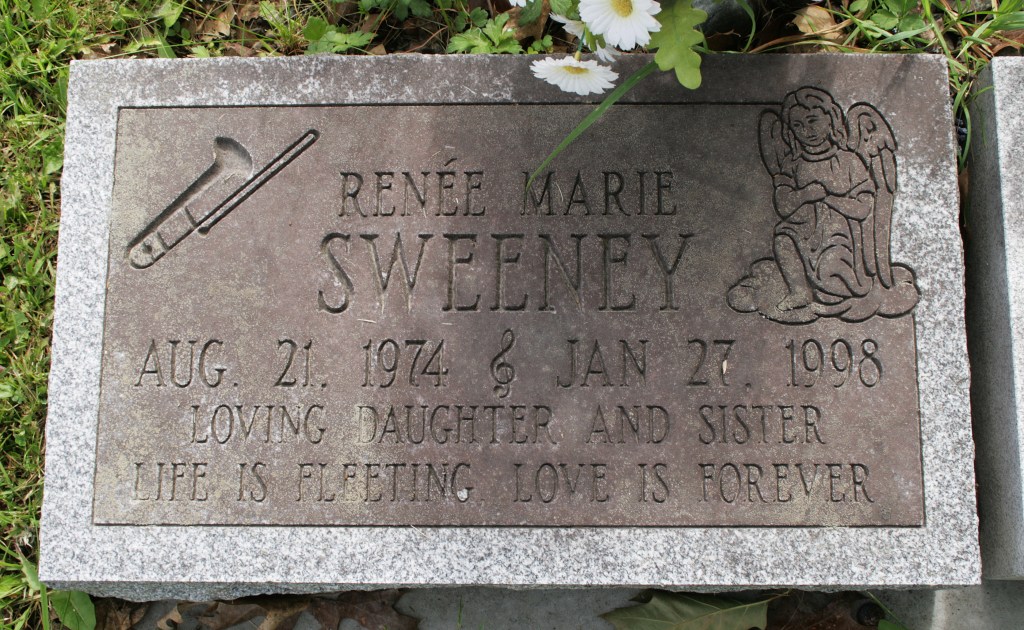
Her grave marker is small, laying flat to the earth, but it tells a story of a life cut short, that had a lot of love yet to give. The epitaph reads “Loving Daughter and Sister, Life is fleeting Love is forever” A trombone is engraved on her stone, as well as a treble clef and an angel. She is buried beside her mother.
What happened to Renée is terrifying and heart-wrenching. She was 23 years old when she was brutally murdered in 1998. She was stabbed at least 30 times while working at Adults Only Video.
Her murder went unsolved for 20 years.
In 2018, Robert Steven Wright was arrested. He faces a second-degree murder charge. Due to the pandemic, he is still awaiting trial. His new trial date as of this writing is October 25th, 2021. The trial is expected to last 5 weeks.
Renée’s story can be found in more detail in Unsolved Sudbury: Missing. Murdered. Unexplained. by Sarah May. Books are available locally at Bay Used Books, Jan Browning Boutique, and Sudbury Paint and Custom Framing.
If you are interested in learning more about this tragic history, you can read more about it at these links:
I find it fascinating and love trying to decipher the symbols and iconography I find. Symbolism can be found adorning tombstones and mausoleums. These symbols can range from simple designs to very elaborate ones. The meaning of symbols is a language in itself, and you can tell a lot about a person by what is on their tombstone. Religion, hobbies, clubs, and organizations can all be found represented, among other things, by symbols and icons within a cemetery.
Whenever I spot a symbol I have not seen before, I always turn to my handy reference books. If I can’t find what I am looking for there, the internet is the next best place to look. My go-to reference book is Stories in Stone: A field guide to cemetery symbolism and iconography by Douglas Keister. I have had this book forever, and always go back to it when I see something new. It’s a very in-depth look at what can be found in a cemetery. It covers architecture, sculpture, symbols, as well as acronyms and initials. I highly recommend it!
I recently added another reference book to my library, Understanding Cemetery Symbols: A field guide for historic graveyards by Tui Snider. I have just started getting into this one and I can tell right away it will be a great resource. It has some really in-depth sections on hand symbolism as will as crosses and even statuary.
So what kind of symbols and iconography can you find in your local cemeteries? For the most part religious symbolism is very common. Below are some examples of some common and not-so-common symbols you can find in Canadian cemeteries:
I love finding hands on a tombstone. Hands are shown in many different forms; pointing downward, pointing up, shaking hands, etc. the list goes on! And all of these different positions have different meanings. One of my favorite examples of hands was found in Terrace Lawn Cemetery in North Bay. These stones have weathered beautifully. This hand is pointed downward, with a finger extended which can symbolize God reaching down to collect a soul. The extended finger can mean a sudden or unexpected death. This hand below, is also holding a chain. A broken link in the chain can represent a family or marriage broken by death.
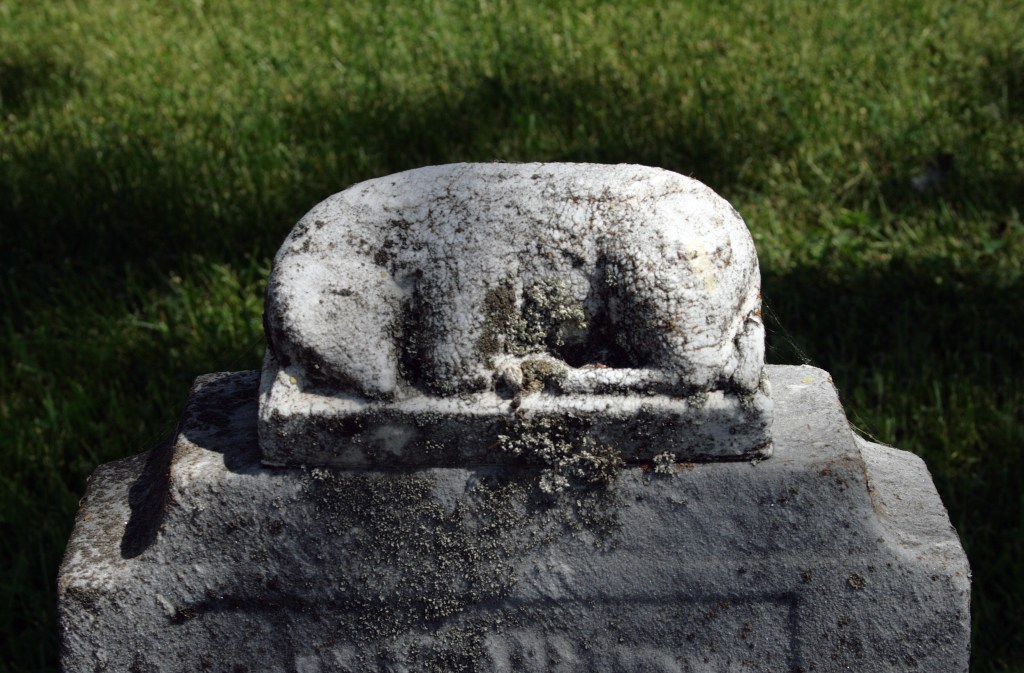
Lambs are a very common sight in cemeteries. These are sometimes accompanied by a tree stump, implying a life cut short. The Lamb itself represents “the lamb of God” and innocence. Sadly, lambs are most often found at the grave of a young child or infant.
Skulls are very rare to come by in my local Canadian cemeteries. I have only found two in all of my local travels, but I am always on the look out for them. They are more commonly found in other places of the world, like the United States and Europe. Most obviously a skull represents death. A skull found at the base of a cross is thought to be symbolic of the skull of Adam.
I have many great examples of symbols and iconography in my photography. If you are interested in seeing more and learning about their meanings, I share them every Friday on Instagram and Facebook.
I would also love to hear about the symbols you have found on your cemetery travels. Do you have a favorite? I would love to read about them in the comments.
Thanks for reading!
References:
Understanding Cemetery Symbols: A field guide to historic cemeteries by Tui Snider
Storie in Stone: A field guide to cemetery symbolism and iconography by Douglas Keister
I wrote a post last week reminiscing about cemetery road trips. It may have been a bad idea as it made me want to plan one even more!
This year, just like last, I have been spending a lot of time with my Mom. We have been visiting different local walking trails as something to see and do while we are in lockdown due to COVID-19. This year we have started visiting provincial parks that are close by to visit their hiking trails. This gave me an idea!
Why not stop at local cemeteries that are along the way or close to our destination? And so the mini road trip was born!
My Mother is fairly used to me making pit stops on the way to our hiking trails, but this past weekend, I deliberately drove out of my way to visit 2 cemeteries. I did a bit of research and found the locations of two cemeteries I have been wanting to visit for a long while now. One in Britt, and one in Byng Inlet. An old co-worker of mine told me about a very old and interesting cemetery in Byng Inlet that I should visit. This was several years ago. It just happens to be across the river from Britt, and another cemetery I have wanted to visit for a while.
We drove to Byng Inlet first with the plan of visiting Britt and Grundy Lake Provincial Park as we made our way back towards home. We enjoyed the drive and I was pleasantly surprised by what we found.
In Byng Inlet, we found Magnetawan Cemetery which looked to be a small family cemetery, as well as two very old cemeteries. Sitting right on the side of the highway sits the cemetery of Saint John the Divine (1911-1931) and beside it, the cemetery of St. Andrew’s Presbyterian Church (1911-1924). Both of these cemeteries are partially hidden by the wild forest that has sprouted up around them. I was only able to find one stone at the cemetery of St. Andrew’s Presbyterian Church. It was an obelisk-style stone, that had sadly fallen to the ground. The cemetery of Saint John the Divine had about 10 stones that I was able to find, including one military grave. I was very excited by this find.
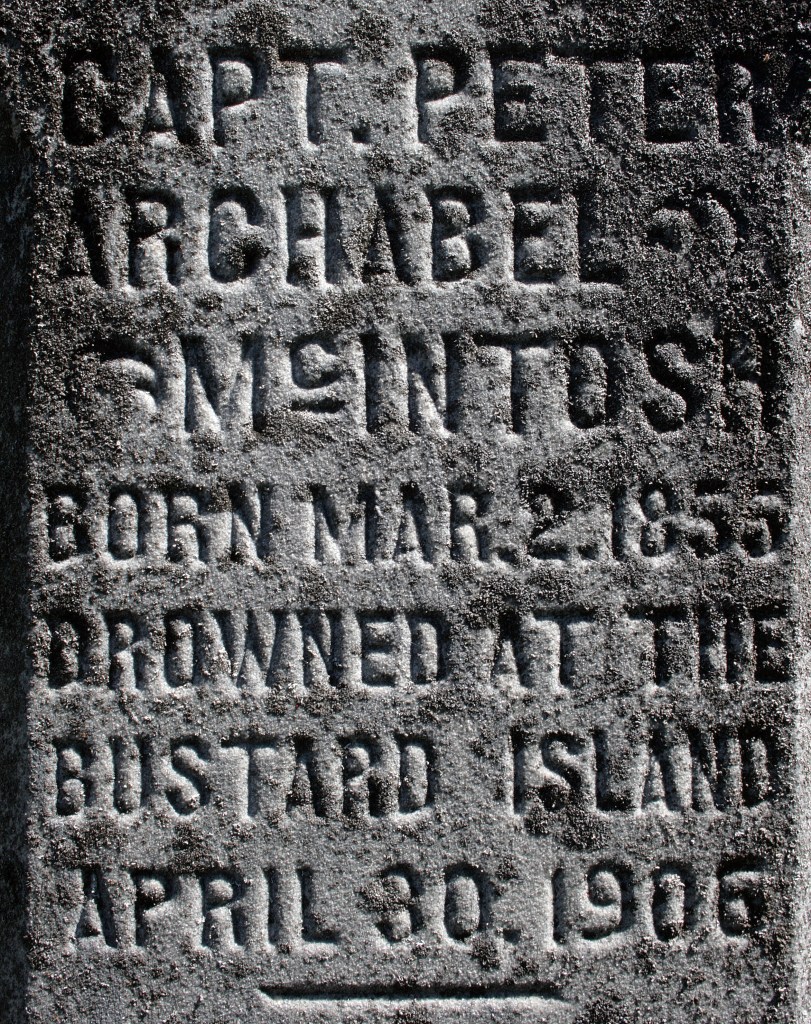
In Britt, we stopped at a small cemetery across from a small white church – the Britt Holy Family Church Cemetery. This small little cemetery, on the bank of a river, holds a mix of old and modern stones. The oldest stone we found was a family grave. Capt. Peter Archabel McIntosh, who drowned at the Bustard Island in 1906, and his wife Lillie Clovetier who passed away in 1905.
After realizing that that was not the cemetery I was looking for, we traveled a bit farther and found not one, but two more cemeteries; the Britt and area community cemetery and the Holy Family Roman Catholic New Cemetery. That made a total of six cemeteries we visited that day.
We walked among the stones for a little while, while I snapped away with my camera. Interestingly enough, there is a campground adjacent to the Holy Family Roman Catholic New Cemetery, filled with RV’s and trailers – with some of them backed up right against the cemetery.
After our cemetery visits, we headed to Grundy lake to stop for a picnic lunch and then go for a hike through their Swan Lake trail. It’s a beautiful trail and was a great way to end our adventures that day.
I think this trip may have started a new tradition of cemetery visits, picnic lunches, and hiking trails. I mean it’s not a bad way to spend time outside during a pandemic.
I have been thinking about road trips a lot lately.
During a normal year, my friends and I would be discussing plans for our next one. I have been itching to research locations and plan travel routes. But alas, just like last year, it looks like it will not be happening this year.
Cemetery road trips are one of my favorite things to do in the summer months. We all would pile into one vehicle, chit-chat, and listen to music while cruising along to our cemetery spots. We usually pick a city or town and stop at all the cemeteries along the way. After visiting the cemeteries within that city’s limits we would also explore the outskirts, sometimes finding hidden cemeteries that we didn’t find in our research. These are great ways to spend time together, make memories and explore our backyard!
The last road trip we did was in 2019. We visited Sault Ste Marie. Normally this trip would only be about a 3-hour drive, but it took us a whopping 6 hours! We made so many stops along the way and took our time exploring. We visited some very old cemeteries, full of the history of the town, as well as some newer ones. Lots of discoveries were made, including one of the largest cemeteries I have ever visited before! We visited 11 cemeteries in total that day. We didn’t beat our record, but it was a very good attempt. Our record so far is 13!
We also took time to do some sightseeing, and visit some of the historic museums there; the Canadian Bushplane Heritage Centre and the Ermatinger Old Stone House. We heard some interesting ghost stories from the staff at the Old Stone house and it prompted some interesting discussion and exploration while we were there. We did not find any ghosts though. It’s a beautiful house with some really interesting history. Getting in some sightseeing was a bonus for that trip.
We have also gotten into the tradition of visiting any Starbucks that we can find, and always end the day at the local Casey’s for supper. A favorite restaurant that we no longer have in our own city. It’s a great cap to the day, followed by a much quicker drive home while we debrief on the fun and experiences of the day.
So for this year, instead of grand travel plans, I will stick close to home and visit my local cemeteries. Re-visit my favorites and take more time to explore those that I have not been to for a while. There is always something new to find and photograph!
Update: After writing this blog post I did just that! I had a mini road trip adventure this weekend. I’ll have a new post coming soon with some new photos.
Flowers may not be the first thing on your mind when visiting cemeteries, unless of course you are bringing in an arrangement. But you may start to notice them more and more, dotting the graves, as well as the green spaces in between. Wild flowers can be found snaking through the grass and reaching into all corners of a cemetery plot.
Abandoned cemeteries are usually filled with wild flowers as there has not been anyone to weed or tend to the ever growing vines. They add a lovely pop of colour to a green space.
I have seen some plots completely filled with wild flowers, where families have made the entire plot a flower bed. I imagine their loved one must have been an avid gardner.
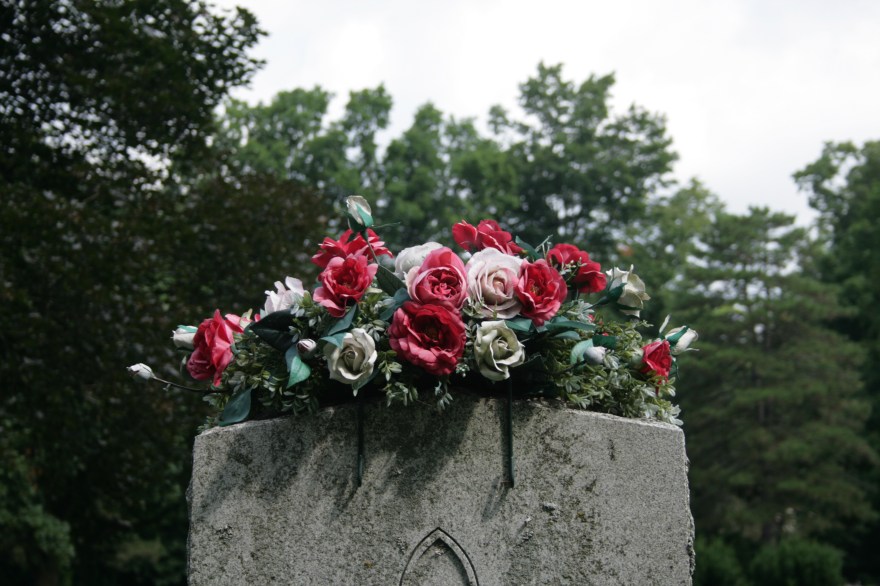
You might also see fabric or plastic flower arrangements. These must have been so beautiful when they were first placed; clean and bright. Over time these arrangements take on a different kind of beauty— weathering the elements and time.
Springtime also means that the snow is melting, making cemeteries more accessible. Trudging through the snow is never fun. I have been slowly making plans for some road trips this spring and summer to visit some new-to-me places as well as some of my favourite spots.
Thankfully cemeteries are not usually a bustling place so being able to physically distance while exploring is great.
I have always had a deep love of cemeteries and graveyards. It may sound a bit morbid, but I have always found beauty and peace in a cemetery. The combination of nature, art and history is what I find really appealing. A cemetery is a great place to go for a quiet walk, to learn about the history of a place, or to learn about your ancestors. Over the years I have visited many cemeteries and love to take pictures of what I see. I like to focus on details of gravestones, iconography, interesting epitaphs and mementos left behind by loved ones.
After realizing I had folders upon folders of photos, I wanted to do something with them—not just keep them to myself. So I decided a website would be a great place to showcase them. I’m still working out the details on how I want to organize them, but I’m sure that will evolve over time.
I chose WordPress because it looked like a great way to showcase my portfolio and include a blog option. I am in no way an avid blogger, but I do get the urge to write sometimes. So please do not expect a perfectly kept up-to-date blog! I’m hoping to write about my favourite cemeteries, road trips, newly explored cemeteries, cemeteries in the news and other cemetery related things.
I will also be slowly adding photos as I go!
If you are interested, I can also be found in other places around the web; Facebook, Instagram and ViewBug.












 Cemetery Photography by Chantal Larochelle