Cemetery Recipes: Snickerdoodles

For this month’s cemetery recipe, I decided to venture back into the world of cookies. After recently finding this recipe etched in stone, I thought it would be a perfect time to try another Snickerdoodle recipe.

This will be the second Snickerdoodle gravestone recipe I have tried, and I was curious to see how this version would compare.

This cookie recipe comes from the gravestone of Sharon Faye Johnson Lawrence, who is buried in Mount Hope Cemetery in Webb City, Missouri.

Sharon passed away on May 25, 2020, at the age of 73, after a sudden illness. A beloved mother, grandmother, and member of the community, Sharon was known for her love of gardening and spending time with her family—especially her grandchildren.1

Her obituary also mentions how much she enjoyed baking and cooking for her family, which makes this recipe engraved on her tombstone even more special.1

This snickerdoodle recipe is now forever part of her legacy, engraved on her tombstone for future generations to discover and enjoy. It’s a beautiful memorial, accented by the lovely image of a cookie jar and plate of cookies.

Here is the recipe, as written on the gravestone:

Snickerdoodles

  • 1 cup soft shortening (part butter)
  • 1 ½ cups sugar
  • 2 eggs
  • 2 ¾ cups gold medal flour
  • 2 tsp cream of tartar
  • 1 tsp soda
  • ¼ tsp salt

Heat oven to 400° degrees. Mix shortening, sugar, and eggs thoroughly. Measure flour by dip-level-pour method or by sifting. Blend all dry ingredients. Stir in. Roll into balls the size of small walnuts. Roll in mixture of 2 tbsp sugar and 2 tsp cinnamon. Place 2 apart on ungreased baking sheet. Bake 8-10 minutes. (These cookies puff up at first then flatten out)

In the Kitchen

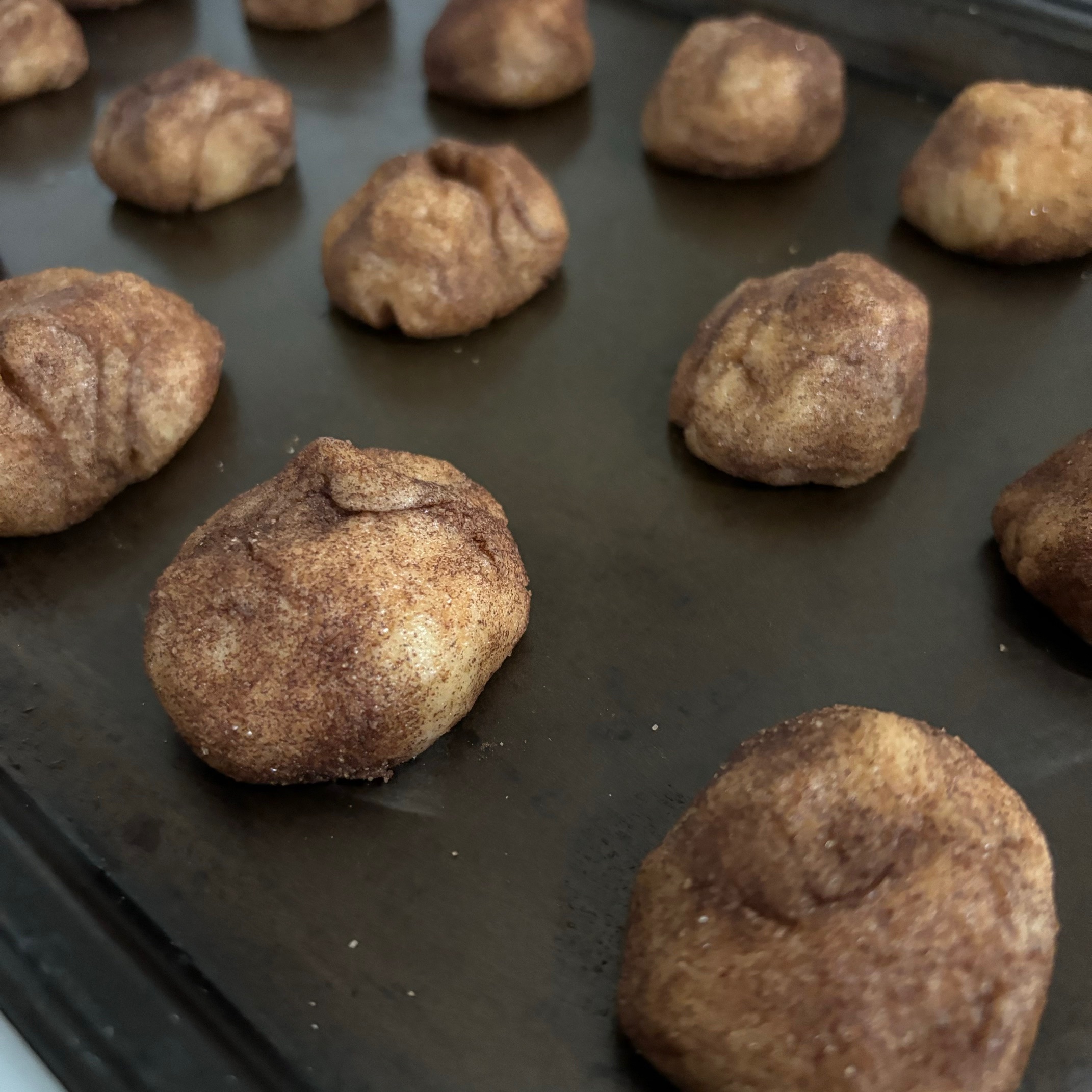
In my kitchen, the baking experience was straightforward and fun. This gravestone recipe was more detailed than most, so it was very easy to follow. Mixing the ingredients was a breeze, and I loved the smell of cinnamon that filled the air. Rolling the dough into small balls and rolling them in the sugar mixture was my favorite part of the process.

I didn’t have the exact flour that Sharon’s recipe called for, but I used the Great Value all-purpose flour I had on hand. Even though it wasn’t the Gold Medal brand specified, the cookies still turned out wonderfully.

I did learn that there is a name for the way I usually measure out dry ingredients. I was curious about the dip-level-pour method that was named in the directions, so I did a quick Google search.

Apparently, this is a common measuring technique, where you scoop the flour into a measuring cup till it’s slightly mounded at the top, then you level it off with a flat edge, like a knife, and then pour that into your mixing bowl.2

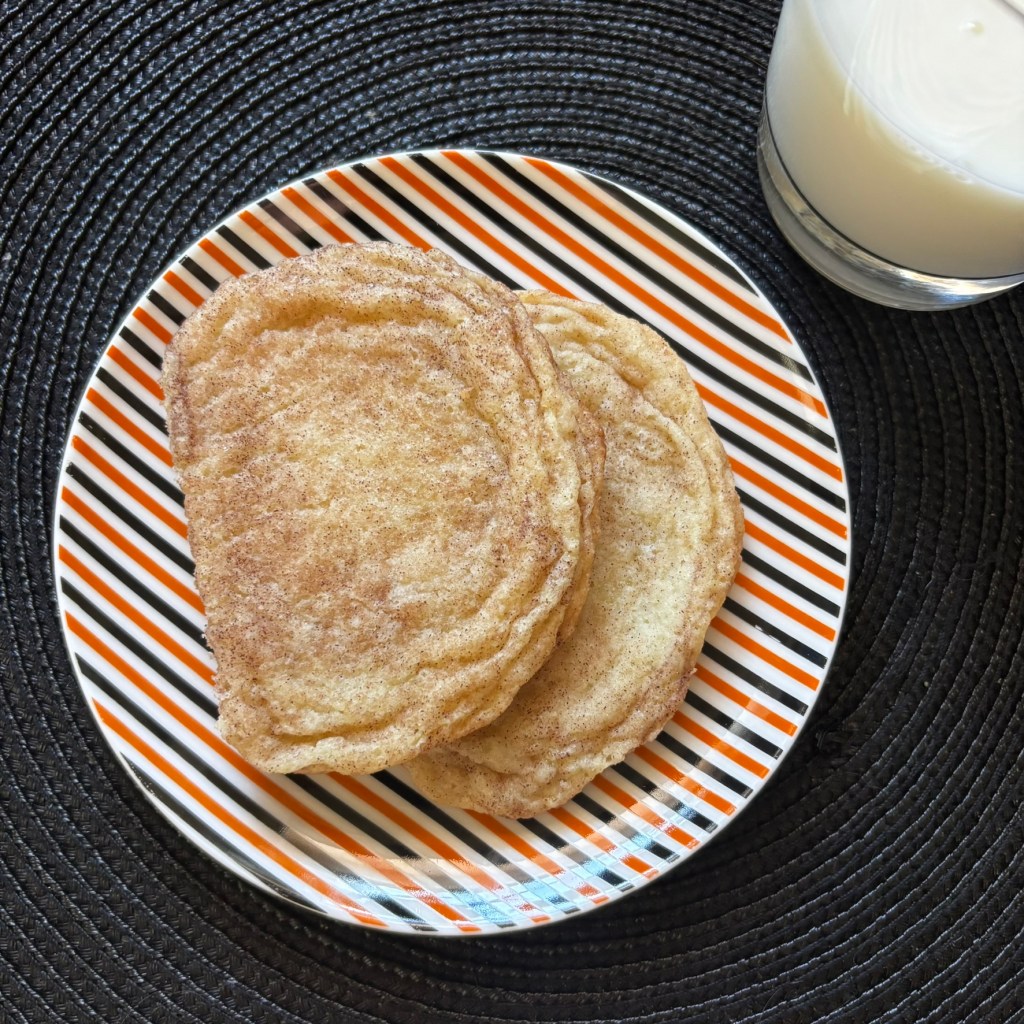
The recipe made a big batch of cookies. I ended up baking two and half trays full. I think I maybe should have spaced them out a wee bit more, as most of them spread out into each other. In the end, that wasn’t a big deal, though.

The smell as they baked was lovely, and the warm, slightly crunchy cookies that emerged from the oven were just perfect!

There is something really heartwarming about baking a recipe with such a personal story behind it. Sharon’s love for baking and sharing meals with her family lives on in this recipe. It’s easy to imagine her making these delicious Snickerdoodles for her grandchildren, sharing the happiness and comfort that only homemade cookies can bring.

Will you give this recipe a try? I’d love to hear how they turned out! Whether you enjoy them with a glass of milk (my favorite) or as a treat to share with friends, they are a sweet way to remember Sharon’s love for her family and her passion for baking.

Thanks for reading!


References:

  1. Sharon Faye Lawrence obituary | Parker Mortuary and Crematory
  2. Measuring Flour–The Right Way | The Cook Along Podcast

Cemetery Recipes: Debbie’s Tea Biscuits

For this month’s cemetery recipe, I wanted to try something a little less sugary after indulging in all the sweets this holiday season. So, when I came across this tea biscuit recipe, I thought it might be the perfect fit.

Most of the gravestone recipes I have come across in my research have been desserts, so I was pleasantly surprised when I found this biscuit recipe.

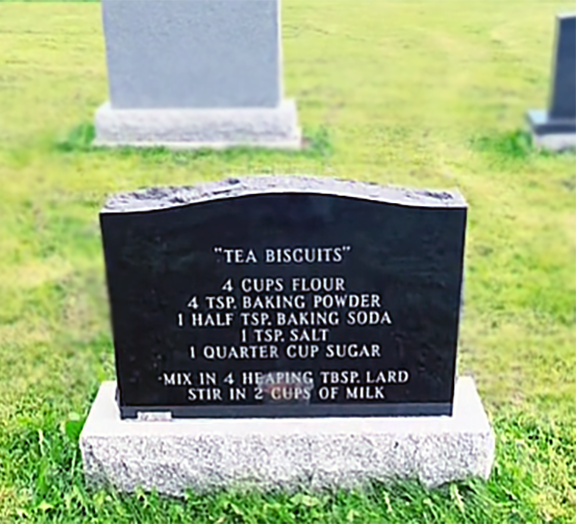
This recipe can be found on the gravestone of Debbie Ann Wilson McNutt, who is laid to rest in Pine Grove Cemetery in Stewiacke East, Nova Scotia. This my first Canadian gravestone recipe.

Debbie passed away on May 19, 2019, just 17 days after her birthday, following a long battle with cancer. She was 65. A beloved teacher and active member of her church, Debbie is remembered for her active lifestyle and for hosting family and friends in the summer.1 She is also fondly remembered for her tea biscuit recipe. According to family and friends, she made these biscuits about once a week.2

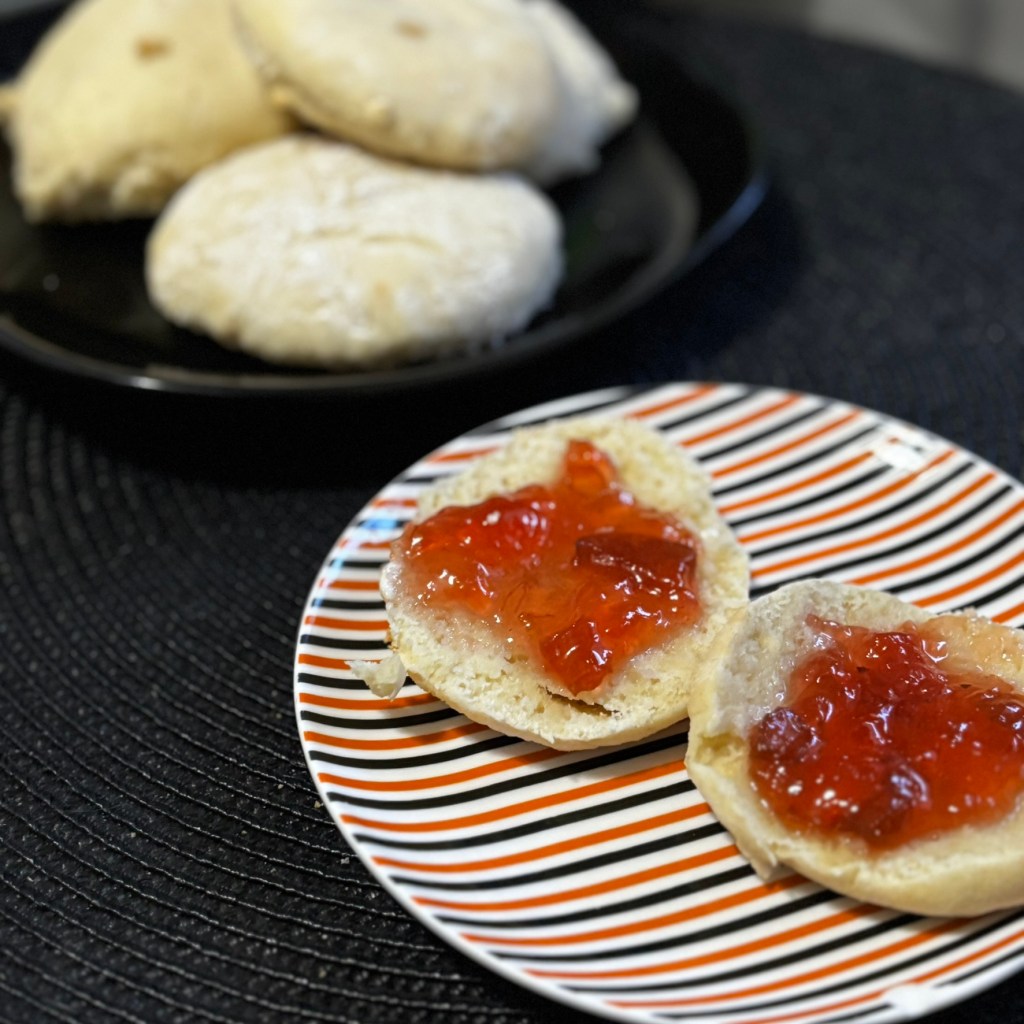
It was Debbie’s husband’s idea to engrave the recipe on her gravestone, hoping it would make people smile.2 This family recipe comes from Debbie’s mother, Jessie Wilson, who is still living. According to the family, the biscuits are best enjoyed topped with homemade jam.2

Here is the recipe as written on the gravestone:

Tea Biscuits

  • 4 Cups Flour
  • 4 Tsp. Baking Powder
  • 1 Half Tsp. Baking Soda
  • 1 Tsp. Salt
  • 1 Quarter Cup Sugar

Mix in 4 heaping tbsp. lard. Stir in 2 cups of milk.

This recipe was also printed on a memorial card for Debbie, which includes the extra baking instructions2:

Roll out, bake at 400oF degrees until golden brown.

In the Kitchen

I have never made biscuits that didn’t come out of a can before, so I enjoyed putting this recipe together. It was very straightforward to follow and pretty quick and easy.

After setting my oven to preheat at 400oF and gathering all my ingredients, I followed the recipe’s instructions and mixed all the dry ingredients together. After adding the last two wet ingredients, I used a hand mixer to combine everything together.

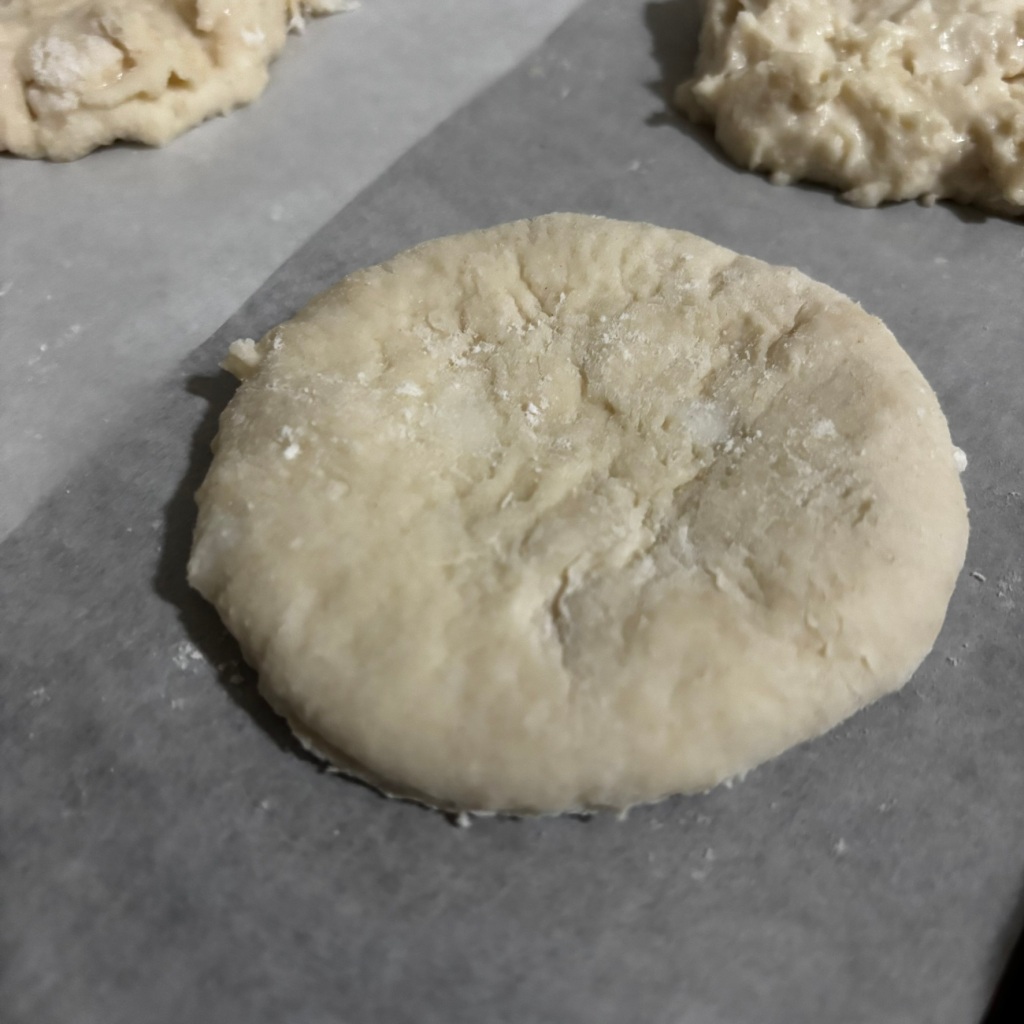
This is where things got a bit messy, but I trusted the process. Using a hand mixer may not have been the wisest choice, but it got the job done. After the dough was ready, I put down a thin cutting board on my counter to create my rolling space. I floured the surface and my hands and rolled out the dough. The dough is very sticky, so I continuously had to flour the surface and my hands.

To cut out my biscuits, I used a drinking glass because I didn’t have a circular cookie cutter. I also had to repeatedly flour the rim of the glass so the dough wouldn’t stick.

This recipe made a fairly big batch—more than I thought it would. I prepared two baking sheets with parchment paper and placed the uncooked biscuits on the sheets as I cut them out.

Unfortunately, the recipe doesn’t say how long to bake the biscuits for, only stating to bake until golden brown. I didn’t want to guess, so I did Google how long they should be baked for, and I found that 8 to 16 minutes should do—or until golden brown.

I put them in the oven and set a timer for 8 minutes. They still needed a bit more time after that, so I put them in for another 2 minutes. That seemed to do the trick.

I can see why Debbie would make this at least once a week. They are quick and easy to make, and taste lovely!

Trying out these cemetery recipes always adds an extra layer of meaning to the experience, thanks to the special stories behind them. There’s something truly heartwarming about preparing and sharing a dish that has been passed down through generations—especially one that brings a person’s legacy to life.

Are you planning to try this recipe? Let me know how it turns out! Whether you enjoy your biscuits with jam or as part of a cozy meal, I’m sure they’ll taste even better knowing the meaningful history they carry with them.

Thanks for reading!


References:

  1. Debbie Ann McNutt obituary | Mattatall-Verner Funeral Home
  2. Ghostlyarchive | TikTok

Cemetery Recipes: Chocolate Chip Cookies from the Cookie Book

Over the summer I took a little break from making gravestone recipes, but I think it’s time to try another one. Fall is coming, so what better time to make chocolate chip cookies? They are always the best when they are still warm from the oven.

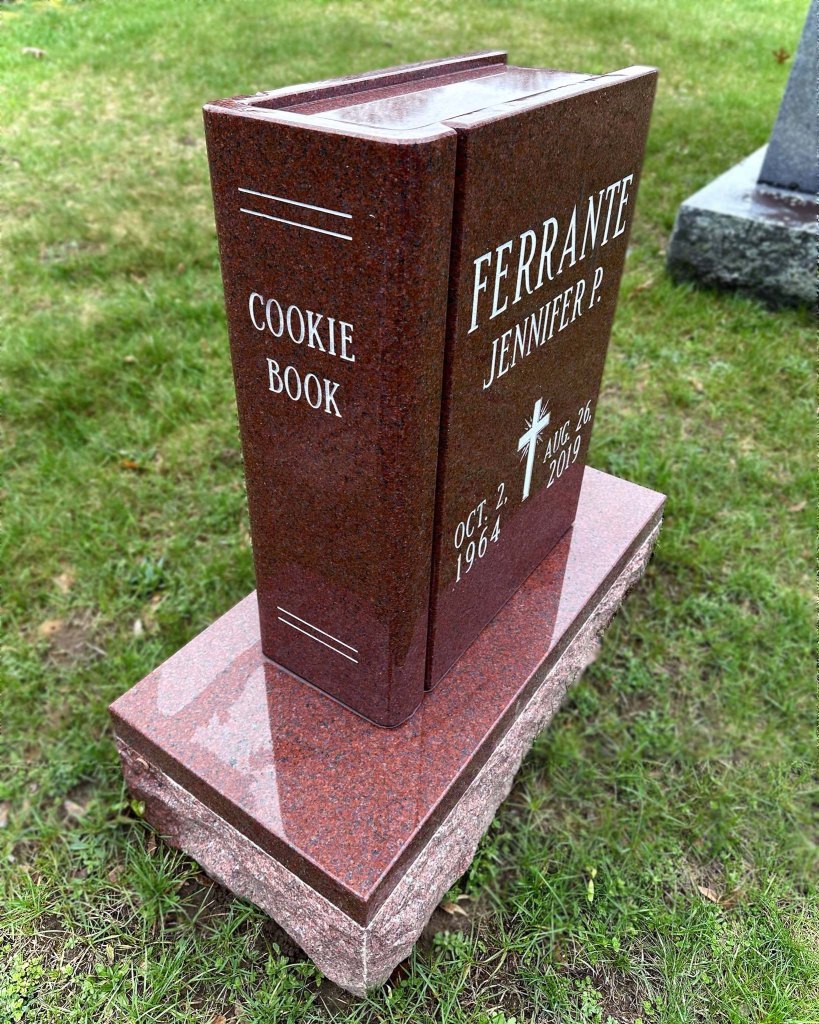
I came across this gravestone on reddit, posted by user ubercrabby. So, today on the blog, I want to try making Chocolate Chip Cookies from the Cookie Book gravestone of Jennifer P. Ferrante.

Ferrante’s red granite gravestone, found in a cemetery in upstate New York, is shaped like a book, with “Cookie Book” inscribed on the side. The recipe can be found on the back side of the stone.

Jennifer Peggy Allan Ferrante was only 54 when she passed away suddenly in August of 2019. According to her obituary, she was a consulting engineer for many years, traveled extensively, and loved spending time with her family and pets.1 She was also an avid baker and was known for her chocolate chip cookies, which she often shared with her loved ones.1

It seems fitting that they would honor her by inscribing her famous recipe on her gravestone for others to make and share.

Here is the recipe as inscribed on the gravestone:

Chocolate Chip Cookies

9 to 11 min 375’F

1) 2 1/4 cups flour
1 tsp baking soda
1/2 tsp salt

2) 1 cup Crisco
3/4 cup white sugar
3/4 cup light brown sugar

2) 1 tsp vanilla
2 eggs
2 cups chocolate chips

Combine dry
Combine wet then add dry

Making the Recipe

Although this recipe is similar to the famous Nestlay Toulouse recipe, also known as Nestle Toll House, there are some small differences—most notably the substitution of Crisco for butter, and the omission of nuts.

It also looks like there might be a typo on the stone, as it has two step 2’s, BUT it might not be a mistake. Both step 2’s contain wet ingredients. Is it possible that it is direction on how to mix the ingredients?

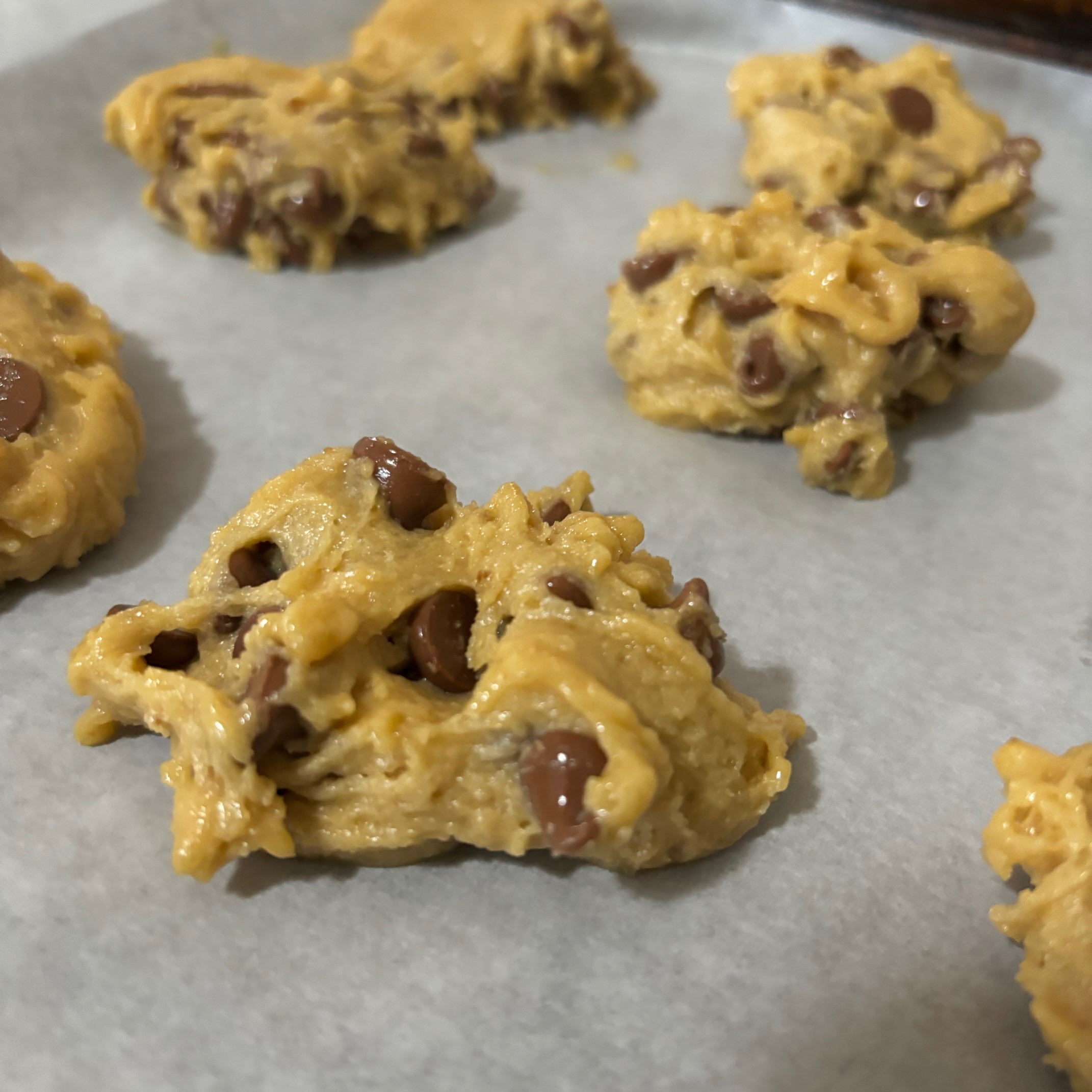
That is the way I read the recipe when I tried it. I mixed the dry ingredients in one bowl, and then in a second bowl, I mixed the ingredients from step 2. Then in the same bowl from step 2, I mixed the vanilla, eggs, and chocolate chips. I was a bit worried about the amount of chocolate chips, it seemed like a lot! When that was mixed well, I then combined the wet ingredients with the dry ingredients, forming a nice cookie dough.

The ingredients consist of pantry staples so it was nice not having to make a special grocery trip to make this recipe. I was curious about the use of Crisco instead of butter. Crisco or shortening, is made from 100% hydrogenated vegetable oil and contains no water.2 It has a higher melting point than butter, so it tends to produce more lift and holds its shape better.2
I try my best to stick to the recipes as written on the gravestone and only make substitutions when necessary—like when ingredients are not available. That being said, shortening has no flavor, so baked goods made with it do miss that buttery taste that only butter can produce. If I made this recipe again, I would make the switch and use butter.

Otherwise, following this recipe was incredibly easy and was a quick one to make. The trickiest part for me was spooning the cookie dough from the bowls to the parchment-lined cookie sheets. I had a bit of a hard time getting uniformed portions so after the first cookie sheet was full, I put a little oil on my hands, to prevent the dough from sticking, and rolled the rest of the dough into balls for the second cookie sheet.

In the end, both cookie sheets came out the same, with the cookies spreading out into each other. I should have given them more space and used one more cookie sheet.

My worries about the amount of chocolate chips were also unwarranted as they didn’t come out a melty chocolate mess. These cookies are incredibly decadent, and delicious!

This is a tasty cookie recipe and easy to make. I can see how this would quickly become a favorite. It’s also a simple recipe with room for modifications if desired. I would make this one again the next time I am craving a nice chocolate chip cookie.

Have you tried this recipe? Or do you have another gravestone recipe suggestion I should try? I would love to read about it, in the comments!

Thanks for reading!


References:

  1. Jennifer Peggy Allan Ferrante | Find a Grave
  2. Butter vs. Shortening in Baking | Land O’Lakes

Cemetery Recipes: Annabell’s Snickerdoodles

Today’s gravestone recipe is another one I have seen floating around on the internet pretty frequently. Since the success of last month’s cookie recipe, I thought it might be time to try another one, this time with some baking involved. 

I am pretty sure I have had a snickerdoodle before, but I don’t recall when. I asked my mother if she had ever made them before, and she said yes, quite often actually. So for today’s gravestone recipe, I try my hand at making Annabell’s Snickerdoodles.

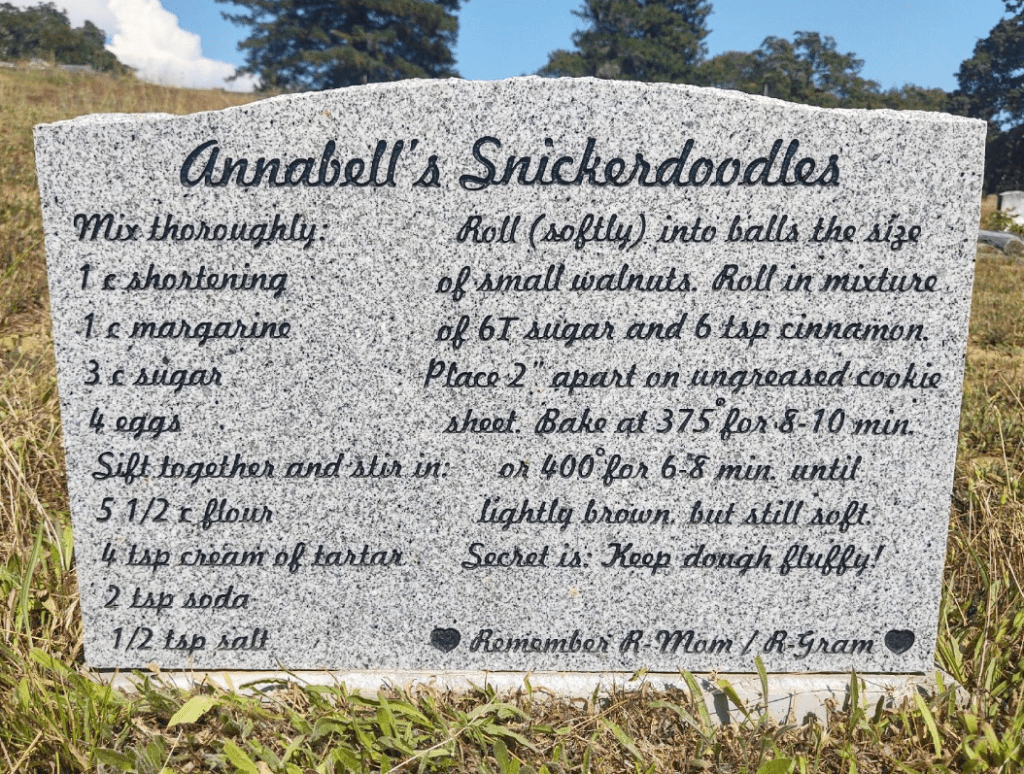
This tombstone treat comes from the gravestone of Annabell R. Gunderson of Willits, California. Found in Willits Cemetery, this gravestone recipe takes up the entire backside of Gunderson’s grey granite gravestone.

Annabell Gunderson passed away at the age of 87, in 2007 after a battle against an unidentified illness.1 In life Gunderson was very active in her community, volunteering her time to multiple organizations. In particular with the St. Anthony’s Ladies Guild.1 Gunderson was known to especially love helping with the yearly enchilada feed—a fundraiser where trays upon trays of enchiladas are made and sold.1 

She is lovingly remembered as a great cook and for her hugely popular snickerdoodles. A recipe that now lives on, etched in stone.

Here is the recipe as engraved on the tombstone:

Annabell’s Snickerdoodles

Mix thoroughly:

  • 1 c shortening
  • 1 c margarine
  • 3 c sugar
  • 4 eggs

Sift together and stir in:

  • 5 1/2 c flour
  • 4 tsp cream of tartar
  • 2 tsp soda
  • 1/2 tsp salt

Roll (softly) into balls the size of small walnuts.

Roll in mixture of 6T sugar and 6 tsp cinnamon.

Place 2” apart on ungreased cookie sheet.

Bake at 375° for 8-10 min. or 400° for 6-8 min. until lightly brown, but still soft.

Secret is: Keep dough fluffy!

Making the Recipe

I spoke to my mom about making this recipe, and right away she was surprised at how much this recipe makes. She suggested I cut the recipe in half to make a smaller batch. Normally I do try to make the recipe as it is written, but I thought making half of this recipe would be more manageable for me in my small kitchen. After learning about Gunderson’s love of community and cooking, I think I understand why this recipe makes such a big batch. 

So after getting out my ingredients and figuring out the new measurements on my kitchen blackboard, I got started on mixing up a batch of Annabell’s Snickerdoodles.

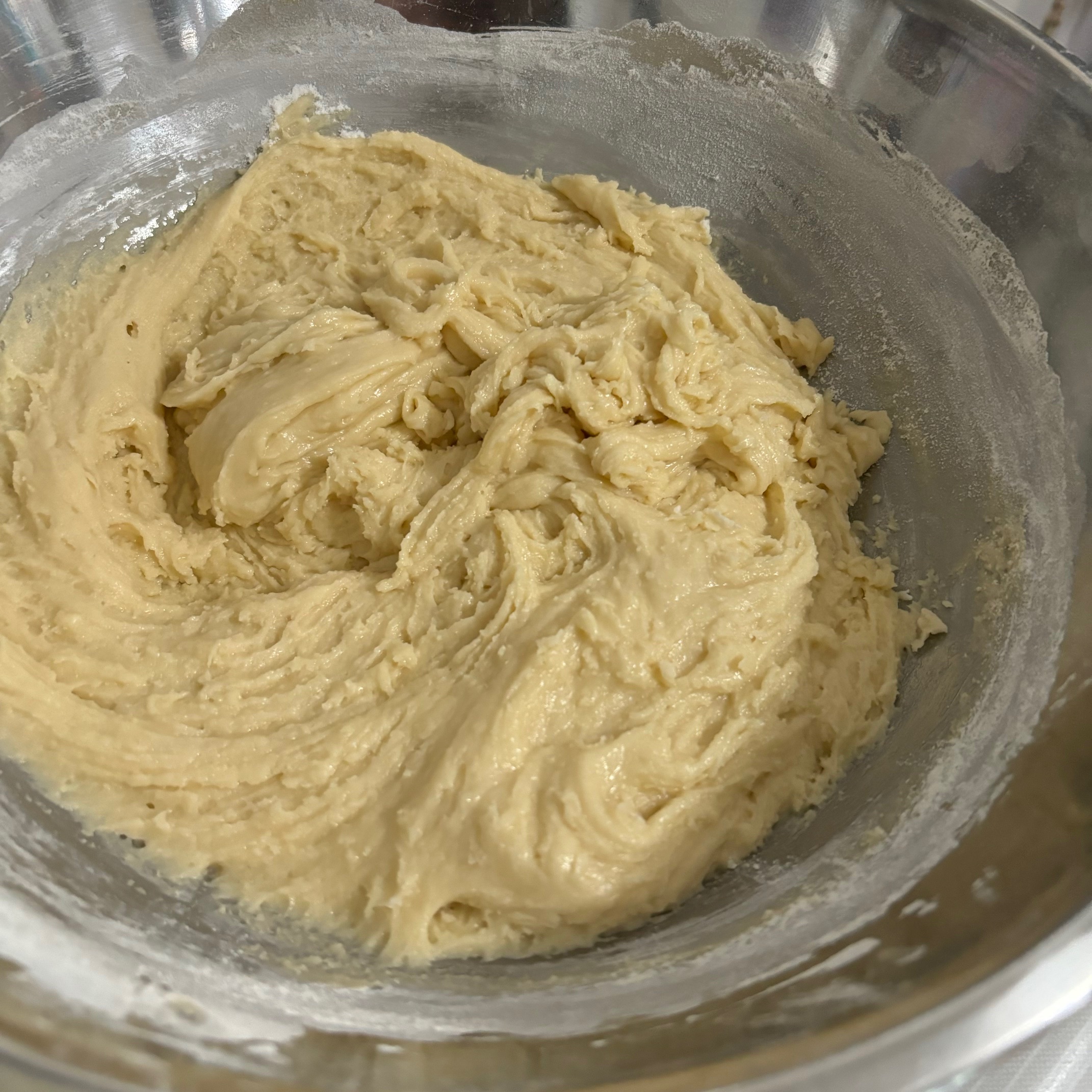
The recipe is very easy to follow, and is very well written. I did have to soften my margarine and shortening in the microwave a bit so it would combine nicely with the sugar and then the eggs. I made sure not to heat them too much though, as I didn’t want to cook the egg at all. 

After that, I sifted in the dry ingredients till the mixture was well combined. I tried my best to not overwork the dough, keeping Annabell’s secret in mind.

Now came the fun part! 

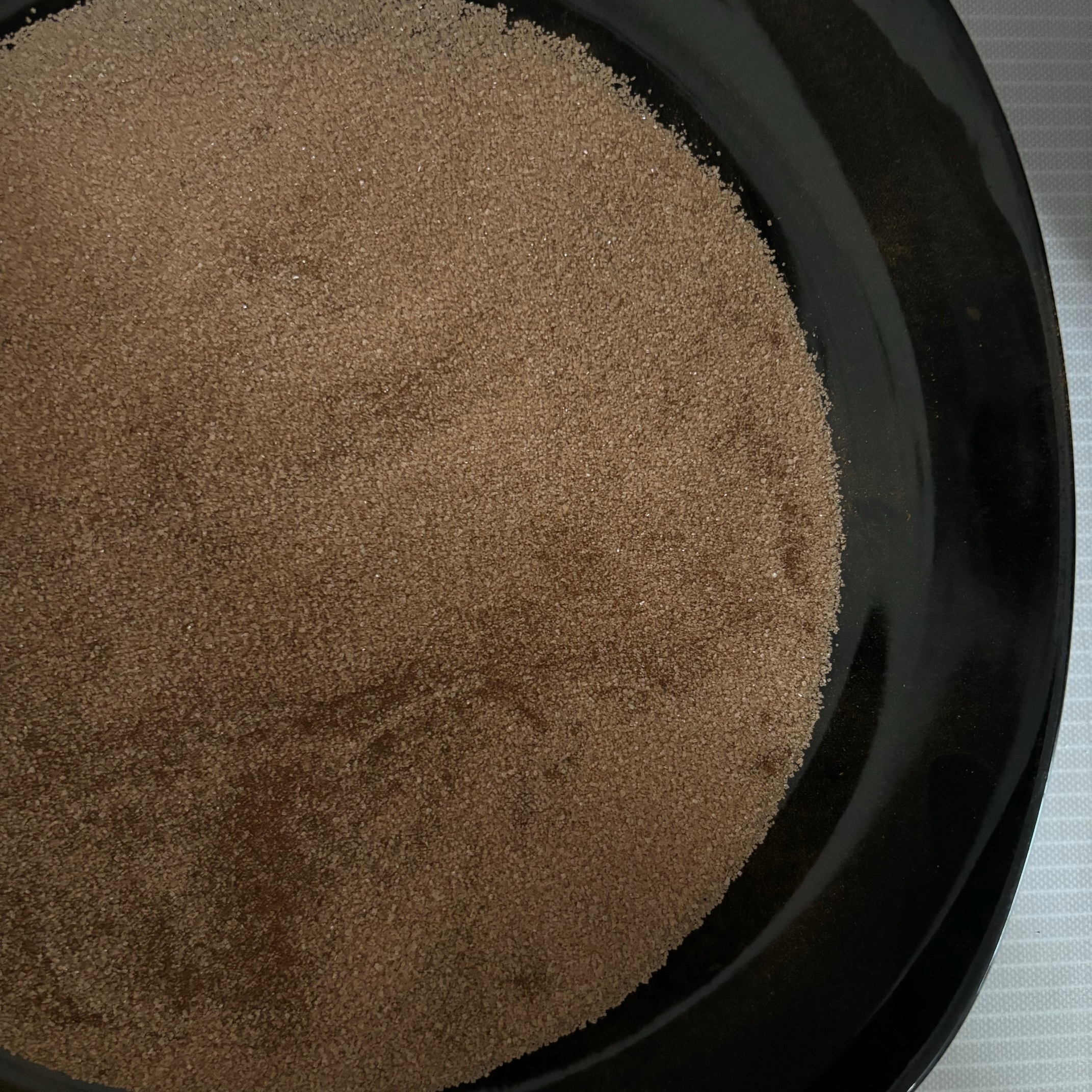
I made sure to mix the sugar and cinnamon very well and put the mixture into a dinner plate so I had lots of surface to roll the dough around. To form the cookies, I pinched off small parts of dough, rolling them between my hands into a ball and then rolled them in the sugar and cinnamon mixture. Then I shaped them a little more with my hands before placing them on the ungreased cookie sheet.

I did flour my hands now and then while rolling the dough to try and stop it from sticking to my hands. I tried my best to space the cookies out evenly between two cookie sheets. I didn’t realize that the cookies would spread, so if I made them again, I would space them out a little more between multiple cookie sheets instead of only using two sheets.

I then placed both cookie sheets in the oven to bake at 375° for 10 minutes. I did a bit of washing up while I waited for them to turn a golden brown. 

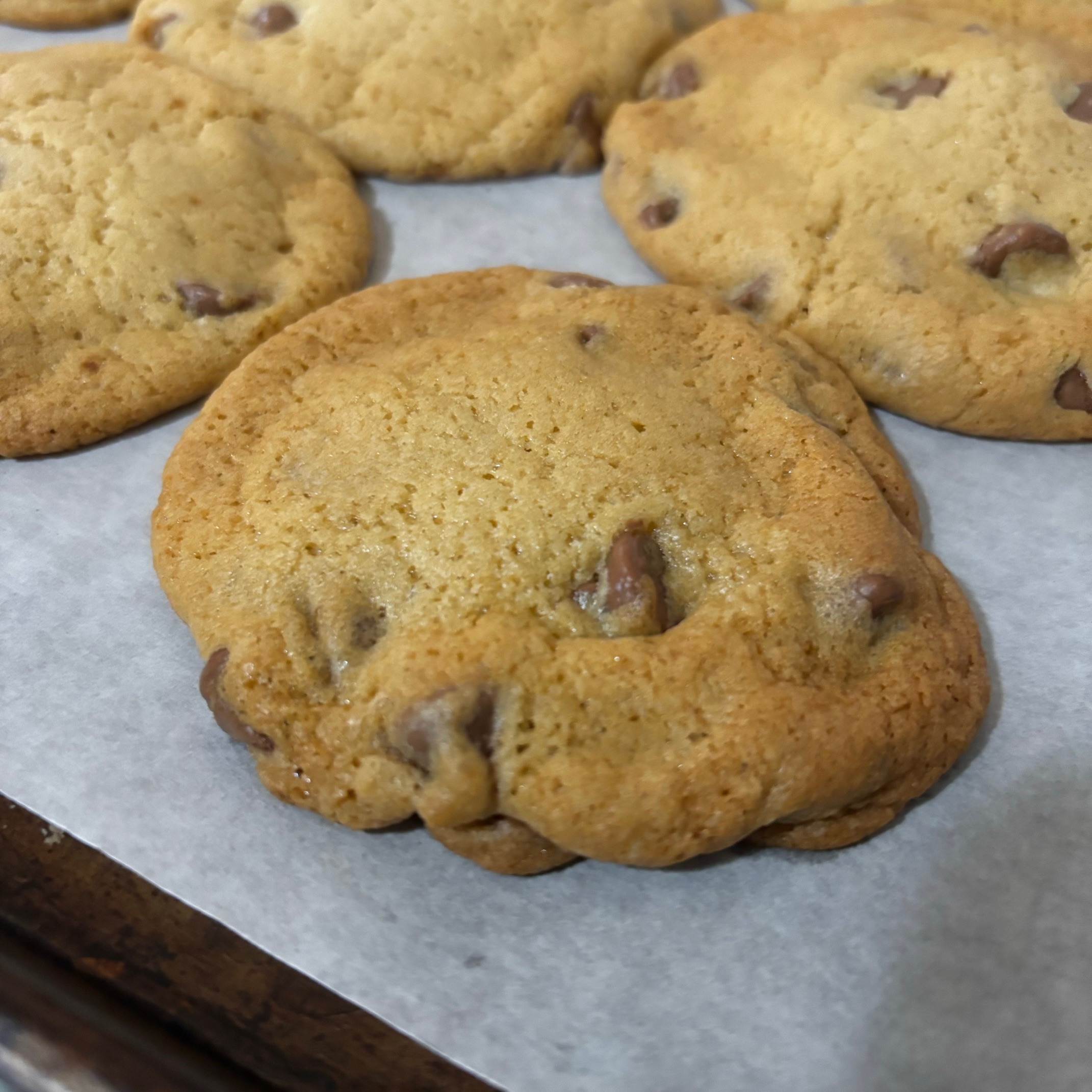
Even though they did spread out a bit on the cookie sheet, it wasn’t terrible. After cooling on top of the stove for 10 minutes I was easily able to break them apart without ruining their shape too much. 

These cookies turned out amazing! I was a little bit daunted by the amount of work that had to go into these. But, it turned out to be not as intimidating as I thought, and the result are some of the best cookies I’ve ever tried—especially right out of the oven.

They are soft and buttery, sweet with a hint of cinnamon. I don’t think they will last too long in my house, as I couldn’t eat just one. I love how they turned out and will definitely be making these again!

This recipe would be great for someone looking for the perfect cookie for a bake sale or cookie exchange. They would also be a fun cookie to make in the kitchen with kids, as I am sure they would love rolling the dough around into the sugar and cinnamon. 

Have you tried this recipe before? Do you have a favorite snickerdoodle recipe? I would love to read about it in the comments!

Thanks for reading!


References:

  1. Annabell Gunderson obituary | The Ukiah Daily Journal

Cemetery Recipes: Chocolate Oatmeal Cookies

I have been craving something sweet and chocolatey for the last two weeks, so when I came across a gravestone recipe for chocolate oatmeal cookies, I knew I had to try them. The bonus is that it’s a no-bake recipe! 

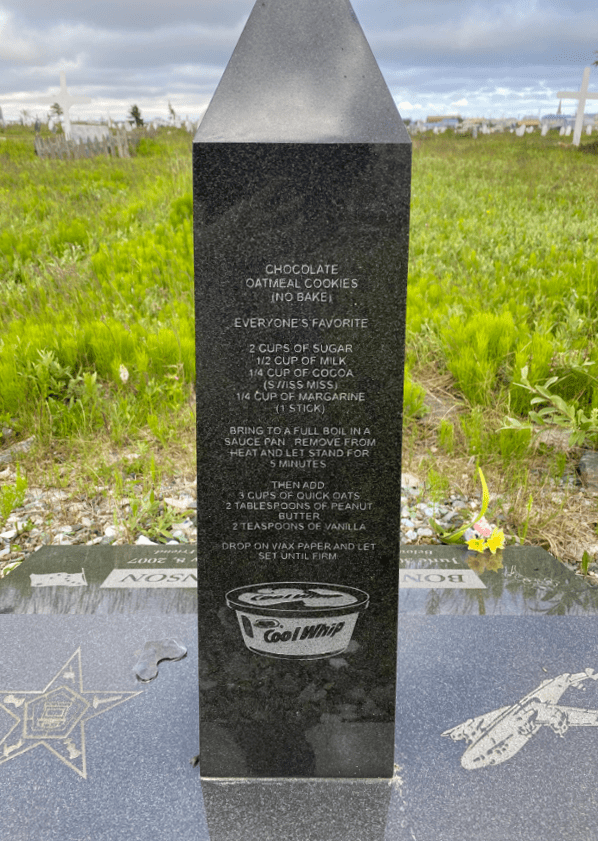
This recipe is found on the gravestone of Bonnie June Rainey Johnson, who is laid to rest in Nome City Cemetery in Nome, Alaska. Johnson, also known as the “driver’s license lady”, worked for the Division of Motor Vehicles in Nome until she retired in 2000, after 30 years of service.1 She was also known for the sweetness of her no-bake chocolate oatmeal cookies.2 In interviews, Johnsons’ daughter Julie, has said that even the person who cleared the snow from their front yard made sure to do a good job because they would get payment in a batch of these cookies.2 Johnson loved spending time in the kitchen, cooking dishes that brought her family and friends together.1 

Bonnie Johnson was diagnosed with Alzheimer’s in 2004 and moved to Anchorage to be with her daughter in her final days. She passed away peacefully on May 8, 2007, surrounded by family.1 She was 71. Her famous oatmeal cookie recipe was inscribed on her gravestone in 2007, along with an image of a Cool Whip container—She was known to collect dozens of them!2

Here is the recipe, as written on the black granite obelisk:

Chocolate Oatmeal Cookies (No Bake)

Everyone’s favorite

  • 2 Cups of Sugar
  • 1/2 Cup of Milk
  • 1/4 Cup of Cocoa (Swiss Miss)
  • 1/4 Cup of Margarine (1 Stick)

Bring to a full boil in a saucepan

Remove from heat and let stand for 5 minutes

Then add

  • 3 Cups of Quick Oats
  • 2 Tablespoons of Peanut Butter
  • 2 Teaspoons of Vanilla

Drop on Wax Paper and Let Set Until Firm

Making the Recipe

This recipe is high on my list for being so easy to make. I had all the ingredients on hand, which was nice as I didn’t have to make an extra grocery trip. I did make one substitution though, as I didn’t have any Swiss Miss cocoa, only a generic store-brand version. 

The recipe is very straightforward to follow. There are also not many steps so it was a quick recipe to make. I added the ingredients in the order they were listed, making sure the margarine was melted and everything was well incorporated. I brought it all to a boil, making sure to watch it so it didn’t burn. I then removed it from the heat and let it sit for five minutes. 

During this time, I prepared two baking sheets with wax paper. I was not sure how big of a batch this recipe would make, but I thought two cookie sheets would be a good start.

After the five minutes, the chocolate mixture had a bit of a film on it. I didn’t stir it, but instead just added in the next ingredients. At this point I did change the order of things, adding the vanilla and peanut butter first. My thought was to melt the peanut butter to better incorporate it into the mixture. Then I added the quick oats, doing so a little at a time and mixing it well. 

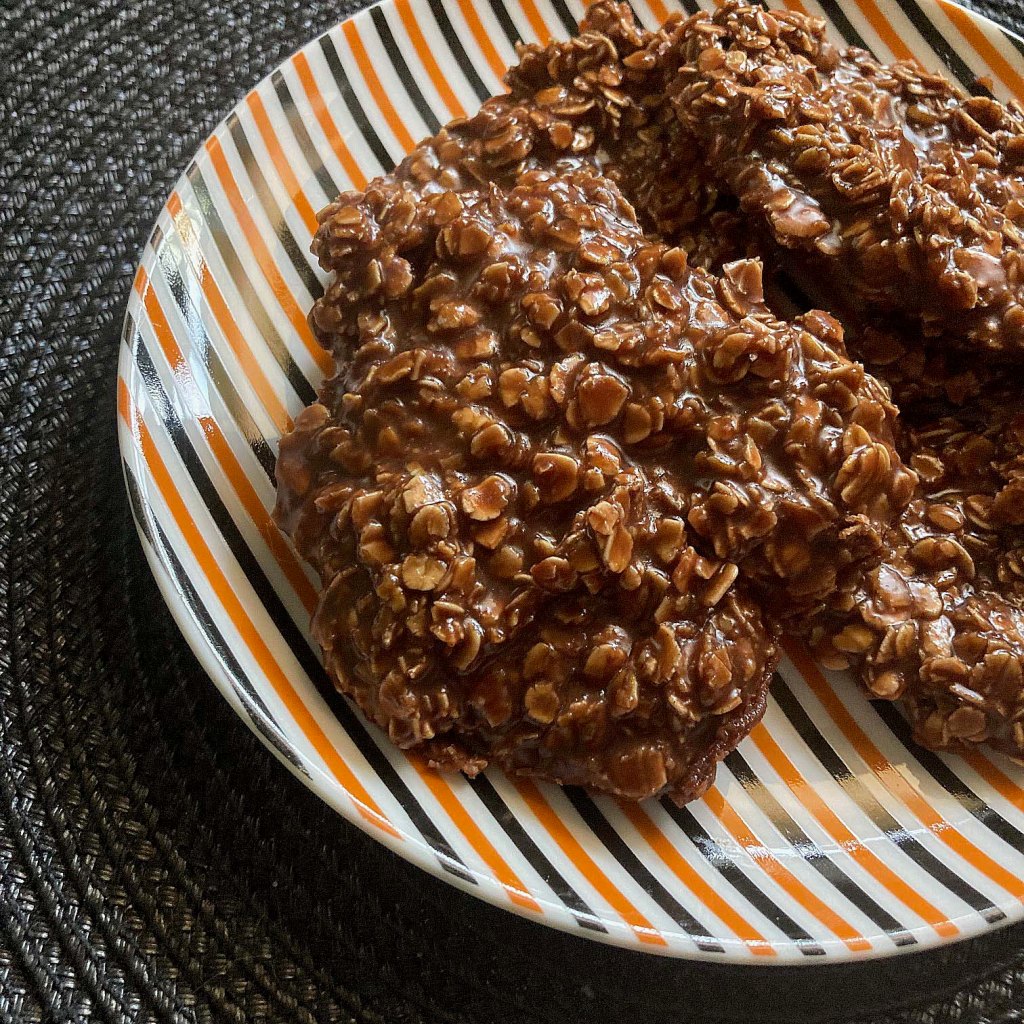
All that was left to do was to drop the mixture onto the waxed paper and let them set. Using two spoons, I made my cookies a little too big on the first sheet. I only fit six cookies on a sheet. I spread them fairly thin but they were large. On the second cookie sheet, I tried to pull it back a bit and make smaller dollops, which I flattened out a little after all the remaining mixture had been spooned onto the sheet. The second cookie sheet had about 12 cookies on it.

Because I made one sheet of larger cookies, I opted to put that one in the freezer to set. The second cookie sheet I put in the fridge to set. After a couple of hours, I pulled out the tray in the fridge to give them a try.

They turned out so good! I was a little nervous, considering my problems with the last gravestone recipe I tried. But I think there was no way to mess this one up. I was afraid they were going to be too sweet, but the oatmeal helps cut some of the sweetness, I think. 

This is a great recipe, and I think will be my go-to the next time I need to whip something up fast the night before a family gathering, to share.

Have you tried this recipe? Do you have a favorite recipe that you would put on your gravestone? I would love to read about it in the comments. 

Thanks for reading!


References:

  1. Bonnie Johnson Obituary | Anchorage Daily News
  2. Tombstones with family recipes, from Alaska to Israel | The Observatorial

Cemetery Recipes: Kim’s Carrot Cake

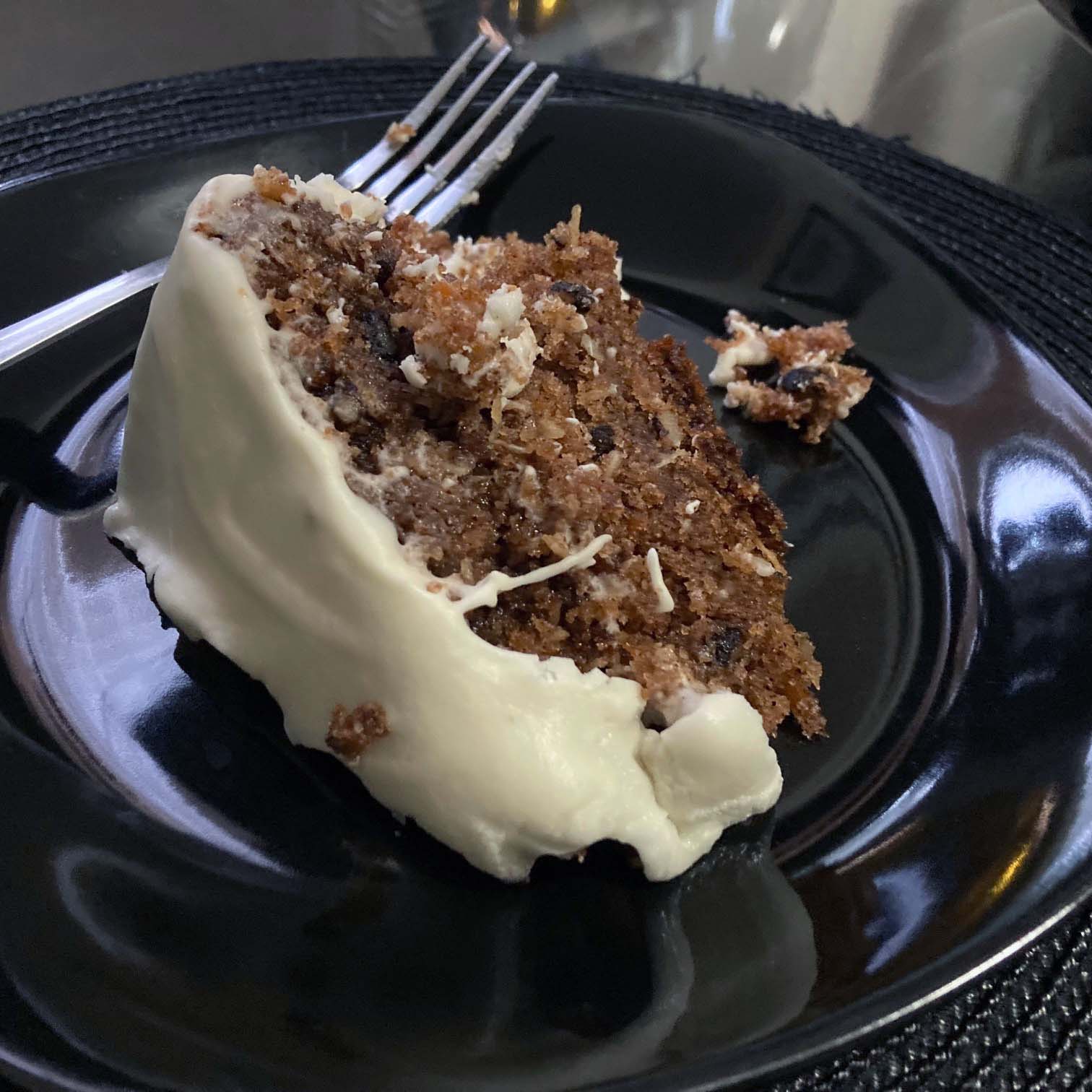
I don’t know why, but Spring often makes me think of carrot cake. So when I was trying to decide which recipe I should make this month, the answer was pretty obvious. Maybe it’s because Easter often falls in April, or because Easter reminds me of picking fresh carrots from the garden when I was a kid. Either way, it’s always a good time to bake a cake. 

So for this month’s gravestone recipe, I wanted to try my hand at making Kim’s carrot cake. This recipe comes from the gravestone of Kimette Lee DeCota, from Cape County Memorial Park Cemetery in Cape Girardeau, Missouri. Kim passed away in August of 2014 at the age of 57.

Reading her obituary on Find A Grave, you will see many references to food and cooking. It describes a passionate woman who loved her family and community. Kim was very active in the church, cooking meals as well as helping her parents in the kitchen among other things. 

I would love to know more about the recipe inscribed on her gravestone. Was this her go-to recipe? Maybe her signature dessert? I may never find out, but it warms my heart to know that someone so passionate about cooking can continue to share their passion from beyond the grave.

Here is the recipe, as written on the gravestone:

Kim’s Carrot Cake

  • 3 cups unbleached all-purpose flour
  • 3 cups sugar
  • 1 teaspoon salt
  • 1 tablespoon baking soda
  • 1 tablespoon ground cinnamon
  • 1-1/2 cups corn oil
  • 4 large eggs, lightly beaten
  • 1 tablespoon vanilla extract
  • 1-1/2 cups shredded coconut
  • 1-1/2 cups shelled walnuts, chopped
  • 1-1/3 cups puréed cooked carrots
  • 3/4 cup drained crushed pineapple
  1. Preheat oven to 350F. Grease two 9-inch springform pans.
  2. Sift dry ingredients into a bowl. Add oil, eggs, vanilla. Beat well. Fold in the walnuts, coconut, carrots, pineapple.
  3. Pour batter into the prepared pans. Set on the center rack of the oven and bake until the edges have pulled away from the sides and a cake tester inserted in the center comes out clean, 50 minutes.
  4. Cool on a cake rack for 3 hours. Fill and frost the cake with the cream cheese frosting.

Cream Cheese Frosting

Doubling the frosting recipe is highly recommended.

  • 8 ounces cream cheese, at room temperature
  • 6 tablespoons unsalted butter, at room temperature
  • 3 cups confectioners’ sugar
  • 1 teaspoon vanilla extract
  • Juice of 1/2 lemon (optional)
  1. Cream the cream cheese and butter in a mixing bowl.
  2. Slowly sift in the confectioners’ sugar and continue beating until ingredients are fully incorporated. The mixture should be free of lumps.
  3. Stir in the vanilla, and lemon juice if desired.

Serve with love.

This recipe is very easy to follow and has very detailed instructions. I found it interesting that the recipe takes up almost all of the room on the gravestone. On the left hand of the stone is an ingredient list and directions to make the cake, while the right-hand side has the ingredient list and instructions to make the frosting. I love that the first note is to double the frosting recipe. I like the way Kim thinks! 

I made this recipe in two parts, first baking the cake and then frosting the next day. For some reason, I only have one spring-form pan so I had to bake the layers one at a time. I really need to rectify that. After the first cake layer was done baking, I took it out of the pan and sat it on a wire rack to cool. I wiped down and reassembled the spring-form pan and poured in the last of the batter. I then put that in the oven to bake.

The recipe calls for the cake to be cooled for three hours. After I took the second layer out of the oven it was fairly late in the evening, so I placed both layers in the fridge to cool overnight.

After work the next day, I set to work making the frosting. I took the cake out of the fridge and placed it on the table to warm up a bit while I mixed the frosting. I know the recipe recommends doubling the frosting, but I found that one batch made more than enough frosting for me. 

Although the instructions were incredibly easy to follow, I do think I messed up a little bit. I baked each cake layer in the oven for the instructed 50 minutes, but didn’t check on them at all. 50 minutes turned out to be too long for my oven; I think I over-baked the cake. It wasn’t burned or anything like that, but the edges became very hard and crisp. So hard that I had trouble cutting the cake when it came time to try a piece. If I were to make this recipe again, I would start checking on the cake at about the 30-minute mark and doing a toothpick test to see if it’s cooked through. 

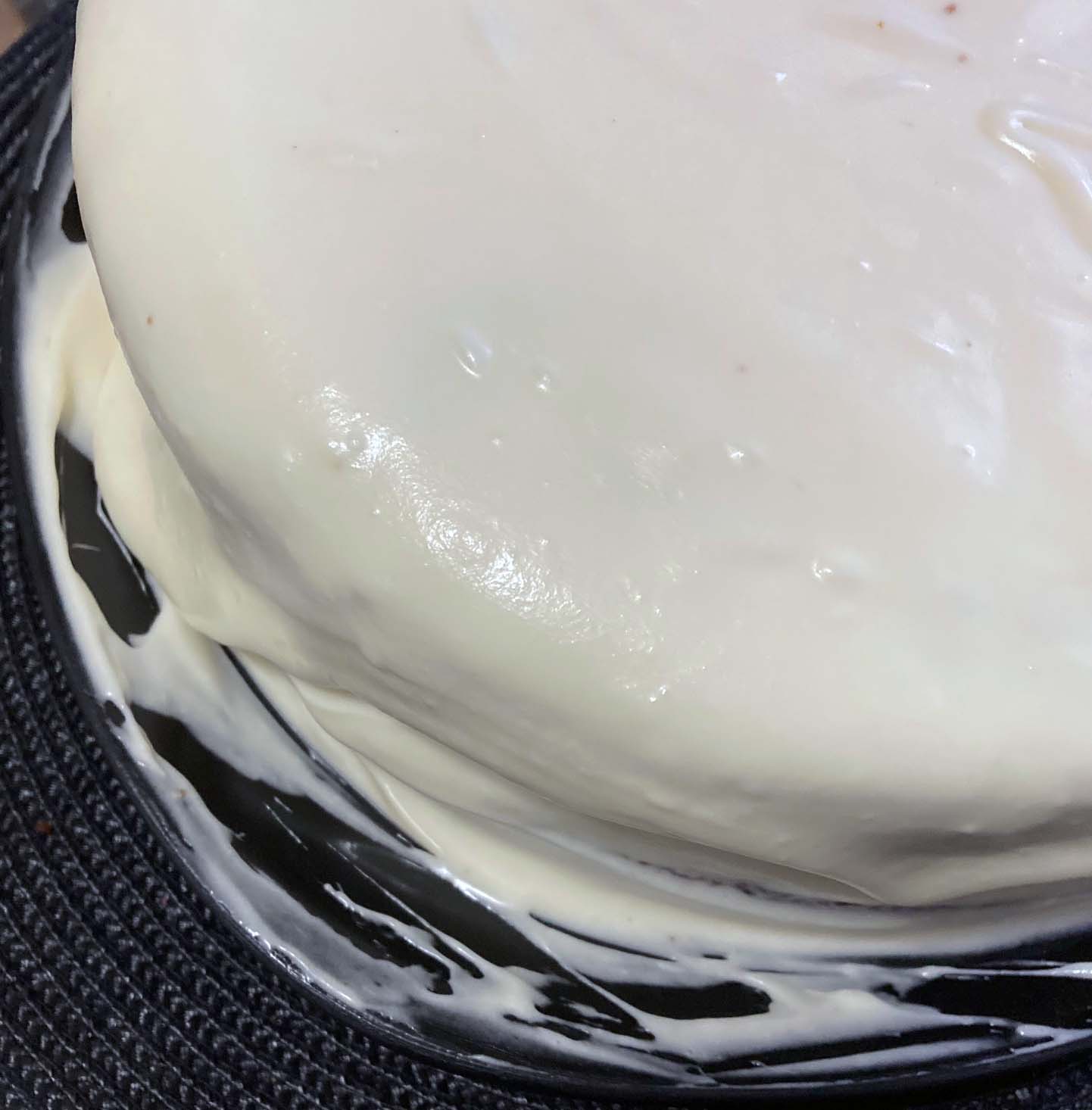
I also think I didn’t frost the cake properly. I think I might be a bit rusty at making cakes! I was afraid to use up too much frosting in between the cake layers so I frosted that section sparingly. I shouldn’t have been worried though, as I had way too much frosting left over. 

I hoped that the frosting would help moisten and soften the cake a bit, but it’s still a bit hard to cut. Other than the human error on my part, this recipe turned out great. This delicious cake is sweet, and the shredded coconut adds a nice flavor to the mix. I would definitely make this one again! 

Have you tried this recipe? I would love to hear how yours turned out, and if you have any baking tips for me. 

Thanks for reading!

Cemetery Recipes: Peanut Butter Cookies

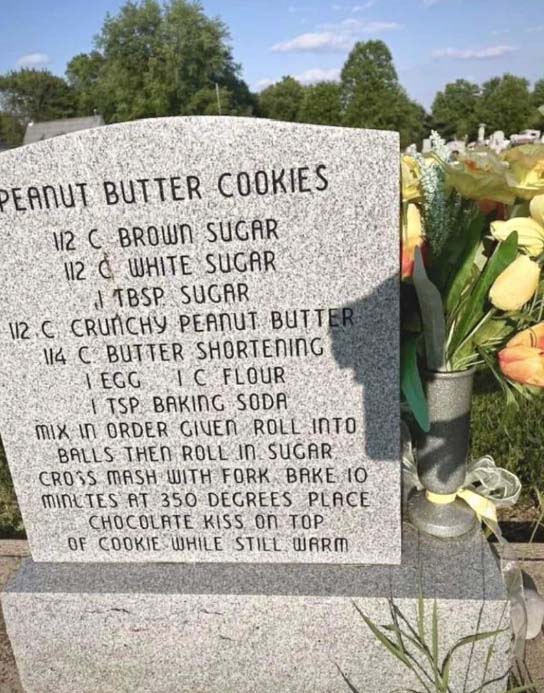
I have been craving peanut butter lately so I thought it would be a perfect time to try another gravestone recipe. This recipe went viral in June of 2023 after Twitter (now X) user SoloFlow786 replied to a Stephen King tweet with a photo of a peanut butter cookie gravestone recipe. The photo quickly went viral, amassing 500k views and over 5,000 likes.1 

Unfortunately, I wasn’t able to learn much about this recipe, or whose gravestone it is written on. According to Rosie Grant, of Ghostly Archive it might be inscribed on a gravestone somewhere in Raymond, Maine. I did find that after this tweet went viral, many folks tried their hand at making this recipe, with great success. 

Interestingly, some users on Reddit think this recipe is a variation of an old Betty Crocker recipe from the 1950s. From what I could find, the recipes are a bit similar. The gravestone version does omit a few things and has the added touch of the chocolate kiss.

Here is the recipe, as written on the gravestone:

Peanut Butter Cookies

  • 1/2 C Brown Sugar
  • 1/2 C White Sugar
  • 1 Tbsp Sugar
  • 1/2 C Crunchy Peanut Butter
  • 1/4 C Butter Shortening
  • 1 Egg
  • 1 C Flour
  • 1 Tsp Baking Soda

Mix in order given. Roll into balls, then roll in sugar. Cross mash with fork. Bake 10 minutes at 350 degrees. Place chocolate kiss on top of cookie while still warm.

This is a pretty straightforward recipe with few ingredients. So it didn’t take long to whip up a batch. The longest part of the process I found, was rolling the cookie dough into even-sized balls. 

The extra tsp of sugar that the recipe calls for, is for rolling the cookie dough into. For my batch, since it was St. Patrick’s Day on March 17th, I decided I would try adding a touch of green to be festive. I managed to find some green sanding sugar, but unfortunately, it was more of a pastel green. More for Easter than St. Paddy’s, so after baking the green colour had pretty much disappeared.

I spaced the cookies out evenly on two baking sheets. My batch made 19 cookies. I found my dough was a bit crumbly, so after mashing it with a fork, they didn’t keep a round shape and some crumbled a little bit. They didn’t spread out too much and kept their crumbly shape. They still taste delicious though. 

I found making this recipe was a little different for me. I often find myself talking aloud to the person whose gravestone the recipe comes from, but this time I don’t know who this recipe belongs to. I find talking out loud while I bake or cook helps me connect to the person. I hope one day I can find out where this gravestone recipe comes from. It would be lovely to be able to put a name to the gravestone.

Until then, I will highly recommend this delicious peanut butter recipe to anyone craving a sweet peanut butter treat.

Have you tried this recipe? What did you think?

Thanks for reading!


References: 

  1. This Peanut Butter Cookie Recipe Is Too Bizarre To Digest | Zee News

Cemetery Recipes: Chicken Soup

We recently had our first big winter snowfall, after enjoying a pretty mild start to the season. The snow and cold weather have me craving warm and cozy comfort food, so I thought this might be a good time to try out another gravestone recipe—Chicken Soup!

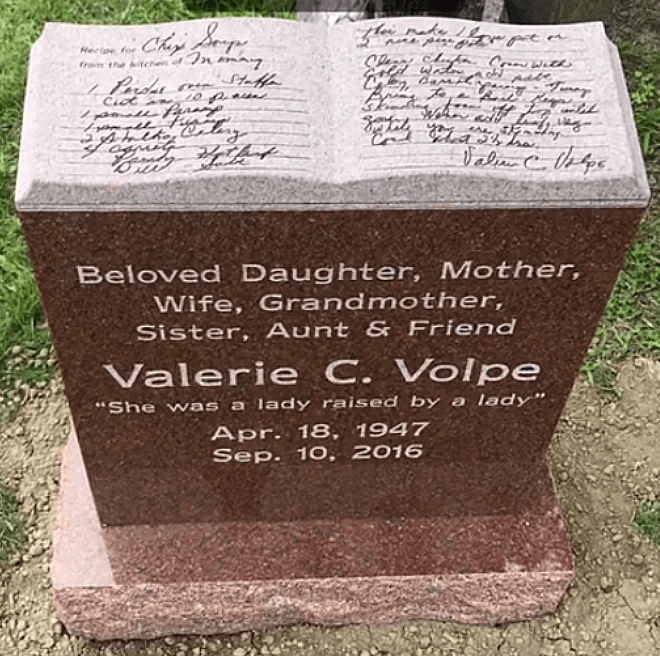
This gravestone recipe comes from the tombstone of Valerie C. Volpe, of West Seneca, New York. I’m not sure exactly where Volpe is laid to rest, but her pink granite gravestone topped with an open book design features her chicken soup recipe in her own handwriting. I thought that was a beautiful touch. 

The recipe, inscribed on the open book is laid out like a recipe card and even has her signature. In life, Volpe was co-owner of Valerie’s Family Restaurant where she not only fed her family but her community as well.1

The epitaph reads: “Beloved Daughter, Mother / Wife, Grandmother, / Sister, Aunt & Friend / Valerie C. Volpe / She was a lady raised by a lady / Apr. 18, 1947 / Sep. 10, 2016”

Unfortunately, the only photo I could find of the gravestone is not the highest resolution, so the handwriting is a bit hard to make out. I did my best to transcribe the recipe, as inscribed on the gravestone. Here is the recipe:

Recipe for Chicken Soup

From the kitchen of Mommy

  • 1 Perdue oven stuffer
  • Cut in 10 pieces
  • 1 small Parsnip
  • 1 small Turnip
  • 2 stalks Celery
  • 4 Carrots
  • Parsley —
  • Dill —

This makes 1 large pot or 2 — pots / Clean chicken. Cover with / cold water — / Celery, Carrots, parsnip – turnip / Bring to a boil — / — / — / — / Cook about 2 1/2 hours.  / Valeria C. Volpe

Since I had such a hard time reading the recipe from the photo, I went by this recipe description from Billion Graves:

“Cut an “oven stuffer” into 10 pieces. Place in a pot. Rinse and cover with cold water. Add salt. Cut up 1 small parsnip, 4 carrots, 1 turnip, and 2 stalks of celery. Add to the pot and bring to a boil. Sprinkle with dill. Cook for 2 1/2 hours and then remove the bones. Top with chopped parsley when ready to serve.”

This is one of the more detailed recipes I have made so far, so once I had the above instructions I didn’t have too much to decipher to make it. The recipe does call for a Perdue oven stuffer, which I did have to look up. A Perdue “oven stuffer” is an American brand, of fresh whole chicken. These chickens, also called roasters, are older chickens and usually weigh between 5 and 7 pounds. I made a shopping trip specifically for the ingredients of this recipe and although we don’t have Perdue brand in Canada, I was able to find a fresh chicken that would work for my needs. 

I have trimmed a roasted chicken before, but trimming a fresh chicken was new for me. I didn’t end up using 10 pieces of the chicken, as the thighs, wings, drumsticks, and chicken breasts were more than enough. I was also worried about smaller bones being lost in the soup and causing a choking hazard, so I was happy to have just some larger bones in the pot. 

I should note that this was my first time making soup from scratch! Aside from getting the chicken ready, this soup is pretty simple with hearty ingredients. 

Once the soup was at a boil I lowered the heat to medium and let it simmer for 2 1/2 hours, checking on it now and then to stir. I will admit I did need to add water periodically as it boiled off leaving more of a stew at times. I made sure to re-season the pot every time I added fresh water, but in the end, I still needed to season it when it was ready to serve. I’m not sure if that was supposed to happen, or if I didn’t really need to let the pot simmer for that long, but in the end, the soup still turned out. I was of course mindful of making sure the chicken was cooked through.

Since it took so long to prepare, I didn’t have soup for supper that night, but I did make sure to do a taste test after removing the bones. It wasn’t as seasoned as I would have liked, but the cozy warm chicken soup taste is unmistakeable. I ended up enjoying a bowl for lunch the next day.

This one was a little tricky for me, and I would tweak the cooking time if I were to make it again. This recipe took me out of my cooking comfort zone. I think I would prefer to stick to sweet gravestone treats, but at least I tried.

Have you made this recipe before? Do you make soup from scratch often? I would appreciate any tips in the comments! 

Thanks for reading!


References:

  1. Gravestone recipes so good they are set in stone | Billion Graves

Cemetery Recipes: Spritz Cookies

It’s the holiday baking season! A time when many family members are baking delicious sweet treats to share with loved ones. What better time than to try out another gravestone recipe? 

For this month’s recipe, I wanted to try Naomi Miller-Dawson’s Spritz Cookies. I have been saving this recipe to try specifically for this month. I hope to share these cookies with my loved ones this Christmas, at our annual family get-together. 

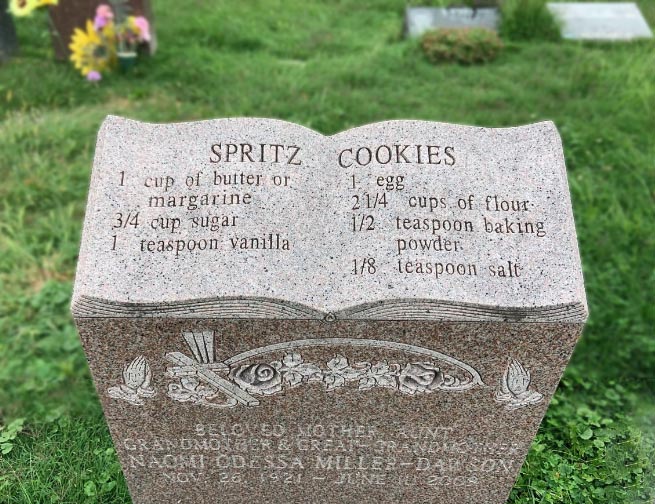
This cookie recipe can be found on the grave of Naomi Odessa Miller-Dawson. Beloved mother, aunt, grandmother and great-grandmother. She passed away in June of 2009 at the age of 87. Her gravestone, which can be found in Green-Wood Cemetery in Brooklyn, features an open-book design.

Commonly a book represents the Bible or book of life, but an open book is sometimes used as a device to display the deceased’s details, like names and dates. Miller-Dawson’s son, Richard, told Medium in 2019, “It’s probably from the design that [one would] use if someone was putting a Bible verse onto the headstone, but instead of having the Bible verse, we put the part of the recipe from spritz cookies.”1  

Naomi Miller-Dawson was a first-generation American, her parents and two older sisters having been born in Barbados. Her family immigrated to America before she was born. She lived in Brooklyn, NY and supported her family by working as a postal worker for over 20 years. She was also an excellent baker, so much so that her two children immortalized her cookie recipe on her gravestone.1

Here is the recipe, as written on the gravestone:

Spritz Cookies⁠

  • 1 cup of butter or margarine⁠
  • 3/4 cup sugar⁠
  • 1 teaspoon vanilla⁠
  • 1 egg⁠
  • 2 1/4 cups of flour⁠
  • 1/2 teaspoon baking powder⁠
  • 1/8 teaspoon salt

You may have noticed that this gravestone recipe only lists the ingredients. I have not baked a lot of cookies in my lifetime, so I did need to do some extra research to figure out the directions of this recipe. I learned that spritz cookies are similar to a sugar cookie but more buttery, and require some extra care when combining the ingredients. 

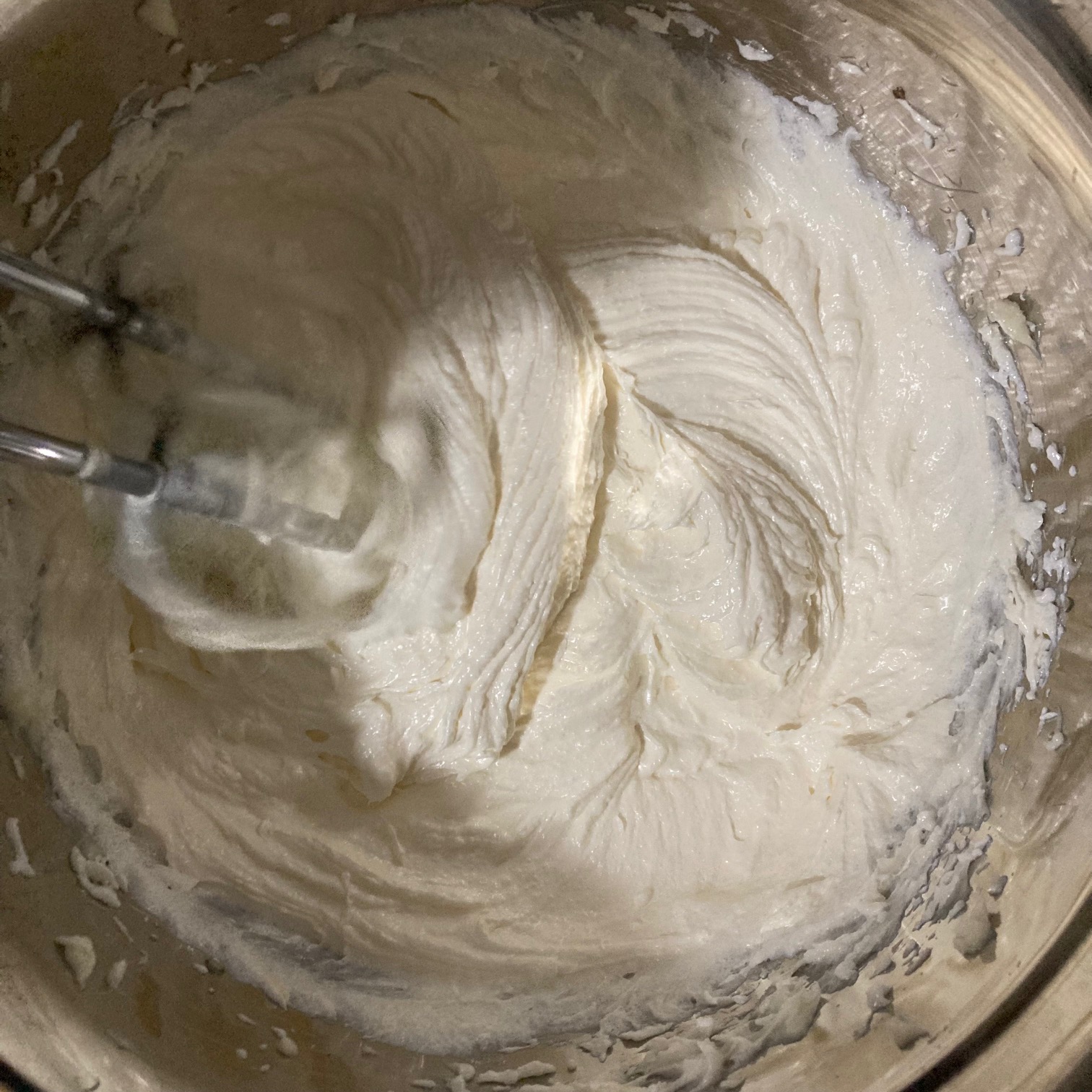
I found some tips for making spritz cookies online and added the ingredients together in the order they are listed on the gravestone. First, I whipped the butter and sugar together, until it was light and fluffy. I used a hand mixer for this part. I then added the vanilla and egg and used the hand mixer again to incorporate them.2

Another tip I found was not to overwork the dough, so I added the flour slowly and folded it into the butter mixture by hand. I then added the baking powder and salt. Making sure not to overwork the mixture created a light and fluffy dough. This is very important for the next part.

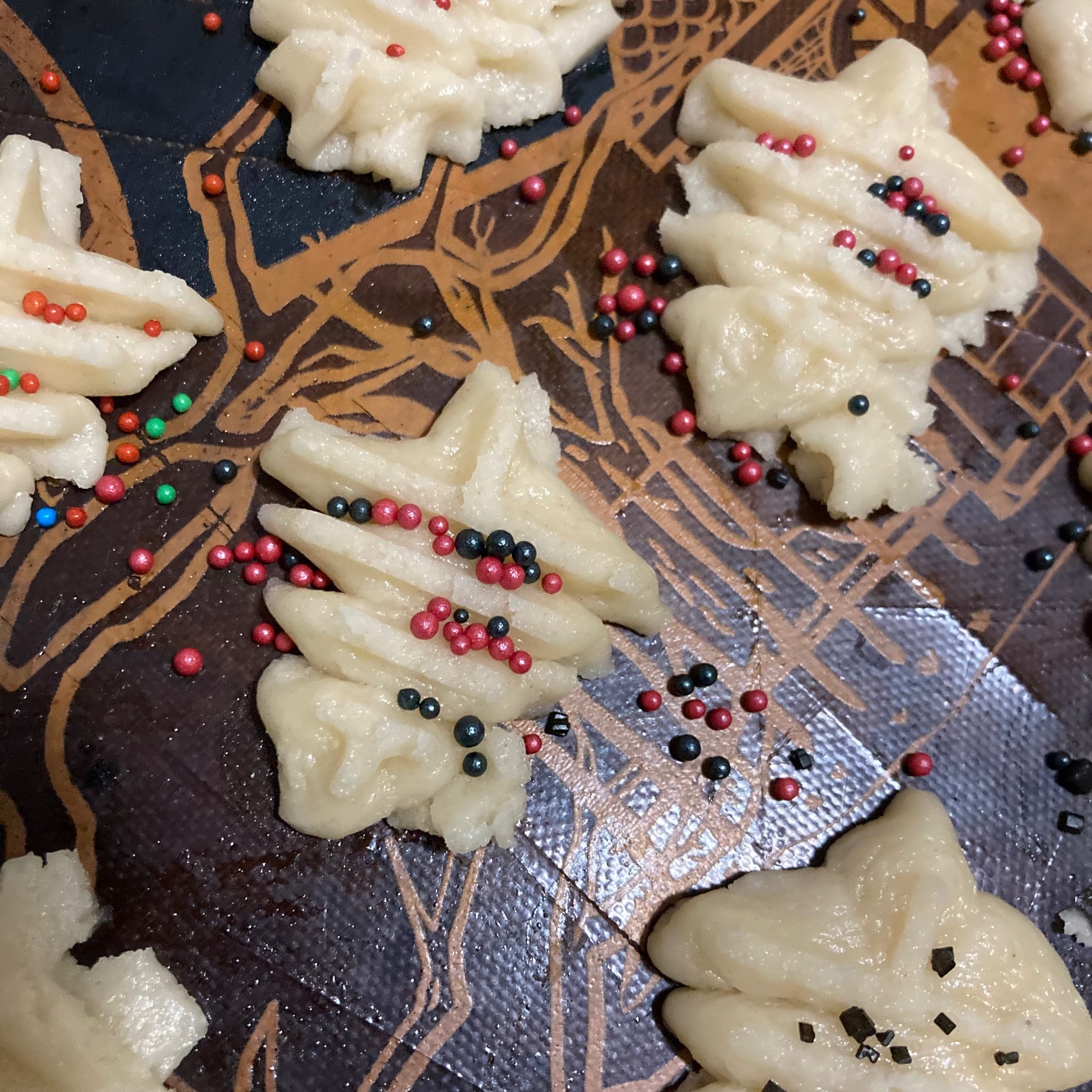
This is where the cookie press comes in! Spritz cookies are named from the German word spritzen, which means “to squirt”. The soft fluffy dough is squirted or pushed through a cookie press to make fancy designs.3 I had heard of a cookie press before but had never tried one. I did specifically buy a cookie press this summer for this recipe. I purchased my Wilton Cookie press at a local thrift shop, making sure to clean it thoroughly before using it. Since I had never used one before, and my thrifted press didn’t come with instructions, I turned to YouTube to learn how. I found a quick tutorial video that made it look incredibly easy.

Unfortunately, my press has a crack in it where it connects to the barrel, so the process of pressing my cookies was a little difficult. It was a bit of a struggle, but I was able to make it work. Luckily, because the dough is so light and soft, mistakes could be easily scrapped up and put back in the barrel to try again. 

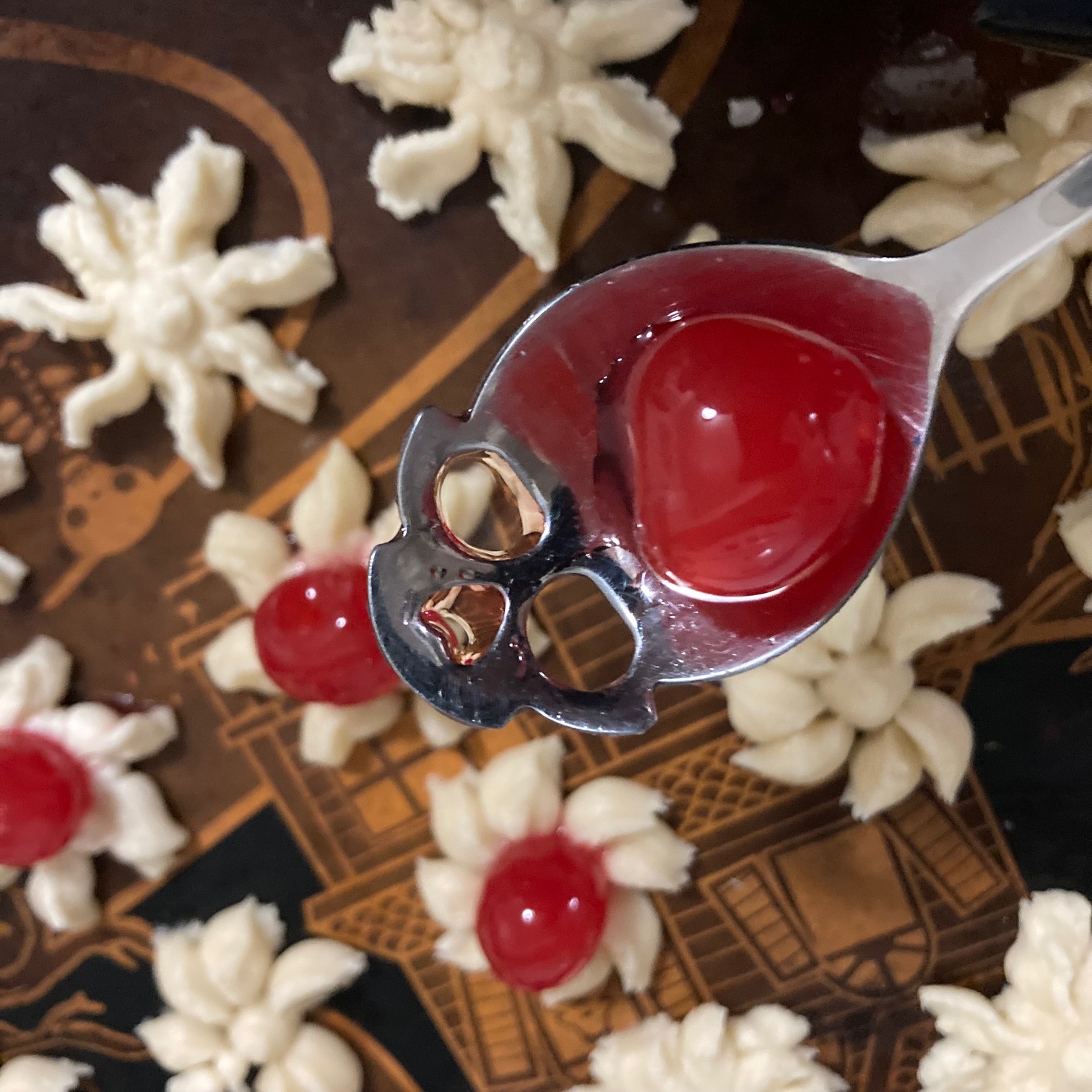
To make them festive, I decorated them with red cherries. Sanding sugar and sprinkles. I had hoped to also use green cherries, but unfortunately, my local shops don’t carry them anymore. 

This recipe makes a fairly large batch of cookies, but because my press was malfunctioning, I don’t know how accurate of a count I can make. I ended up baking 5 full cookie sheets in the oven, at 400°F for 6 to 8 minutes each. You need to keep an eye on your cookies, as you only want to bake them until they are golden brown on the edges. They should still be very light in color when they are done. 

All in all, these were a very fun recipe to make, and the cookies turned out delicious. They are similar in taste to a sugar cookie but much more buttery. These would be great to make as an activity with friends or young children because they are so fun to decorate, the possibilities are endless. These spritz cookies also make a great big batch, which is perfect for sharing with friends and family while also enjoying a few, or several yourself.

Will you be trying out this recipe? Or do you have another gravestone recipe that you are dying to try? I would love to read about it in the comments.

Thanks for reading!


Refernces:

  1. Memorializing a Mother Who Fueled Lives With Spritz Cookies | Medium
  2. Tips To Make the Best Spritz Cookies | Go Bold with Butter
  3. Classic Spritz Cookies | Gold Medal Flour

Cemetery Recipes: Guava Cobbler

While doing some groceries the other day, I was surprised to find fresh guavas at my local Walmart. The guavas immediately made me think of the Guava Cobbler recipe I had seen online not long ago. I have never seen guavas before in the produce section, so I thought what better time to try out another gravestone recipe!

This gravestone recipe is found on the grave of Julia Belle Kelley Pate, who passed away at the age of 87 on May 16, 2011. Julia is laid to rest in Frierson-Hendry Cemetery in Fort Myers Florida. According to her gravestone, Julia made the best guava pie and cobbler in the South!

Here is the recipe, as written on the gravestone:

Guava Cobbler

  • 1 Cup Sugar
  • 1 Cup Milk
  • 1 Cup Self Rising Flour
  • Half Stick Butter
  • 2 Cups Cooked Guava

Mix first 3 ingredients together. Melt butter in baking dish. Pour mix in pan, spoon guavas evenly on top. Bake at 350 for 30 to 40 minutes till done.

I have never bought or baked with fresh guava before, so this recipe would be a lot of fun! My first thought was how to prepare the guava. The recipe is fairly simple and calls for 2 cups of cooked guava. I had to do a little Google search to see how to eat and prepare guava. Guava is completely edible; skin, flesh, seeds, and all. They are a great source of fiber. So to cook my fresh guava, I gave the fruit a good wash and trimmed the stems away. After that, I sliced the guavas into rounds and put them into a pot with a bit of butter to cook.

While those were simmering I worked on mixing the dry ingredients. The recipe calls for self-rising flour. I couldn’t find any at the grocery store, but I discovered later that bread flour would have worked as well. My solution though was to create my own self-rising flour. I had all-purpose flour on hand, so I mixed in 1 teaspoon of baking powder, 1/4 teaspoon of baking soda, and 1/2 teaspoon of salt into my 1 cup of all-purpose flour.

After mixing my dry ingredients I continued following the recipe and popped my cobbler in the oven. After 30 minutes I used the toothpick method to see if it was ready. It still needed a bit more time so I put it in for another 10 minutes. The 40 minutes was perfect, and it came out looking golden brown and beautiful. 

I carved myself a piece right away. In creating these tombstone treats I have found a love of cobblers. This is the second one I have made, the first being O’Neal’s Peach Cobbler. They are so delicious and easy to make. This guava cobbler was no different. This cobbler was not as sweet as the peach cobbler, the guavas do have a sweetness but are also a bit tart. I didn’t have ice cream to pair with my cobbler this time, but I didn’t miss it. The only thing I would do differently next time is remove the seeds. Since the seeds are edible, I decided to leave them in, but I didn’t care for the texture that the seeds created. Next time I would scoop out the seeds. 

This recipe is so good and so easy to make! Now I am wondering about Julia’s guava pie recipe. I would have loved to try it!

Have you made this recipe before, or maybe another gravestone recipe? Do you have a gravestone recipe that you would recommend? I would love to hear about it in the comments!

Thanks for reading!


References: