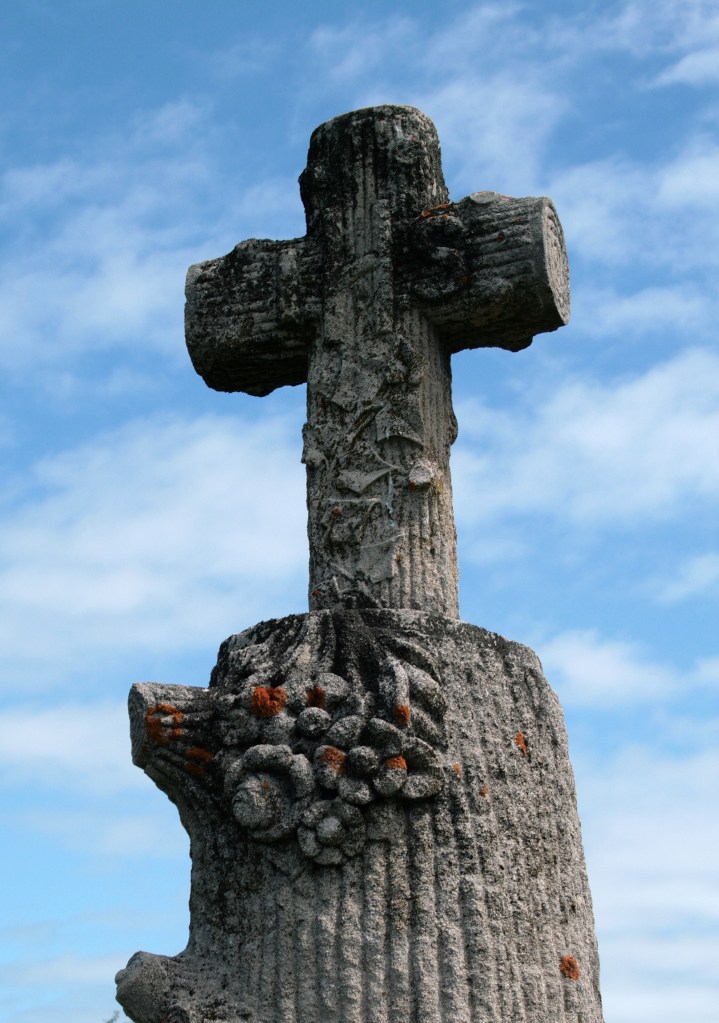
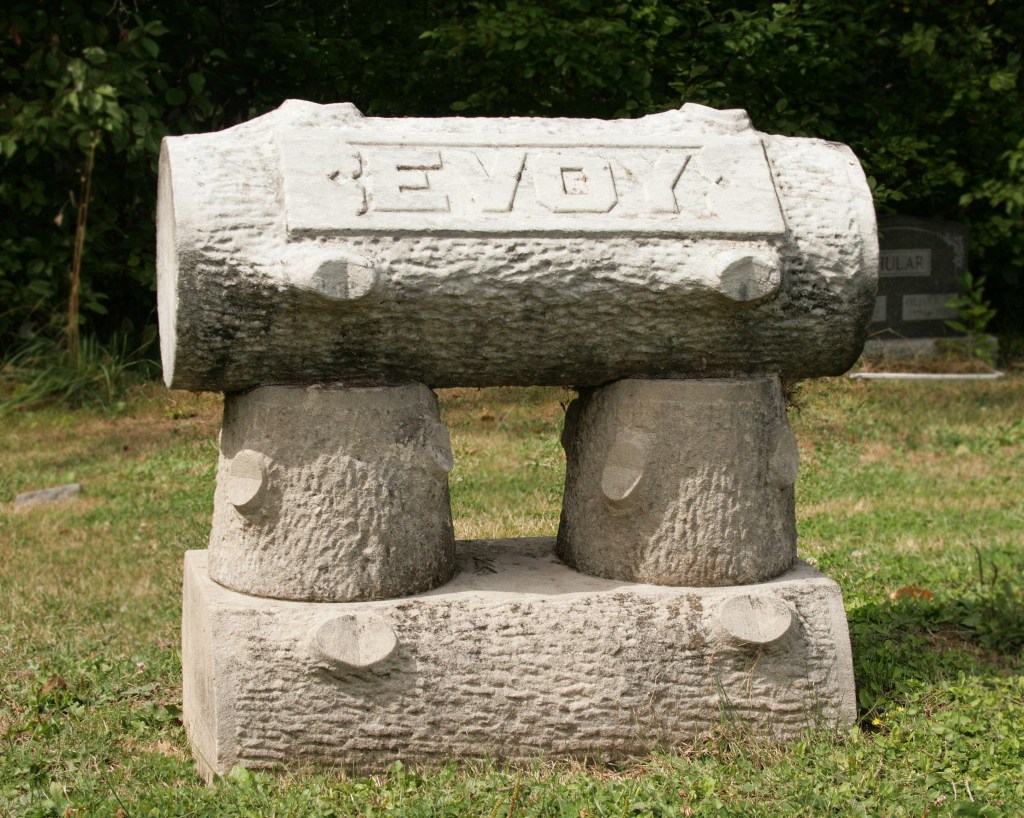
While wandering a cemetery, have you ever come across a monument that is shaped and textured to look like a tree? Today, I want to take a closer look at these types of grave markers, called tree stones. Although they are a bit harder to come by in Northern Ontario, you can find them, and they are usually very easy to spot since they are so unique!
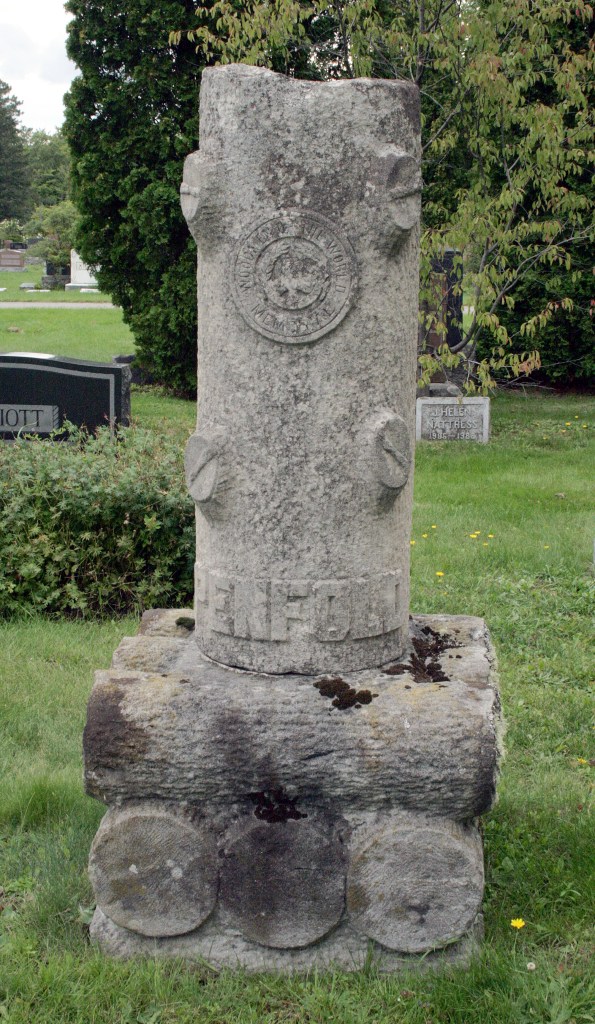
Tree stones are often used as memorials for members of the Woodmen of the World, a fraternal organization. This fraternal order was started in 1890, and membership included those who worked in particularly dangerous professions. The organization offered health insurance and death benefits to its members, which included a tree stone tombstone.1
Woodmen of the World tree stones, often bare the Woodmen crest, as well the tools of the trades like an axe and sledgehammer, representing the works of man. You may also find other symbols on tree stones like ivy or doves, representing friendship and peace, respectively.
The severed branches or tree stump of a tree stone, Woodmen of the World or otherwise, often represents a life cut short. We often see this combined with other symbolism, like a lamb or dove laying in front of a stump. Lambs and doves are often found on the graves of small children, symbolizing innocence and purity.
Sometimes the number of logs on a tree stone can be symbolic of the number of children the deceased had. A tree stone can also be seen as a representation of the tree of life, symbolizing knowledge.
Christmas time is almost here! For me, Christmas is synonymous with holiday baking! What better time of year to warm the house with the sweet smell of cookies in the oven? So, I thought it’s the perfect time to try out another tombstone recipe. I have been saving this one specifically for this time of year—Mom’s Christmas Cookies.
This cookie recipe can be found on the backside of a beautiful, large black marble tombstone. This is the gravestone of Maxine Menster.1 It can be found in Cascade Cemetery, in Cascade Iowa. The front of the stone has a beautiful sand-blasted winter scene, of a lovely detached house surrounded by forest. You can view the front of the stone on Maxine’s memorial page on Find A Grave.
Maxine’s family wanted to do something special to remember their mother and chose the sweetest way—with the family sugar cookie recipe. Jane Menster, Maxine’s daughter has said that when they were trying to think of something specific to her mother to put on her stone, “It was her cookies.”2
Maxine passed away in 1994, so this recipe has marked her grave for decades. According to Atlas Obscura, this recipe was part of a long-standing family tradition, where they would bake this cookie recipe on Christmas Eve, then hang the sugar cookies on the Christmas tree. They would be an early morning treat on Christmas Day.3
The backside of Maxine Mensters’ gravestone. Photo taken by Find a Grave contributor Cheryl Locher Moonen. (Used with permission)
Here’s the recipe:
Mom’s Christmas Cookies
Cream:
1 cup sugar
1/2 cup oleo
Add:
2 beaten eggs
1 tsp. vanilla
Add:
3 cups flour
3 tsp. baking powder
1 tsp. salt
Add alternately with 1 cup cream.
Chill and roll out with flour.
Bake 350 degrees oven, and frost.
Most tombstone recipes use short form when it comes to the instructions. Instead of turning to Google, I thought I would ask my Mom. We went through the recipe together and talked about each step, and how long to chill the dough. My mom is an avid baker, especially at this time of year. We had a nice chat about baking instructions and tombstone recipes in general. I have yet to find a Canadian one.
I was also surprised to find out that my mom was familiar with the tradition of baking cookies to put on the tree for Christmas morning. It’s not something we ever did when I was growing up. We also had dogs. She recounted a story about putting candy canes in the tree one year and coming home one day to find the tree on the floor. My dog Shadow had gotten a little too excited about finding candy in the tree. No foodstuffs ever went into our tree after that.
After our chat, I got to baking cookies! This recipe is very straightforward. There is one ingredient that some people might question, the 1/2 cup of oleo. What is oleo? Turns out that it is just an older term for margarine. Mixing everything was a breeze and didn’t take that long at all. The biggest question I had about the recipe was how long to chill the dough. My Mom had suggested an hour. After an hour in the fridge, I got to work on cutting out the shapes.
I am not a traditional Christmas person and don’t actually own any Christmas cookie cutters. I choose to go with a skull, tombstone, and bat for my shapes. I also didn’t have any frosting on hand, so instead, I opted to use sprinkles. My usual go-to for baking is cupcakes, so I have a lot of sprinkles on hand—just not Christmas ones. So I used black sanding sugar, red and black nonpareils, black bats, and purple, red and black sprinkles.
I left the cookies in the oven for about 10-14 minutes and ended up baking 4 trays of cookies. This recipe makes a pretty big batch.
They turned out delicious! I think this will be my go-to sugar cookie recipe moving forward. They are very easy to make and so tasty, especially right out of the oven. I ate way more of them off the cookie sheet than I should have, but I just couldn’t resist. I also really enjoyed making this recipe because it prompted some good conversations with my Mom. Usually, when I make tombstone recipes, I talk out loud to the deceased, talking through the recipe. This time around it made more sense to talk about Mom’s Christmas cookies with my own Mom.
Thank you, Maxine, and the Menster family for sharing this delicious recipe with the world!
Have you made this recipe before? Or do you have a go-to Christmas cookie recipe? I would love to hear about it in the comments.
It’s almost Christmas time, and the hustle and bustle of Christmas dinners and get-togethers are right around the corner. I love finding unique and meaningful gifts for my loved ones. It’s a great feeling to see someone close to you, open up a unique gift that you know they are going to love! These types of gifts also don’t need to cost a fortune, and supporting a small business is always a bonus. I have been eyeing a few fun and interesting cemetery-related items online myself. Unfortunately, I don’t have any taphophiles in my family to buy for, but I thought maybe some of you might.
So this year, I thought I would try my hand at writing a little gift guide for those looking for some inspiration for your cemetery loving friends and family, or maybe your own Christmas wish list.
Below is my round-up of some unique, beautiful and practical cemetery-related items that I think any taphophile would love!
Cemetery Photography by Chantal Larochelle is not affiliated with these brands and artists. I do not receive any proceeds from sales. Just sharing products I love!
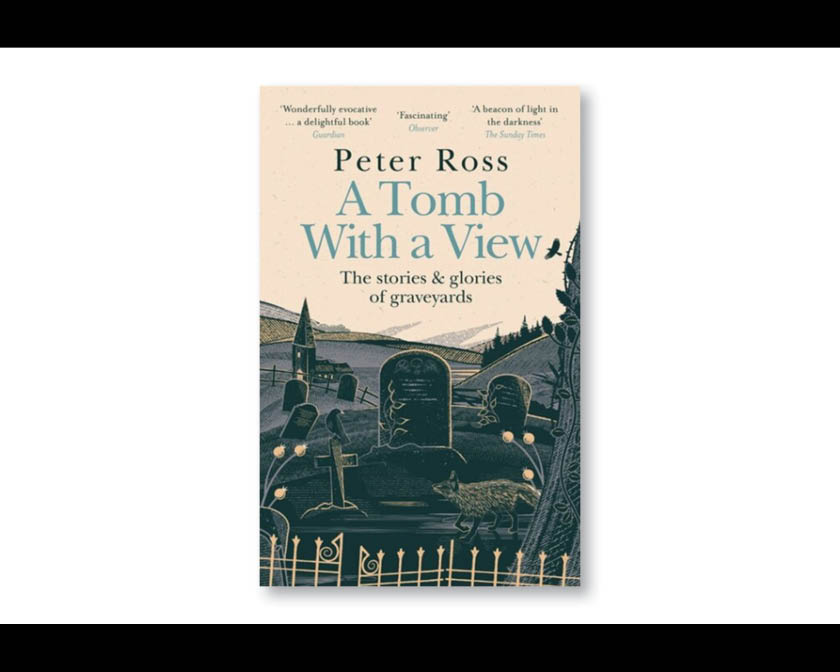
If your taphophile friends and family like to read, you can’t go wrong with a cemetery book. I’ve heard excellent things about Peter Ross’ new book, and hope to pick myself up a copy if I don’t get one for Christmas. “A book for anyone who has ever wandered through a field of crooked headstones and wondered about the lives and deaths of those who lie beneath.” – Indigo.ca
A Tomb With A View By Peter Ross. (Photo from Indigo.ca)
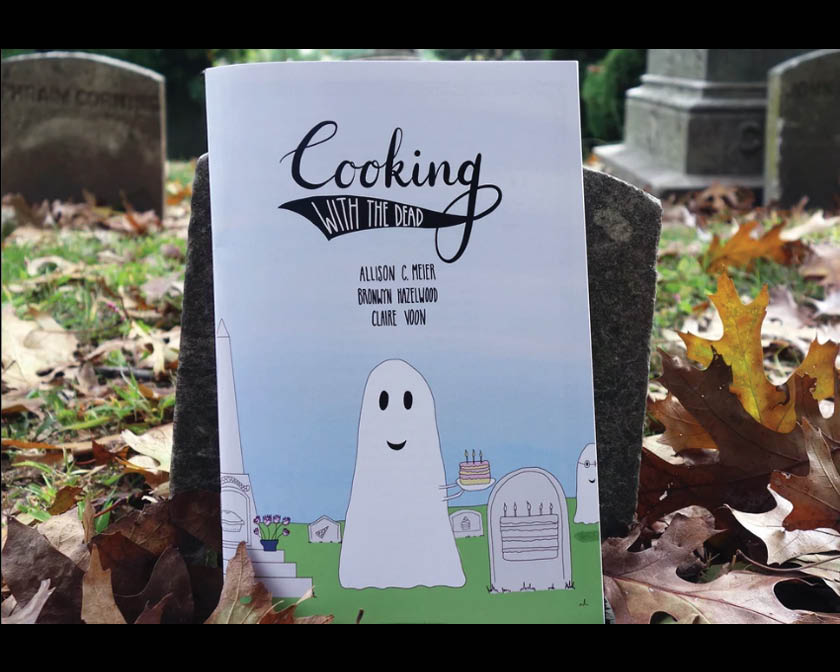
A unique full-color illustrated zine by Reading Reliquary. This 20-page booklet features recipes found on tombstones from “Alaska to Israel”. There are a bunch of other spooky-cute items available in their Etsy shop, such as stickers, bookmarks, and another zine about the language of floral symbolism on tombstones. Unfortunately, some items don’t ship to Canada.
Cooking with the Dead: A zine of Tombstone Recipes by Reading Reliquary. (Photo from Etsy)
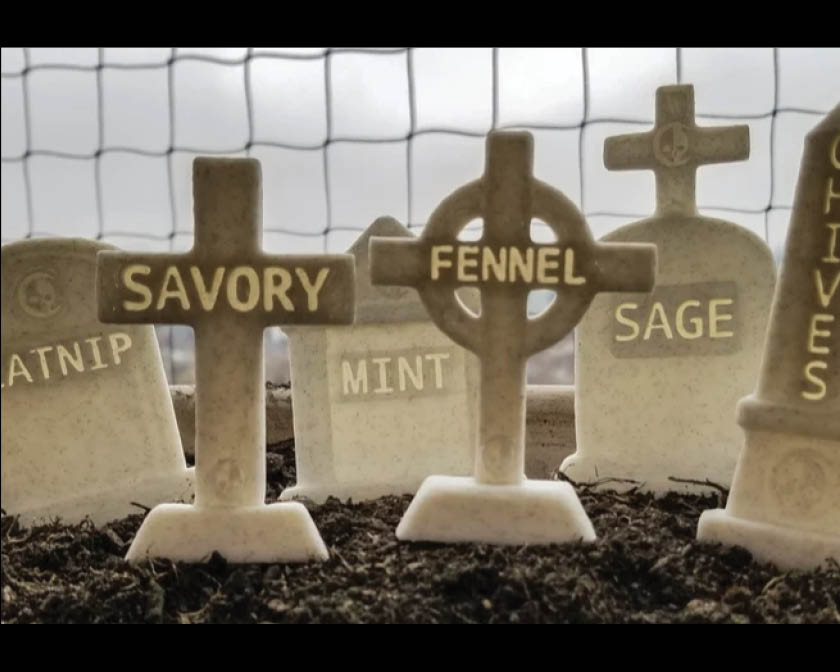
Cursed by Design offers a set of 6, 3D printed garden stakes. You can customize them with any of the 40 available herb names, or you can personalize them with your own names. They would be perfect for a taphophiles herb garden!
Custom Graveyard Garden Stakes by Cursed by Design. (Photo from Etsy)
This new book of essays, edited by Loren Rhoads, illuminates the reason why people visit cemeteries. This collection features 40 personal essays, written by cemetery tourists, genealogists, geocachers, anthropologists, and more. A great addition to any taphophiles library.
Death’s Garden Revisited: Personal Relationships with Cemeteries edited by Loren Rhoads. (Photo from Blurb)
This gorgeous 1.5” soft enamel Deaths Head pin, by Verona Black, would look striking on a jacket, camera bag, or anywhere really. It also has some interesting symbolism behind it. A Deaths Head or Skull effigy is a form of Momento Mori, a reminder of your mortality.
Deaths Head Enamel Pin by Verona Black. (Photo from Etsy)
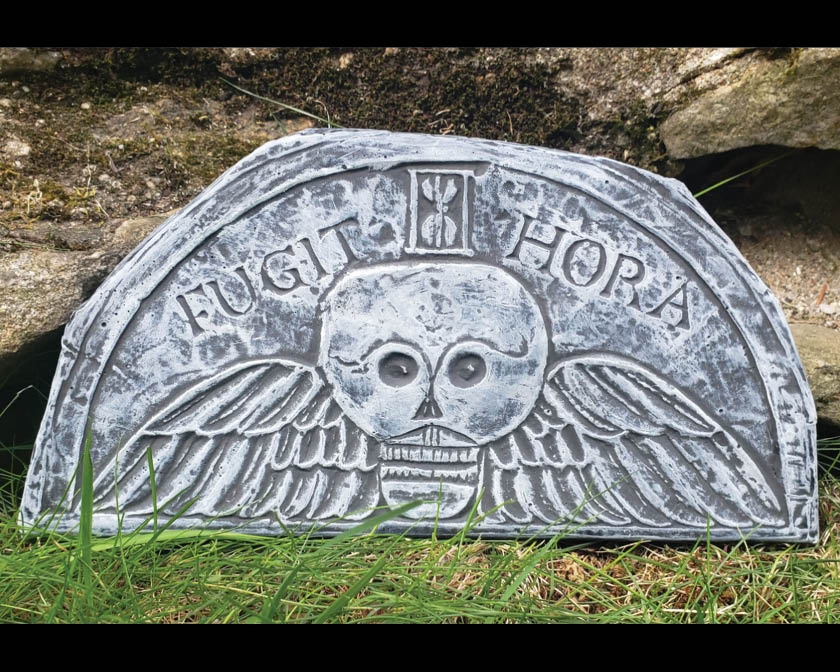
Their online store is filled with beautiful castings of old New England gravestones. Their pieces range from small magnets to large castings. They all feature unique gravestone symbolism. The Gravestone Girls, who are fellow taphophiles, have over 30 years of experience working in old cemeteries. So you can be certain that these beautiful gravestone castings have been made with every precaution taken to not harm the gravestones.
Gravestone Casting Wall Art (Don’t Run A-Fowle) by The Gravestone Girls. (Photo from the Gravestone Girls website)
This unisex t-shirt features some beautiful gravestone symbolism, illustrated by Meagan Meli. The symbols are also accompanied by their meanings. Perfect for those who would rather be visiting a cemetery. I know I would personally try to find all the symbols on it if I ever wore this while visiting a historic cemetery.
I feel like t-shirts are always a safe bet, especially if they have some cool graphics. This t-shirt by Shaded Grove Art on Red Bubble features a bold, but simple design that lists different types of gravestones. It’s a little bit classic, and a little bit nerdy, a great combination.
Gravestone Types Classic T-Shirt by Shaded Grove Art. (Photo from Red Bubble)
Does your vehicle brake for cemeteries? This is a fun novelty accessory, but I can see how this would come in handy on cemetery road trips. Other drivers should be warned!
I brake for Cemeteries bumper sticker by TalkDeath (Photo from the TalkDeath website)
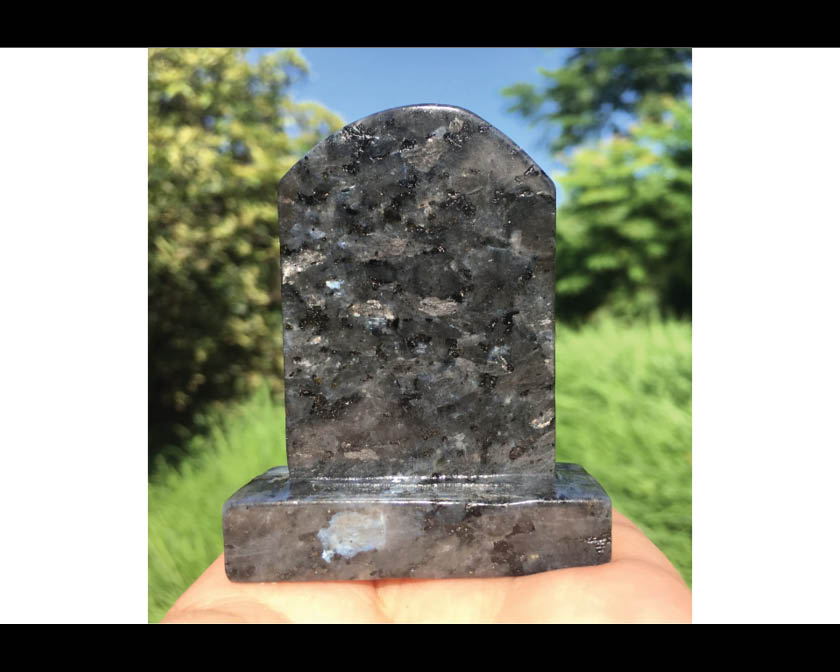
These beautiful miniature tombstones from WHCrystal are made from spectrolite minerals that flash beautifully in the sunlight. These would be a very unique addition to someone’s rock and mineral collection, or as a stand-alone piece. I just love the look of these little gravestones.
Natural Spectrolite Tombstone from WHCrystal (Photo from Etsy)
A one-year membership to AGS is a gift that keeps on giving! Members receive some great benefits throughout the year, like The AGS Quarterly, filled with cemetery and gravestone-related articles. They also receive the monthly e-newsletter that features special announcements, news articles, and event information. Membership also includes the next published issue of Markers, their annual journal full of definitive cemetery and gravestone articles. You also get member pricing for the AGS Annual Conference, that’s also known as Cemetery Camp.
Logo for the Association for Gravestone Studies (from the AGS website)
Landis Blair is an amazing illustrator and is offering pre-orders of this beautiful Pocket Cemetery booklet. “A convenient reminder of your pending mortality.” This 24-page booklet contains 21 black & white illustrations of a variety of cemeteries and is estimated to ship by the end of November. They also offer prints and stickers in their Etsy shop.
Pocket Cemetery with illustrations by Landis Blair. (Photo from Etsy)
Did you know that Find a Grave has an online store? My favorite item in their shop is this grey zip-up hoodie, perfect to keep you warm while you wander cemeteries and fulfill photo requests.
Tombstone Zip Hoodie from Find A Grave. (Photo from the Find a Grave Store)
There you have it, 13 gift ideas for the taphophiles in your life.
It’s been a little while since I shared a book review on the blog. I have some catching up to do on my reading. There are a lot of cemetery-related books in my to-be-read pile! Now that October has come to an end, I should have a bit more time to read through them. There are quite a few I am really looking forward to getting into.
I did manage to get some reading in last month, so today I wanted to talk about The American Resting Place, by Marilyn Yalom, with photography by Reid S. Yalom. “Four hundred years of history through our cemeteries and burial grounds.” This book, published in 2008, by Houghton Mifflin Company, boasts 64 pages of beautiful black and white cemetery photographs and traces a path across America, looking closely at the ever-changing ideologies on death, burial practices, and history.
“Cemeteries and burial grounds, as illuminated by an acclaimed cultural historian, are unique windows onto our religious, ethnic, and deeply human history as Americans.
The dedicated mother-son team of Marilyn and Reid Yalom visited hundreds of cemeteries to create The American Resting Place, following a coast-to-coast trajectory that mirrors the vast historical pattern of American migration.
Yalom’s incisive, often poignant exploration of gravestone inscriptions reveals changing ideas about death and personal identity and demonstrates how class and gender play out in stone. Rich particulars include the story of one seventeenth-century Bostonian who amassed a thousand pairs of gloves in his funeral-going lifetime, the unique burial rites and funerary symbols found in today’s Native American cultures, and a “lost” Czech community brought uncannily to life in Chicago’s Bohemian National Columbarium.
From fascinating past to startling future–DVDs embedded in tombstones, “green” burials, and “the new aesthetic of death”–The American Resting Place is the definitive history of the American cemetery.”
The first 64 pages of the hardcover version of The American Resting Place consist of glossy black-and-white photos. They range from lovely landscapes to detailed close-ups. It’s a feast for the eyes before you even get into the meat of the book. The book chapters are broken down into geographical locations, but there are also a couple of chapters on the history and evolution of death and burial practices. Because the photos are presented at the front of the book, it requires some flipping back and forth to reference them when they are mentioned in the text. That would be my only negative critique of the book.
Otherwise, Marilyn and her son Reid take the reader on a very well-researched and informative trip across the state, taking us along with them on their journey, as they explore funerary art and burial practices. I was a little afraid when I started reading this book that it would be incredibly dry and academic, but the information is presented in a tone that is relatable and keeps you interested. I would love to see something similar written about Canadian cemeteries and burial grounds.
This would be a great read for anyone looking for information specifically on American burial rites and practices. It is very fascinating stuff, so I think any taphophile would love this book for their bookshelf. The copy of The American Resting Place I found was a previously loved library book. I am a bit sad it was retired and will no longer be discovered by curious readers, but I am very happy to have it now in my collection. I hope there are many more copies of it out there, in other libraries that are piquing the interest of budding taphophiles.
As usual, I am always on the hunt for cemetery-related book recommendations. Please feel free to share in the comments. If you are an author and have a cemetery-related book you would like me to review, please reach out at hello@chantallarochelle.ca. I would love to hear from you.
October is coming to an end. This post-pandemic Halloween season has felt a bit more normal because of all the fun spooky activities happening. It’s been a whirlwind of a month for me, between pumpkin patch activities, a haunted holiday, watching way too many horror films, and visiting cemeteries. I even put up my own little front lawn cemetery for the trick-or-treaters on Halloween night.
This year, I was able to visit some cemeteries a little farther away from me, in Cobalt, Haileybury, Huntsville, and Penetanguishene. I am looking forward to sharing more about those visits in upcoming posts. You can read about my visit to the Beck House and the Presbyterian Cemetery here.
I also had a chance to participate in this year’s Cemetery Scavenger hunt, put on by TalkDeath. I wrote a bit about TalkDeath and their annual event last week. You can read it here, in case you missed it. This cemetery scavenger hunt takes place globally, so you can participate from anywhere. All you have to do is visit a local cemetery. In some areas, you can participate with TalkDeath members in person. This year there were members at Graceland Cemetery in Chicago, Green-Wood Cemetery in Brooklyn, Mount Royal Cemetery in Montreal, and General Protestant Cemetery in St. John’s, Newfoundland.
My mother and I joined in from Park Lawn Cemetery in Sudbury, Ontario. It was so much fun! Although we were the only ones in the cemetery searching for clues, it was still a nice way to spend some time on a Sunday afternoon. Park Lawn Cemetery is not the oldest cemetery in the city, as it was established in 1924. But it is a large one, which I thought would be an advantage to searching for clues. I may have been half right. We started strong, finding a few clues pretty quickly, but we started getting stumped. We fanned out and as I searched I fell into my normal cemetery photography mode, which is a little bit slower-paced. I did eventually manage to find 12 of the 20 clues, but it was way too late to place in the top 5. I think the fastest time may have been 12 minutes!
I was no where close to that time, but that’s ok! It was a great opportunity to get outside, enjoy one of the last beautiful weekends of October, visit a cemetery and spend some time with my mother. We spent about an hour in the cemetery. After I submitted my photos, we wandered around a little bit, enjoying the weather and looking at the beautiful stones. We also found some interesting epitaphs that I think will require some research, later on, to learn their story.
I think this years Scavenger Hunt was a success! I can’t wait to participate again next year! It was a really fun way to close the cemetery season for me.
If you are not aware, November usually brings with it some pretty cold weather here in Northern Ontario, and that means lots of snow. I’m not fond of winter, so I tend to stay indoors during the colder months. That means my cemetery visits are pretty much done for this year.
That doesn’t mean that you will stop seeing content from me!
In the colder months, I focus on editing the monstrous number of photos taken over the summer. I’ll be doing portfolio updates in the coming months, adding to what’s currently on the website. I’ll also be doing more work uploading memorials to Find a Grave, helping clean up their cemetery map information for Ontario, and transcribing photos. I’ll also be sharing more cemetery road trip stories from over the summer, and cemetery book reviews. I’ll also be taking some time to bake and share some more tombstone recipes. I don’t think I have made one since the spring!
That being said, I hope that you have had a wonderful October, were able to enjoy some fun activities throughout the month, and got to visit a cemetery or two! I would love to hear about your October adventures in the comments.
For this month’s cemetery book review, I wanted to share an old favourite of mine. I first found out about Charles Wilkins’s book In the Land of Long Fingernails: A Gravedigger’s Memoir, in the book section of Rue Morgue Magazine. Rue Morgue has always been a great resource for discovering new authors.
This book, first published in 2008, is a coming-of-age memoir set in a Toronto cemetery in 1969. It’s filled with weird-but-true events, that could only happen while working in a cemetery.
Here is the full book synopsis: “During the hazy summer of 1969, Charles Wilkins, then a student at the University of Toronto, took a job as a gravedigger. The bizarre-but-true events of that time, including a midsummer gravediggers’ strike, the unearthing of a victim of an unsolved murder, and a little illegal bone-shifting, play out amongst a Barnum-esque parade of mavericks and misfits in this macabre and hilarious memoir of mortality, materialism, and the gradual coming-of-age of an impressionable young man.” – Goodreads.com, In the Land of Long Fingernails
In the Land of Long Fingernails: A Gravedigger’s Memoir by Charles Wilkins.
I enjoyed this book immensely, I couldn’t put it down! It’s a very easy read with great pacing. I found I devoured it quickly. I think it also helped that I felt a connection to this story because it takes place so close to me, in Toronto, Ontario. The specific Toronto cemetery is never named in the book, but being that I live about 4 hours away, I know I can visit it someday. There are some incredibly funny moments, but also some somber ones, creating a balance between the anecdotal stories. It’s a fascinating memoir but also a great insight into the everyday work life of a gravedigger in the late 60s.
I highly recommend this book if you’re looking for a light read, that could also fall into the feel-good read category. It’s also a quick read, which would make it a perfect choice if you need a break from heavier or academic content.
I am always on the hunt for cemetery-related book recommendations. Please feel free to share yours in the comments. If you are an author and have a cemetery-related book you would like me to review, please reach out at hello@chantallarochelle.ca. I would love to hear from you.
Summertime is meant for road trips! In July, I went on a two-week vacation full of adventures. One of the trips I was looking forward to most on my vacation was visiting Algonquin Provincial Park. Algonquin is Canada’s first Provincial Park, having been founded in 1893.1 It’s a large and beautiful piece of wilderness, that also holds a mystery.
My 80-year-old mother joined me on this camping trip. It had been about 40 years since she last went camping, so I made sure we did all the fun camping things; sleeping in a tent, cooking on a fire, and making s’mores. There were a couple of other things on our to-do lists: visit Canoe Lake, search for Mowat Cemetery, and find the grave of Tom Thomson.
The story of Tom Thomson is an interesting one. Today, he is often referred to as the Canadian Van Gogh.2 And rightly so, his use of color and thick strokes vividly bring the northern landscapes to life. Thomson spent a lot of time painting and fishing in beautiful Algonquin Park. His love of the area must have been contagious as he soon had other painters joining him on his painting excursions. They even had a name for themselves, the “Algonquin Park School of painters”.3 You might recognize them more now as the Group of Seven. Unfortunately, Tom wouldn’t live long enough to see that recognition as he died mysteriously, two years prior. I would consider him a founding member, of the now famous group of painters.
There have been many things written about what happened to Tom Thomson on that fateful day in July. But to this day, no one knows for sure what happened. With so many varying accounts over the years, speculating what may have happened, the details of the events don’t seem to add up. We do know that Tom’s canoe was found on July 8th, but he was not. His body was found in Canoe lake, 8 days later on July 16th.4 He was found with bad bruising on his face and head, with a fishing line wrapped around his left or right ankle, depending on which account you read. In most accounts, the fishing line is seen as an indication of foul play. I don’t agree. I have been doing a lot of reading about this mystery and one thing that always stands out to me is the fishing line.
Tom’s body was found floating in the lake. Many people speculate that something heavy was tied to the fishing line to weigh the body down, that he was purposely drowned. BUT all the accounts mention that the body was tethered to the shore, and not removed immediately from the water. I think it would make sense that they would have used a fishing line to tether the body to the shore, which would account for the fishing line. One blog post I found corroborates this thought, but for some reason has not been looked at more closely. The blog post comes from a professional journalist, Robert Reid. In his blog post, Epistles from the Grave, Robert talks about letters that were written in the 1970s by Jack Wilkinson. He would have been six years old at the time of Tom’s death. These letters were written to correct some inaccuracies in the accounts that were circulating, most notably the fishing line. In the letters, Wilkinson confirmed that the fishing line was merely used to tether the body to the shore, so it would not float away until the coroner could be alerted and come collect the body.5 This would mean the fishing line had nothing to do with Tom’s death. Still, the questions persist—was it murder? Or was his death an accident? These details we may never know.
Tom was hastily buried at Mowat cemetery, sometimes referred to as Canoe Lake cemetery. This is not what his family wanted. They wanted him brought home. So his remains were exhumed the next day and transported to Leith, Ontario, near Owen Sound. There his remains were buried once again, and a proper headstone was erected.1 Here lies another facet of the mystery—many people claim his body was never moved.
Is that why people also claim to see a ghost in the early morning fog on Canoe lake? Over the years, many people have reported seeing a man slowly paddling a distinctive grey canoe through the still waters of the early morning.6What’s interesting about these sightings is that in life Tom Thomson had painted his canoe a unique dove-grey color, that he had mixed himself from his paints. This dove-grey canoe stood out among the identically colored canoes of the local lodges.1 Unfortunately, I was not able to find anyone in the park who had experienced any sightings firsthand.
Our search for his grave began on the morning of July 17th, which just so happened to be the 105th anniversary of Tom’s burial at Mowat Cemetery. We drove into Algonquin Park that morning, and after stopping in to check on our campsite at Tea lake, we decided to try and find the cemetery. I had been planning this trip since the early spring of this year and had been researching how to find the hidden cemetery. In early June, Back Road’s Bill, a local adventure/nature writer, published an article about the two graves of Tom Thomson, so I reached out to him about directions for reaching the cemetery. He was very helpful. With the coordinates locked into my Google Maps, I felt pretty confident that we could reach the cemetery.
That confidence wavered a little though when we visited the Canoe Lake Access Point Permit Office. We stopped in, after taking in the view of the infamous Canoe Lake, to buy some firewood and talk to the staff. The clerk was a young man, who had just started working at the permit office. He didn’t have any personal stories to share about the haunting of canoe lake but did have some interesting ideas about where Thomson may actually rest. He shared an interesting theory that the gravedigger that was hired to move the body had sent a coffin filled with dirt and rocks to the family, to approximate the weight of a body. He also told me that the cemetery can only be accessed by canoe and that the back roads I had pointed out are actually the train line, not a road. I was a little dismayed, but I had faith in Back Roads Bill and his map, so we continued on.
And good thing we did! The rail line the Permit office staff talked about was now a camp road. We followed it as far as we could, safely by car. At one turn-off the road became quite rough so we decided to park the car on the side of the road and continue on foot. This would turn out to be our hike for the day. It was a very nice walk in the lush woods of Algonquin Park. After walking for a time, we came upon some cottages on the lakefront. One cottage had a large family gathering outside, so we stopped and asked them for directions to make sure we were on the right path. They assured us we were and gave us some landmarks to go by, as there is no sign marking the cemetery. We continued on our way, trying to align ourselves with Canoe lake, and picture what it would look like to travel the route by canoe. We couldn’t easily see the lake. Unfortunately, the landmarks the cottagers gave were not the most helpful and we got a little turned around.
For an area that seems incredibly remote, there are a fair number of family cottages out there. We happened upon another cottage where it looked like they were packing up to go home. We asked again for directions. The gentleman we had asked was kind enough to walk with us to the entrance of the cemetery trail. We had gone a bit too far, having stayed to the left when we should have taken a right at the fork in the trail. His german shorthaired pointer puppy joined us, zooming back and forth past us as we walked. He told us how that day was the anniversary of Tom’s burial and how his family sometimes walked up to the cemetery to pay their respects. He didn’t have any ghost stories to share though. He brought us to the start of the cemetery trail, a small almost hidden trail that veers again to the right off of the bigger trail. We thanked him and continued on our way. This part of the trail was more rugged, with felled trees and a faint trail that was sometimes hard to distinguish in the wild forest. My mother said she was starting to have doubts at this point in our adventure, but those doubts faded when we came to a hill.
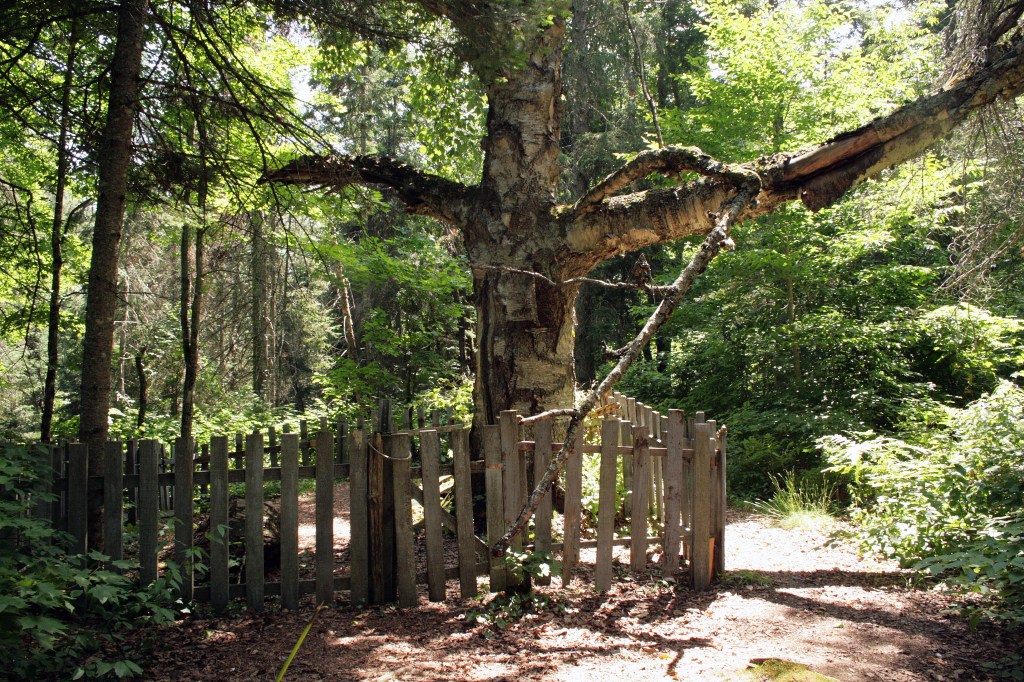
Sitting at the top of the hill we could see an old weathered fence and the supposedly 500 year old birch tree. It’s the largest birch tree I have ever seen! We happily climbed to the top and walked into Mowat cemetery. This small pioneer cemetery is a small remnant of the town of Mowat. This mill town was the largest in Algonquin Park and had about 500 residents in its heyday. The town included a hospital and school, as well as recreational lodges. Tom Thomson often frequented Mowat Lodge. The town began to dwindle, after the lumber recession.7 Today, all that remains of Mowat is the cemetery and a few cement foundations.
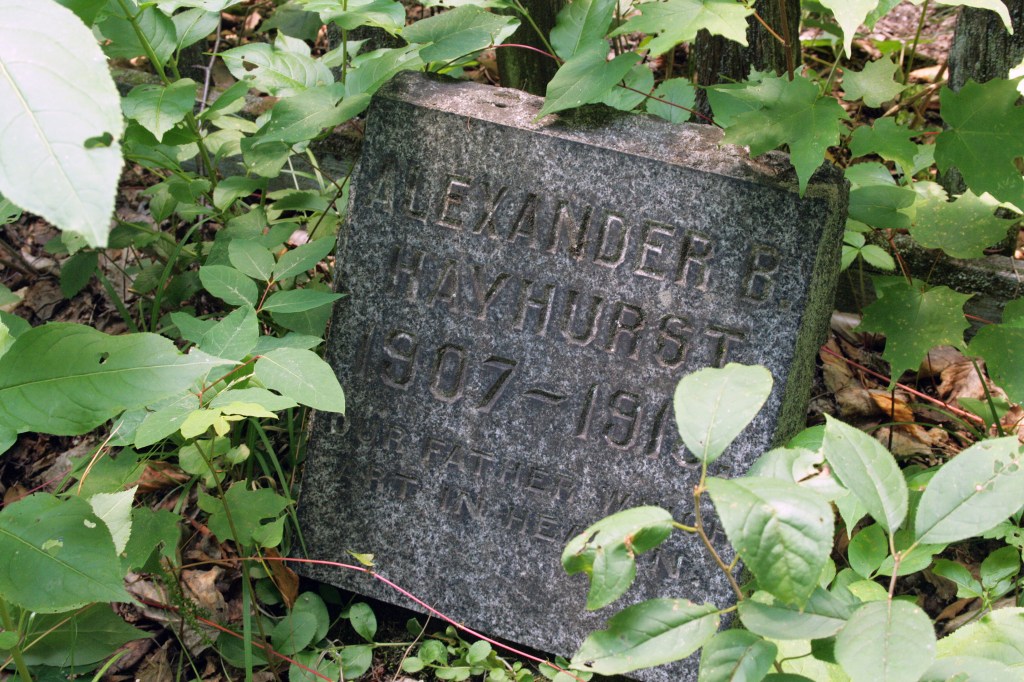
The cemetery is very small, with only a handful of grave markers. There is one field stone, and two engraved headstones within the picket fence. There is also a white wooden Latin cross, that marks the grave of Tom Thomson. It is thought that the cross was placed by the CBC in the 1960s for a documentary. There also seems to be a depression in the ground at his grave. There were a few grave goods left for Tom; a small electric tea light, some paint brushes and a fishing lure. There was no one at the cemetery when we visited, but I think Tom still receives his fair share of visitors.
There is also a large flat gravestone for Ja’s Watson who is thought to be the first person buried at Mowat Cemetery. His stone is hardly legible now, but records say that the epitaph reads:
“In Memory of Ja’s Watson / The First White Person Buried / at / Canoe Lake / Died May 25 1897 being one of / about 500 employed at this Camp by / the Gilmour Lumbering Co. Aged 21 yrs / Remember Comrades (when passing by) / As you are now so once was I / As I am now so you shall be / Prepare thyself to follow me.”8
We spent a lot of time in the cemetery, trying to decipher the stones and admiring the enormous birch tree, and paying our respects to Tom Thomson. We tried to imagine what the cemetery would have looked like in 1917 when he was laid to rest. After a time we decided to head back down the hill and retrace our steps back to the car. It was a bit of a long journey, but it was incredibly rewarding. Back at our campsite we had a nice campfire supper of burgers and corn on the cob and talked about our visit to Mowat cemetery. We speculated on what might have happened to Tom and whether or not he was still laid to rest on that hill. My mother was very adamant that he was still there. After supper, we made some s’mores for dessert and enjoyed the campfire as it lit up the darkness of the night.
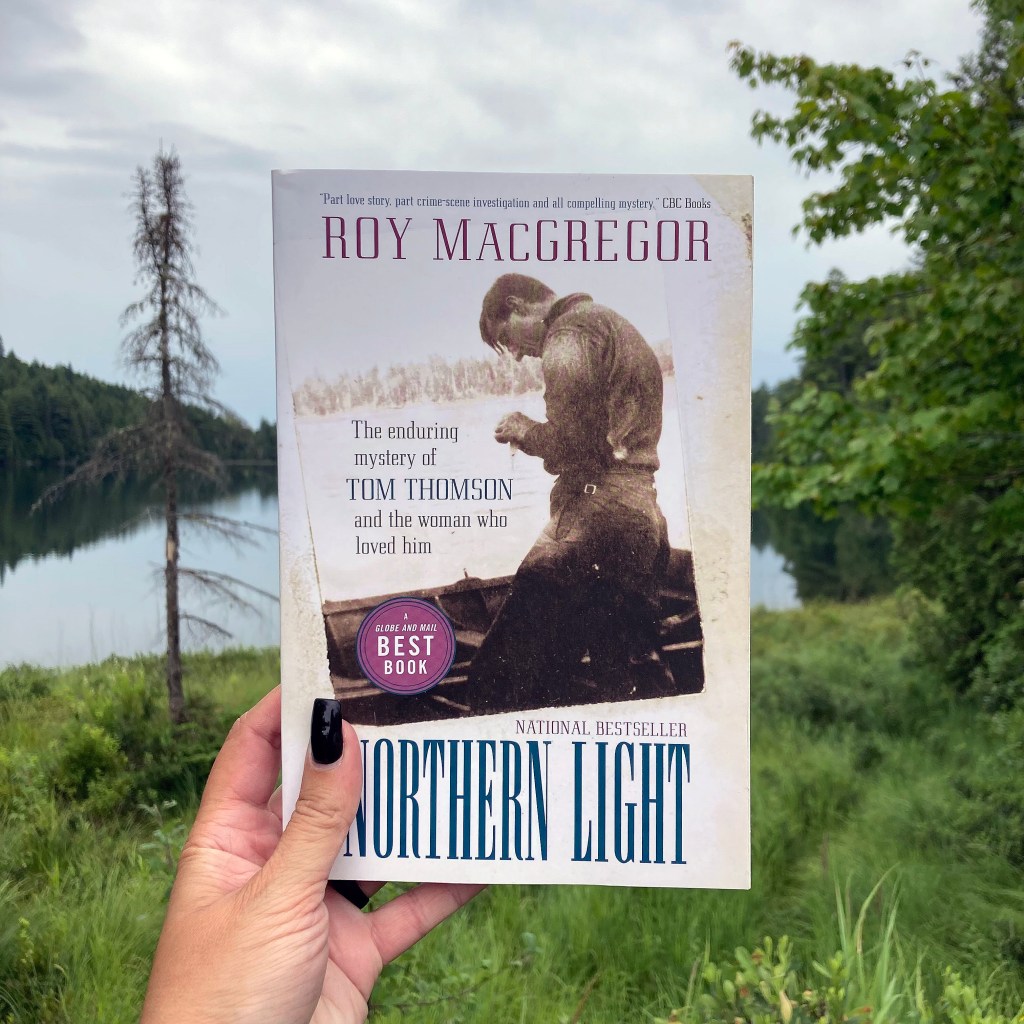
The next morning we decided to explore the park a little more before heading home. We stopped in at the Algonquin Art Centre to look around. This world-class art gallery showcases some of Canada’s foremost wilderness and wildlife artists.9 Outside, on the Centre grounds, we took a look at a set of plaques celebrating Tom Thomson. They told the story of Thomson as a painter, his attraction to Algonquin Park, his body of work, and his legacy as an artist. We also viewed an outdoor exhibit of painted canoes, called Tom Thomson’s Canoe Murals. We spent some time inside the gallery as well, taking some time to admire the gorgeous art gallery and browsing the gift shop. This is where I purchased my copy of Northern Light by Roy MacGregor.
Northern light: The enduring mystery of Tom Thomson and the woman who loved him by Roy MacGregor
Northern light: The enduring mystery of Tom Thomson and the woman who loved him by Roy MacGregor is a very good read. It presents some really interesting theories as to what may have happened to Thomson, and also suggests that his body never left Mowat Cemetery. In the 1950s, a small group of men took it upon themselves to prove whether Tom was still buried in the cemetery on Canoe lake. They took some shovels, went up to the cemetery, and started digging. I think to even their surprise, they did find human remains. They took a few bone samples, including the skull, and sent them for analysis. The results were not what they expected and seemed to raise more questions.1 More recently, a facial reconstruction was attempted using photographs of the unearthed skull. The face that emerged was pretty uncanny, but does that mean the mystery is solved?10
I don’t think the mystery will ever truly be solved. I believe the truth of what happened to Tom Thomson went to the grave a long time ago. But that doesn’t mean people will stop trying to solve it. Stories will continue to be told about his tragic life, cut short. As much as Algonquin Park was a part of Tom’s life, his artwork is now a part of it as well. You can find his artwork at the Art Centre. You can see the inspiration for his art in the beauty of the wilderness. You can learn more about his life in the Visitor Centre, alongside the history of the land and the evolution of the communities within the park. Tom Thomson, whether it be his artwork, his story, or his ghost will continue to be a big part of Algonquin Park.
I really enjoyed my time exploring the park and searching for the grave of Tom Thomson. It was a rewarding trip, that let me explore nature while also learning more about art and Canadian history. It was one of the more challenging cemeteries to find, but it was a beautiful place to visit and photograph. My mother enjoyed this trip immensely. She was a bit leery at first, but the history drew her in. She talks about our trip often. Coincidentally, I started writing this blog post on what would have been Tom’s 145th birthday, August 5th, 2022. My mother shares his birthday.
Have you ever been to Algonquin Park? Have you seen the ghost of Tom Thomson? I would love to read your stories in the comments. If you are interested in reading more about the mysterious death of Tom Thomson, check out the links below.
Thanks for reading!
References:
MacGregor, R. (2010). Northern light: The enduring mystery of Tom Thomson and the woman who loved him. Vintage Canada.
During my two-week vacation, something unexpected happened. While touring around the winding roads of St. Joseph’s Island, I found a Pet Cemetery.
I had researched the area before my trip and had marked off every cemetery on the island, with the hopes of visiting them all. I had not read anything about a pet cemetery, so I was very surprised when I noticed a large stone with the words “Wm. Wright Memorial Pet Cemetery” engraved on it. I quickly pulled over to the side of the road and made a three-point turn. My mother, who was traveling with me, was just as surprised as I was when she saw the cemetery sign.
The William Wright Memorial Pet Cemetery sits on land that was once the site of a Presbyterian Church. The Church suffered a fire, and from my understanding, the cemetery behind this church was moved to a cemetery further down the road. The land was inherited by William’s great-grandson, David Wright, who started the Pet Cemetery and named it after his Great Grandfather, in 1985. Today, the cemetery is cared for by the St. Joseph Lions Club.1
This beautiful cemetery is surrounded by large maple trees. It has a little chapel and even its own little receiving vault, also known as a dead house. When the Lions Club took over the care of the cemetery, they converted a shed to accommodate two freezers for winter storage.1
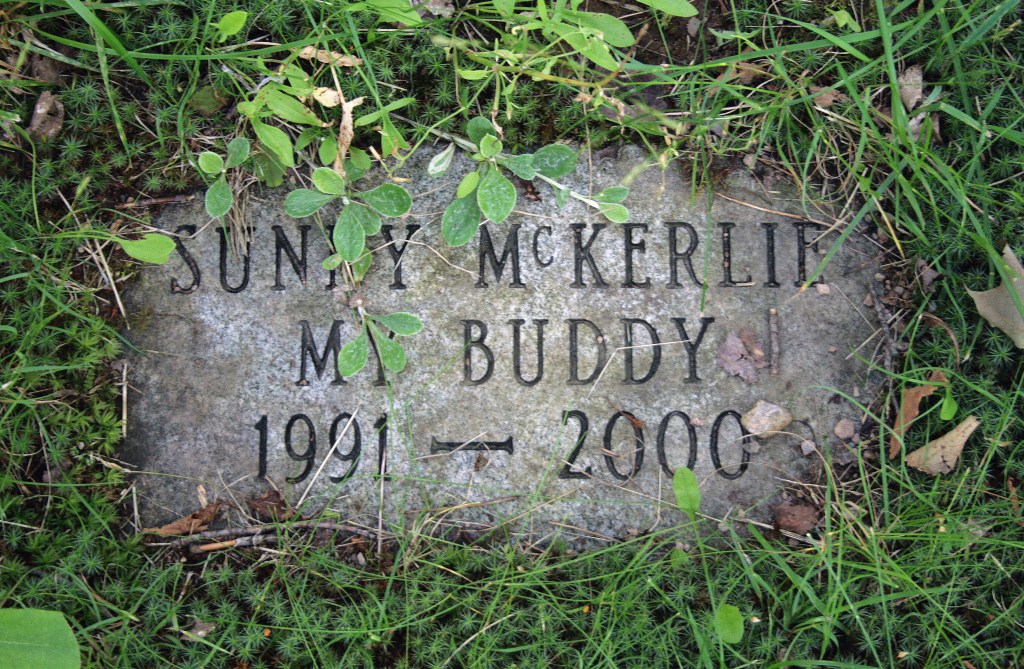
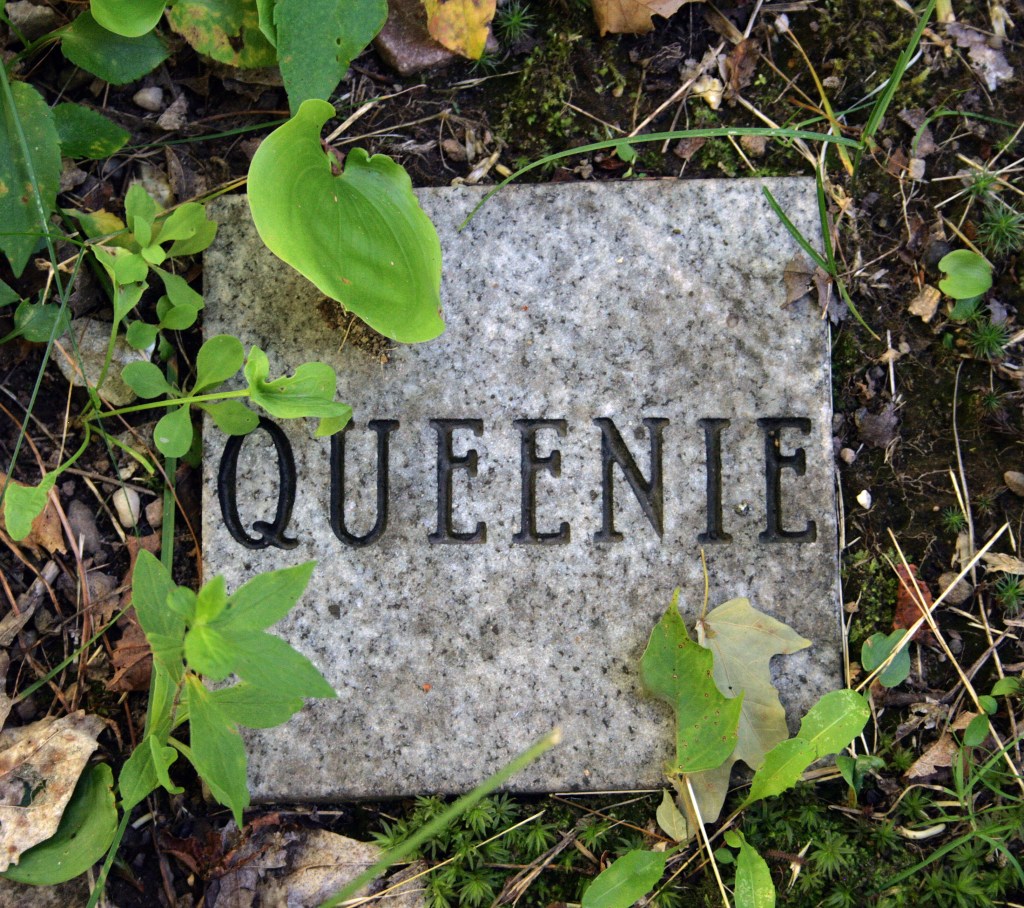
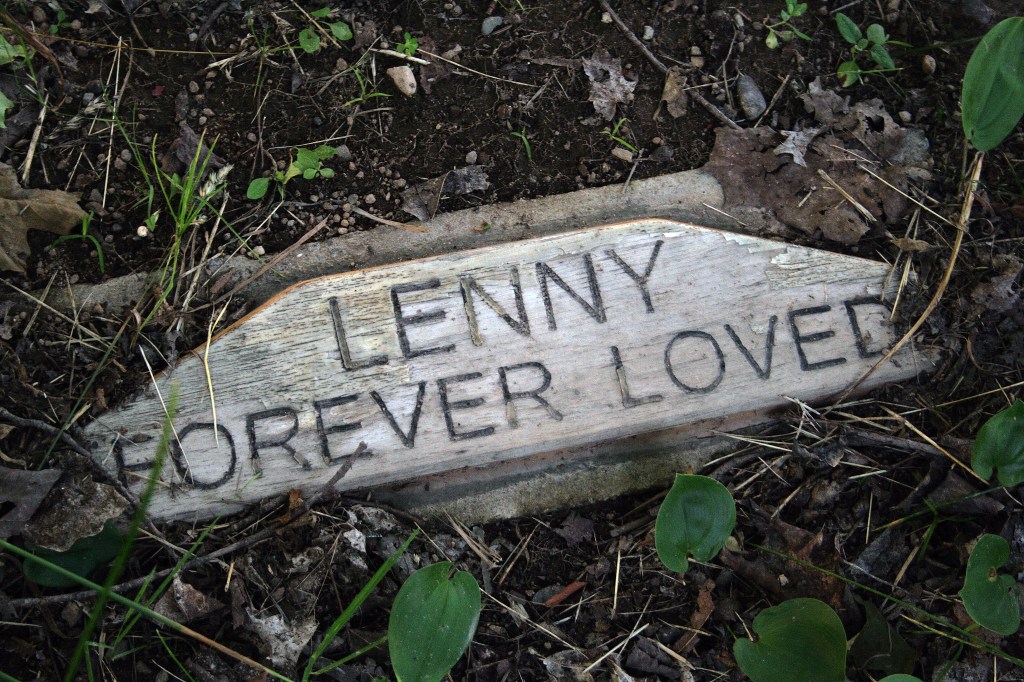
This was my first time visiting a pet cemetery. There is a mix of flat grave markers, homemade crosses, and other types of homemade gravestones that looked to be laid out in sections. I was affected immediately by the love and care that was taken to memorialize these animals. They were not just animals, but furry family members and beloved pets.
Some of the markers only bared names, while others had etched portraits or had loving epitaphs inscribed on them. The epitaphs got to me the most —things like “My Buddy” and “Forever loved”. Seeing these kinds of things inscribed on a tombstone for a pet, some of which were only in this world for a short time, was incredibly heartbreaking. I don’t usually have this sort of response in cemeteries and was a little surprised at how hard it was for me to read each stone.
Although it was an emotional experience for me, I was thrilled to be able to visit a pet cemetery. I think that they are growing in popularity, but they are still a fairly rare thing. After a little research, I only found information for eleven of them in Ontario, including the one I visited. I did try to visit a pet cemetery a few years ago, in Sault Ste Marie. But, we were unable to find it, and I have since been able to find out very little more about it. I would love to be able to visit more in the future. They are incredibly beautiful places.
Have you been to a pet cemetery before? What was your experience like? I would love to read about your experiences in the comments!
It’s a trend on social media in the cemetery community that uses that hashtag, to showcase the beauty of mausoleums. Unfortunately, mausoleums are not a common sight here in Northern Ontario, so I have not had the chance to visit or photograph very many. This is one of the reasons I found Doug Keister’s book Going out in Style: The Architecture of Eternity so interesting. For this month’s book review, I wanted to share it with you.
Going out in Style: The Architecture of Eternity by Douglas Keister
Douglas Keister is a photographer, author, and co-author of forty-five critically acclaimed books, twenty-five of which are on architecture.1Going out in Style, published in 1997, showcases some of America’s most beautiful and unusual mausoleums. This coffee-table book is filled with gorgeous full-color, glossy photos, each accompanied by short descriptions that give a small taste of their stories and histories.
“From a nationally renowned photographer and author team, Going Out in Style: The Architecture of Eternity provides an engaging and at times surprising look at America’s forgotten architecture: the mausoleum.
Elegant, full-color photographs display the grandeur of the mausoleum, documenting the work of some of America’s most noted architects and in some cases the only remaining examples of a particular architect’s work. Additionally, photographs of the interiors of some mausoleums show rarely seen Tiffany stained-glass windows.
Going Out in Style takes readers into beautiful and historic cemeteries in such cities as New York, Philadelphia, Buffalo, Boston, Chicago, New Orleans, Los Angeles, San Francisco, and many others.” – Synopsis from Amazon.ca
Going out in Style: The Architecture of Eternity by Douglas Keister
This is a beautiful book! I was lucky enough to find a first edition hardcover copy, with glossy pages. All the photos are beautifully shot, really showcasing what makes each mausoleum unique. I loved that they took advantage of the book’s large size by including full-page images. There is also a paperback edition available, that is printed on uncoated paper. I have been told the uncoated paper dulls and muddies the photography. That just seems wrong for a photography book!
I enjoyed exploring the histories of all the beautiful mausoleums presented, but it did feel like much more could have been written about them. Sometimes I found the descriptions to be just too short! I’m sure whole books could be written on some of them. Because I am not very familiar with mausoleums and their architecture, I did enjoy learning more about the different styles and periods and found myself trying to figure them out before it was noted in the description.
One of my favorite aspects of the book, was when we were given a look inside the mausoleums. That was by far my favorite chapter. Some of them are just as ornate on the inside, as they are on the outside, while others are very plain compared to their exterior. Some mausoleums hold amazing pieces of art, like Tiffany stained glass windows. It was lovely to peek inside, into what we often don’t get a chance to explore.
I would highly recommend this book and think it would make a great addition to any taphophile’s library. I would especially recommend it to those who love mausoleums or those interested in learning more about architecture. My only note would be to make sure you get the hardcover edition!
__
I am always on the hunt for cemetery-related book recommendations. Please feel free to share any in the comments. If you are an author and have a cemetery-related book you would like me to review, please reach out at hello@chantallarochelle.ca. I would love to hear from you.
I haven’t posted a road trip story in a little bit, so today I wanted to share my adventure of finding a cemetery via railroad tracks!
It was back in 2020, amid the COVID-19 pandemic. Social bubbles were very much in place and almost everything was shut down. There was not a lot to do that summer. BUT visiting cemeteries is always a viable option! My fiancé and I, and our close friends whom we had been bubbling with (that’s an odd to say), decided to go on a little adventure to try and find two cemeteries in Spragge, Ontario.
The little town of Spragge found its beginnings in 1882 but was originally named Cook’s Mills. It was a self-sufficient town of about 350 residents all built around the sawmill. In 1895 the whole operation was sold, and the village was renamed Spragge, after the township. When the depression hit, the mill closed in 1932. That same year, there was a devastating fire that burned almost the entire village to the ground. This caused a lot of folks to leave town, although a few remained and tried to rebuild. The mill never did re-open, and now there only sit about a dozen homes within the small village limits of Spragge.1 Two cemeteries remain, the Spragge Catholic cemetery and the Spragge Protestant cemetery.
This adventure would take us a little over an hour and a half on the road to get to Spragge. Our little group made a day trip out of it. We stopped at a diner and safely had lunch outside on the patio. We asked some of the locals about the cemetery. The stories we heard were pretty interesting. We were told that the owners of the property where the cemetery sits, do not like visitors and consider them trespassers. They talked about how this causes some tension between the townsfolk who want to visit their relatives, but are barred from doing so. The community was trying to get free access to the cemeteries. We were also told that the property owner was known to brandish a shotgun! We were a little put-off by the stories, but we were determined to take a look for ourselves.
After our slightly uncomfortable lunch, we continued on our way with directions by Google Maps. We turned off the main road onto a side road and what looked like a parking area. My fiancé was completely put-off by the stories we were told, he was also not as enthusiastic about visiting the cemeteries as we were, so he waited in the car and played look-out.
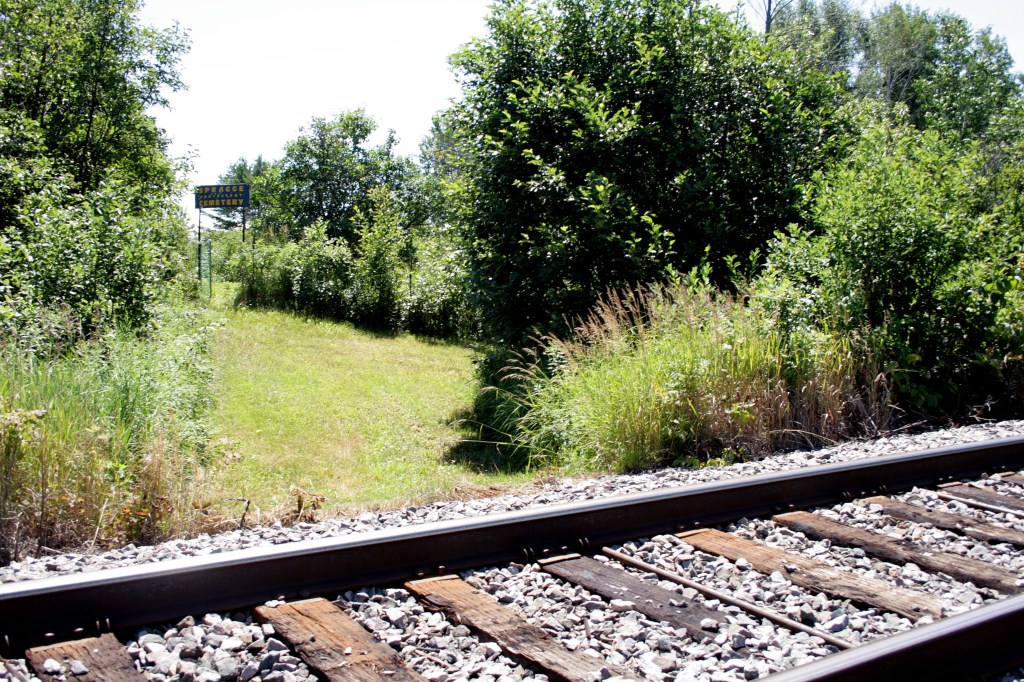
The rest of us began tentatively walking down the dirt road. When it opened up and we could see it was a driveway leading directly to a house, we decided to turn around and try a different approach. We had crossed a set of train tracks, that ran parallel with the main highway. After consulting Google Maps, it looked like we might be able to access the cemetery at a clearing just off the train tracks. We decided to try that. We chose a hot day to walk along the train tracks, but it ended up only being a short walk. On our left, a little clearing opened up which lead into the cemetery.
We had found the Spragge Protestant cemetery! We took some time to wander the grounds and look at the beautiful stones. It was a smaller cemetery and looked to be well-maintained. Not at all what we had pictured in our minds. We had been under the impression that the cemetery was abandoned and in disrepair. Some of the stones were too worn to be read, but some others were still in great condition. Some of the common cemetery symbols we found were clasped hands, obelisks, and little lambs.
After we explored a little bit, we tried to find the Spragge Catholic cemetery. According to my friend’s research, it should have been very close to where we were. We branched out a little, exploring the oddly well-kept lawn that snaked in between clumps of trees. We were nervous about getting too close to the house or going in full view of it. After a little more wandering, with no luck, we decided to turn back and reunite with my fiancé, who was patiently waiting in the car.
We were very happy to have at least found one of the cemeteries, and we vowed to do a little more digging and return in the future to find the elusive cemetery. It was still a fun adventure, after all exploring is half the fun.
But that’s not the end of the story!
This past winter I was busy uploading photos to Find a Grave and uploaded some of my photos from Spragge. A woman reached out to me, looking for coordinates for the Spragge Catholic cemetery, as she has family there. I passed on all I knew, and let her know we were not able to find it. She had also heard about the access issues, but since she was a relative was hoping the property owner would be understanding. She later contacted me and gave me an update. She was able to locate both cemeteries and visit her family. It turns out the town of Spragge did not want the expense of maintaining the cemeteries, and a private owner requested to take it over and purchased the property. When he is not in town, he has entrusted maintenance and upkeep to another property owner in the immediate area—who also happens to have loved ones buried in the cemeteries.
I also had another person reach out about these cemeteries. They have turned out to be pretty popular locations. This time, the person who reached out was searching for the location of the Spragge Protestant cemetery. He had visited the Spragge Catholic cemetery but did not find the other. We exchanged information. I shared everything I knew about the one I had visited. In return, he shared the exact coordinates of the Spragge Catholic cemetery and the contact information of the property owners. If we had searched closer to the water’s edge when we were there, we would have found it. So close!
I’m still a little confused about the stories that the folks at the diner told us, about the owners brandishing shotguns. From what I heard from both people who reached out, the owners seem very kind and willing to allow visitors into the cemetery. Although one had also heard about the access issues. Were there issues at one time? A misunderstanding maybe? Or maybe it was just some locals trying to scare away visitors? That mystery still remains…
Armed with all this new information, I will have to make another trip out to Spragge to visit the elusive Catholic cemetery. I love how this little adventure turned out because it showcases how interesting cemeteries can be. Cemetery mysteries are very much a part of the fun, and the fact that the cemetery community is so willing to share information and come together to solve these little mysteries is heartwarming.
Have you ever visited the cemeteries in Spragge? Do you have a cemetery mystery you would like to share? I would love to read about it in the comments.


























 Cemetery Photography by Chantal Larochelle