The August heat is starting to wane, as the cooler Autumn weather is starting to take over here in Northern Ontario. In an attempt to hold onto the last Summer has to offer, I thought it might be a good time to make another gravestone recipe. This month, I am trying out Marian’s Heavenly Daze Ice Cream.
That’s right, an ice cream recipe that can be found on a gravestone!
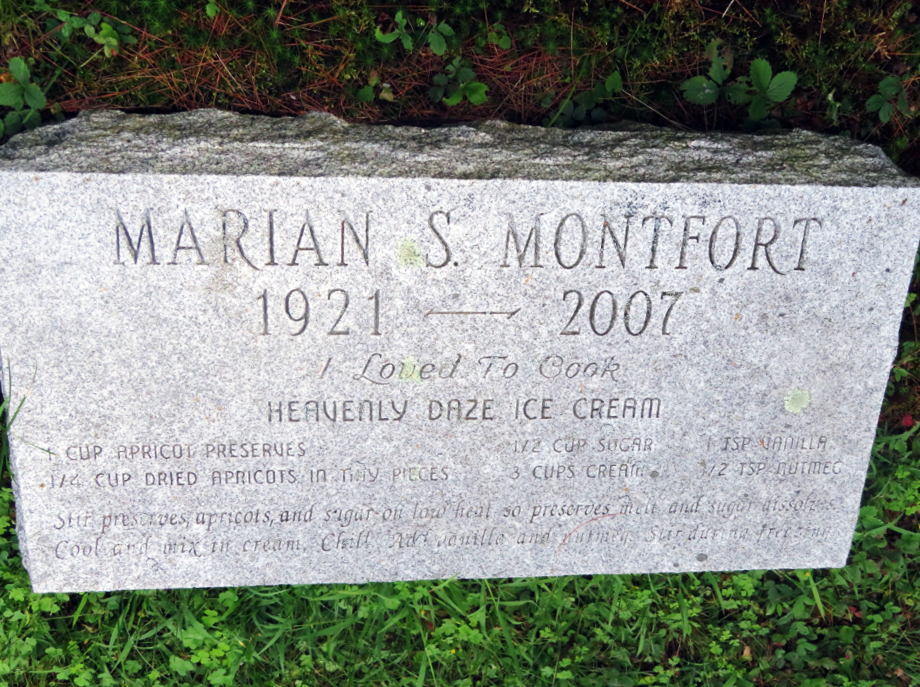
This recipe can be found on the gravestone of Marian Woodward Sheaffer Montfort. Marian passed away at the age of 86, in Portland, Maine. According to her obituary, she was a dedicated wife and mother who also enjoyed sewing and knitting. She was also very independent, living at home until the end, enjoying the company of her cats and the wildlife in her yard. By that description, she reminds me a little of my own mother.
Marian is laid to rest in Robertson Cemetery in Weld, Maine, beside her husband Robert Montfort, who passed away in 1991. Sadly, her daughter Amethyst also rests in Robertson Cemetery, having also passed away in 1991. I couldn’t find more information about Robert and Amethyst, but I was grateful to see they were laid to rest in the same cemetery.
Marian’s gravestone also boldly states “I Loved To Cook”. So what better way to remember her, than by making and enjoying her ice cream recipe!
Grave of Marian S. Montfort. Photo by Find a Grave contributor Catonlocke123. Photo used with permission.
The recipe reads:
Heavenly Daze Ice Cream
1 cup Apricot Preserves
1/2 cup Sugar
1 tsp Vanilla
1/4 cup Dried Apricots in tiny pieces
3 cups Cream
1/2 tsp Nutmeg
Stir preserves, apricots, and sugar on low heat so preserves melt and sugar dissolves.
Cool and mix in cream. Chill. Add vanilla and nutmeg. Stir during freezing.
This recipe was easy to make but ended up taking way more time than I thought it would. It’s been a while since I made an ice cream recipe, but I made sure to make some room in my freezer and put my ice cream machine bowl in there to freeze for a couple of days before attempting this recipe. For the ingredients, I used apricot jam instead of preserves because I couldn’t find any. I think the jam probably has some extra sugar in it, so I was a little worried that it would be too sweet, but I took the chance.
I melted the jam, sugar, and apricot pieces on low heat, but I wasn’t sure how long it would need. I kept an eye on it to make sure it didn’t burn and kept stirring it until the sugar looked like it was melted and incorporated into the jam.
Like with most gravestone recipes, I did have to look up some best practices for cooking and cooling times. Luckily, I have an ice cream recipe book. So I did refer to that to see how long I should be cooling it. I followed the book’s instructions, and put the saucepan in the fridge for 30 minutes to cool. After that, I incorporated the cream and put it back in the fridge for 3 hours to chill. It was about 9 p.m. when my timer went off to take it out of the fridge. I was too tired to start up the ice cream machine at that point, so I left the saucepan in the fridge overnight to chill more.
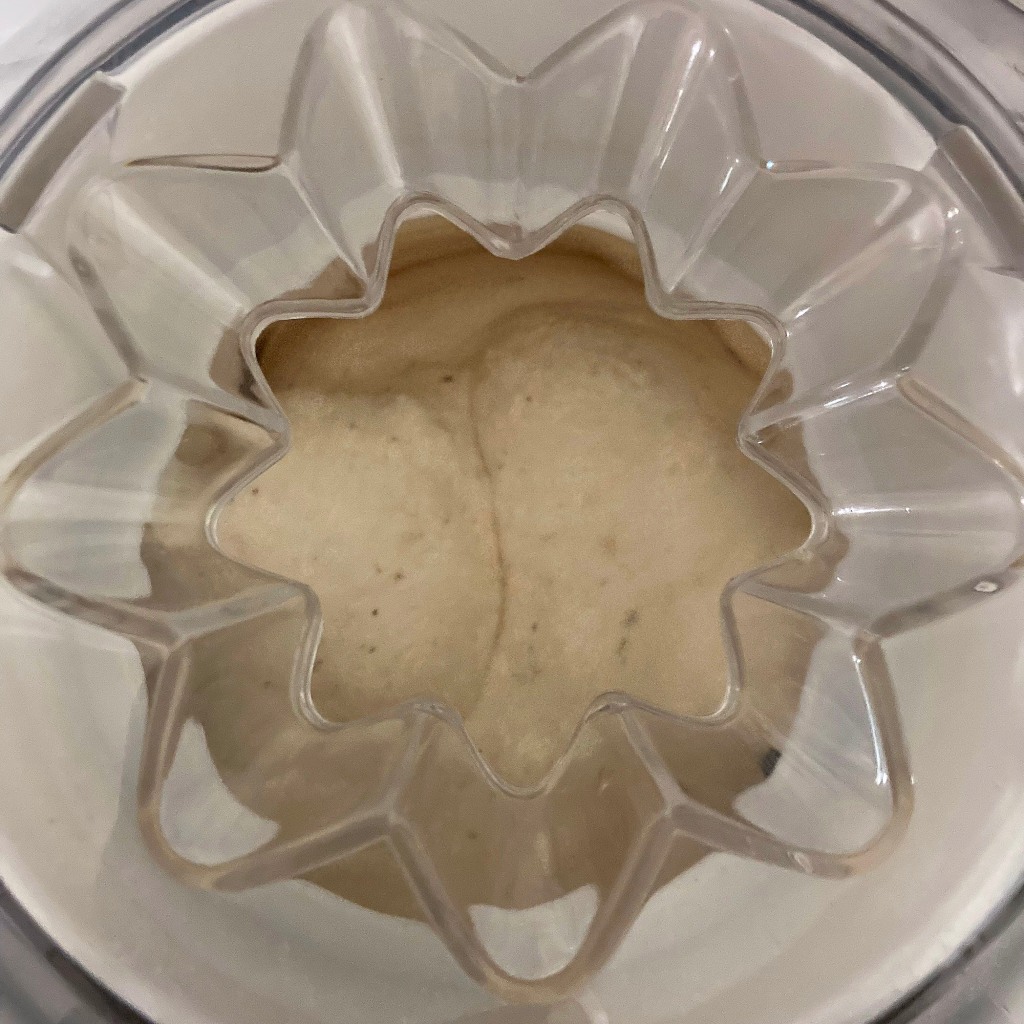
The next day, on my lunch break, I mixed in the vanilla and nutmeg and started up the ice cream maker. I forgot how loud that thing is! I let it run for 30 minutes and checked on it now and then. I love seeing the consistency get thicker over time. I also had to sneak a taste. The nutmeg really makes this recipe!
After enjoying a little bowl for dessert, I removed the machine bowl and placed it back in the freezer. I recommend letting it sit over night so the flavours can really combine and the extra time in the freezer also brings out that ice cream texture we all love.
This was such an easy recipe to make, made even easier by the use of an ice cream maker. The flavours of the apricot and nutmeg work so well together. I think I like apricot a little more because of this recipe. As for my use of jam vs. preserves, I don’t think it made much of a difference. My ice cream didn’t turn out nearly as sweet as I thought it would because of it.
I would love to learn more about how this recipe came to be on Marian’s grave. Was this her favourite ice cream? Did she make it often? In any case, I think it’s so sweet (pun intended) that this recipe lives on along with her memory.
Do you have a favorite gravestone recipe? What family recipe would you put on your gravestone? I would love to read your thoughts in the comments.
It’s been a week since I have been back from vacation, and I am just now starting to feel settled back into my regular routine. It was great to take a break from work life and focus on relaxing and enjoying time with family.
Although my vacation did get off to a rough start.
At the beginning of July, while visiting cemeteries in Cobalt, I picked up a bad case of poison ivy, except I didn’t realize it was poison ivy till about two weeks later. It spread quite a bit before I realized what it was. I was given some medication and spent most of July housebound, to try and heal up as fast as possible.
This is a good reminder to always dress appropriately when exploring overgrown cemeteries!
On top of that, a week before we were set to fly to Montreal, I also caught COVID-19. And because bad things usually happen in threes, the airline canceled our flight the night before our Monday departure and rescheduled it to a later flight on Tuesday. This change completely kiboshed our plans as we had appointments in Montreal booked for early Tuesday. We scrambled to try and make the trip work, regardless of all the challenges thrown at us, but alas it just didn’t work out. We had to cancel our whole trip. It was a huge bummer and left both my fiancé and I feeling defeated.
If we had made it to Montreal, I wouldn’t have had a chance to visit Notre-Dame-des-Neiges Cemetery after all. The labor strike is over, but due to the need for maintenance and cleanup, the cemetery is not open yet. As of this writing, their website states that site cleaning is only at 45% completion. I suspect that they will be opening in September sometime.
So the first week of my vacation was a bust.
I was able to enjoy the last week of my vacation, after finally testing negative for COVID. I enjoyed some beach days with my fiancé and a three-day trip with my mother.
That being said, I have some great cemetery road trips and stone stories to share with you! Keep an eye out for some upcoming posts about visiting the second resting place of Tom Thomson, and seeing his artwork in person. We also made a stop to visit the grave of Billy Bishop, Canada’s own World War I flying Ace. We also had a chance to visit his childhood home which has been preserved as a historic house.
Despite the medical setbacks, my summer vacation was still enjoyable, with lots of cemetery visits completed. The summer isn’t quite over, but I am starting to look forward to spending more time in cemeteries in the fall. I am also already starting to plan some fun spooky season content for the blog. There are only 79 days till Halloween after all!
I hope you have had a great summer so far too, and have been able to take some time to do the things that you enjoy. I would love to read about what you have been up to on your summer vacation in the comments!
For the next two weeks I will be taking some time to step away from my computer and work life to enjoy the waning summer weather. I am hoping to disconnect, step out of routine, and explore with friends and family.
I plan on visiting quite few cemeteries while I am away, like Canadas largest cemetery in Montreal. I also plan to pay my respects at the second resting place of Tom Thomson. So keep an eye out for some upcoming blog posts about those adventures.
That being said, I will not be monitoring my social media channels while I am away, and I will reply to all questions and comments on my return. Regularly scheduled social posts will continue to go up as normal, except for my weekly blog posts.
I hope everyone takes some time for themselves this summer to relax and recharge!
When people ask me why I love cemeteries so much, I often say it’s because they are great places to learn about art and history. Today on the blog I wanted to share a recent cemetery visit that is a perfect example of this.
On the Canada Day long weekend, some friends and I took advantage of the nice weather to explore some areas in the Temisikaming District. We toured around Temagami, and up to Kirkland Lake. We visited 18 cemeteries that day, (New Record!) and found some really interesting things along the way. A day or two before we left for our cemetery road trip, one of my friends learned about an interesting gravestone in a cemetery in Earlton.
We made it a priority to find it.
In one of my friend’s work offices, they have a bronze sculpture created by a famous Canadian sculptor. When describing the artist’s work, it was mentioned that one of her sculptures sits atop a gravestone, in Earlton, Ontario. I’ve always thought of cemeteries as open-air art galleries, and this gravestone proves that point.
That famous French Canadian sculptor is Rose-Aimée Bélanger. She was born in 1923 in Guérin Quebec,1but lived most of her life in the small township of Armstrong, near New Liskeard.2 In 1945, she began her studies at l’École des Beaux-Arts de Montréal but paused her studies to marry and raise nine children. It wasn’t until thirty years later, that she would return to her love of sculpture.1
Her work, in clay and bronze, mainly depicts women frozen in everyday moments. Her work is informed by her own life experiences, and inspired by her community.1Arguably her most famous, and most photographed work is Les Chuchoteuses (The Gossipers), which can be found in Montreal, Quebec.3
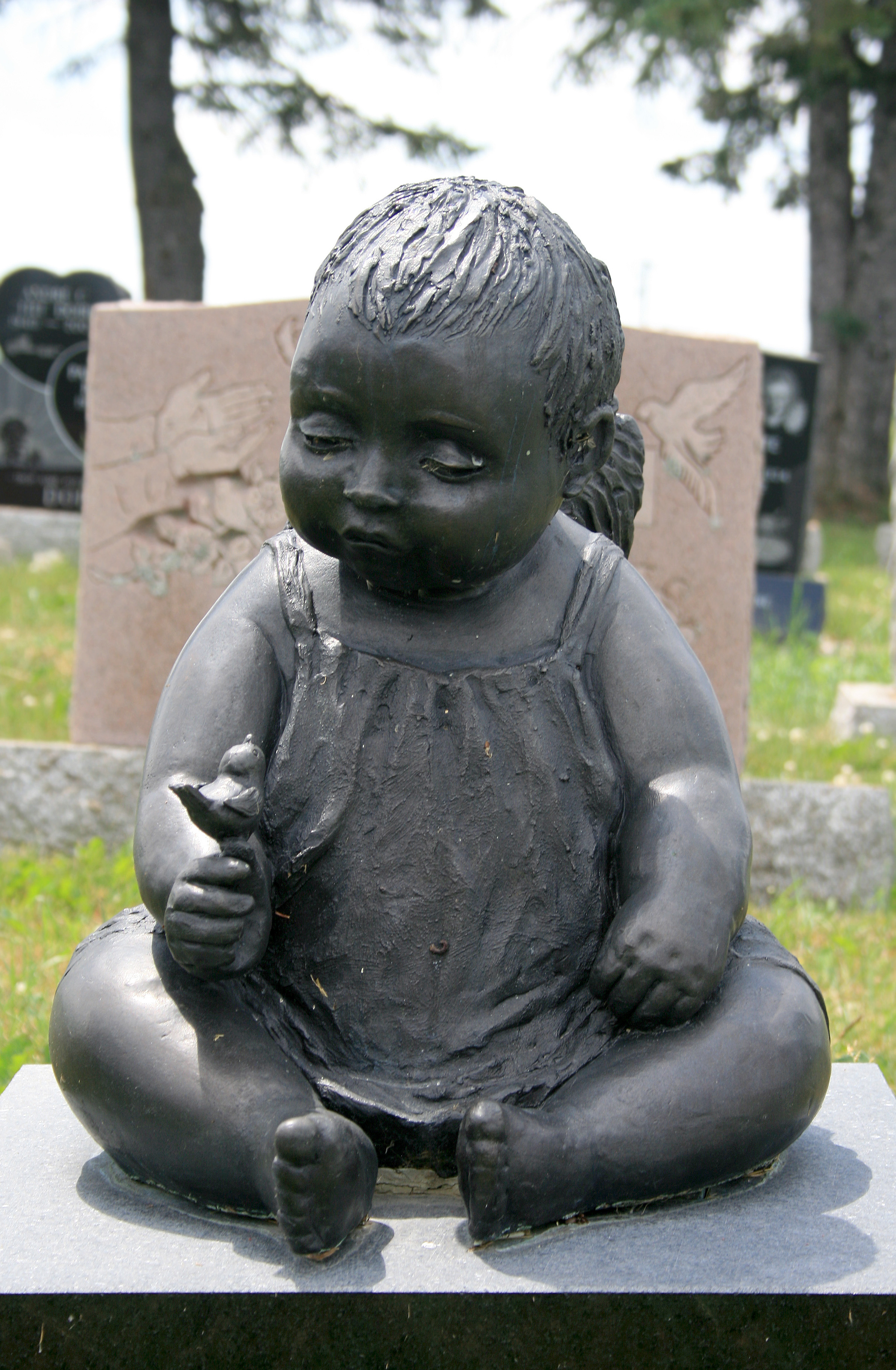
Another of her bronze sculptures can be found on top of the grave of her son Charles Bélanger, in St. Jean Baptiste Cemetery. Charles rests beside his father, Laurent Bélanger, and the future resting place of his mother. One of nine children, Charles passed away of pneumonia in 1951 in Timmins, Ontario.
Shortly after we visited Charles’s resting place, my friend had the chance to meet Pierre Bélanger, Charles’ brother. He shared that young Charles was eventually moved to the Bélanger family plot in Earlton from Timmins when his mother, Rose, felt she was ready.
The final resting place of the Bélangers can be found in St. Jean Baptiste Cemetery, in the small town of Earlton Ontario. The cemetery is a fairly small one, although Find a Grave does list 797 memorials for this cemetery.4 I had some trouble trying to locate this cemetery on a map, but after reaching out to a fellow taphophile on Find a Grave, I had the address and coordinates and we were able to find the cemetery easily.
The epitaph, written in French, reads: “In loving memory of / Charles / son of / Laurent and / Rose-Aimée Bélanger / died February 17, 1951 / at the age of 1 year 8 months.”
It didn’t take us long to find this beautiful sculpture, as it does stand out a little bit among the gravestones. Possibly bronze in color at one time, the sculpture now has a dark patina. The sculpture depicts a small cherub of a child sitting on top of a granite square. He holds out his hand where a small bird has perched. He looks down wistfully at the little bird in his small hand. He is dressed in what might be a little linen jumper and has two small angel wings protruding from his back.
You can tell right away, this sweet tribute was made with love. From the angel wings to the soft look of the face, the attention to detail is impressive. I love the little dimples on the hand. It is a poignant symbol of a mother’s love, expressed in the most natural medium for her. It must have been a cathartic experience creating this piece.
My friends and I paid our respects to Charles and Laurent, lingering to admire Roses’ beautiful work. We were very happy that we were able to visit. I have always said that cemeteries are the perfect place to go for a walk, enjoy nature and look at beautiful art. And in this case, explore some Canadian art history.
Rose-Aimée Bélanger celebrated her 100th birthday this year, on July 4th. In celebration, she also unveiled a new sculpture. Titled Appeasement, her new work can be found at the Canada House Gallery in Banff, Alberta.3 She has many art pieces in collections all over the world1, but you can see some of her beautiful artwork while paying your respects at the cemetery.
Today’s cemetery-related book review is another AGS Bookclub pick; The Rural Cemetery Movement: Places of Paradox in Nineteenth-Century America by Jeffery Smith. I found this one very fascinating and wanted to share my thoughts.
I was looking forward to reading this one. I am very interested in the different types of cemeteries and graveyards that exist. I haven’t had the chance to visit many rural cemeteries, also sometimes called garden cemeteries. I have visited only a handful of them, but I look forward to visiting more after having read this.
The Rural Cemetery Movement was published in 2017 and is available in three different formats; hardcover, softcover, and a kindle edition. I was able to find a paperback edition on Amazon.ca. It’s filled with lovely black-and-white photos as well as some detailed cemetery maps.
Here is a snippet of the book synopsis from Goodreads.com: “The Rural Cemetery Movement: Places of Paradox in Nineteenth-Century America breaks new ground in the history of cemeteries in the nineteenth century. This book examines these “rural” cemeteries modeled after Mount Auburn that were founded between the 1830s and 1850s. As such, it provides a new way of thinking about these spaces and a new paradigm for seeing and visiting them. While they fulfilled the sacred function of burial, they were first and foremost businesses. The landscape and design, regulation of gravestones, appearance, and rhetoric furthered their role as a business that provided necessary services in cities that went well beyond merely burying bodies. They provided urban green spaces and respites from urban life, established institutions where people could craft their roles in collective memory, and served as prototypes for both urban planning and city parks.”
The Rural Cemetery Movement: Places of Paradox in Nineteenth-Century America by Jeffery Smith
This fascinating book is incredibly well-researched and takes an in-depth look into the rise of the rural cemetery movement. It details the gradual shift and impacts it had on urban planning and ultimately the business of cemeteries. Essentially this is a book of essays that look at different aspects of the rural cemetery and its effects on burial and cemeteries worldwide. It’s full of fascinating history about the creation and layout of garden cemeteries and the effect they had on other landscapes, such as what we know today as public parks. I found it also fascinating to read about the effort that went into creating the look of rural cemeteries and how the rules and regulations evolved to maintain that look. There is also an interesting section on cemetery tours and how some were created as marketing tools before a cemetery was even opened!
I found the content so interesting that I devoured this one pretty quickly. It’s well-researched and written at a high level but still very graspable which made it an excellent read. I found the added photographs and maps a nice touch as well. There are also extensive notes and a bibliography if you are interested in further reading.
I extremely enjoyed this book. It’s a great resource for those looking for information specifically about garden cemeteries. This would also be a good read for those interested in learning more about different styles of cemeteries, or anyone interested in a behind-the-scenes look at how cemeteries operate and the business of cemeteries.
There are not many garden cemeteries in my local area, but I know I will be thinking about this book the next time I do visit one. Have you read The Rural Cemetery Movement? If not, will you be adding it to your reading list? Do you have a favorite garden cemetery? I would love to read your thoughts in the comments.
Thanks for reading!
I am always on the hunt for cemetery-related book recommendations. Please feel free to share yours in the comments. If you are an author and have a cemetery-related book you would like me to review, please reach out at hello@chantallarochelle.ca. I would love to hear from you.
Writing these weekly blog posts, I often feel like a travel writer. Cemetery tourism is one of my favorite things! For this week’s blog post I wanted to share another cemetery road trip destination—The Screaming Heads.
At the beginning of June, I went on another Birthday weekend road trip. This trip was a mix of cemetery visits, museums, and attractions. We visited 15 cemeteries, played a game of Cemetery Bingo, and visited the Wiseman’s Corner Schoolhouse Heritage Centre, which happened to have a gravestone on its grounds.
The main attraction of this trip, and the whole reason we visited Burk’s Falls, was to finally visit and experience The Screaming Heads, in Midlothian. We had talked about visiting for about the last 2 years but never managed to make our way there. So this year we made a special birthday trip to visit this unique resting place. You never know where you might find a cemetery.
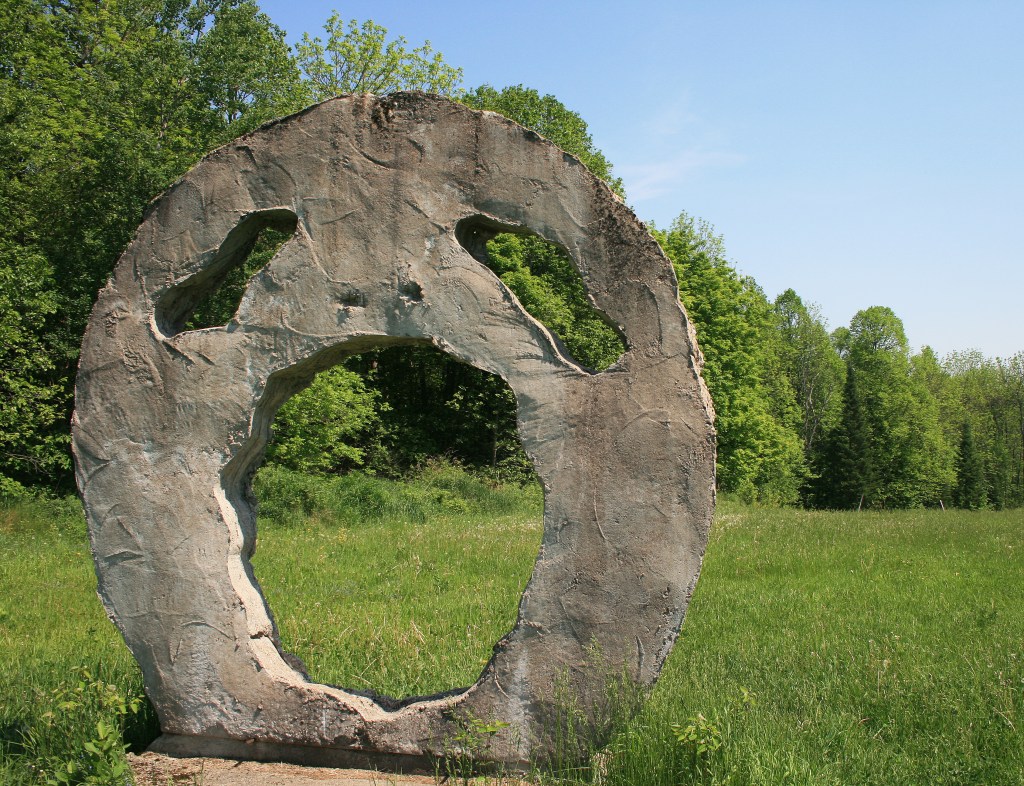
The Screaming Heads is an ever-growing art installation created by Peter Camani, a Canadian artist, sculptor, and retired art teacher. This public open-air art gallery dots the landscape of his 310-acre property.1 Living among his artwork, Peter lives in the Midlothian Castle, which was built upon a 19th-century derelict farmhouse.
There is a giant spider web gate made of stone and rebar that surrounds the castle. If the gate is open, you may get a chance to look inside and visit the artist’s studio and living space. Everywhere you look there are interesting details to admire, from the metallic dragon that breathes smoke when the fireplace is lit, to a giant head that houses a studio space within it, to the rows of smaller screaming heads that line the top wall of the gate.
Located on Midlothian Road, near the small town of Burks’s Falls, The Screaming Heads is an off-the-beaten-path roadside attraction. You know you are getting close if you start spotting smaller screaming heads; like at the Burk’s Falls visitor center and the Wiseman’s Corner Schoolhouse Heritage Centre. Peter opens his property to tourists year-round, from dawn till dusk. You’ll find much more at this attraction than just amazing artwork. The property is also home to about 300 species of birds, including peacocks. Their eerie calls can be heard all around you as you hike through the open fields and bush. There is a small gift shop that has some neat Screaming Heads merch, and on weekends you might also find a small farmers market.
The main attraction is of course The Screaming Heads. The artist has described these 20-foot-tall concrete sculptures as a warning against environmental degradation, “the earth rebelling against what we’re doing to the land.”2 Peter has transformed this once barren farmland, by planting many of the trees on his property and propagating spring-fed ponds. His large concrete structures are arranged in such a way that they form the shape of a dragon when viewed from the air, although today the trees are so large they obscure some of the statues.2
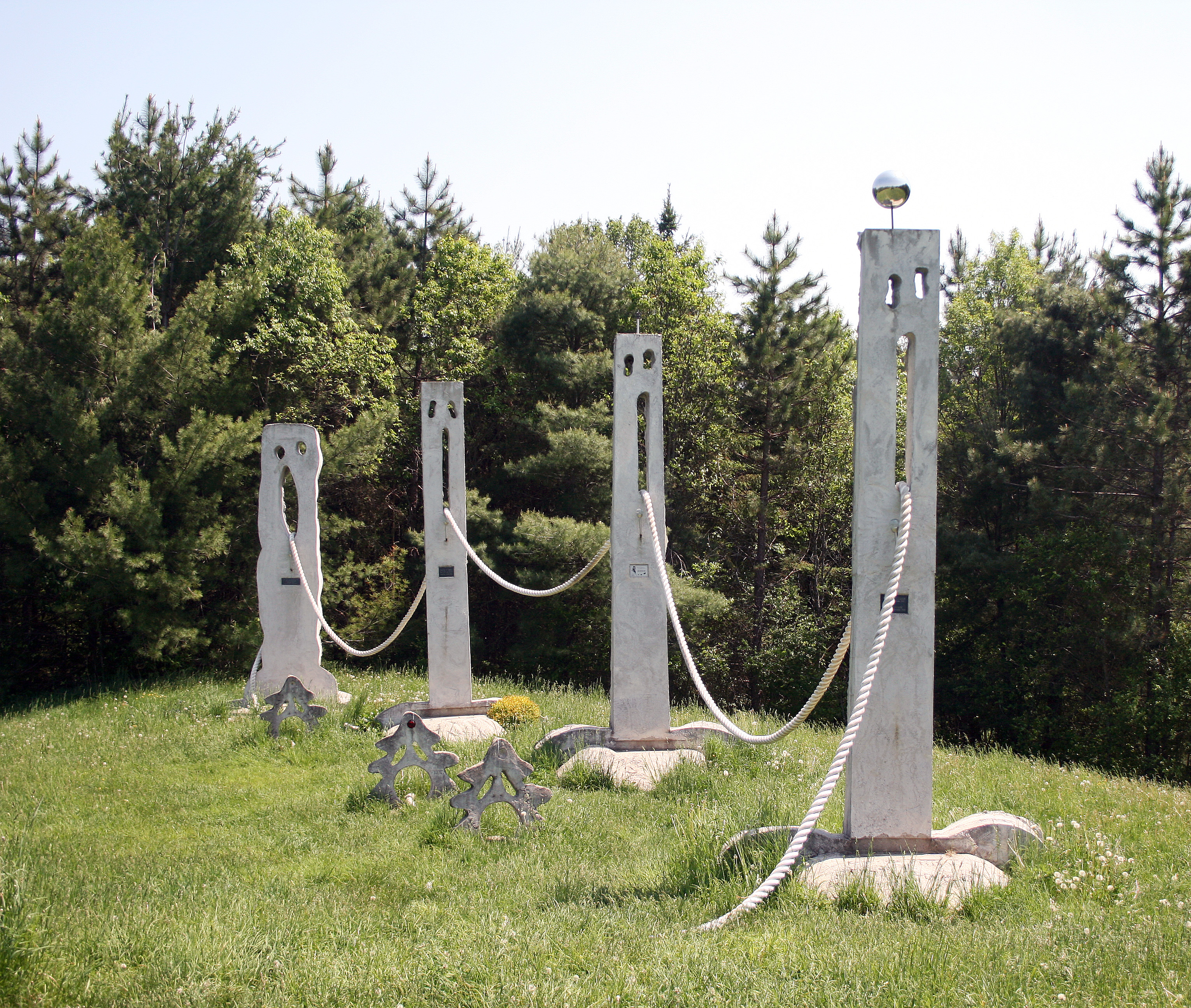
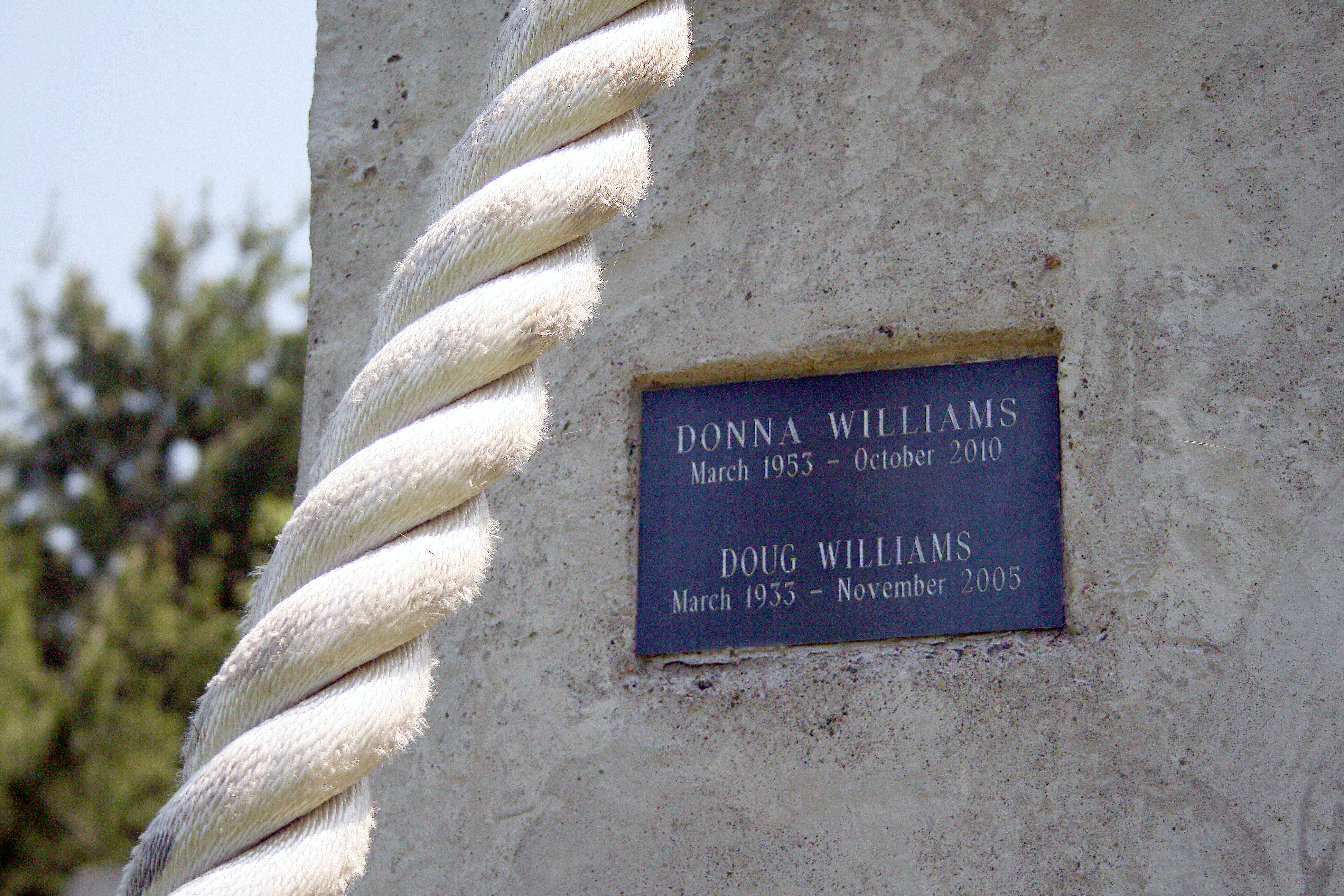
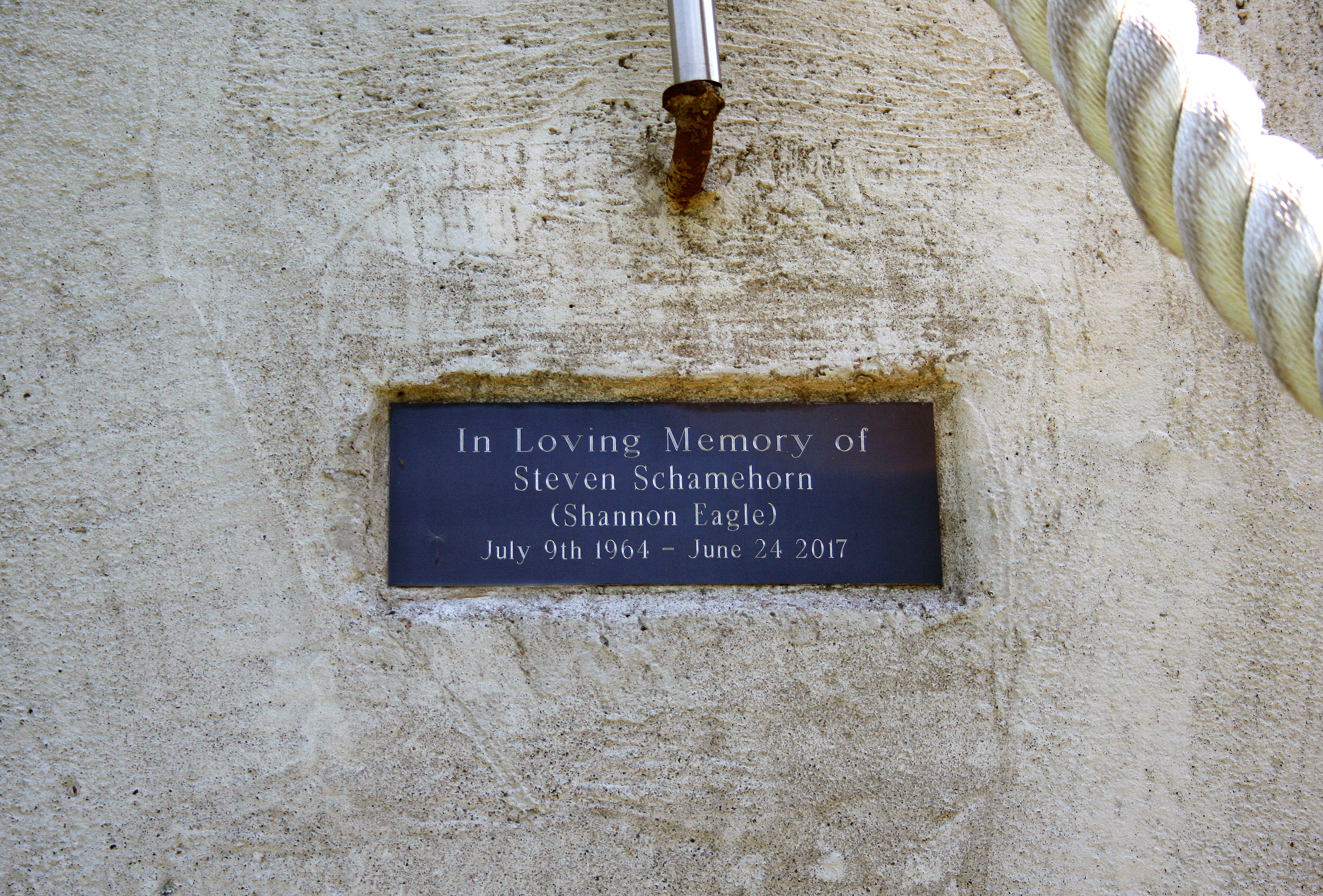
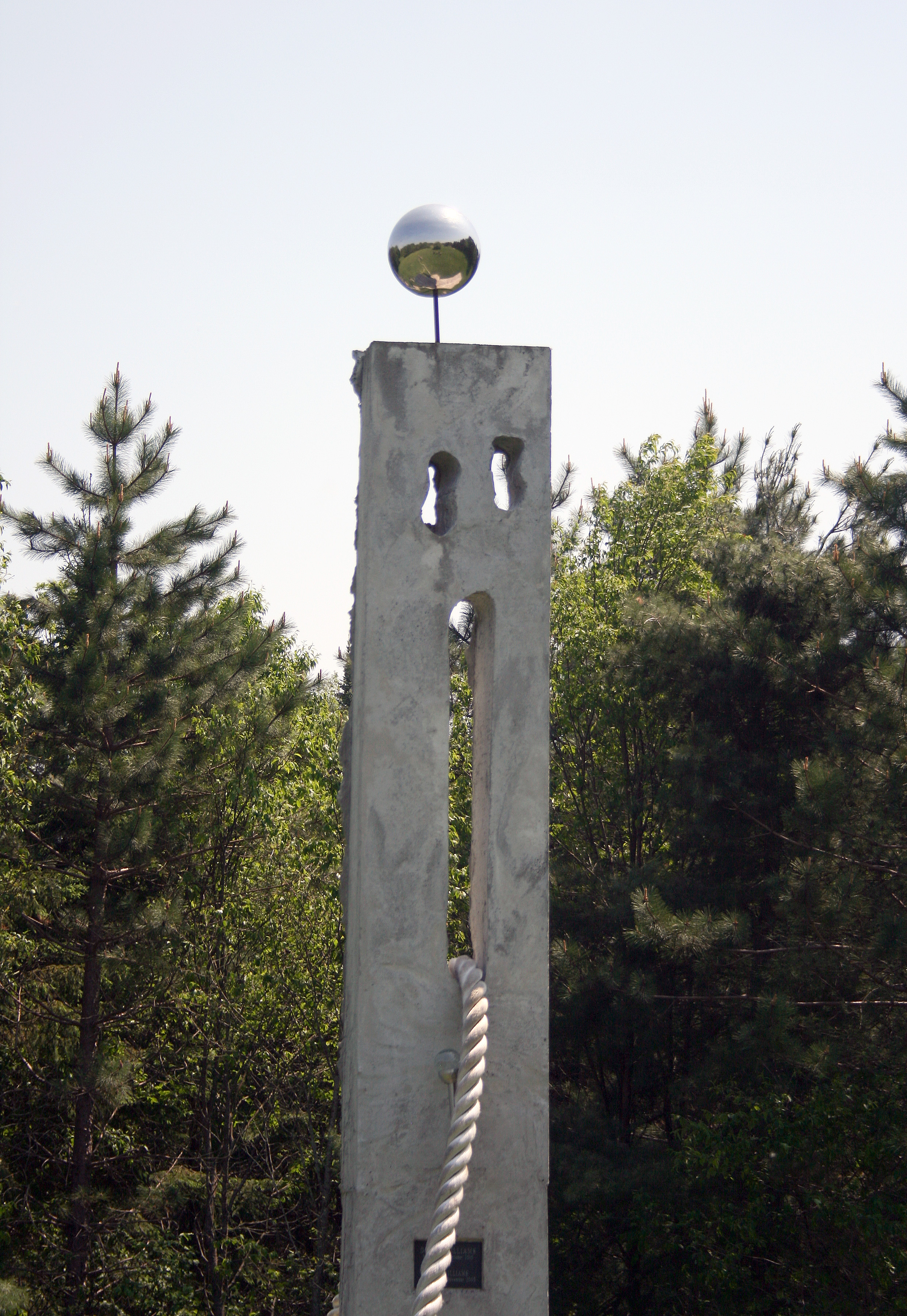
Along with being a unique roadside attraction, The Screaming Heads can also be considered a cemetery. A small grouping of Screaming Heads stand out among the other round Edvard Munch-like sculptures. These tall narrow creations have cremated remains mixed into the concrete. On his website, which now seems to be defunct, the artist had a creative suggestion for where your final resting place could be when you pass away; “Why settle for a small underground plot in the suburbs, when you have the option of joining a vibrant creation that fills the landscape?”3 At one time, If you wanted to be memorialized in this open-air art gallery, you would need $10,000 to reserve your spot.3 Since the website is now gone, I am uncertain if this option still exists.
At the time of our visit, there were 4 human ash sculptures, with memorial plaques for 5 people.
Everyone’s experience with the Screaming Heads will be different, as there is no set way to explore the grounds. There is no trail map, and there are a few trailheads to choose from. When we visited, on an exceptionally warm day, we managed to come upon the memorial sculptures first. The photos don’t do them justice, as they are larger than life! We asked ourselves many times as we wandered the grounds, about the process of making these immense sculptures and what that might look like.
There is something magical about this place. As you walk among these enormous, whimsical sculptures, it’s easy to feel like you are in a magical forest, where strange creatures may reveal themselves at any moment. I was filled with a sense of wonder as we walked through the woods and fields, discovering hidden sculptures as we got closer to them. The eerie sound of the peacocks also added to the experience. Their cries always seemed to surround us, and just when we thought we were close enough to see one, we would hear their scream from another direction.
I can understand why someone would want their final resting place to be in such a magical place. The idea of becoming art, becoming part of something larger than yourself, to instill a sense of awe in others; that guarantees you will always be remembered.
Do you want to plan your own trip to visit The Screaming Heads? They are located in Midlothian, Ontario, close to the small town of Burk’s Falls. The grounds are open year-round, from dawn till dusk, and admission is by donation. Make sure to bring your camera, your water bottle, and LOTS of bug spray. Have you already visited? I would love to hear about your experience in the comments.
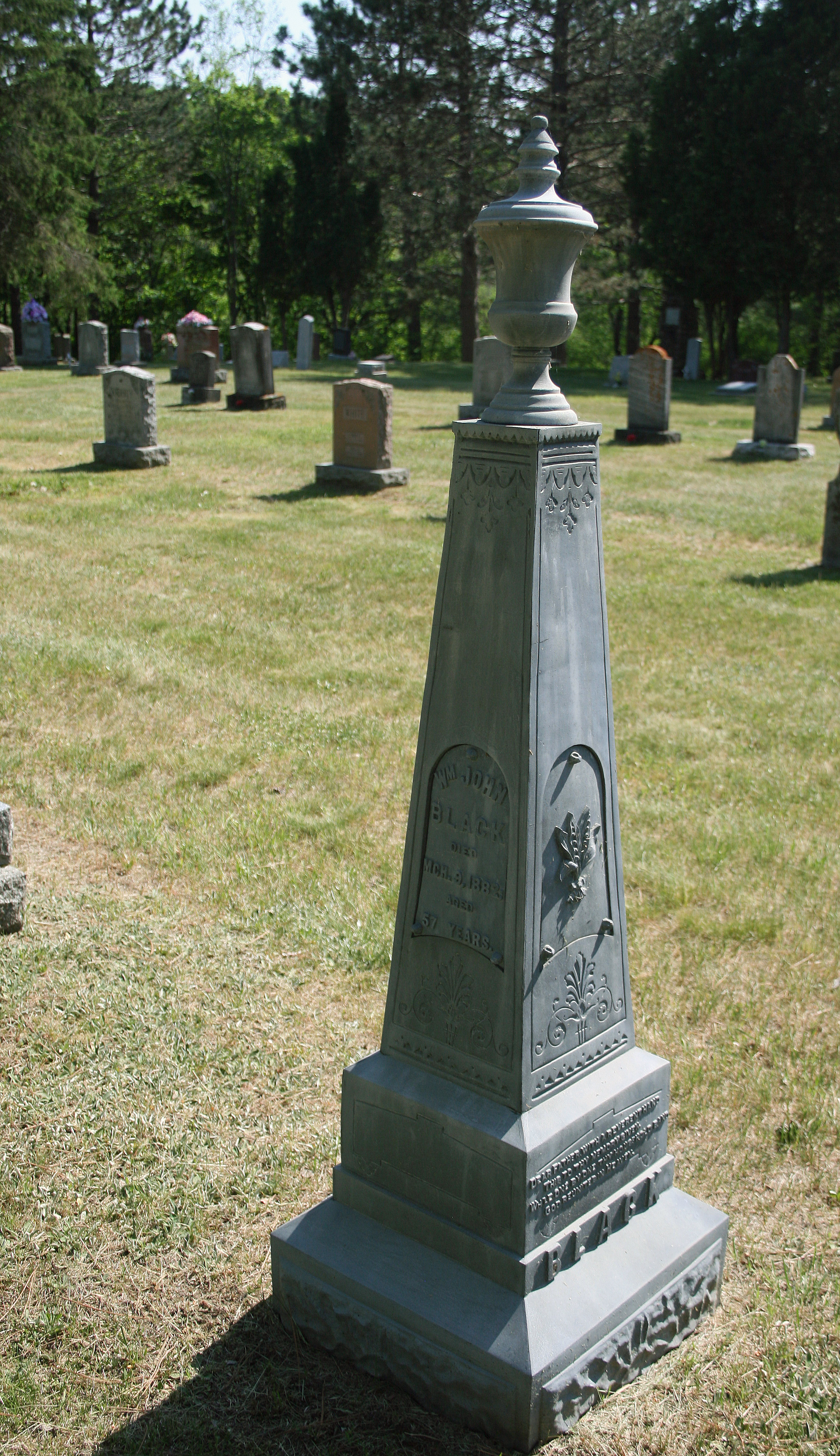
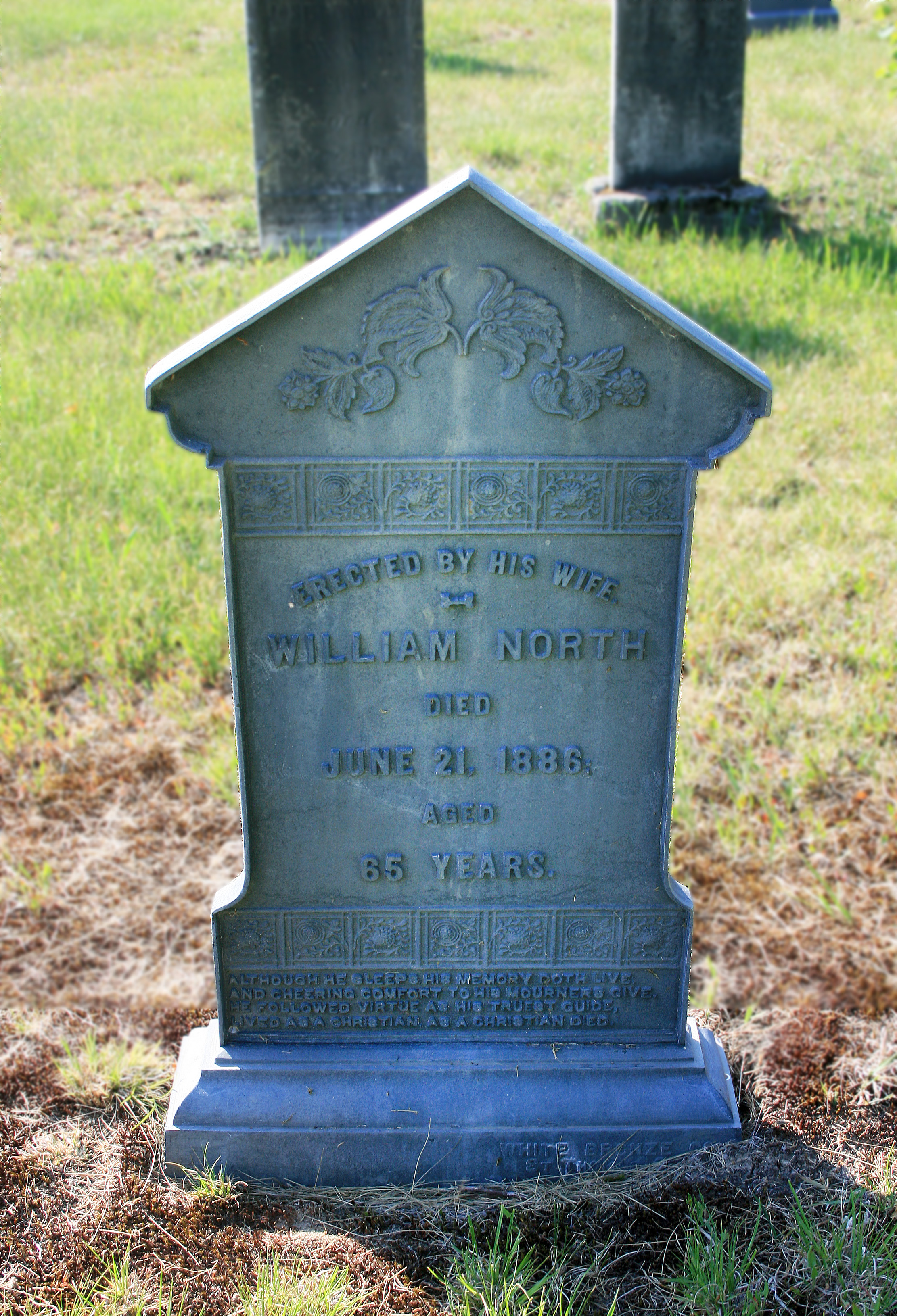
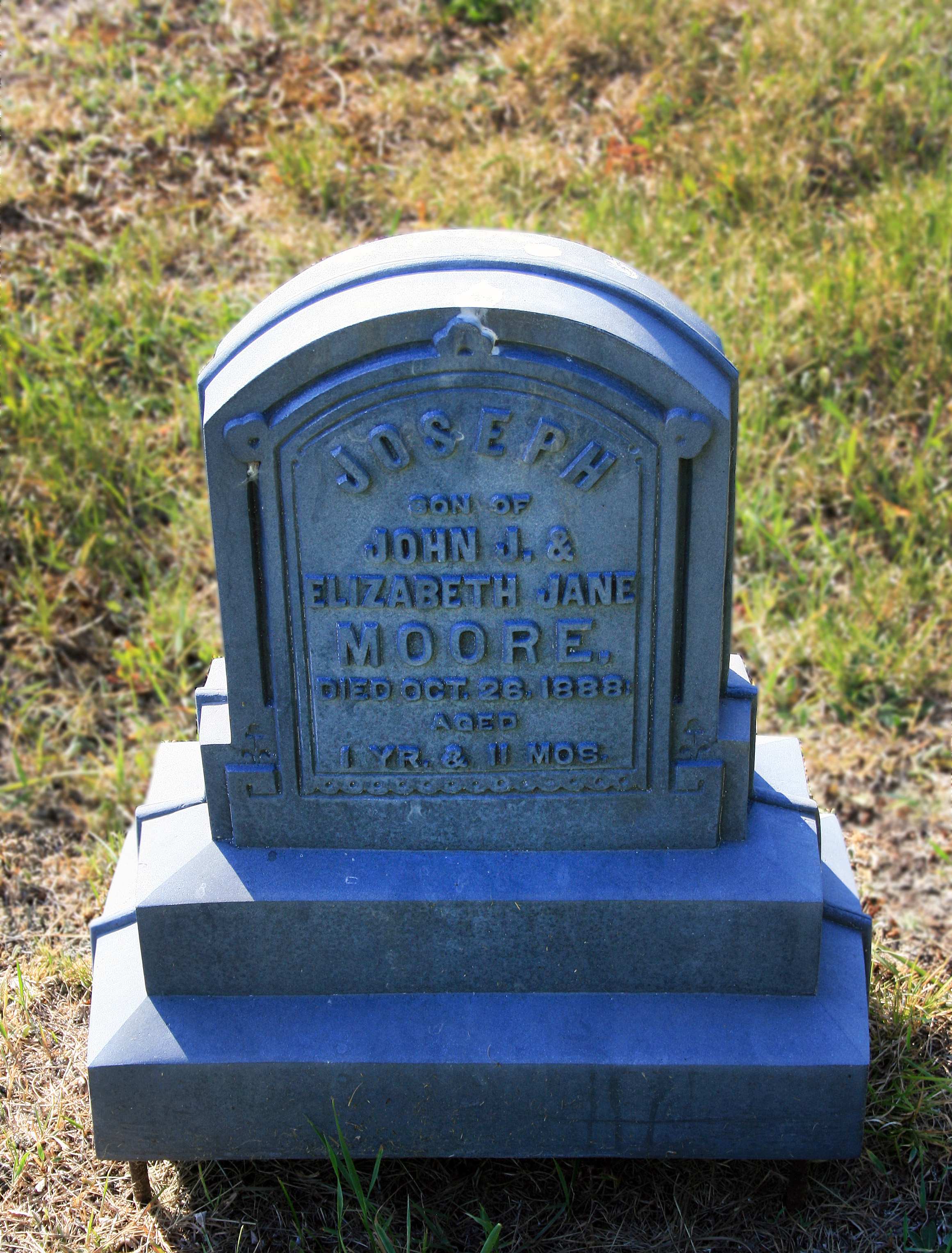
Last weekend, some friends and I went on a cemetery road trip in the Burks Falls area. I was really surprised at the amount of white bronze markers that we found. Almost every cemetery we visited had 1 or more zinkys. I had never come across that many before. They are not a common sight in my local Sudbury cemeteries.
So for today’s blog post, I thought I would share a collection of white bronze markers.
In January 2022, I wrote a post that looked more into the history of these unique gravestones. Zinkys as they are lovingly referred to, are also known as white bronze. You can recognize these types of headstones by their bluish-grey color, and if you give them a gentle tap, it should produce a hollow metallic sound.
These types of gravestones never came back into fashion after World War I, but because of their durability, you can still find them in great condition.
Although these markers are very durable, they do sometimes get damaged. According to Understanding Cemetery Symbols by Tui Snider, in the United States during the prohibition era, it was claimed that bootleggers would pry the panels off of these monuments to hide their contraband booze. I am curious if this was also a practice in Canada, as I have found some markers with their panels pried off.
Have you found some of these unique gravestones in your local cemeteries? Do you have a favorite design? I would love to read about it in the comments.
Thanks for reading!
References:
Understanding Cemetery Symbols: A Field Guide for Historic Graveyards by Tui Snider
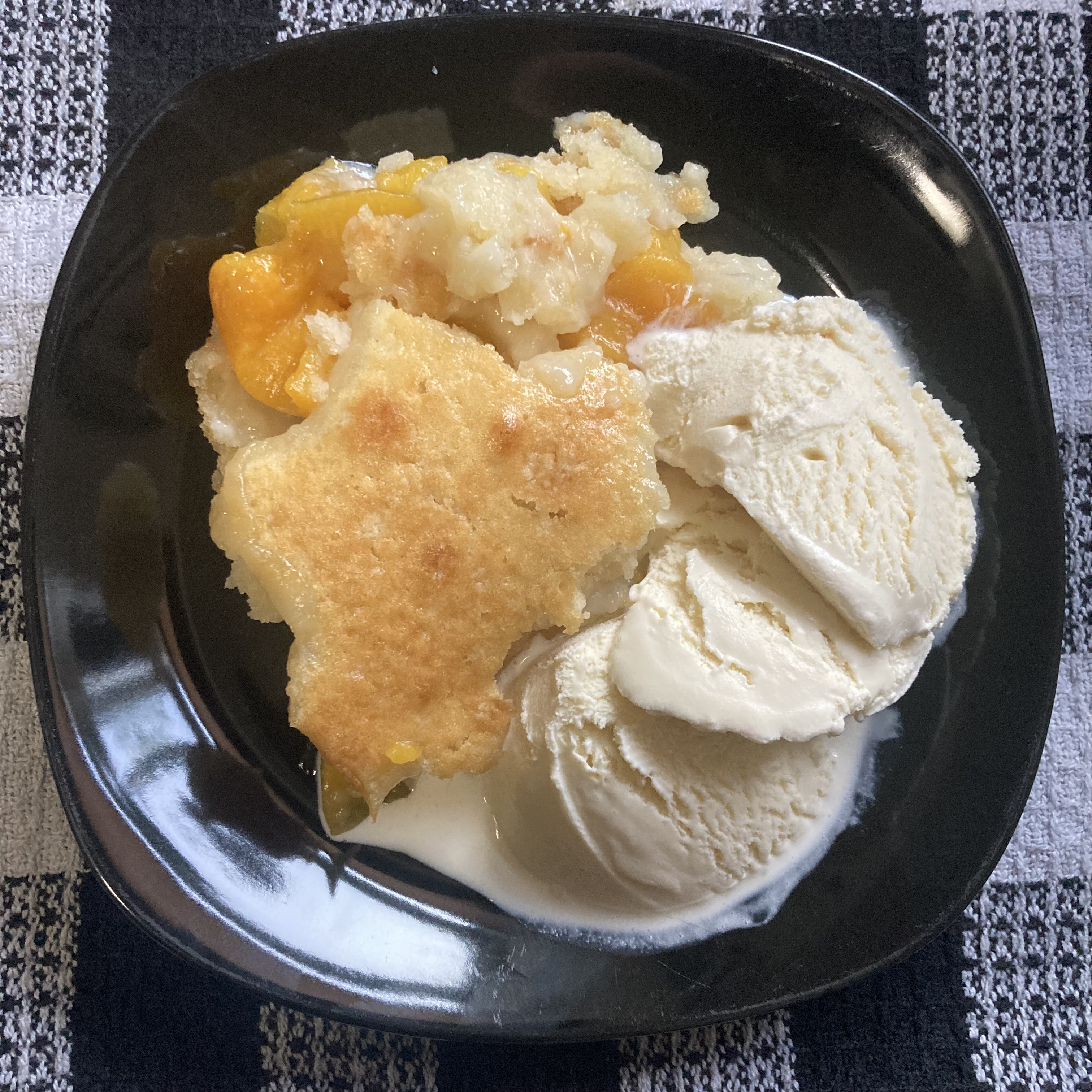
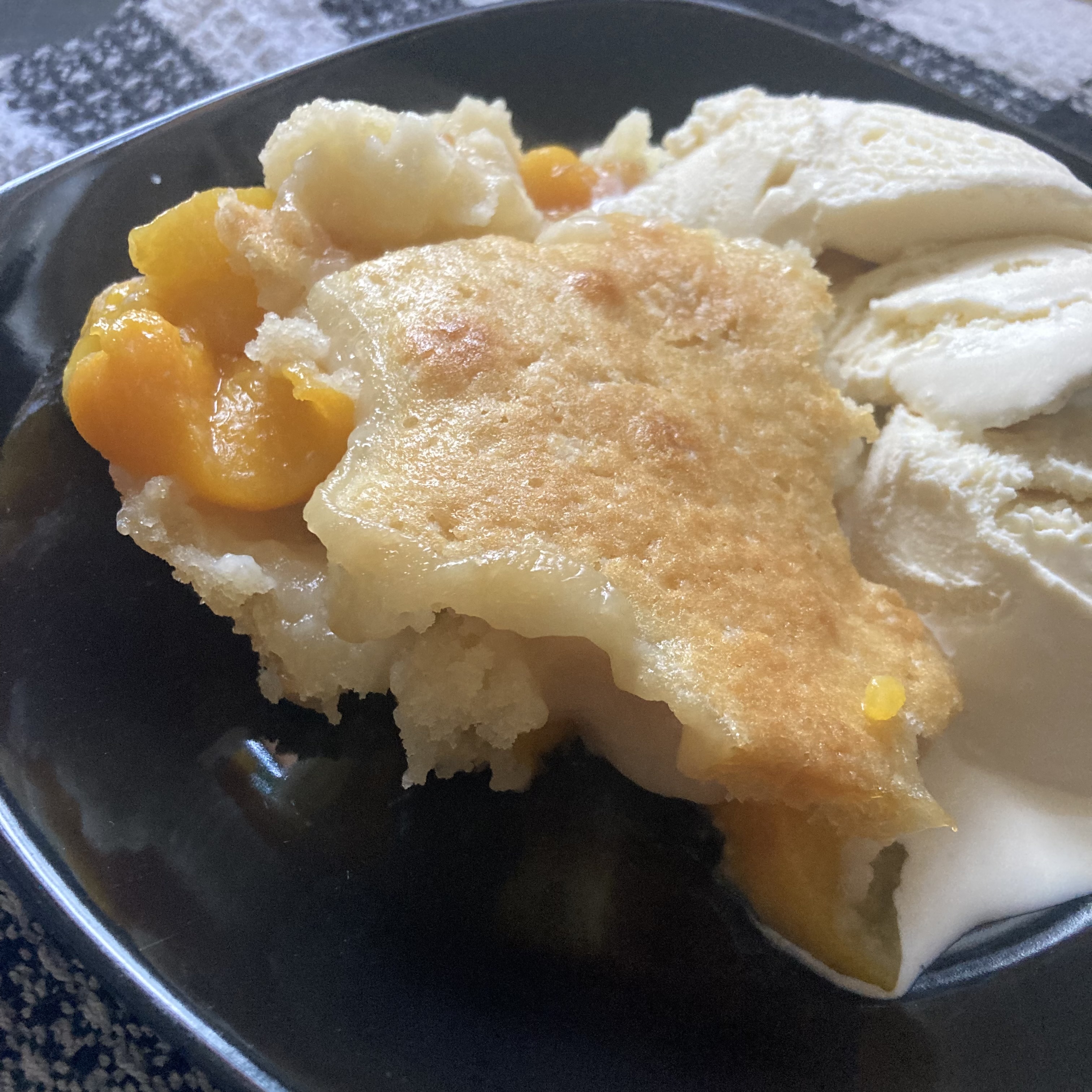
I’ve been craving a sweet treat lately, so I think it’s time for another cemetery recipe! Peaches are coming into season right now so I thought why not try O’Neal’s Peach Cobbler? This tasty treat would also go well with a side of ice cream. It is summer after all!
O’Neal’s Peach Cobbler recipe can be found on the gravestone of O’Neal Bogan “Peony” Watson, in New Ebenezer Cemetery in Castor, Louisiana. O’Neal’s son Charlie McBride loves this family recipe so much, that he had it inscribed on his Mother’s grave after she passed away in 2005. He said “It really is just a great recipe”.1 In an article for the Sault Lake Tribune, Charlie reminisced about memories that making this recipe brought up. It’s a perfect example of how these cemetery recipes are a sweet way to remember our loved ones.
Here is the recipe, as inscribed on the gravestone:
O’Neal’s Peach Cobbler
1 c. Flour
2/3 c. Sugar
2 tsp. Baking Powder
1/2 c. Butter
1/4 tsp. Salt
Mix ingredients. Add 3/4 c. Milk.
Put fruit into pan. Pour on topping.
Bake at 350’ until done.
Grave of O’Neal Bogan Watson. Photo by Find a Grave contributor Colette Alfred-Sikes. Photo used with permission.
I always find it interesting how descriptive or nondescriptive recipes found on gravestones can be. I realize it might be too expensive to inscribe too much text on a stone. I do appreciate how creative some authors get to skirt around that. This recipe is a short and sweet one, pun intended. The only things I found missing was the amount of fruit, and how long to bake it for.
Rosie Grant over at GhostlyArchive, of TikTok fame, used 1 can of whole peaches that she cubed up, so I did something similar and used 1 big can of sliced peaches. I drained the peaches before putting them in the pan and tried to make sure they were evenly distributed.
I followed the recipe as closely as possible, mixing the dry ingredients first, then adding the milk. I poured on the topping as evenly as I could, now it was time for it to go into the oven. The recipe says to bake it at 350’ “until done”. I wasn’t sure how long that should be, so I started with a timer for 20 minutes. After 20 minutes it wasn’t looking cooked through, so I left it in for another 10 minutes, then another 5. After 35 minutes it was looking nice and golden so I took it out to cool.
I paired my first serving of O’Neal’s Peach Cobbler with Häagen-Dazs vanilla ice cream. It was to die for! The topping puffed up, creating a lovely fluffy texture that combined nicely with the soft peaches. I’ll be keeping this first batch for myself, since there isn’t enough left to share! But, I will need to make this again for a friend or family gathering.
Have you tried recreating any cemetery recipes yet? Share your favorites in the comments!
Today on the blog I wanted to share a little bit about my first cemetery road trip of the year! A couple of weekends ago, two of my best friends and I went on a fun-filled day of adventures to celebrate a birthday. We traveled over 900 km to visit Grimsby Ontario, in the Niagara Region—and it did not disappoint!
A month or so ago, my friend had asked to visit a graveyard for her birthday, as she had never visited one before. There are closer graveyards we could have visited, but since this was a special occasion I took some time to try and find the perfect spot. Weirdly enough, the internet provided the solution. Randomly, or not so randomly if you believe that technology listens to us, a video popped up in my Youtube feed by Canadian Cemetery History. I took the bait and watched the video. It showed a visit to Saint Andrew’s Anglican graveyard. This beautiful graveyard was just what we were looking for!
Not only does Saint Andrew’s Anglican Churchyard boast the 4th oldest church in the province, but it also has a lychgate and table stones. Both of which we have never seen before in person. So I began looking into what else we could visit in Grimsby; other cemeteries, museums, attractions, haunted locations, and of course interesting places to eat. I pitched the idea to the group, and they were as excited as I was to explore this beautiful little town.
I continued to research things for us to do and managed to book us a private tour of the Nelles Manor Museum. We would be visiting the resting place of the Nelles family at Saint Andrew’s, so it made sense to visit their historic home and learn more about this prominent family.
The day of the trip started bright and early. After picking up our first Starbucks of the day, we left Sudbury a little after 6 a.m. The plan was to drive straight to the graveyard, with a Starbucks stop along the way, to make the best time. Then we would take our time exploring, and visit the Nelles Manor at 3 p.m. for our private tour.
We arrived at Saint Andrew’s Anglican graveyard at about 11 a.m. and got out to stretch our legs and explore. The graveyard was absolutely beautiful. As was the weather, we had a beautiful day for exploring. Right away we noticed the prominence of the Nelles family as they had their own family plot, as well as family members scattered throughout the graveyard. We would learn more about the Nelles family when we toured the Museum later in the day.
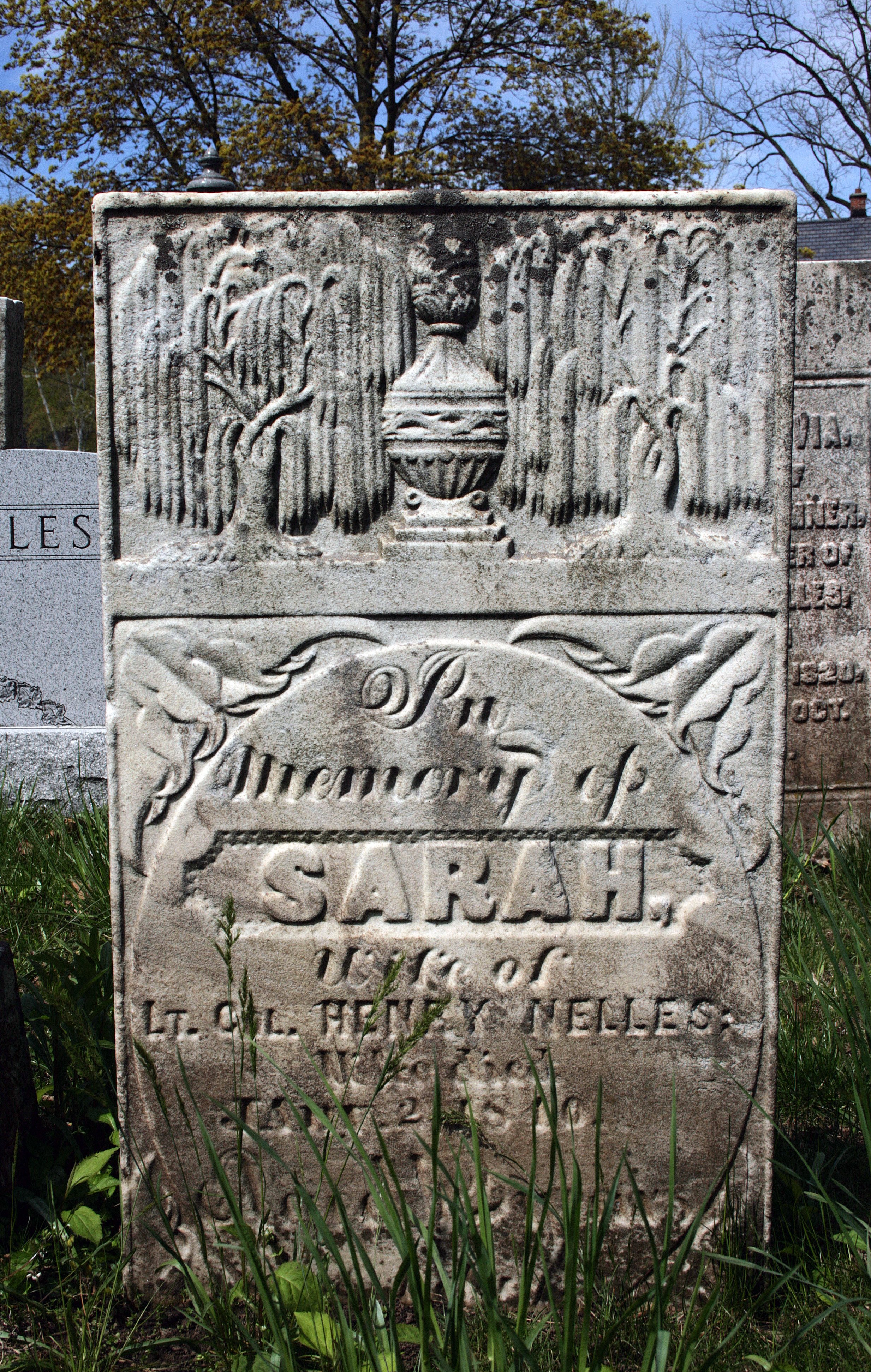
Saint Andrews Anglican Church and graveyard is located a stone’s throw away from the Nelles Manor. The current church building dates back to 1825. The graveyard is well-maintained and has a large number of historically important grave markings. The land for the church was originally donated by Colonel Robert Nelles.1 The Nelles family plot is closest to the church on the left side of the churchyard, enclosed by a chain with small cast iron tassels hanging from it.
This graveyard also acts as an arboretum of sorts, with beautiful examples of different varieties of trees. Many were in full bloom when we visited. There is a lovely variety of gravestones to be found there as well, many of which I had not seen in person before, like the willow and urn motif, broken column symbolism, and closed books covered in cloth. It was curious to see the difference in popular cemetery symbols that we found. In the Sudbury area, lambs, doves, and hands are very common. There also stand the tallest tablet stones I have ever seen. They are taller than I am! The gravestones I was most looking forward to seeing in this graveyard were the table stones. I have not had the chance to see one in person yet, and I find them so unique and fascinating.
Table stones have an elevated ledger top, that provide space for a longer inscription, and is supported by four to six columns. This type of gravestone was popular during the first part of the 19th century.2These types of stones were used for prominent people and were sometimes installed many years after the person’s death. In that instance, these stones would sometimes cover the original gravestone. These tabletop stones are often more worn, like the ones we saw, due to larger surface erosion, making the stones barely legible.3
After we wandered the entire graveyard, we took a break for lunch and then made our way back toward the Nelles Manor. We were a little bit early for our tour, but luckily there were a few points of interest in and around the Nelles Manor for us to explore while we waited. We visited the Trinity United graveyard, and the Grimsby Museum and grounds where we discovered more interesting Grimsby history. When it was time, we made our way a couple of houses over to visit the historic Nelles Manor Museum for our private tour.
The Nelles Manor was built from 1788 to 1798, well before the American invasions in the War of 1812. The house was fully built and lived in by the Nelles family by the time the Americans declared war on the British. The Niagara Peninsula became a gateway for American fighting forces to work their way from the American frontier on the East side of the Niagara River as they reached for Burlington, York, and Kingston. Nelles Manor was occupied by British and local militia during the War of 1812, but on at least two occasions was also occupied by American forces that had moved up from Niagara.1
We received a very warm welcome when we arrived at the Nelles Manor. Our tour guide Kate, and two other guides, were finely dressed in period clothing, which added to the authenticity of the experience. We started our tour outside, taking in the magnificent architecture of the building, as well as the warm weather. Our guide talked about the land where the Nelles Manor sits, and its connections to its surroundings. Our group found it very helpful that we had visited Saint Andrew’s, as well as the Grimsby Museum grounds before our tour.
After moving inside, we were treated to a walking tour of the house; starting at the front door, touring through the sitting room parlor, and making our way upstairs. Every room is beautifully decorated for the time period, with great attention to detail. Along with period-specific furnishings, the house is decorated with some original pieces that belonged to the Nelles family, as well as original art from the period. It felt like we were stepping back in time.
The guides are incredibly versed in the history of the house, the Grimsby area, and the Nelles family. They had no trouble answering our many questions. We had explained that we were in the area to visit the cemeteries and graveyards, and they kindly pointed out artifacts and related tidbits as they took us along the tour. At the end of our tour, they asked if we would also be interested to hear some of the haunted history of the house. We of course said yes!
They shared stories of experiencing odd smells when there shouldn’t have been any, such as smelling a delicious roast or floral perfume, which was a favorite of Mrs. Nelles. They also shared some stories from paranormal investigations that have taken place in the manor. Paranormal teams have reported their fresh equipment batteries dying quickly and suddenly. They have also captured some eerie electronic voice phenomena (EVP). The staff now use some of these EVPs during their Halloween events, wherein they tell the haunted stories of the house. I would love to attend one someday. As we were discussing the spooky happenings, my friend happened to check her Apple Watch and noticed the battery was dead. Were the Nelles spirits letting us know they were with us?
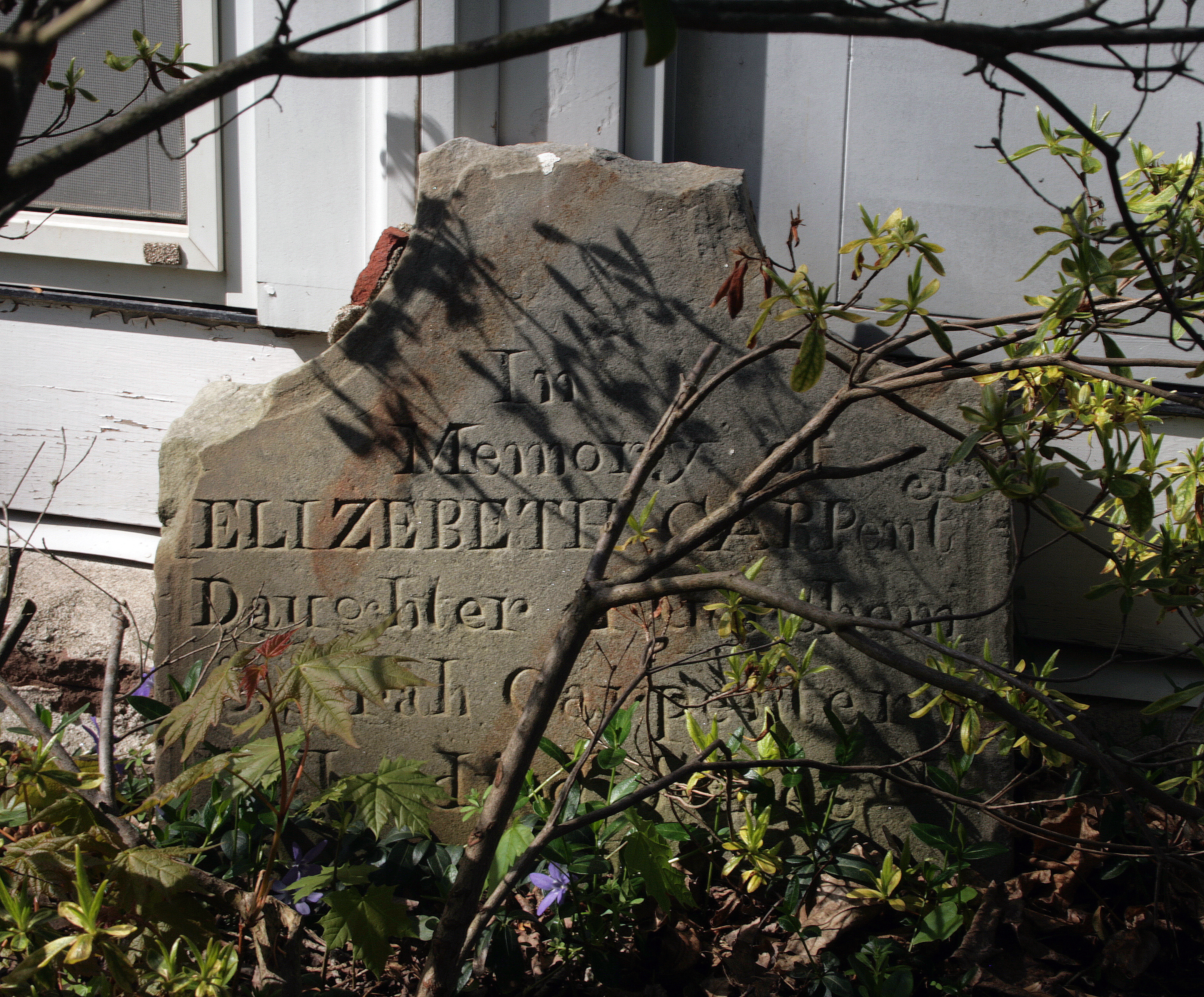
We thanked our tour guides for an amazing tour and made our way outside. They had one last interesting piece of history to point out as we were leaving. In the garden, leaning up against the house are two small gravestones, that are still very legible. Kate explained that these stones were originally at a graveyard close to the water’s edge, which has since eroded away. A cenotaph was erected at Saint Andrew’s Churchyard in memory of the souls that were washed away, and the original gravestones were moved; some ended up at the manor and used as flagstones for the walking paths. These two were preserved and now sit in the garden. You never know where you might find a gravestone.
There was so much we explored and experienced that day. As well as exploring the Nelles Manor Museum, we visited two graveyards, one cemetery, and one burial ground. We also stopped in at the Grimsby Museum and quickly visited the Grimsby Gingerbread houses. I’m sure I will write some more in the future about those visits. It was a very long day, but it was worth it.
If you ever get the chance to visit Grimsby, I highly recommend the Nelles Manor Museum. It’s a beautiful place to learn more about the history of the Niagara region and the War of 1812, and you might also have a paranormal experience. Don’t forget to also pay your respects to the Nelles family at Saint Andrews’s Churchyard.
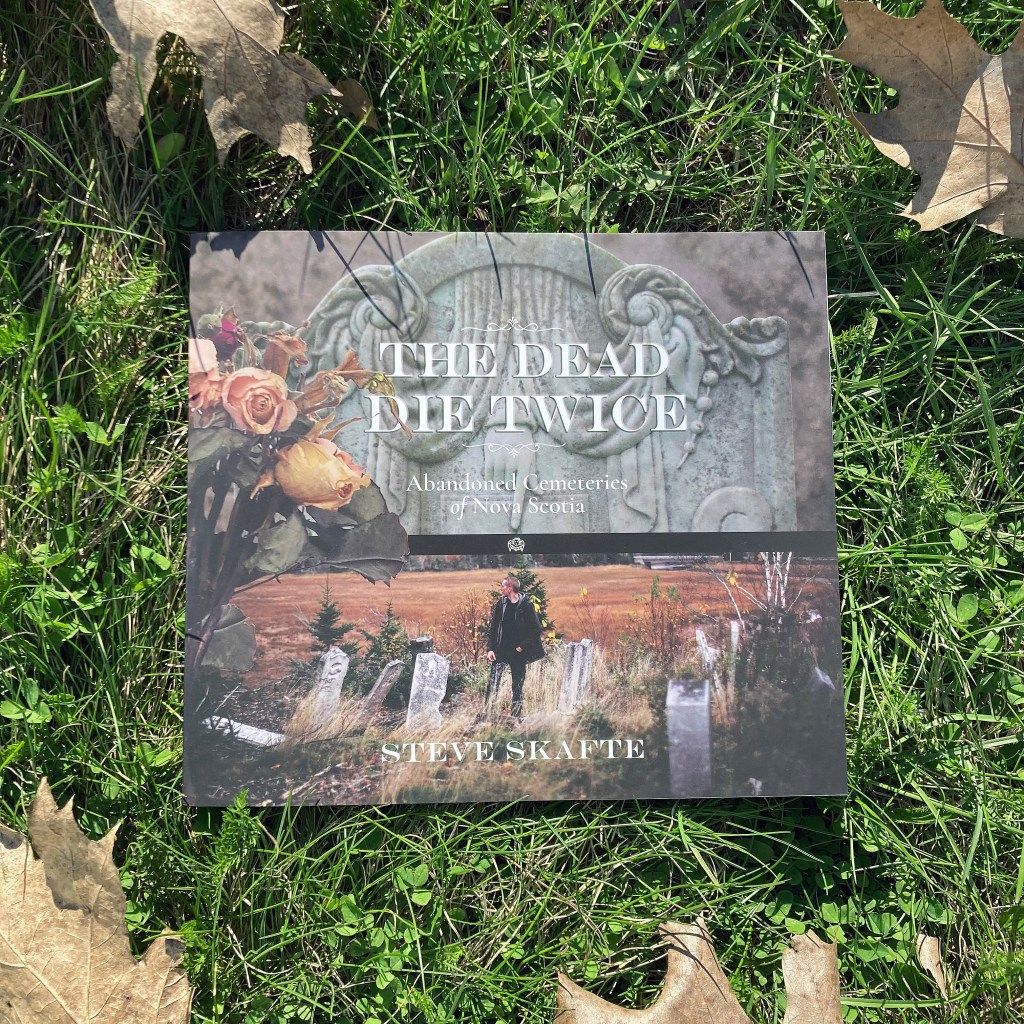
Back in March of this year, I was scanning some news sites when I came across an interesting article titled This N.S. photographer is saving the province’s abandoned cemeteries. It spoke about an upcoming new book that I knew I just had to read! I find books on Canadian cemeteries are somewhat rare, so I made my way to Steve’s Etsy shop and bought myself a signed copy. I was thrilled when it came in the mail a week or so ago. So, for this month’s book review I wanted to talk about The Dead Die Twice: Abandoned Cemeteries of Nova Scotia by Steve Skafte.
The Dead Die Twice is a beautiful little book. It’s filled with gorgeous full-color photography and beautiful prose. The author, Steve Skafte, is a fellow Canadian taphophile, who has been exploring, photographing, and cleaning up old abandoned cemeteries in Nova Scotia. The book is broken up into 3 seasons; Autumn, Winter, and Summer. Each section showcases several abandoned cemeteries and burial grounds, each with an assortment of stunning and moody photography, paired with eloquent musings.
Here is a snippet of the synopsis from Goodreads: “Steve Skafte has lived his entire life in Annapolis County—or what he calls “The Dead Centre”—a place with more forgotten history than anywhere else in the country. In search of those forgotten stories, Skafte stumbled over a couple of overgrown cemeteries and began his quest for what was hiding in the hundreds of cemeteries and burial grounds that lie abandoned in the woods all over Nova Scotia. En route, he discovered twisting trails of indifference, forgetfulness, and desecration. Featuring 80 haunting color images and more than 20 deeply poetic tales of discovery, The Dead Die Twice: Abandoned Cemeteries of Nova Scotia chronicles Skafte’s year of exploring abandoned cemeteries, pushing through walls of scratching brush, cutting a path to the past, and unearthing buried stones and half-forgotten stories.”
The Dead Die Twice: Abandoned Cemeteries of Nova Scotia by Steve Skafte.
Reading this book is a rich experience, starting from the soft satin finish of the cover, the saturated moody photographs, to the beautiful and sometimes whimsical writing. Steve is a very talented photographer, and it’s easy to get lost in the photographs. The accompanying stories also paint a picture, revealing heartbreak and sometimes intrigue.
While I read The Dead Die Twice, I found myself trying to slow down and take my time with each location. I didn’t want to rush it, even though I easily could have read the whole thing in one sitting. I wanted to explore each place as I would if I were there in person. The accompanying text added to that. I love that the coordinates to each cemetery have also been included in the book, with helpful tips on how to find them. If you’re like me, you’ll want to pin these spots on a map for future cemetery travels, or maybe just use Google Maps to take a closer look at the area.
I think any Canadian taphophile would be excited about this book. As I’ve mentioned before, Canadian cemetery books are a little harder to find. I believe this is also the first book I have read specifically about abandoned cemeteries, which some might find particularly interesting. This gorgeous book would be an excellent addition to any art and photography library as well.
For those interested in purchasing a copy, you can find it pretty much anywhere books are sold. But, if you would like the bonus of a signed copy, I would order it directly from the source, the author’s Etsy shop.
Thanks for reading!
I am always on the hunt for cemetery-related book recommendations. Please feel free to share yours in the comments. If you are an author and have a cemetery-related book you would like me to review, please reach out at hello@chantallarochelle.ca. I would love to hear from you.




















 Cemetery Photography by Chantal Larochelle